Defending the Constitution: VA, yes; AZ, no

With the removal of the statutory imposed right of an HOA to fine members from Virginia’s  HB 791, the VA legislature demonstrated that it stood behind the separation of powers doctrine of the US and VA constitutions.

I had written VA Rep. Suorvell and Senator Petersen, who opposed the bill as it was written, about the Virginia Supreme Court’s findings in Gillman v. Unit Owners, which said HOA fines were unconstitutional.

In Gillman the Virginia Supreme Court held,

We do not agree that it was ever the intent of the General Assembly of Virginia that the owners of units in a condominium be a completely autonomous body, or that such would be permitted under the federal and state constitutions. Admittedly, the Act is designed to and does permit the exercise of wide powers by an association of unit owners. However, these powers are limited by general law and by the Condominium Act itself.

The imposition of a fine is a governmental power. The sovereign cannot be preempted of this power, and the power cannot be delegated or exercised other than in accordance with the provisions of the Constitutions of the United States and of Virginia. Neither can a fine be imposed disguised as an assessment. . . . We think it clear that the Gillmans were being punished, not assessed, and hold the action of the Association to have been impermissible.

 And very importantly from a constitutional point of view (my emphasis), “A condominium restriction or limitation, reasonably related to a legitimate purpose, does not inherently violate a fundamental right and may be enforced if it serves a legitimate purpose and is reasonably applied.”

Sadly, the Arizona Legislature is still trying to pass for a 4th and 5th time (two versions of last year’s trice defeated HB 2371/SB 1454).  It would allow unlicensed and untrained HOA property managers to represent HOAs in small claims court and in administrative hearings;  but not allow the homeowner a third-party representative, violating the equal application of the laws and no special laws for special groups provisions of the US and AZ  constitutions.

What is the legitimate AZ government purpose to selectively deny homeowner equal representation?  Does it reasonably promote good public policy?

Whether apathy or anger, it’s always the HOA owner’s fault

The policy of the pro-HOA forces, including your state legislature, is to hold the homeowner at fault for problems in his HOA.  Never the HOA government itself.  Owners are apathetic and should be more involved in solving HOA issues, they argue,  but when owners join they find that their minority position has no power against the clique.  And if they react with anger against repeated outright violations by the board, they are again the problem people who just can’t get along.  Never the HOA government itself.

Many of us, who are involved in attempting to make changes in the public arena have encountered failures by our elected officials to provide fair and just HOA laws. And after a number of years begin to walk away with a harsh understanding that you can’t fight city hall.  There is nothing any different with the similar behavior of HOA owners facing the same public government failures with their HOA government.  They just can’t fight HOA city hall, too.

On the other hand, a number of homeowners react in the other direction by getting angry with the repeated frustrations with the failures of their HOA. With the lack of a viable means to correct these flagrant violations and unjust powers cast in concrete as CC&Rs and pro-HOA laws, what can you expect of good people?  So they get angry, shout, and become bitter at their treatment with no avenue for relief.  They are charged with abusive behavior, harassment, and bullying by the HOA. But, it’s never the fault of the HOA government itself.  Never.

The position of the pro-HOA forces has been, in my view: if the owners would only follow the rules all would be fine. Their position is that the HOA government works in the best interests of the community for everyone.  And that the best interests of the community rests in the unquestioned obedience to the HOA government.  Or suffer the consequences.

Like any other totalitarian government or banana republic, the HOA has the power to destroy your life by taking your home, by imposing harsh monetary penalties (fines), by curtailing your free use of the common property, by denying your right to vote as if you were a criminal of the HOA, and by ostracizing you and your family before the community. To drive you out of your home.  But, it’s never the fault of the HOA government itself.  No, never.

Of course, as with all dictatorships and banana republics where there are loyalists — those who support and defend their government — so, too, do HOA governments have their loyal supporters.  They have bought into the system and refuse to accept anything to the contrary. But what kind of community are they defending? Surely not a democratic system that surpasses that of the US Constitution.  It’s only common sense.

Letter criticizes CLRC rewrite of Davis-Stirling (HOA) statutes

Below are excerpts from my January 30th  4-page letter to CLRC.

“I read Ms. Vanitzian’s LA Times column of December 29, 2013, Attempt to Simplify California Condo Laws Ends in Confusion and your response contained in MM14-09. As you may be aware I commented on her article in two parts. . . .  If you are looking for facts, allow me to introduce a few.  I recall Susan French’s study in 2000 (H-850), at the request of CLRC, that started the ball rolling ‘to clarify the law [and] establish a clear, consistent, and unified policy with regard to formation and management of these developments.’ 

“Still, much of her report aside from the need for clarity, Part II, sections C and D, called for protections of homeowner rights and a bill of rights statute in the rewrite of Davis-Stirling. . . .  Whatever happened to the proposed ‘Chapter 2, Members Rights, Article 1, Bill of Rights,’ (MM06-25)?

“There was my letter (MM05-25s1) arguing for the need for this equal rights chapter, to which you answered with, ‘Beyond the scope of this project’ even though French had recommended protecting homeowner rights. . . . It is obvious that this rework by stakeholders without meaningful homeowner input easily leads to clarifications and simplifications as interpreted solely by this group, from its perspective, which would not protect the homeowner. The new D-S cannot be seen as the result of an unbiased effort and with integrity.

“The approach used by CLRC has the smell of corporatism, the rule by a handful of corporations.  It is a form of government that flows from fascism as defined by its founder, Italy’s Benito Mussolini, Il Duce.  ‘Fascism combats the whole complex system of democratic ideology, and repudiates it . . . . Thus understood, Fascism is totalitarian, and the Fascist State . . . interprets, develops, and potentiates the whole life of a people.

“CLRC responded with, ‘However, a bill of rights would probably go beyond the substantive rights that are currently provided in the law’ (MM05-03), but in the next sentence dismissed the US Bill of Rights as non-existent substantive law. The obvious answer – as there were a number of published books, papers and journals from nationally recognized researchers and political scientists relating to this issue – was to recognize that indeed HOAs were de facto governments and to subject them to the Constitution.”

****

The cry “no government interference” while accepting HOA private government interference is irrational.  This acceptance of undemocratic, authoritarian HOA government with less protection of individual rights and freedoms than public government is a rejection of the Constitution, the Declaration of Independence, and the Bill of Rights. These people have lost their common sense!

Neither CLRC nor CAI will go down in history as Heroes of the American Republic, but perhaps may be remembered as Heroes of HOA-Land

The complete critical letter can be found at MM14-09s1.

The influence of HOA special interests on an AZ legislator — SB 1454

First-termer idealism and the awakening

Michelle Ugenti arrived at the Arizona Legislature in 2011 riding in as a Clean Election Candidate, meaning she took no special interest money.  On her web page she quotes from the Arizona Constitution, All political power is inherent in the people, and governments . . . are established to protect and maintain individual rights.”

It appears from her comments about her first term that she ran right into the reality of how bills become laws:

The following two years [after being elected] have taught me what happens when ideas and principles meet head-on not just with competing beliefs but also with individual self-interest, whipped into a frenzy by forces armed with money and power. 

She’s talking about the special interest money and the influence it has on legislators.  Still, with a positive outlook facing her re-election in 2012 Ugenti writes on her web page, “I hope that my constituents find me faithful to . . .  preserving our rights and freedoms.”

But, something seems to have happened to Ugenti upon her re-election in 2012.  She seems to have found and adopted the way and the means to make a name and to advance herself in politics.  She talks of hard politics, of when to compromise and when to negotiate, and of being successful and effective.

It is precisely this delicate balance of knowing what to give and what to fight for that makes an effective legislator. I believe I am successful because I have the integrity and courage to examine each issue and stand wherever my conscience and conviction demand I stand.

The lure of the special interests

In 2013 we saw Ugenti’s tenacity to fight and stand by her conscience in regard to her HB 2371 HOA bill and incorporating this failed bill into SB 1454. It ran afoul of the Arizona Constitution and House Rules. She showed her conviction before the Senate GE committee hearing on HB 2371 and clearly demonstrated her newly found path to success as a legislator – by advancing the agenda of the HOA “stakeholders,” the special interests who make money from servicing HOAs.  And CAI is one leading “stakeholder.” (Stakeholders are not homeowners who are excluded from such meetings. And the legislators well know it.)

At that hearing Ugenti stated that each year there was “a plethora of personal HOA legislation” and tried “to spare the [committee] members the constant agony of many personal pieces of HOA legislation,” as contrasted to the industry legislation. She also said that she “felt very responsible to the stakeholders.”   That was in March. In July a lawsuit, Staropoli v. State of Arizona,  was filed against the State for an unconstitutional SB 1454. The Attorney General’s office and court agreed, removing Ugenti’s HOA provisions.

Yet, the Arizona Legislature sees no wrong in her conduct leading to the filing an amendment from the floor and refused to discipline her. Ugenti’s integrity and conviction is examined in SB 1454: Machiavelli at work in the AZ legislature – Part 1 and AZ House ‘circles the wagons’ in defense of pro-HOA legislator.

CAI stakeholder support of Ugenti

In October 2013, stakeholder and national HOA lobbyist CAI praised Ugenti for her efforts to advance HOA interests, as CAI sees them.  In an article in the Fall 2013 Community Resource magazine, AZ lobbyist DeMenna wrote, echoing Ugenti’s view that only  stakeholder legislation has any value:

“Under the leadership of Representative Michelle Ugenti . . . a working group was established to address HOA-related issues advanced by legitimate stakeholders. . . . and Representative Ugenti personally led the effort to ensure that only sensible and functional proposals were considered. CAl played a critical role in this process, although some compromises were required. . . . In the end . . . Representative Michelle Ugenti, is to be commended for her leadership in this area.

And in the AZ CAI chapter’s email, Notice to CAI Members **Very Important-Please read!**, Oct. 18, 2013, the AZ chapter wrote, again echoing Ugenti’s views,

Representative Ugenti . . . is instrumental in the development of HOA policymaking. Representative Ugenti’s stakeholder meetings, formed in effort to tackle the growing number of HOA bills introduced every session, are critical in defeating shortsighted proposals.

The email went on to announce a fundraiser for Ugenti:

Fundraising Reception in support of REPRESENTATIVE MICHELLE UGENTI.  Please make checks payable to: MichelleUgenit.com [sic].  If you are unable to attend, you can mail your contribution to CAI’s Arizona Lobbying Team: DeMenna & Associates. . . . Paid for by: www.MichelleUgenti.com.

The decline and fall of a legislator

What happened to Rep. Michelle Ugenti since her first term in 2011?  It appears she has serious issues of integrity and the demands of her conscience to fight for her beliefs. She has fallen away from those ideals and values of “preserving our rights and freedoms”; and that governments “are established to protect and maintain individual rights.” The  authoritarian, private HOA government has no legal obligations “to protect and maintain individual rights” as does our Constitution with its Bill of Rights.

Apparently, she has succumbed to “individual self-interest, whipped into a frenzy by forces armed with money and power.” Her conscience and convictions have led her to advancing special interest agendas and to crossing the line and violating the Arizona Constitution.  

CAI reacts to HOA Enlightenment Movement with targeted lobbying of legislators

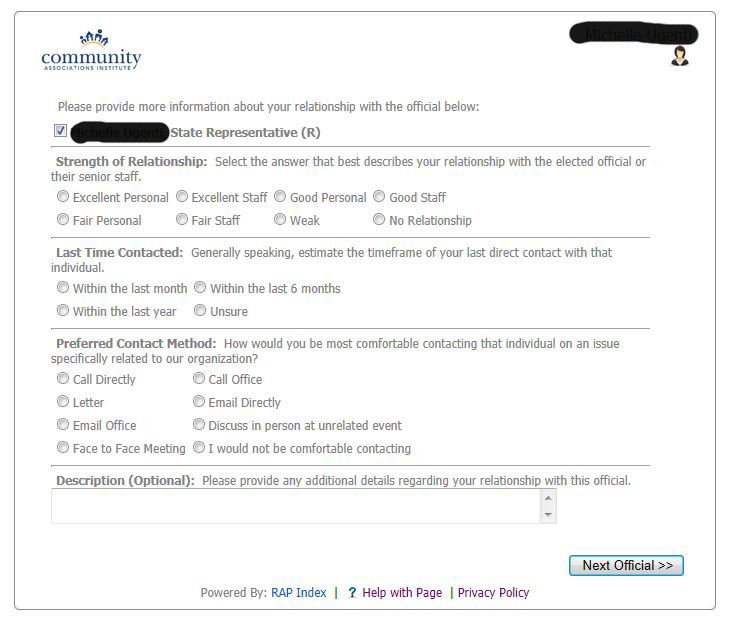
Apparently, CAI Central in Falls Church, VA is feeling the heat of the Enlightenment Movement — the awakening of the public, the media and state legislators as to what HOA-Land is really all about.  It has sent an email (“You can Enhance CAI’s Advocacy Program by Participating in this Brief Interview,” July 24, 2013) to its faithful members — presumably its “volunteer” members who are for the most part HOA directors — asking for their participation in a survey of their relationships with elected officials.  Obviously, for intense, micro-managed lobbying efforts in support of CAI’s objectives.

By understanding our network of relationships with elected officials, we can build advocacy programs that advance our positions on any number of issues that directly impact our members and the community association industry.

Recall that I wrote that CAI was formed in 1973 to deal with the problems of HOAs as defined and modeled by the 1964 Homes Association Handbook.  In 1992, CAI made a substantial change in its mission and elected to no longer be an educational organization (Tax exempt 501(c)3) and to become a business trade organization (501(c)6).   It did so under mounting pressures and criticisms in articles, research journals, and books, including McKenzie’s Privatopia.  CAI had to reach the legislatures that controlled state laws regarding the HOA industry.

This latest “brief interview” is another attempt to influence legislators in favor of HOA friendly legislation, knowing that advocates are still fragmented.  With the response from the party faithful, CAI will not only know who the friendly legislators are, but what members have good relationships with specific officials.  CAI Central, or through the local state chapter, can then produce targeted emails — as successfully used by Obama in the past election — to influence legislators. The advocates, unless they want to demand copies of all emails, will be in the dark.

This tactic by CAI has ominous consequences for HOA reforms in every state!  It becomes extremely important that advocates and homeowners in every state seeking redress of HOA problems form an advocacy group to inform the public, the media and their legislators of their views.  As I have long argued, advocates must, even more so now, confront, challenge and expose CAI propaganda.  They must also advance quality reform legislation.

This tactic by CAI of addressing legislators in all states makes it a national issue of unfairly influencing state legislators to advance authoritarian private governments not subject to the US Constitution.  Homeowner rights advocacy groups must be given equal access to their legislators!  Advocates must be given equal bargaining powers over HOA issues!  Legislative committees must not be allowed to hear that the “stakeholders” met without hearing from an advocacy group!

Links to representative CAI “interview” questions: CAI-network3, CAI- network 4, CAI- network 5, and CAI-network6.


See What is this “association law” thing all about? and The questionable role of HOA attorneys.