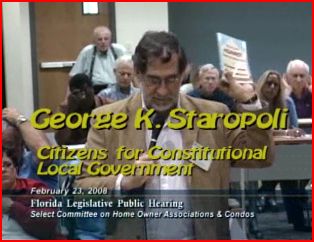
Landmark FL HOA law imposes criminal conduct

FL Session Law, Ch. 229 (2023), “Homeowners’ Associations  Bill of Rights,” adds the following section imposing misdemeanor charges against certain violations for fraudulent elections.

FL § 720.3065. “Fraudulent voting activities relating to association elections; penalties.—Each of the following acts is a fraudulent voting activity relating to association elections and constitutes a misdemeanor of the first degree, punishable as provided in s. 775.082 or s. 775.083

This is a landmark bill that imposes criminal penalties on the conduct of the HOA and all persons involved in fraudulent HOA elections.  Recent court decisions have held the private government HOAs are public entities with respect issues concerning the governance of the HOA.

Criticism of the board’s conduct is subject to the constitutional protections of free speech. The Nevada Supreme Court opinion in Kosor ((Kosor v. Olympia Companies, NV No, 75669 (Dec. 31, 2020))  held that HOAs are public forums and referenced several California opinions serving as legal precedent.

 “[A] unit owner’s association or a planned community association (association) may not prohibit a unit owner or member (member) from peacefully assembling and using private or common elements of the community . . . legitimate and valid criticisms of your HOA and its president and board are protected from HOA lawsuits of defamation and libel.”

I find it incredible that there are homeowner rights advocates who find it difficult to see how challenges of constitutionality apply to private government HOAs. The 14th Amendment, Section 1, in part, “No state shall make or enforce any law which shall abridge the privileges or immunities of citizens of the United States.”

In Kosor the NV appellate court upholds HOAs as public forums

In January of this year I posted the Nevada Supreme Court’s opinion on HOAs as public forums and the president as a limited-purpose public figure (NV supreme court upholds HOAs as public forums).  Last month on an appeal (Olympia v. Kosor, No. A-17-765257-C (Nev. Ct. App. 2021) from the remand, to  let the trial court hear the case on above issues, the appellate Court upheld the supreme courts findings and opinion.

The tremendous constitutional question of free political speech on issues of HOA governance was upheld. Finally! In doing so, the Court also held, citing several cases that [note 1],

  • [the HOA]  “is a quasi-government entity ‘paralleling in almost every case the powers, duties, and responsibilities of a municipal government.’”
  • the Nevada Supreme Court has found the [the HOA] Board to be in the nature of a quasi-government entity largely paralleling the powers, duties, and responsibilities of a municipal entity and its meetings similar in function to a governmental body.
  • homeowners’ associations open meetings are public forums as such associations play ’a critical role in making and enforcing rules affecting the daily lives of [community] residents.’”  
  • “the HOA meetings at which Kosor made certain of the statements at issue were ‘public forums’ … because the meetings were ‘open to all interested parties, and … a place where members could communicate their ideas. Further, the…meetings served a function similar to that of a governmental body.”
  • In deciding this Motion, this Court also concludes Plaintiffs at least constitute limited-purpose public figures.
  • The test for determining whether someone is a limited public figure includes examining whether a person’s role in a matter of public concern is voluntary and prominent.” [as is the case with HOA boards and presidents]
  • the issues Defendant raised involve efforts to encourage homeowner participation in and oversight of the governance of Southern Highlands, “an inherently political question of vital importance to each individual and to the community as a whole.”

. . . .

Your HOA cannot stop your free speech if you argue Kosor! Just be careful about making harsh, accusatory statements that violate elements of defamation that will  defeat your free speech.

NOTE 1. Damon v. Ocean Hills Journalism Club, 102 Cal. Rptr. 2d 205, 214 (2000); Cohen v. Kite Hill Cmty. Ass’n, 191 Cal. Rptr. 209, 214 (1983); Pegasus v. Reno Newspapers, Inc., 57 P.3d 82, 91 (2002).

NV supreme court upholds HOAs as public forums

Last week the Nevada Supreme Court, in Kosor,[i] citing California Davis-Stirling law and Damon[ii] and Kite Hill[iii] opinions, affirmed HOAs as public forums. Issues relating to HOA governance are matters of public interest protected by free political speech.

SPOTIFY Audio PODCAST of post

In short, legitimate and valid criticisms of your HOA and its president and board are protected from HOA lawsuits of defamation and libel. At heart: Are the statements made in good faith and truthful?

Kosor filed an anti-slapp motion in defense that argues that the statements at issue were protected under free public speech —  statements that were of general interest to the public.  In summary, here’s what the Court upheld, following California’s rulings and law.

Accordingly, we conclude that Kosor met his prima facie burden to demonstrate that the statements in question were all made in public forums on a matter of public interest.

“Nextdoor.com post qualifies as a public forum for the purposes of anti-SLAPP protections. . . .these steps [Kosor’s statements] do not seem to differ significantly from that which might be required to view posts on Facebook; that is, a post on Nextdoor.com is as compatible with expressive activity as one on the other platform, which we have already held can support a public forum.

“The HOA here is no less of ‘a quasi-government entity’ than that in Damon, ‘paralleling in almost every case the powers, duties, and responsibilities of a municipal government.’”

“it appears that Kosor’s post, like his HOA meeting commentary, campaign flyer, and printed letter, sought to open conversation among Southern Highlands community members and enlist their participation in the community’s decision-making process.

Does your state protect your right to dissent in an HOA?  Why not?

References


[i] Kosor v. Olympia Companies, NV No, 75669 (Dec. 31, 2020).

[ii] Damon v. Ocean Hills Journalism Club, 102 Cal. Rptr. 2d 205 (Ct. App. 2000).

[iii] Cohen v. Kite Hill Cmty. Ass’n, 191 Cal. Rptr. 209 (Ct. App. 1983).

Calif. holds HOA elections as protected free speech public elections

Speaking of HOA members and public voting rights, “Why Are HOA Members Allowed A Public Vote?”[1], let’s look at the reverse side and ask, Why aren’t HOA elections equivalent to public elections?  This is another example of how successful constitutional challenges can lead to and bring about broad HOA reform legislation.

Many of us are aware of the treatment of dissenting and opposing voices with respect to BOD actions and elections. There are the threats by rogue BODs of harm, and of  slanderous and libelous statements aimed to discredit and injure the dissenter’s reputation. And then, in true attack the attackers,  there are the lawsuits by the BOD claiming that the dissenter’s speech was harmful and injured the reputation of the HOA and/or BOD members.

Anti-SLAPP

These lawsuits are referred to as Strategic Lawsuits Against Public Participation – SLAPP —  whose purpose is to silence the dissenting homeowner(s) by arguing that the HOA/BOD was defamed.[2]  In the name of justice, or the appearance of justice, many states have adopted anti-SLAPP statutes to protect the dissenters; in our case here, the homeowners. The common criteria to file an anti-slapp suit includes (my emphasis):

A moving party may file a special motion to dismiss [the HOA suit] under [the state’s] antiSLAPP statutes “if an [HOA] action is filed in retaliation to the exercise of free speech [homeowner dissent].” In considering a special motion to dismiss, a district court must undertake a two-prong analysis. First, the court must determine whether the moving party [homeowner] has, by a preponderance of the evidence, established that the action [anti-slapp motion] is based upon a good faith communication in furtherance of the right to free speech in direct connection with an issue of public concern.

Furthermore, 1)  the statement must be made without knowledge of falsehood or truth with respect to a public concern, 2) the statement must be made in a place open to the public or in a public forum, and 3) “aimed at procuring any governmental or electoral action, result or outcome.” WOW! No chance in hell to bring an anti-Slapp suit against an HOA.

HOA elections are public

However, as expected, the anti-slapp statutes vary from state to state with Arizona adopting the very strict government election requirement while California has held, over several court cases, that (my emphasis):

California courts have repeatedly held in the context of anti-SLAPP litigation that board meetings of a homeowners association “serve[] a function similar to that of a governmental body. As [the California] Supreme Court has recognized, owners of planned development units “‘comprise a little democratic subsociety.”‘ … A homeowners’ association board is in effect ‘a quasi-government entity paralleling in almost every case the powers, duties, and responsibilities of a municipal government.”[3]

The use of mail or internet – social media or websites open to the public —  have been held by the California courts to be “ a public forum.”   Nextdoor was held to be a public forum in spite of the fact it functions as a closed group, but its intent is clearly to be open to anyone.[4]

This is another important tool for homeowners and advocates to use in CA, and to lobby for the same return to justice anti-slapp laws in other states.

Notes

[1] George K. Staropoli, “Why are HOA members allowed a public vote?” HOA Constitutional Government (July 20, 2019).

[2] See in general, Colorado’s anti-Slapp statute, Colorado becomes 31st State.

[3] Quoted Appellant’s Opening Brief,  Kosor v. Olympia Companies, LLC, (Nev. SC NO.75669, Feb. 8, 2019). At this writing Kosor has not yet been accepted to be heard by the Nevada Supreme Court.

[4] Id, Part C, vii, printed page 33.  See Kronemyer v. Internet Movie Data Base, Inc., 59 Cal. Rptr. 3d 48 (2007).

Beware of unsupported legal arguments and opinions when in court

All too often judges make decisions on HOA cases, making new law and new contract meanings, with unsupported statements not related to the case on hand. For example, in a question of signage, a court may state that the HOA is not a mini-government and offer no legal authority for that statement. It is referred to as a dictum (dicta) and is non-binding. However, it is used as if it were indeed a court proven and decided fact.

In the Nevada Supreme Court decision in Sanzaro v. Adiente HOA, Nev. No. 61288 (Oct. 16, 2015) we have a good example that deals with the question of proper notice. (“Proper notice” is a 14th Amendment due process requirement.) Here, arbitrators ruled that Sanzaro had “constructive notice” — here we go again, no need to read the notice — that no dogs were allowed and charged the homeowners with $17,000 in legal fees (and I thought arbitration was the best solution to HOA decisions). The district court upheld that decision, finding that the homeowners had “not shown by competent evidence any deficiency that would warrant the relief being sought.”

As it happened, the homeowners, at purchase time, were told to see the HOA webpage for a copy of the rules, but the web page rules were not the latest with the dog restriction. The HOA insisted that sending a welcome letter about the web page with its rules amounted to constructive notice. In other words, like with the CC&Rs, the homeowners were told that there was another document affecting them. Go get it and read it.

The Court found that arbitration awards are reviewed to determine whether the arbitrator’s decision represents a ‘manifest disregard for the law’ . . . the error of accepting respondents’ [HOA’s] contention that appellants [homeowners] received proper “constructive notice” of the amended rule . . . or that such notice was even properly achieved in light of appellants’ arguments and evidence to the contrary, demonstrates a manifest disregard for the law.”

In regard to CC&Rs, most state laws and CC&Rs require a mailing or personal delivery of the changed rules, or other governing documents. Nevada is one of them. In other words, constructive notice does not trump statutory notice. Some allow constructive notice of amendments by simply filing with the county clerk — BEWARE!!!!

Of course, in regard to the CC&Rs, there are no provisions in the CC&Rs requiring the delivery of the documents to a new buyer. While some states require delivery of the governing documents before closing, this requirement is waived or the documents are not read to the detriment of the buyer.

The important point is that arguments used against homeowners by HOA lawyers must be based on evidence and legal authority and not on a vague statement, like 95% of the people in HOAs like HOAs. The HOA lawyers claim to be the experts; get them to prove it and demand the legal basis for their statements.