CAI is worried about homeowner reasonable expectations

I am confused by two CAI Arizona supreme court briefs in defense of the HOA in CAO v. Dorsey;[i] one by Scott Carpenter and the other by Krupnik,  a former Carpenter attorney and, along with Scott, a member of the CAI attorney’s group, the College of Community Associations Lawyers (CCAL).  In my view dealing with CAI over 23 years in several states, it reflects the awareness by CAI of the potential loss of its dominance over HOA boards and state legislatures.

The CAI Krupnick brief

In Krupnick’s brief, she argues that condos are a creature of state law otherwise they could not exist. We all know that state HOA laws and Acts favor the HOA against member rights.

“Sui generis presents a view of HOAs as private government principalities supported by your state legislature and is used to justify special laws for a special organization, the HOA. But the condominium is a unique form of real property ownership and . . . are created and governed by specific statutory schemes that deal with ownership, administration, transfer, and termination of commonly held property interests. More fundamentally, it is that statutory scheme, not the common law, that frames the issues in this controversy”[ii]

Does that make them state actors —  arms of the state?[iii] Existing constitutional law is inadequate to support this model of local governance [sui generis] and so, in violation of US and state constitutions,  we see all those HOA/PUD/condo “Acts” in almost every state.  These Acts constitute a parallel supreme law of the land with sharp contrasts to the US Constitution.

Krupnik stresses state laws control and “reasonable expectations”[iv] is not involved. “the amendment to A.R.S. § 33-1228 . . . does not significantly impinge on the parties’ reasonable expectations.” Her argument is that it would create problems for the administration of the HOA to have so many grandfathered clauses as the governing documents are amended from time-to-time. Gee, for over 247 years we have lived with the protection of grandfathered clauses in the public domain. What’s the problem?  The fear mongered survival of the HOA and CAI’s member income stream, that’s what!!

In my early days a CAI member emailed me saying: “What are you doing, George? We have a good thing going here.”

The CAI Carpenter brief

I focus on an important aspect of this brief.

Carpenter follows Krupnick’s argument on the need for uniformity, citing a precedent which held that “majority and minority owners alike were subject to a uniform set of rules which were consistent with the parties’ collective expectations at the time of contract.” Adding, “If left unchecked, the Opinion will very quickly leave Arizona community associations struggling to discern which versions of the state’s robust statutory  schemes apply to which owners in their communities.”

Carpenter raises a valid question, one that I concluded with in my commentary on CAO, should the HOA need to ask each owner if he agrees to be bound by  state law? And also asked for agreement to reasonably expected future amendments to forced sale in a takeover scenario. How can one agree to something ill defined?   This is a question to mislead the focus of the lawsuit.  Carpenter ignores contract law that requires a bona fide meeting of the minds and an  understanding of the explicit terms, and any assertion to be bound by iffy amendments in the future is without validity.

Obviously, contract law implicitly raises the question of surprises and a true meeting of the minds. No putting one past the other party in a violation of good faith. We know that there is wide misrepresentation in the selling process!

“By focusing on the amorphous concept of an owners’ reasonable expectations at the time they took title subject to an association’s declaration, the Court of Appeals has ignored an important reality: the statutes which apply to owners and associations must be applied uniformly, unless they contradict a pre-existing express term of the contractual covenants.”

He is arguing that ex post facto HOA amendments are valid, and the constitutional protections  do not apply to private contracts. After all, according to CAI HOAs are sui generis and have their own “constitution” outside the US Constitution. Carpenter makes the anguished plea — my interpretation –

“By creating an untenable and unworkable rule which deeply burdens associations and the owners who comprise them, the Court of Appeals’ Opinion will make it nearly impossible for any future association to effectively terminate their condominium.”

Poor baby! It’s a cost of doing business under the HOA legal scheme, but CAI wants more favorable treatment.  It’s an HOA defect because of the limited number of payees to support the HOA —  the members who are severally and jointly responsible for the viability of the HOA. (If Pete can’t pay, we’ll get it from Joe or Mary who can pay).  Is that a reasonable expectation of members?? I don’t think that have any idea of their financial obligations.

Please note that five other amicus briefs were filed in favor of the homeowner, CAO, including one by the Cato Institute and one by Arizona’s Goldwater Institute.  Only CAI opposed the appellate decision.

Notes


[i] CAO v. Dorsey, CA-CV 21-0275 (Ariz. App. Div.1, 2022).

[ii] Why aren’t HOAs held as state actors based on USSC criteria? (2019).

[iii] Id. The US Supreme Court has held state laws  that are “supportive”, “cooperating,” “encouraging,” and “entwined” in both public policy . . . and in the “management and control” of the HOA create state actors.

[iv] See HOA constitutional “takings” and reasonable amendments.
Biden must order law colleges to uphold HOA content-neutral free speech

We must make the injustice visible” Mahatma Gandhi

Can Americans look forward to any improvement in the application of the 14th Amendment equal protection of the laws and due process protection of their constitutional rights as a citizen?   I do not think so when college law students, especially those wishing to be competent and knowledgeable constitutional lawyers, are not educated in the unconstitutional aspects of the presumptively invalid declaration of covenants, conditions, and restrictions (CC&Rs). The CC&Rs are in reality the HOA subdivision/condo “constitution.”

Justice Ginsburg stated in her equal pay for women dissent that,

Title VII [Employment equal pay for women discrimination act] was meant to govern real world employment practices and that world is what the court [US Supreme Court] ignores today.”

This is very same attitude by the courts with respect to what is really happening in the real world of HOA-Land; the courts do not have any understanding of homeowner constitutional issues.  Otherwise how could it deny constitutional protections?  What are the factors that blinds them to the ab initio unconstitutional CC&Rs?

I keep waiting for an illustrious constitutional lawyer or political scientist to rise to the level of Ginsburg and uphold the original intents and purposes of the US Constitution as stated in its Preamble.

Could it be that the law colleges are also intentionally blind to the constitutional issues plaguing HOAs since 1964 when the “bible,” The Homes Association Handbook, was published?  For example, ASU’s Sandra Day O’Connor School of Law does not provide library references to these issues and insists on only listing the materials based on the CAI School of HOA Governance; by the national lobbying arm supporting the HOA legal scheme of today.

Have the law schools been indoctrinated into accepting CAI’s self-interest perspective and treat HOA-Land as an institution, accepting that is the way it has always been?  The judicial system, the law colleges, the legislatures, the Uniform Law Commission (UCIOA), the media, and the public in general all need to be deprogrammed!

I do not believe other prestigious law colleges include HOA unconstitutionality as an item in their degree programs. Unconscionable!

For more information on deprograming and reorienting HOA-Land indoctrination, see my publications and web page Commentaries:

HOA bill of rights history updated
ASU Law ignores content-neutral free speech for HOAs
Uniform Law Commission rejects subjecting HOAs to Constitution
The HOA-Land Nation Within America (publication, 2019)
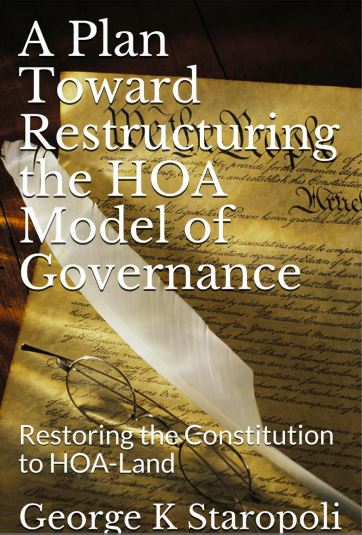
A Plan Toward Restoring the HOA Model of Governance (publication, 2020)
See restoring HOA Constitution Plan FAQ

Uniform Law Commission rejects subjecting HOAs to Constitution

Today I received a telephone rejection from ULC on my proposal for an HOA Members Bill of Rights.  It comes a day after my Commentary on ASU Law silence containing a statement that there has not been a ULC response, some 3 weeks after ULC’s Oct. 29 meeting.

“I am waiting for a response from The Uniform Law Commission (ULC) that is drafting updates to UCIOA. Its Scope Committee is reviewing my request for ULC study of my proposal for an HOA Member Bill of Rights; it will meet again in January.”

Nothing in writing, nothing formal, just a phone call. The essentials of the call, after a short debate where we could not reach an eye-to-eye understanding of what my point was, is very disappointing.

“I appreciate your call and our discussion on my rejected proposal.  I think we are too far apart at this time: ‘not functionally useful for lawyers,’ and ‘not workable.’”   The Scope Committee and editorial board “had difficulty in seeing HOAs as a government.”

In this call I stressed my proposed statute that would mandate HOAs to be subject to the Constitution like any other local government; the response was, “they didn’t see how that would help.

Long ago The Founding Fathers rejected the patchwork approach to modifying the Articles of Confederation and replaced it with a complete rewrite — The US Constitution and the Bill of Rights. It’s well beyond time that the HOA “constitution,” the CC&Rs, be replaced in its entirety as proposed in A Plan Toward Restructuring the HOA Model of Governance.

ULC apparently doesn’t believe so!

ASU Law ignores content-neutral free speech for HOAs

Much to my disappointment, the ASU Law library has not responded to my 3 emails[i] requesting an HOA advocate resource listing on its Homeowner Associations resource webpage. Under Books CAI attorney member Scott Carpenter is listed (reference is to an AZ Bar Assn booklet on HOA law, and under Websites AACM (community manager association) is listed.

Both of these listings carry the lobbying view found in the CAI School of HOA Governance.[ii] Neither address constitutional issues nor do they contain the views of constitutional lawyers. There is a constitutional issue at play as I informed the librarian and the Law School Dean  — the illegal bias toward one party’s content while denying another party’s material content. The law requires content-neutral free speech which I believe is being violated by ASU. So, as I proposed, remove these listings, or add my books and web pages or those of other homeowner rights advocates.

How can law students from the prestigious Sandra Day O’Connor School of Law obtain access to material information concerning the long ignored HOA legal scheme that, apparently, ASU does not agree with?  Change cannot occur in the blind! There cannot be change without change!

PS:  I am waiting for a response from The Uniform Law Commission (ULC) that is drafting updates to UCIOA. Its Scope Committee is reviewing my request for ULC study of my proposal for an HOA Member Bill of Rights; it will meet again in January.

NOTES


[i] Copy of email letter

gKS256@nyu.edu

To:  Beth DIFelice (beth.difelice@asu.edu)

CC: ‘douglas.sylvester@asu.edu’; Diana.Bowman@asu.edu

November 11, 2020

Email letter

Beth DiFelice

Director ASU Law Library

Sandra Day O’Connor College of Law

Arizona State University

[ii]  The foundation and principles of the School can be traced back to CAI’s Public Policies, The CAI Manifesto (its 2016 “white paper”), its numerous seminars and conferences, its Factbooks and surveys, its amicus briefs to the courts, and its advisories, letters, emails, newsletters, blogs etc. I have designated these foundations and principles collectively as the CAI School of HOA Governance.