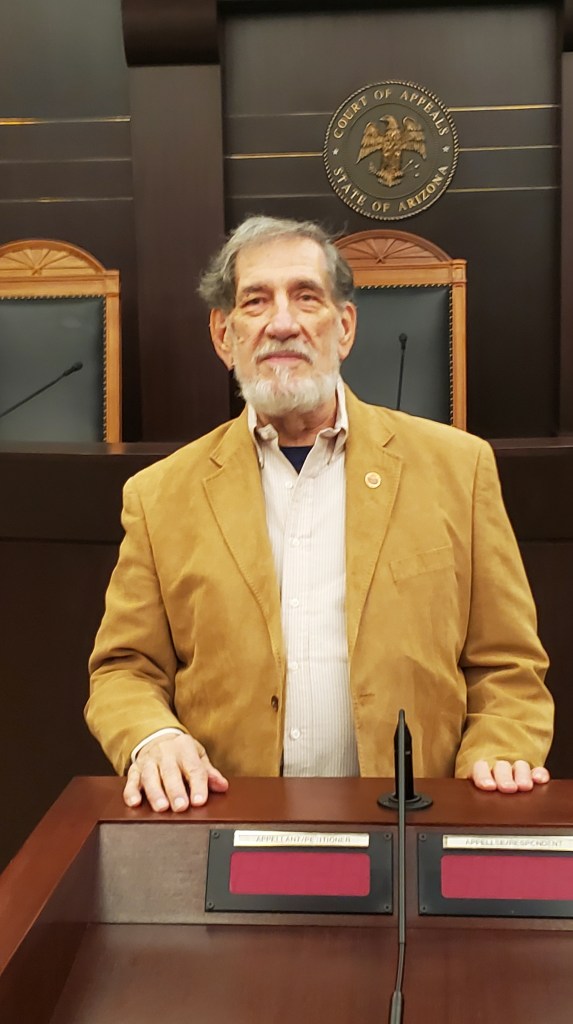
path to HOA legislative reform victory

Include the following “fill-in [ ]” model as “Section 1” to all bills proposing HOA reform legislation:

Be it enacted by the Legislature of the State of [ ]:

Section 1. It is the policy of this state that notwithstanding any provision of [insert the appropriate planned community or condominium acts] to the contrary,  the CC&Rs or Declaration for any planned community, condominium association or homeowners association shall state that, “The association hereby waivers and surrenders any rights or claims it may have, and herewith unconditionally and irrevocably agrees to be bound by the US and State Constitutions and laws of the State as if it were a local public government entity.”

Law review article criticizes HOA public policy

In her 44-page OK Univ. Law Review “Note” (2022) the author, Saige Culbertson, concentrates on the questions of agency relationships and duty of care. However, in order to discuss the question of agency relationships, Culbertson addressed many of the issues still causing problems in HOA-Land including the status of HOAs as quasi-governments, the validity of the CC&Rs “contract,” and the reality of maintaining property values.

With respect to agreeing to be bound, the author maintains in regard to the individual homeowner subject to the CC&Rs,  that

  • “HOAs use these contracts as a basis for their decision making because courts often presume the homeowners have a full understanding of their HOA’s obligations, because they have the duty to examine their contract for real property. The typical HOA contract is overly generalized and broad.
  • “When buying a home, a homeowner does not often have the option to not join. Homeowners also have little-to-no choice of which actions the HOA may take on their behalf, or, crucially, any actions taken by the HOA for any purpose.  
  • “However, the lack of mutual assent is constant throughout the relationship with the HOA. At the beginning, the homeowner might not have agreed to a relationship with the HOA, and those who have agreed might not have a full understanding of the rules of the HOA.
  • “[S]ome courts and scholars argue that HOA contracts are a form of adhesion contracts. Adhesion contracts are exclusively pre-determined by a single party and are presented as “take it or leave it,” while the non-drafting party has no room to negotiate.”

With respect maintaining property values, Culbertson is concerned about “The Fictional Purpose of a Homeowners’ Association,

  • “The Community Association Institute recently reported 71% of individuals believed their community association rules ‘protect and enhance property values.’ While this belief may have been true in 2005,  more recent research indicates otherwise. 
  • “[A] study found that “[p]roperties located in HOAs do not appreciate faster, on average, than properties not located in any type of neighborhood government”

 and cites this study by Robertson,

  • “[A] 2021 study conducted by former Yale Professor Leon S. Robertson found that “[c]urrent sales price[s] [are] related to property characteristics and local market conditions[,]” and that “sales prices do not reflect the efficacy of homeowners associations to protect property values.
  • “Robertson remarked that “[s]tate and local laws that sanction homeowners associations and allow their coercive practices based on the premise of property value preservation are ill founded.”

With respect to quasi or local government, the author favors making “HOAs part of local government, founded in democratic ideals, and with regulation by the state or municipality,”

  • “The nature and purpose of the HOA are so closely linked to that of local government that . . . clearly give rise to a special sense of responsibility . . . . This special responsibility is manifested in the . . . requirements of due process, equal protection, and fair dealing. The severity of the risks associated with the substantial overreach by HOAs is further shown by actions depriving individuals of their basic rights.
  • “[U]pon analysis of the association’s functions, one clearly sees the association as a quasi-government entity paralleling in almost every case the powers, duties, and responsibilities of a municipal government. As a “mini-government,” the association provides to its members . . . . [citing Cohen v. Kite Hill Cmty. Ass’n, 142 Cal. App. 3d 642].
  • “The lack of checks and balances on HOA actions is a national problem and homeowners are often left with no remedy for violations of their rights. The need for regulation of HOA activities, and further federal protections for individuals, is especially apparent . . . .
  • “[H]omeowners should urge their local government to increase regulations on HOAs to protect their fundamental rights as Americans. States should therefore pass legislation to make HOAs part of local government, founded in democratic ideals, and with regulation by the state or municipality.”

Source: OK Univ. Law Review (PDF download).

Amazon Reviews of Collected Writings

One small step for CK, one giant leap for Americans in HOAs

by supporting HOA reforms with an   AMAZON Customer Review

CK 5.0 out of 5 stars For every American, the essential book on understanding homeownership in private communities.  Reviewed in the United States on February 15, 2024

I’ve known of and been a follower of Mr. Staropoli’s writings for many many years. What a gift this book is to Americans who seek knowledge, truth, transparency and clarity!”

Back cover HOA Constitutional Government

Please consider submitting a review on Amazon as  short as the above, or more detailed as you would like to say. In your own words. If you read the book, great! If not, please read the Description on Amazon and view the Preface sample selection to help your thoughts.

If you decide to submit, include your credentials – social media group or webpage — to promote your  advocacy nationwide on Amazon along with others.

HOA Constitutional Government: collected posts

Before the AZ Supreme Court

The purpose of this book is to educate the people — the general public, the HOA members, the media, state legislators, and those learned authorities — who have been subjected to disinformation presenting a misleading view harmful to the Constitution and our democratic system of government.

The posts contained in Collected Writings have been selected from my Commentaries posted in HOA Constitutional Government (http://pvtgov.info).  There are over 1,300 posts dating back to 2004 discussing issues, and dealing with events, legislation, statutes, and state court appellate cases that came to my attention.  The Commentaries are short, to the point, and contain related notes, references, and links to complete papers and provide authoritative documents for further study. They are the original Commentaries with some technical adaptations.

Available shortly will be a 145-page paperback on Amazon. In draft is a Kindle eBook version also available on Amazon. There are 4 main areas covering countrywide events – developments as far back as 2000:

  • On Legislation
  • On the Bill of Rights
  • On the Judiciary
  • On Civics  

On this 2023 New Years Eve, resolutions to move forward on effective HOA constitutionality challenges and reforms would be very appropriate, and necessary.

Effective HOA reform legislation

If advocates want truly effective legislative reforms, they must actively support their legislative champions sponsoring these reforms. There have been important successes as a result of the increased call for and proposed reform legislation in several FB social media groups.

However, these reforms MUST address the very broad and larger constitutional issues that deny homeowners rights — rights that people not living in HOAs enjoy. Simply stated, HOAs must be made part of the Union!  The trickle-down effect would be enormous. All homeowners would be protected and treated fairly when their rights and privileges fall under the well understood laws of the land.

Here’s a simple, straight-forward bill first proposed in March 2011 found in Proposed “consent to be governed” statute, the “Truth in HOAs” bill.

“The CC&Rs or Declaration for any planned community, condominium association or homeowners association shall state that, ‘The association hereby waives and surrenders any rights or claims it may have, and herewith unconditionally and irrevocably agrees to be bound by the US and State Constitutions and laws of the State as if it were a local public government entity.'”

Item 4 of the Truth in HOAs Statute (Bill).