All state “may/shall” statutes imply HOAs as state actors

The use of the words “shall” and “may” have generally accepted meanings in state laws and statutes. Their use in bills and laws relating to HOA-Land raises the highly controversial question of: Are HOAs state actors?  “The overlooked impact and consequence of this word is to legalize activities and actions that were all-to-fore not legal rights granted to the HOA.”[1]

Arizona’s HB 2575 creates HOAs as state actors with the slick use of the legal differences between these terms. BUT, as applied to sui generis HOAs, implicitly create state actors. The bill introduces a new section (emphasis added) with, “ARS 33-1820. Powers of the association. Subject to the provisions of the declaration, the association may:” A 12 item list is presented mimicking the CC&Rs, a common tactic to legitimize contractual challenges to the governing documents. Very clever!

Item 4 is particularly onerous because of the use of the introductory “the association may.” A 12 item list is presented mimicking the CC&Rs, a common tactic to legitimize contractual challenges to the governing documents. Very clever!

Item 4 was particularly onerous because it permitted the HOA Board to lobby in the name of the members.

“[the association may ] 4. Institute, defend or intervene in litigation or administrative proceedings in its own name on behalf of itself or two or more members on matters affecting the association or planned community or the members’ interests.”

After 3 sessions ending with “ret on cal,” (retain on calendar)  I emailed my may/shall state actor argument (as summarized here) to the legislative leadership resulting in the sponsor’s amendment rewording item (4). In relevant part, the association may not institute, defend or intervene in litigation or arbitration in its own name on behalf of itself or a member.

Thus, a potential constitutionality challenge was avoided as I had instituted in 2013, and won, with the help on a nonprofit legal organization, Arizona Center for Law in the Public Interest (ACLPI).[2]

Although the bill passed out of the House with the other argument that the 12 items also reflect an implied state arm it was a major victory 1) on a broad constitutionality issue and 2) a punch in the nose to CAI who actively sponsored this bill, according to the AZ Homeowners Coalition.  CAI can be beat!

There are other arenas to challenge and expose CAI for what it is and stands for.  I present some 56 events over 24 years that serve to guide what worked and what did not work for advocates to successfully challenge the Evil Empire. Organized into 4 sections: On Reform Legislation, On The Bill of Rights, On the Judiciary, and On Civics.[3]  Available on Amazon, paperback or Kindle.

References


[1] See in general, Are HOA state actors created by statutory use of shall/may? (Section 2, paragraphs 5 +). (2019).

[2] Suing the AZ Legislature: AZ Attorney General admits SB 1454 HOA to be invalid and without effect.

[3] Read the book, HOA Constitutional Government: the continuing battle. 

standing up for HOA reform legislation

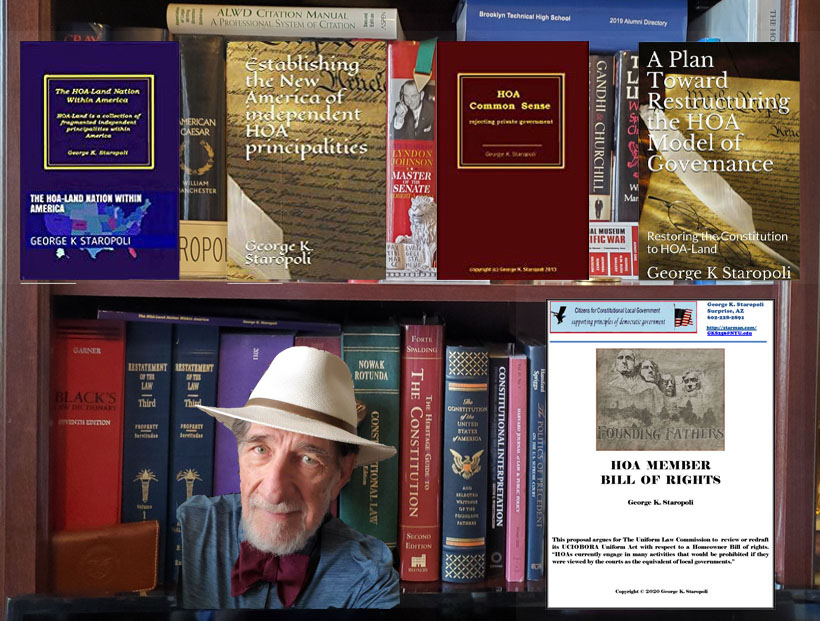
The publication on Amazon of my paperback Collected Writings (for Kindle version) is the latest in my long-term plan and strategy to achieve HOA reforms across the country. An opportunity exists for seriously motivated owners and advocates to come to the aid of the HOA reform movement on a national scale, and call attention to the invalid HOA legal scheme.

It’s simple: put your $$$$ where your mouth is.  By purchasing Collected Writings on a national scale on a leading international website, Amazon, our outcry for reforms can no longer be denied. You can purchase for others, or for a group of others. Amazon will not permit price discounts for these books.

An unworkable alternative at this time would be to set side a percentage of the profits into a nonprofit account to be used to support statewide lobbying of selected reform bills. But this would require substantial purchasers/donators in the order of 10,000 or more.

For those who do purchase these important issues, all presented in one collection, you can write and submit an Amazon review —  no charge.

Of course, there will be a few who will claim  that he’s just looking to make some money. Over my 22+ years  I have received minuscule payments after spending some $10,000 of my own funds.

Who’s in charge of the larger HOA? The BOD or CAI?

Over the years I’ve come to believe that the CAI member HOA attorney are really in charge and run HOAs, especially the larger ones where the money really is.  Its influence runs the gamut from its CAI School of HOA Governance,[1] to pervasive lobbying state legislatures, and its CAI Manifesto.[2] The manifesto is its “white paper,” 2020 and beyond, in which it advises its followers to influence state legislators and the courts.

QUOTE Most legislators do not thoroughly understand common-interest communities or who their patchwork legislation is actually protecting. Legislators too often shoot from the hip, passing laws that ricochet and cause collateral damage. And they will continue to do so in the future unless the CIC interests undertake vigorous lobbying and education programs and awareness campaigns to enhance their understanding.“[p. 7][emphasis added]. UNQUOTE

In 2016 CAI published its survey[3] of large-scale associations (LSA) that revealed some insights into the strength and dominance CAI attorneys who are involved with the policies and operations of LSA HOAs. CAI  defines these associations as having more than 1,000 lots with an operating budget  of $2,000,000 or more, and that “provide municipal type services.

QUOTECAI’s Large-Scale Managers (LSM) Committee . . . provides input on education curriculum, best practices, public policies related to management or operations of large-scale community associations, or identifying what is of value to the large-scale manager membership” [p. 2]. UNQUOTE

By “municipal type services,” CAI explains,

QUOTE “Many municipal governments viewed this new community housing concept as a means to transfer various public works and recreational responsibilities to a third party, which possessed the ability to assess property owners for the administration of these varied services.” UNQUOTE

The facts revealed

You may ask, so what has CAI really done or is this mere words? Based on CAI’s own data in the 2016 LSA survey, with only 94 respondents, readers can see the extent of CAI’s presence in these large scale HOAs — these master planned communities and these active-adult and retirement communities.  Reworking the data, the study revealed that 83.5% use an HOA attorney, which is not surprising for HOAs that can have as many as 9,000 homes or more and revenues that can reach upwards to $20,000,000.

Also not so surprising is that 92.5% of the HOA’s top leaders – president, CAM/COO — are CAI members in a strong case for conflict of interests.  As for senior staff, 64.9% are CAI members, and just 44.7% are on the BOD.  Understand that an HOA can have one or all three categories at the same time.

Consequences

I ask again, who runs the HOA, and where does the BOD’s advice come from if not from the teachings of the CAI School of HOA Governance? I suspect that the smaller the HOA the lower the percentages using an attorney or having CAI member HOA officials. The money isn’t there! 

This translates into follow the money that focuses legislators, the media, the political scientists, and the constitutional law think tanks on the LSA HOAs, treating the smaller HOAs as local nuisances. This is one good reason for failures in obtaining meaningful HOA reforms and even daily operational reforms.

References


[1] The foundation and principles of the School can be traced back to CAI’s Public Policies, The CAI Manifesto (its 2016 “white paper”), its numerous seminars and conferences, its Factbooks and surveys, its amicus briefs to the courts, and its advisories, letters, emails, newsletters, blogs etc. I have designated these foundations and principles collectively as the CAI School of HOA Governance.

[2]  Community Next: 2020 and Beyond (May 5, 2016).

[3] Large Scale Associations CAI study, 2016.

CCHAL in Calif. stands up to CAI

The California homeowner activist group, CCHAL, with Marjorie Murray as its president is moving in the right direction.  In its email distribution urging homeowners to contact their representatives to OPPOSE SB 391, CAI is called to task and criticized for its support.

“’The Community Associations Institute (CAI) and the property managers (CACM) are still “stretching the truth’ about SB391 (to put it politely.) CAI and CACM keep publishing ads saying  ‘SB391 gives HOAs the right to hold teleconference meetings during an emergency…’ This is FALSE.”

We need more advocate leaders and homeowners to speak up strongly to force CAI to defend its statements, if they dare, or to shut up!  Silence only helps CAI to increase its stature before legislatures, the media, and the public. Victory is ours by not remaining silent!  

(See If only advocates would stand up to CAI).

CAI knows its defending the indefensible. Do you know that?

HOA Constitutional Government

SB 1454: Machiavelli at work in the AZ legislature – Part 1

Part 1. Rep. Ugenti, Senator Griffin and lobbyist Sandquist 

(See Part 2).

Back in July I commented about SB1454 and wondered whether the Constitution or Machiavelli was alive and well in the Arizona Legislature.  In the subsequent two months I’ve come into possession of additional information on the events surrounding SB 1454 and its predecessor, HB 2371, and the underhanded manner in which it became an unconstitutional law. 

This post elaborates on the above commentary, which should be read first as it provides background information. This post also provides insight on how a legislature really functions, and undoubtedly how your legislature functions with respect to HOA legislation.

Furthermore, for a better understanding of the events the reader should view my video of the HB 2371 hearing before Senator Griffin’s GE committee.  It includes some interesting statements between Rep. Ugenti, who sponsored HB 2371, and Griffin; and between the HOA manager association lobbyist and Griffin. (The lobbyist’s statements begin at 9:13 into the 11 minute video). 

Please pay attention not only to their words, but to their body language as well. Listen to their arguments, but closely examine what is being said “between the lines.”


A.        Representative Ugenti

The March video of Senator Griffin’s hearing shows a perky Ugenti exuding confidence. She makes use of the special interest mantra, “stakeholder,” and states how all the stakeholders met and agreed upon the bill. She basically tells the committee that they are vendors (“stakeholders” refers not to homeowners, but to all those vendors who are making money off the HOA and off the homeowners).  The problem is, is that these vendors are daring to set legislation affecting the rights of homeowners that serve their own agenda.  Yet no committee member asks, “Where are the homeowners?”

Ugenti stated that each year there was “a plethora of personal HOA legislation[1] and tried “to spare the [committee] members the constant agony of many personal pieces of HOA legislation,” as contrasted to the industry legislation. Ugenti also said that she “felt very responsible to the stakeholders.”


B.        Senator Griffin

Senator Griffin is also the Senate President Pro Tempore, second in line in the leadership hierarchy. The AZ Legislative Manual states that, the chief duties of these officers are to preside over Senate and House proceedings and to otherwise assume the duties of the President and the Speaker when they are absent from the Legislature.”  

Griffin played a role in two separate incidents.   The first, see (C) below, is her withdrawal of an amendment to HB 2371, thereby allowing HB2371 to go on the Consent Calendar. This calendar leads to a direct vote by the Floor without further debate by all the representatives. However, it was objected to being on the Consent Calendar, which forced the bill to be debated by the Committee of the Whole (COW).  The bill was never debated and never came to a vote; it died in the Senate.

Second, having faced defeat in her bill Ugenti once again obtained the co-operation of President Pro Tem Griffin. Griffin added the failed HB 2371 HOA amendments to HB 2518 (Rep. Olson was the Sponsor), now before the Senate.  The bill passed the Senate and was sent to the House where a Conference Committee was recommended – the House did not accept the Griffin/Ugenti amendment.  This time, the House failed to hear the amended HB 2518 and it, too, died along with Ugenti’s HB 2371 HOA amendments.[2]

  “The role of morals in politics is mainly to cultivate illusions . . . politics is merely appearance and morality is merely pretense.” (“Machiavelli and America,” Hadley Arkes, p. 104, The Prince (Yale University Press, 1999)).


 C.       Jeff Sandquist, AACM lobbyist

At the end of the above mentioned video (see Part 1), Jeff Sandquist, lobbyist for the Arizona Association of Community Managers (AACM) addressed the committee.  AACM stood to gain much from HB 2371, which would allow its members to represent HOAs in small claims court and before administrative law judges at OAH (Office of Administrative Hearings).  State certified legal document preparers (paralegals) are not allowed this right. There were no provisions in the bill for licensing, training, or educating property managers to adequately represent HOAs. Nor equal representation for homeowners.

Note the very friendly dialogue between Sandquist and the Chair, Griffin, which is out of order for a committee hearing.  “Tell your Mom hello for me.” Griffin mentions that making an amendment got her to see her “buddy” Sandquist.  He thanks her for not offering her amendment.

Sandquist also vaguely spoke about how the courts would like to see a provision moved to another section, implying an acceptance by the courts. It also implies a recognition of a separation of powers issue on granting HOA managers representation rights.

Two days after filing the complaint, about a month after the Governor signed SB 1454, a Supreme Court Rule 31 change was requested seeking an exception for HOA managers to be able to represent HOAs in small claims court (still pending).


[1] I digress. My emphasis reflects, to good extent, homeowners failing to see the broader picture beyond their HOA problem, such as raising substantive issues of constitutionality. Ugenti is saying that homeowners don’t really understand the problems with HOAs, which only the HOA industry special interests can solve. It is evident that this is the view held by all state legislatures across the country. Homeowners have failed to deal with this reality.

[2] In my 13 years I have seen isolated cases in various legislatures in different states where the right and ethical action was taken and legislation was defeated or passed as appropriate, as we see here with these 2 bills.  But, on the whole, far too few.