Why HOA reform advocates fail at legislative reforms

This Commnetary is in response to a comment to my book review of Colorado Senator Morgan Carroll’s, Colorado senator’s guide to effective HOA legislation.

Your comment is understandably emotional and angry, because of failed attempts at HOA reforms.  I assume you have read my commentaries on the basic theme that state legislatures are not friendly toward HOA reforms. But the book shows you how to throw it back at Carroll and the dysfunctional legislatures and hypocritical legislators.  Just take it from the mouth of the “enemy” and use it against her.  Show her as a hypocrite, if that’s what you believe.  I do it all the time with the Arizona Legislature, and a new strongly worded critique is on the way.

You are mistaken in stating that I praise Carroll as a friend of HOA reforms.  I praise her because the book shows the way to reforms, and similar advice has been provided by legislators in other states.  The problem has always been the failure of homeowner advocates to recognize the fact that this is power politics, just like you see on TV, and they must learn to play the game.  And Carroll tells you how.

Yes, the book implies that all upright and good standing representatives will come to the aid and do right by the people, if they speak out loud enough and in large numbers.  Carroll does not say “right is might,” because the laws do not deal with justice.   Legislators, except for a very small minority in isolated cases, do not take up the “Mr. Smith Goes to Washington” cause of the people that this ain’t right. Wake up guys! 

While small groups have spoken out in many states, they are not organized or powerful enough to overcome the paid lobbyists with their credentials.  But, over the years nobody really wants to organize a national HOA reform advocacy to counter the CAI propaganda.

Yes, there have been champions of HOA reform, but advocates fail to realize that these legislators must buck the powers that be at the legislature and win over the votes of a majority of other legislators. And this takes outcries by many people, not with gripes of “I wuz wronged!” but with valid arguments as to why HOAs are wrong for the state and the general public well-being.  And how to fix  these wrongs.  

This must be understood. The legislature does not get involved in your personal gripes! You must raise your issue to a general issue, a fundamental rights issue, before any legislature will get excited.

Learn from the book and take it to Carroll and show her “dual personality” in public, where it counts, and not here among others who know but do nothing.
State legislatures and HOAs: When will they ever learn?

It should not come as a surprise to anyone that state legislators have allowed the HOA legal scheme, which they have played a strong hand in supporting, to deny the equal application of the laws for all, and the loss of constitutional protections. 

Free speech, flying the flag, due process, clean elections, etc. have been denied by HOA regimes.  Even noted CAI member attorney, Adrian Adams, speaking about HOAs in the Davis-Stirling online Newsletter article, Animal Sacrifice: Just as private organizations can restrict free speech, they could conceivably restrict religious practices that negatively impact other members.

The denial is basis on the specious and false argument of a “consent to agree.”  A consent that falls dismally short of meeting Supreme Court judicial scrutiny for constitutionality. All the HOA has to show is an HOA interest for the benefit of the entire community and the courts will find no problem, just as if the HOA were a government entity that has some legitimate interest in the issue.

Furthermore, legislators accept the argument that any validly passed CC&Rs amendment binds everyone including any dissenters, regardless of its relevance, bearing, or reasonable expectancy of the restrictions being imposed on owners.  It’s the “general government interest” approach. It appears that public government attributes are ascribed to the contractual HOA, with the contractual terms are being ignored.  All reform legislation is an attempt to restore those rights wrongfully denied the homeowners, on a case by case, HOA by HOA, state by state basis. 

HOAs are not de jure governments — not state entities.   But, they are de facto governments operating under state legislature protections, but in contrast to all other government entities, without constitutional protections.  HOAs are unrecognized governments as is Cuba, but functioning nevertheless every day.

When will legislatures learn?  When will they undertake an independent study of HOAs with a truly independent “think tank”?  Like the Arizona State’s Morrison Institute for Public Policy.[i]  When?  Perhaps never, since they don’t seem to really want to know, and perhaps because they know what the findings will show.


[i] “Morrison Institute provides public policy research for government agencies, private associations, nonprofit organizations, and communities. In conducting research, analysts draw upon a variety of disciplines and methods: collecting original data through public opinion surveys, interviews, and consultation with experts; and analyzing existing information through review of published research reports, current legislation, and statistical data.”  (See http://morrisoninstitute.asu.edu/about/about-the-morrison-institute).

HOA democracy at work: dysfunctional adoption of amendments by minority vote


OPEN LETTER TO  TERRAVITA CA MEMBERS

Understand what a YES vote means for Terravita and your image as a citizen

Summary

The writer provides an example of how HOAs create a dysfunctional, un-American community, using arguments against the adoption of CC&Rs amendments on two occasions by the Terravita CA in Scottsdale, AZ.  In the first instance, amendments that violated Arizona statutes in regard to the content of the ballot were approved in 2010. One non-disclosed amendment made significant reductions in the requirement for adoption of future CC&Rs amendments, from a supermajority vote to a minority vote.  (In 2011, the Legislature defeated a CAI drafted bill that would allow for minority control of HOAs). 

The current amendment reflects an undisguised intent to punish one member for filing Office of Administrative Hearings (OAH) Petitions against Terravita.  Attorneys are not awarded fees at OAH because they are not required, yet the poorly constructed amendment removes attorney fee awards in civil court actions.  As a result of the approval of the non-disclosed “minority control” amendment in 2010, a minority of only 307  out of 1380 votes will be required to adopt this Board approved punitive amendment. 

Without any prior open discussion or debate, the distributed Absentee Ballot is one-sided in favor of the Board without opposing arguments. Adopting these amendments by a minority of members reflects an un-democratic and dysfunctional culture within Terravita.  The objectives of the “corporate state” are primary and individual property rights are secondary. Members are urged to reject the amendments.

Read the full letter here . . .

Colorado senator’s guide to effective HOA legislation

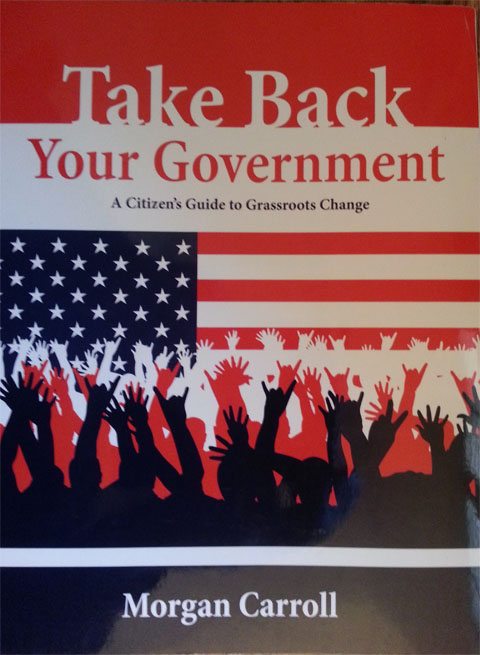
An excellent guide for citizens seeking to effectively lobby their legislature to bring about desired change. 

 Take-backThe author, Morgan Carroll, is an eight year Colorado legislator and is currently the Colorado Senate Majority Leader.  Take Back Your Government sends a strong message to citizens to get involved in the legislative process if they sincerely seek change, otherwise the paid, special interest hired-hand lobbyists will strongly influence the legislators. And set the tone for new laws and changes to existing laws.

Carroll’s opening chapter contains advice, such as, “We elect people to represent our interests, but our elected representatives cannot adequately represent you unless they hear from you. . . . If you don’t participate in your government, then the only remaining participants in the system are legislators and lobbyists.  And she reminds her readers that, “Democracy only works when citizens participate, engage and become informed voters.”  And that is why democracy is a farce in the authoritarian HOA private governments where apathy abounds for numerous reasons.

Part II, Advocacy for Beginners, is chock full of “dos and don’ts”  in contacting and dealing with bill sponsors, and how to draft and understand the wording and format of bills. The author provides advice for citizens such as, to “suggest a solution,” make your request “shorter and simpler,” and “summarize prior attempts to fix the problem.”   Her concern for the people include warnings that, “every right [permitted by law] should come with a remedy or an enforcement mechanism, or it’s an empty law.”  And there’s the commonly found use of “shall” and “may,” clarifying that “may” means “is permitted to” or “is authorized to,” both of which mean making the act legal.

And there is much, much more on how to get heard, how to contact legislators, how to testify, creating fact sheets to support your position, etc.  Definitely applicable, but not tailored just for HOA reforms. This book is must reading for advocates, especially HOA reform advocates who have faced a solid wall of indifference when seeking legislative change and who have been unsuccessful in the past. 

Thank you Senator Carroll.


Take Back Your Government; A Citizen’s Guide to Grassroots Change, Morgan Carroll (Fulcrum Publishing 2011).

Review by George K. Staropoli, a nationally recognized advocate for HOA reform legislation.

The FEDS must restore law and order in secessionist HOA governments

The following is my comment to a post by Evan McKenzie on his Privatopia Papers blog, Las Vegas HOA corruption probe continues.  In his post, Prof. McKenzie raised the question of federal congressional hearings on HOAs.

—————————————————————————————————

I think it is not only time for federal intervention, but well past the time.  There are a number of reasons.  First, as I wrote on my blog, people living in HOAs are still citizens of the US and of their respective states, not having waived or surrendered their citizenship. State legislatures have ignored not only the US Constitution and Bill of Rights, but their own Declaration of Rights as found in their state constitutions.  They have abdicated their responsibilities to their citizens.

Second, each state has its own set of laws governing HOA private governments creating a confusing and conflicting state of affairs as to what is law and what is not law. It depends on the state you are living in.  Only the federal government — and not a national lobbying organization nor a uniform laws commission that have been devoid of any homeowner representation —  can legitimately set a single, comprehensive set of laws governing the rights, freedoms, privileges and immunities of citizens. 

Third, a decision to settle the issue of  HOAs as state actors or as de facto government entities must be made, and that can only come from a decision by the US Supreme Court upon a complaint filed by the DOJ.  Can HOAs exist as a government entity?  Why not?  If not, then what? 

Understand, and do not be confused by the blurring of definitions, that the homeowners association is the governing body over a subdivision subject to a Declaration of Covenants, Conditions and Restrictions (CC&Rs).  The planned community development is the subdivision’s real estate “package” setting the amenities, housing, landscaping, common elements, and infrastructure that also mandates an HOA form of private governance. 

Fourth, it is an issue affecting some 20% of the US population, a percentage greater than the percentage either for the Hispanic or the Black minorities.

It’s time to bring unity to this country and end subdivision governance by HOAs that create independent principalities.  The planned community development can remain under a democratic form of government subject to the Constitution.  And that must come from Washington.  It can start with hearings to air those constitutional issues that have been avoided by every state and court for far too many years.