HOAs & state legislatures: rule by the Prince or by the Constitution?

“Where ethical restraint is lacking, there can be no hope of overcoming problems.”[1]

With the banishment of God from government, our “unalienable” rights, which were held by the Founding Fathers to be superior to any rights granted by any government, have been declared null and void by the US Supreme Court. With no substitute standard being announced by the Supremes to guide the people, they are left to flounder. And we have floundered.[2]

In his commentary on Machiavelli’s The Prince,[3] William B. Allen provides Machiavelli’s view of politicians,

Once the obligation to act according to natural or devine standards is removed, the question that remains . . . is how to participate in the management of political appearances to secure their [the politicians’] own interests.[4]

For Machiavelli “the role of morals in politics is mainly to cultivate illusions . . . politics is merely appearance and morality is merely pretense.”[5] 

Understandably, it is not surprising that the Supremes have held that all legislation is presumed to be constitutional, placing the burden on the people to prove the unconstitutionality of a law.  With this legal doctrine, the Supremes, the 9 Men In Black, have declared that “the sovereign can do no wrong.”  But, that is not the fundamental basis of our system of government with its separation of powers, checks and balances, and Bill of Rights.  The Supremes just abdicated their function under the Constitution.  In its place, it has assigned the role of the Protector of the Constitution to the people, the average person. 

Consistent with this doctrine, the Arizona Legislature also presumes all statutes to be constitutional, perhaps because the Legislature provides checks on the constitutionality of a bill before it can be sent to the Governor for signing. (The Arizona Constitution also provides a check on statute constitutionality before signing by the Governor).

However, in spite of statements to the contrary found in the Arizona State Legislature guides for the public, the legislature and individual legislators have failed to protect the people against the violations of the Arizona Constitution as in the case of the unconstitutional SB1454. They have ignored their duties, obligations and rules for the proper functioning of the Legislative Council and the Rules Committee. (See HOA reforms, SB 1454 and the inner workings of the legislature).

In contrast to Machiavelli’s principles of government, Hadley Arkes reminds us that

The founders understood that the principal mission of government was to secure people in their natural rights — to protect them against the lawless private thugs as well as of ill-intentioned legislators (emphasis added).[6]

He quotes US Justice Wilson’s (1798) warning that

The people in sovereign office might well perform unjustified and therefore lawless acts . . . such acts, though vested with ‘legal’ authority could not fully claim nor elicit from the people an obligation to obey.[7]


In regard to the HOA amendments surreptitiously placed into SB 1454, Arizona has dropped the ball.  Arizona has fallen off the pedestal.


References


[1] Ethics for the New Millennium, His Holiness The Dalai Lama, p. 26, Riverhead Books, 1999.

[2]God is dead, and so, too, are our unalienable rights, HOA Constitutional Government, February 5, 2008

[3] The Prince, Niccolo Machiavelli, Yale University, 1997.

[4] Id., Machiavelli and Modernity, W. B. Allen, p. 108.

[5] Id., p. 104.

[6] Supra n 3, Machiavelli and America, Hadley Arkes, p. 145.

[7] Id., p. 128.

HOA reforms, SB 1454 and the inner workings of the legislature

Arizona’s Rep. Michelle Ugenti amended a bill in an underhanded tactic to bypass the Arizona Constitution[i] in her determined and overzealous efforts to have special laws enacted for special organizations. Attorney for the plaintiffs, Tim Hogan, Executive Director, Arizona Center for Law in the Public Interest, explained the reasons for the complaint in his Arizona Horizon PBS interview.[ii]

In her interviews, Ugenti defended her amendment in terms of procedural legislative rules; my Staff said it was legal: “that the rules committee staff found her amendment to be germane to the original bill”[iii]  and “her additions to the bill are legal, if for no other reason than one of the changes does deal with elections.”[iv]    Her actions can be better understood in terms of the inner workings of state legislatures, so let’s examine the inner workings of the Legislature. 

The Bill to Law publication[v] of the Arizona Senate talks about the role of the Legislative (“Leg”) Council (my emphasis):

All proposed bills are drafted and prepared for introduction by the Legislative Council staff. Legislative Council may be requested to prepare a proposed bill draft by any legislator, by partisan staff at the direction of a legislator, or by direction from a committee of the Senate.

. . . .

Most importantly, legal staff in Leg Council may suggest changes intended to help the proposal pass Constitutional muster. For example, the Constitution (Article IV, Part 2, Section 13) [the very issue of the complaint] requires that, “Every act shall embrace but one subject and matters properly connected therewith…” If proposed legislation obviously covers two or more subjects, Leg Council will advise the sponsor that the bill must be trimmed, split into two or more bills, or face a potentially successful challenge on Constitutional grounds.

 The question remains: who told who?  And did Ugenti overrule the Legislative Council? Or, did the Legislative Council get it all wrong?  

And what about the Rules Committee, that functions as described in the Bill to Law publication[vi]:

Legislators on the Rules Committee, aided by advice from the nonpartisan Rules Attorneys, function as a sort of legal review panel for proposed legislation. Among other things, the Rules Committee reviews each bill for constitutionality . . . .  

It is in the Rules Committee that potential difficulties with constitutionality and form are worked out. In rare instances a bill is rejected entirely. Most often amendments are proposed to correct deficiencies noted by the Rules Attorney.

 In a surprisingly frank statement of the inner workings of the Legislature (my emphasis), 

It is not unheard of for proposed legislation to pass even though almost all parties know it will be ruled unconstitutional — sometimes there are political reasons for doing so. For the most part, though, a ruling by the Rules Attorney that proposed legislation is unconstitutional is enough to severely dim any chances of the proposed bill becoming law.[vii]

I guess the legislature “got caught with its pants down” with respect to SB 1454!  Or, is it a case of “The sovereign can do no wrong”?   I don’t think so under our constitutional system of government.

In regard to HOA legislation, the legislative inner workings are described in my latest Commentaries:

  1. CAI reacts to HOA Enlightenment Movement with targeted lobbying of legislators
  2. What is this “association law” thing all about?
  3. The questionable role of HOA attorneys
  4. SB 1454: crossing the line for HOAs

I raise the question once again: what was Ugenti’s motive for dogmatically and overzealously pursuing these HOA amendments?  Is she a diehard, true believer in HOA-Land?  Or, were there other factors that pressured or influenced her in her decision to sneak HOA reforms into SB 1454?


References


[iii] “Public interest group claims last-minute HOA bill is unconstitutional”, Arizona Capitol Times, July 16, 2013

[iv]Lawsuit filed against Arizona’s new HOA law”, East Valley Tribune, July 17, 2013.

[v]The Role of the Legislative Council,” From Idea ….. To Bill ….. To Law, State Senator Randall Grant (2000) , p. 29. (http://www.azleg.gov/alisPDFs/BillToLaw.pdf).

[vi] Id., “The Role of the Rules Committee”, p. 51.

[vii] Id., p. 51-52.

CAI reacts to HOA Enlightenment Movement with targeted lobbying of legislators

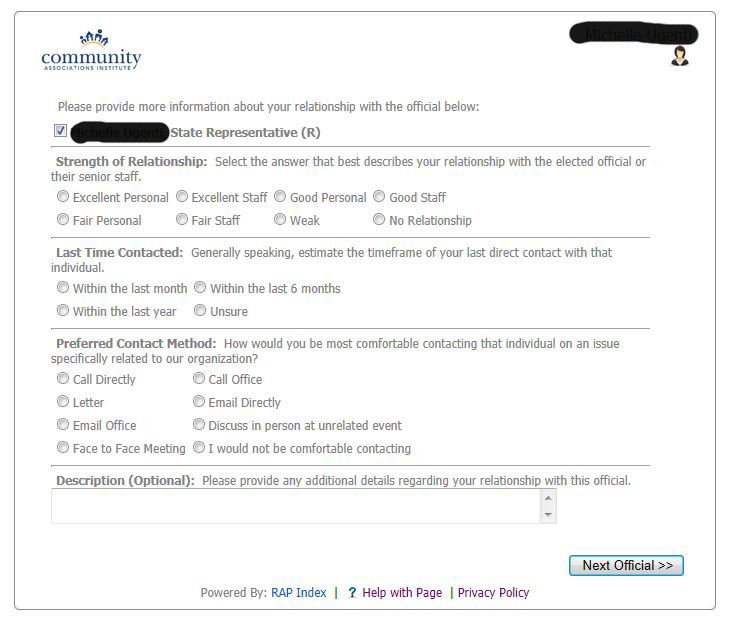
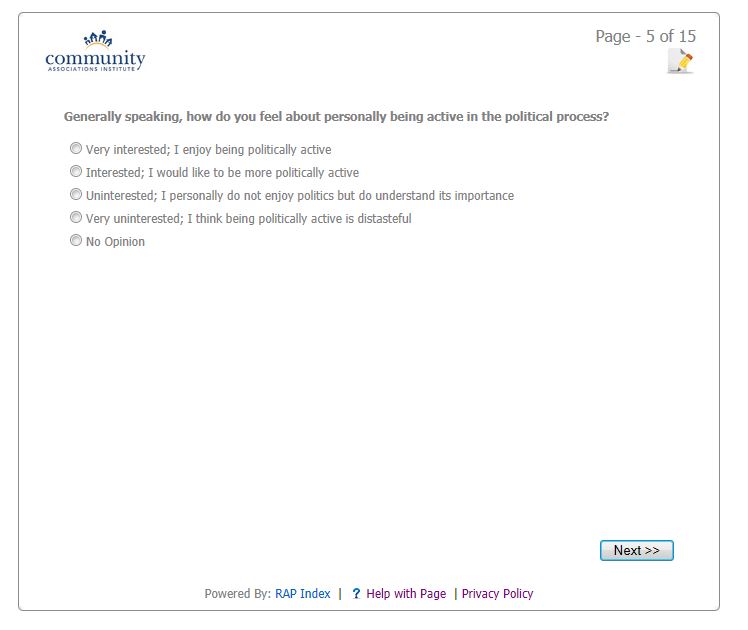
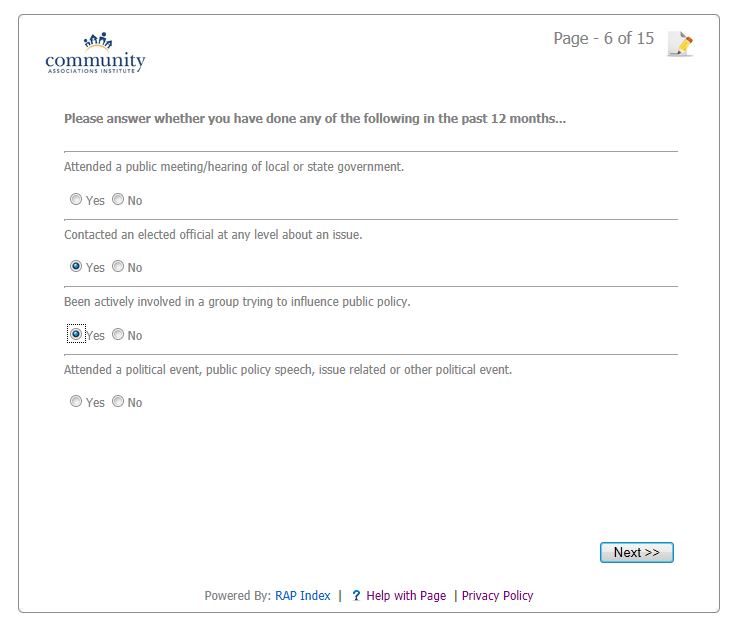
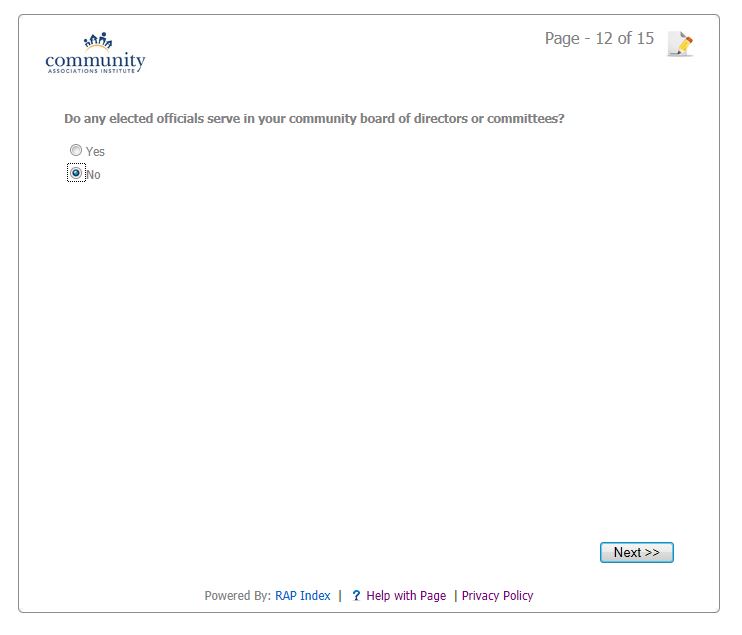
Apparently, CAI Central in Falls Church, VA is feeling the heat of the Enlightenment Movement — the awakening of the public, the media and state legislators as to what HOA-Land is really all about.  It has sent an email (“You can Enhance CAI’s Advocacy Program by Participating in this Brief Interview,” July 24, 2013) to its faithful members — presumably its “volunteer” members who are for the most part HOA directors — asking for their participation in a survey of their relationships with elected officials.  Obviously, for intense, micro-managed lobbying efforts in support of CAI’s objectives.

By understanding our network of relationships with elected officials, we can build advocacy programs that advance our positions on any number of issues that directly impact our members and the community association industry.

Recall that I wrote that CAI was formed in 1973 to deal with the problems of HOAs as defined and modeled by the 1964 Homes Association Handbook.  In 1992, CAI made a substantial change in its mission and elected to no longer be an educational organization (Tax exempt 501(c)3) and to become a business trade organization (501(c)6).   It did so under mounting pressures and criticisms in articles, research journals, and books, including McKenzie’s Privatopia.  CAI had to reach the legislatures that controlled state laws regarding the HOA industry.

This latest “brief interview” is another attempt to influence legislators in favor of HOA friendly legislation, knowing that advocates are still fragmented.  With the response from the party faithful, CAI will not only know who the friendly legislators are, but what members have good relationships with specific officials.  CAI Central, or through the local state chapter, can then produce targeted emails — as successfully used by Obama in the past election — to influence legislators. The advocates, unless they want to demand copies of all emails, will be in the dark.

This tactic by CAI has ominous consequences for HOA reforms in every state!  It becomes extremely important that advocates and homeowners in every state seeking redress of HOA problems form an advocacy group to inform the public, the media and their legislators of their views.  As I have long argued, advocates must, even more so now, confront, challenge and expose CAI propaganda.  They must also advance quality reform legislation.

This tactic by CAI of addressing legislators in all states makes it a national issue of unfairly influencing state legislators to advance authoritarian private governments not subject to the US Constitution.  Homeowner rights advocacy groups must be given equal access to their legislators!  Advocates must be given equal bargaining powers over HOA issues!  Legislative committees must not be allowed to hear that the “stakeholders” met without hearing from an advocacy group!

Links to representative CAI “interview” questions: CAI-network3, CAI- network 4, CAI- network 5, and CAI-network6.


See What is this “association law” thing all about? and The questionable role of HOA attorneys.

The questionable role of HOA attorneys

In my view after 13 years dealing with HOA attorneys, and especially those who are members of CAI across the country, they are lawyers first and foremost and not advocates for a cause.  They deal with the laws and statutes and CC&Rs as they are, having had a profound role in their creation.

An advocate fights for a cause, or at least, for justice and fair play against unjust, unfair and illegitimate laws.  He sees a societal wrong and seeks to redress these ills of society.  The HOA attorneys defend private corporations without a moral or ethical perspective, as they insist is the law. They do not concern themselves with the de facto acts of HOAs as private governments.   Therefore, under the CC&Rs contract, concern for individual rights and freedoms, those basic American values, are of little importance.

Over the years I’ve seen attorneys cross the line and act in collusion with the wrong-doing of HOA boards, even advising how “to deal with the new laws” that grant homeowner rights and freedoms.  They have proposed suggestions that are in keeping with the letter of the law while openly unreasonable and designed to give the homeowner a “hard time.”  A prime example, offered by the current president of CAI’s College of Community Association Lawyers (CCAL), in his guidelines[i] on videotaping board HOA meetings, as permitted by Arizona’s ARS 33-1248 and 33-1804. 

I’m sorry, but I must admit that my opening statement above is wrong. The CAI HOA attorneys are indeed advocates, advocates for HOAs under the banner, as stated on CAI’s home web page “Building Better Communities[ii] and “responsible citizenship.” The banner is quite explicit as stated on the Arizona chapter’s web page, “Creating Better Communities Through HOA’s”[iii]  (sic).

When their acts and actions before state legislatures are contrasted with their lofty public relations materials, the average person gets a clear picture of the better America being advocated by CAI attorneys.  It’s an America not based on the basic American values that created this great nation, but on authoritarian private governments permitted to operate outside the protections of the US and state constitutions.  And those protections were established to protect the rights of the people, and not private governments.

In contrast to the intents and purposes of HOA “constitutions,” America took pains in its Constitution to protect individual rights and freedoms:

THE Conventions of a number of the States, having at the time of their adopting the Constitution, expressed a desire, in order to prevent misconstruction or abuse of its powers, that further declaratory and restrictive clauses should be added: And as extending the ground of public confidence in the Government, will best ensure the beneficent ends of its institution.[iv]


Notes


[i] Videotaping Board Meetings – “Reasonable Rules” (http://www.carpenterhazlewood.com/resources/enews/2011/videotaping-board-meetings-reasonable-rules, April 29, 2011).

[ii]Celebrating its 40th anniversary in 2013, CAI provides information and education to community associations and the professionals who support them. Our mission is to inspire professionalism, effective leadership and responsible citizenship. (http://www.caionline.org/Pages/Default.aspx, July 21, 2013).

[iii] CAI-Central Arizona Chapter (http://www.cai-az.org/home.html, July 21, 2013).

[iv] The Preamble to the Bill of Rights.

send a wake up call to the US Supreme Court on HOA defects

I just read the 23 page US Supreme Court amicus brief[i] for The Cato Institute in Mariner’s Cove v. the United States, No. 12-1453, written by an illustrious group of legal-academic aristocrats. Let me make it quite clear at the start that I am not part of that group, or even an attorney, so I don’t have a built in “good ol’ boy” bias.

Selective citations and quotes were made from a number of cases, journals, and books including those of Evan McKenzie, Paula A. Franzese, and Steven Siegel.  (They wrote a critique of the NJ Supreme Court Twin Rivers decision, and other works, but you wouldn’t know that from the quotes).  Also quoted was Susan French who made that comment, not quoted in the brief,  in the Forward of The Restatement (3rd) of Property: Servitudes that, “Therefore this Restatement is enabling toward private government.”

My activist take on the brief can be summarized quit simply as:

1.         HOAs are growing faster than the rabbit population.

“The number of citizens opting to live in community associations—and the extent of commerce affected by such arrangements—is sure to keep growing, as the majority of new housing built in the past three decades is subject to association arrangements.”

 2.         The people love HOAs. “More and more citizens choose to enter into these property-rights-sharing arrangements because they provide substantial benefits.”

 3.         HOAs and local municipalities have a beneficial symbiotic relationship for the betterment of the community. 

 Community associations provide a variety of private and public benefits, including increased property values, greater efficiency in the delivery of services, and lower costs to the public.

 “Community associations offer such benefits to local governments that developers are increasingly required [sic] to structure proposed housing developments as community associations as a condition of approval.”

 4.         That it’s only fair for taxpayers to pay the HOA for the loss of income. 

By shifting a greater burden for paying for such services to the remaining members of the association without compensation, the Government’s taking here presents a textbook case of “forcing some people alone to bear public burdens which, in all fairness and justice, should be borne by the public as a whole.

“The constitutional requirement of just compensation derives as much content from the basic equitable principles of fairness, as it does from technical concepts of property law.”


Now, from these quotes as a good sampling, the 9 Men in Black cannot help but think that HOAs are the next best thing to heaven on earth. They would have no clue whatsoever that there is “trouble in River City.”  I would venture that they have no knowledge of the happenings and goings-on in HOA-Land, and would have to rely on the self-serving Cato amicus brief.

What is needed is a response showing the other side of HOA-Land that can be obtained from some of the same authors used by Cato, McKenzie, Franzese, Siegel and others. Court cases can be cited like the horrendous Poris decision by the Illinois Supreme Court, and the Wittenberg decision by the California appellate court, to name a few.  Or how about asking the Justices to think about, and asked to explain, The Truth in HOAs Disclosure[ii] as a starting point.

We have an opportunity to be heard by the US Supreme Court!

WHAT IS IMMEDIATELY REQUIRED IS TO INFORM THE SUPREME COURT JUSTICES of loss of rights, privileges and immunities of citizens under a despicable argument of a bona fide and legitimate consent to be governed.  I am not a lawyer.  I cannot file an amicus brief!

This is a very good time to act and be heard!


Notes