Support CO 22-1137 for HOA due process justice

Another HOA enlightenment bill has been proposed in Colorado, 22-1137, joining California’s and Arizona’s legislation to restore homeowner fundamental rights and freedoms.  Reading the bill as introduced, it addresses a number of issues designed to provide meaningful due process, to good extent, allowing for small claims adjudication and restrictions, limitations on the HOA’s right to fine, interest charges, late payments, work-out plan before foreclosure, and limits on the amount of collection to just 3 times amount owed (avoids unusual and cruel punishment charges). 

What more can a homeowner ask for to obtain justice and fairness within the HOA government? Go for the bill! Support it!  Get what you can before the evil empire strikes back and whittles the bill down!  Yet, to my disappointment, a homeowner advocacy group has found problems with this bill, all relating to how it would cost the HOA more money. 

What is needed, as I’ve repeatedly argued, is strong support for the sponsor, Rep. Naquetta Ricks, and an outpouring of emails to the legislators, especially to the committee members who will hear the bill.  If there is a Request To Speak option at the legislature, sign up and use it!

Related issues

In a broader view of HOAs as private, separate local governments keep in mind what has been ignored and bypassed by state legislatures across the country, including Colorado. Why are there private HOA governments when there are public home rule, charter governments?   

All the states have a version of home rule that varies in the degree of independence granted to a local governments and under what terms.   Given this existing legal mechanism for strong, independent  local control, why was there a need for the creation and approval of, and the support for, private government HOAs?

 (See America’s homeland: HOA law vs. Home rule law; Colorado Constitution, Art. XX, §6, Home rule for cities and towns).

Can HOA members expect justice in Arizona courts?

“HOA members in Arizona should not expect justice from the courts”

If you are a member of an Arizona HOA/condo, or soon plan to be one, you should pay heed to the above quote made in response to the Arizona Supreme Court’s denial to hear the Bendt appeal petition for review.[i]  In my Commentary, trying to understand the rationale for the denial,

“The homeowner, Bendt, is punished for speaking out, in admittedly harsh terms, [relating to issues of HOA governance]. Yet the judicial system stands by looking at a distance and allowing Trump and his followers to function as vexatious litigants; allowing them to  raise allegations, which are not only laughable but blatantly false under Rule 11, is shameful conduct.[ii]

What message is being sent by this disturbing decision? To the public? To the homeowners in HOAs seeking the equal protection of the laws under the Constitution? To the national lobbying trade group, CAI, who can breathe easy with respect to any challenges to the constitutionality of the HOA legal scheme that  contains denials of fundamental rights and privileges?

Professor Randy Barnett wrote, speaking of justice and judicial legitimacy,

A constitution that lacks adequate procedures to ensure the justice of valid laws is illegitimate even if it was consented to by a majority …. A law may be ‘valid’ because it was produced in accordance with all the procedures required by a particular lawmaking system, [the HOA amendment procedure, for example] but be ‘illegitimate’ because these procedures were inadequate to provide assurances that a law is just.[iii]  

And we must not ignore the effect of precedent on court opinions. Hansford and Spriggs found [that] the doctrine of stare decisis, itself, falls victim to the preferences of the judges. The closer the precedent was to the judges views, the more the precedent would be followed, and vice versa. Additionally, the research found that “the justices are more likely to negatively treat [modify or reject] a precedent they dislike on ideological grounds if that precedent is quite vital [how often cited in support]” by the judges (p. 75).[iv]  Bad HOA laws abound leading to favorable anti-homeowner decisions.

And still we see “Equal justice under the law” emblazoned on the façade of the US Supreme Court building. It contains a major defect, a misleading fallacy,  and a presumption of supreme court infallibility [without error].  Bad laws — unjust laws — will not produce justice for all!  And that is just what we face in the HOA-Land Nation.

I have argued (2009) for a judicial system that adhere to the following:

Before we can decide, we must examine some of the myths and realities of the American judicial system.  First, we have the concept of justice, the very foundation of any judicial system, although some have argued it is to uphold the law.  Philosophically, a judicial system cannot exist in a democracy if it does not uphold justice and correct the wrongs of the past.  In fact the people are told “Equal Justice Under Law”, the motto on the Supreme Court building; “to secure justice”, the commonplace stated purpose of court rules of procedure;   “to establish justice”, the opening purpose in the Preamble to the US Constitution; and we designate the members of the Supreme Court as “justices”. Notice that “to uphold the law” is not included in the above.  This is the argument, along with the insistence on precedent, used by those special interests who favor unjust laws.[v]

. . . .

So, in particular, what is wrong with the AZ  supreme court denial in Bendt?  A lot!

An amicus brief is submitted, and subject to approval by the Court and the parties, to advise the Justices in better understanding the conditions and factors relevant its opinion that it may not be aware of. The following is a summary of arguments presented in my amicus brief[vi] seeking the Court to review the petition in the name of justice for the homeowner, Bendt, and for all other citizens living n Arizona HOAs.

“The Hannaman 2002 study (NJ) was quite frank and revealing describing problems and complaint still in existence some 19 years later in spite of efforts by the self-proclaimed HOA experts and educators, national CAI. “

“[Referring to Nevada Supreme Court in Kosor v. Olympia Companies, 478 P.3d 390 (2020)]. Because we conclude that each of Kosor’s statements was “made in direct connection with an issue of public interest in a place open to the public or in a public forum,” we reverse the district court’s decision to the contrary and remand for further proceedings consistent with this opinion.

“As our [California] Supreme Court has recognized, owners of planned development units ” ‘comprise a little democratic subsociety . . . .’ ” (citations omitted).” (Damon v. Ocean Hills Journalism Club, 102 Cal. Rptr. 2d 205 (Ct. App. 2000) at “A. Public Forum”).

“Among its findings [South Carolina HOA study committee] were . . . While the Community Association Institute (CAI) and other private entities offer educational resources to homeowners and managers, state government cannot place the sole responsibility of educating homeowners and board members on a private entity.

“Although not presented by the Appellant where three plaintiffs who] are lawyers, and based on claims of false and inexcusable character assassination against Tarter . . . this Court has reasonable suspicion to remand the case for a determination the validity of an anti-slapp motion.

“This Court, or any court, cannot allow a group of individuals or organizations to create a devise in order to escape constitutional protections and enter into a contract, constitutionally valid in all other aspects, to form private local governments whose members remain citizens of this country as well as of their respective states. It, as it stands in regard to HOAs, makes a mockery of the Constitution and our principles of a democratic society.

“The free speech issues of limited-purpose public figure and of HOAs and social media as public forums with respect to political HOA governance issues have been raised and need to be addressed.

“As with Brown [v. Bd of Educ.], America’s culture and environment has changed dramatically from 1964’s Homes Association Handbook and the formation in 1973 of Community Associations Institute (CAI) to deal with rising HOA problems and constitutional concerns after only 9 years. In 1992 CAI dropped its 501(c)3 educational status for 501(c)6 trade organization so it could lobby state legislators.”

I cannot understand the Supreme Court’s denial of Bendt’s petition and the opportunity to rule or to further investigate these issues, by orders or by request to the Legislature — as it has so ordered in the past —  and thereby fulfilling its obligation to defend the Arizona and US Constitutions.  Instead, it seems that the Justices have allowed their opinions to be guided by the prevailing public policy favoring private government HOAs that are independent of the two Constitutions.[vii]

References


[i] See AZ supreme court denies hearing HOA case raising limited-purpose public figure doctrine.

[ii] Id.

[iii] Randy Barnett, Restoring the Lost Constitution, Princeton Univ. Press, (2004).

[iv] Hansford and Spriggs, The Politics of Precedent on the U.S. Supreme Court, Princeton Univ. Press (2006).

[v] See in general,  HOAs, justice, and judicial myth and precedent.

[vi] Staropoli Amicus brief Tarter  v. Bendt

[vii] See in general, The HOA-Land Nation Within America and Establishing the New America of Independent HOA Principalities.


Why HOA members fail in court – failing to know the enemy

In Nuclear Verdicts, not specifically addressing HOA cases and speaking to defense attorneys, author and defense attorney Tyson sees the failure to succeed  as a failure of the defendant to get angry.  “YOU are the solution to what has been wrong with our legal system.”  In keeping with the mission of a homeowner advocate’s cry of “fightclub,” Tyson’s Nuclear Verdicts’  mission “is about fighting individuals and groups who are attempting to take advantage of our legal system.  There are people every day who make false and exaggerated claims . . . .”   

I have applied his general statements to HOA-Land.  Tyson is quite on the mark with the many instances of HOA attorney conduct in the courtroom.  And on the failure of homeowners to appropriately and strongly respond. “Bad lawyering [on the part of the homeowner’s attorney] is much more common” than the HOA attorney’s “stretching their claims beyond what is real and verifiable.”  The homeowner attorney  “is surprised, or unprepared, or just not as good as the” HOA attorney. Tyson sums it all up with, “So how do you fight injustice? First of all you need to get angry! You need to stop complaining and do something about it.? 

. . . .

I have read dozens of trial and appellate court cases and opinions across the states, and have personally witnessed the conduct of HOA attorneys and board members in court. My research is consistent with Tyson’s position. I offer my own views for those seeking to go to court to take heed of, and to just DO IT!

My conclusions as to why homeowners lost in court fell into several causes, the chief being the failure to know the enemy, as Sun Tzu wrote in the Art of War. Other causes, as I saw them, 1) insufficient evidence and documentation provided to the court, 2) failing to state a claim, in other words, the HOA broke no laws or violated the governing documents but just exercised its discretion as was its right, 3) attorney lack of expertise and knowledge of HOA  case history, and 4) member afraid to argue the case as warranted for one reason or another.

I possess, as well as on other advocate websites including CAI’s pages on it amicus briefs and case history reviews, a wealth of information on knowing the enemy. Failing to provide this information to your attorney that will enhance your chances of success and to lessen his “learning time,” saving you money, can harm the chances of your winning in court.

YOU are the solution to what has been wrong with our legal system.”

I’d like to thank Sonia Bendt for understanding this need to cooperate and work together, and who sent me Tyson’s book realizing it would be very helpful to all homeowners going to court.

Robert F. Tyson, Jr, Nuclear Verdicts: defending justice for all, Law Dog Publishing (2020).

HOA attorneys support coercive HOA laws over member justice

Yesterday, June 24, I attended a ZOOM meeting with a number of attorneys from across the country who were debating 1) whether or not new HOA laws should be applied retroactively to all HOAs even those that were formed prior to the effective date of the new law, and 2) should draft versions of the HOA minutes, from member and board  meetings, be made available to the members and when. 

The general attitude was that new  laws should be made retroactive for the “comfort” of judges and BODs — too many old laws was a pain. But America has existed for over 234 years  with restrictions on ex post facto laws, and more generally, restrictions on civil retroactive laws. While the consensus would allow for individual pre-law HOAs  formed prior to the effective date to opt-out of retroactive application, failure to do so would automatically subject the HOA to the new version of the law a few years later, regardless. The rationale was that the HOA had an opportunity to remove itself from the law.  The general consensus was to adopt the retroactive law in spite of the fact that it was coercive in nature.  HOAs were promoted with this privacy aspect and objections to top-down government interference of one size fits all.

Allow me to explain, if an act, either by the HOA or by  member,  was valid at that time a subsequent version of that law would apply.  Applying the new law could make such a pre-law act invalid with potential financial consequences for the member.  For example, putting a then valid storage bin in the backyard is now invalid if over  a specified footage, and must be removed at the member’s expense.  Or forced to paint his home because the new law gave the HOA permission to require new painting for the good of the community. These ex post facto laws, like the ex post facto HOA amendments, make your alleged contract at closing a mere piece of paper and your rights surrendered to the whims and views of your neighbors.  These retroactive laws are coercive and do not serve member justice nor reflect a home rule doctrine where deference is given to the local community.

In regard to draft minute access, concerns centered around practicability and protecting the HOA, even though many states have laws allowing for verbatim videoing of these meetings — a growing trend toward transparency. I called to their attention that making draft versions available served as a check and balance on BOD conduct and that it would make the BOD’s actions more circumspect. I also raised my concern with regard to the timing of draft and approved minutes since delays of over a  month are an obstacle for effective member response – limiting any after the fact opposition.  In general, it was felt that the member should attend these meetings if concerned, which also raised practicality issues.  There was substantial support  for draft availability.

Overall, the attitude was toward protecting the HOA over BOD transparency.

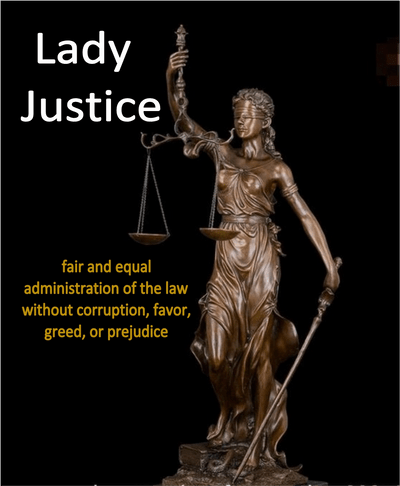
Lady Justice is blind to HOA justice

I think it’s well past due for someone of courage to remove the blindfold from the Lady so she can see the real HOA world as it is.