HOA advocate credentials are lacking

Should the FEDS get involved in HOA-Land abuse even though HOAs are controlled by state laws?  It would need to come under the approach that state laws are so varied that uniform laws must be adopted, and not by ULC that is steeped in the past and promotes more bad laws. This “what state are you in and that’s the law” has been a general argument for federal law and is a reason for federal intervention in the courts.

With all due respect for the hard work of several reform social media groups, getting the attention of state legislatures and DOJ/FBI depends upon the credentials of advocates. Can they make arguments at the level where the courts and lawyers will stand up and take notice? This is a longtime failure of HOA reform efforts even though they have obtained important reforms here and there over the years.

These reforms, for the most part, are rooted in “operational” reforms that affect the laws now on “the books” —  the overwhelming bad laws dealing with day-to-day operations and functions of the HOA. This reform legislation is needed to bring  a fair and just treatment under the constraints of the HOA legal scheme until reforms of substance are adopted.

Allow me to explain with an example.  There are many “good” laws that are designed to protect the homeowner and his rights, and put restrictions on the HOA. They may even have strong enforcement provisions with criminal violations.  Great? On the surface yes because enforcement is still the task not of the state, but the homeowner who has to bring such charges. The state – district/county attorneys and attorney generals — are not obligated to act. BUT, by definition, a crime is an act harmful to the state beyond one person. “Crime is “the intentional act usually deemed socially harmful or dangerous . . . prohibited and punishable by law.”

This “not my job,” hands-off posture constitutes an error of omission by the state that, under the obligations of the Constitution.

We the People of the United States, in Order to . . . establish Justice, insure domestic Tranquility . . .  promote the general Welfare . . ..”

Stay with me.  What is necessary is to rewrite the CC&Rs that is based on The Homes Association Handbook, as the Founding Fathers did when they threw out the Articles of Confederation for the US Constitution.  There has been and is little support for this approach, which I believe is the result of a lack of understanding and a fear that their HOA would be abolished —  a very successful fear mongering by CAI. And that includes a fear of CAI.

Over the years I filed an IRS tax-exempt complaint against CAI for having the customers of its members also a member of the business trade group in violation of its tax-exempt status. In 2005 CAI had to drop HOAs pe se from membership. Earlier this year I filed a 40-page complaint with the antitrust division of DOJ arguing that CAI was a monopoly, and has acted to thwart competition and the free entry into the HOA education market. 

Recently I asked for support of my appeal to the Federalist Society  to encourage and promote dialogue on the constitutionality of and loss of citizen rights in an HOA. The Society’s mission is educational for lawyers and student lawyers, and has a national  program of local law school chapters to debate issues. (Notable attorneys and government officials attend these meetings. My grandson had the opportunity to meet the Governor.)  I argued that new lawyers sally forth lacking the truth about HOA-Land serving to perpetuate the unjust laws.

HOA reformers and groups must present themselves as knowledgeable advocates, united nationally, who understand the law and the judicial process.  Reformers need to be able to stand up before CAI, the courts, and state legislators and win!  As I posted elsewhere, I am still waiting for an answer to my 2006 challenge to debate the CAI “elite” lawyers who are members of CAI’s CCAL.

As the renowned international management consultant Peter F. Drucker made clear, “A mission statement has to be operational; otherwise, it’s just good intentions.

Elitist large-scale HOAs

Understanding private elitist HOAs as social welfare HOAs

Data on HOA member demographics is scare but I’ve been able to uncover  documents, 11 years apart, that lead one to believe that H-O-As are elitist for the most part.  A CAI  survey showed 79% respondents with incomes over $50,000 and 86% with some college of more.  US Census showed 24.4% and 44.9% respectively. A confirming study on a large-scale H-O-A showed 88.1% with some college or more and 76.4% with income over $45,000.

According to CAI’s LSA (large-scale associations) category of 1,000 or more units, a Nevada CAI survey showed a mere 2.0% were LSAs. This emphasis by CAI on LSAs, a small minority of HOAs across the country, impacts all H-O-As of every size in the state as a result of its intense lobbying efforts, its one size fits all policy.

These surveys are not  consistent with the totality of social welfare HOAs as contained in the IRS databases of 36,532 organizations filing under (c)4. Just 10.8% (3,931) of these organizations met the criteria for “homeowner associations” under the IRS subcategories, a far contrast with the surveys. Analyzing the justification by the IRS for one large-scale H-O-A raised concerns about the (c)4 tax-exempt process.

The absence of any discussion by SCG, a large-scale H-O-A, of it’s social welfare status  and related activities is compelling.  Based on my many years exposure to HOA legalities, I would hazard a guess that the board had advisers and assistance in preparing and filing its application.  SCG has close ties to CAI by virtue of its directors being CAI members, its attorney and CAM being CAI members, and its accounting firm, Mansperger Patterson & McMullin, also being a CAI member.

Read the full research study at elitist H-O-As.

What is the range of HOAs by revenue?

In this post I will not be discussing CAI’s dominance and influence on HOA-Land, its legalities, environment or culture, but setting the CAI record straight.

All that I now about HOAs I learned from CAI,

from its polls, surveys,  and fact sheets going back as far as 2005.  All of which revealed some 70% plus  happy and contented homeowners in their land of milk and honey

I have been concerned about several issues not addressed by CAI’s findings, one of which was the distribution — number of HOAs in each category by size — according to population, by preference, or by revenues as used in this study.

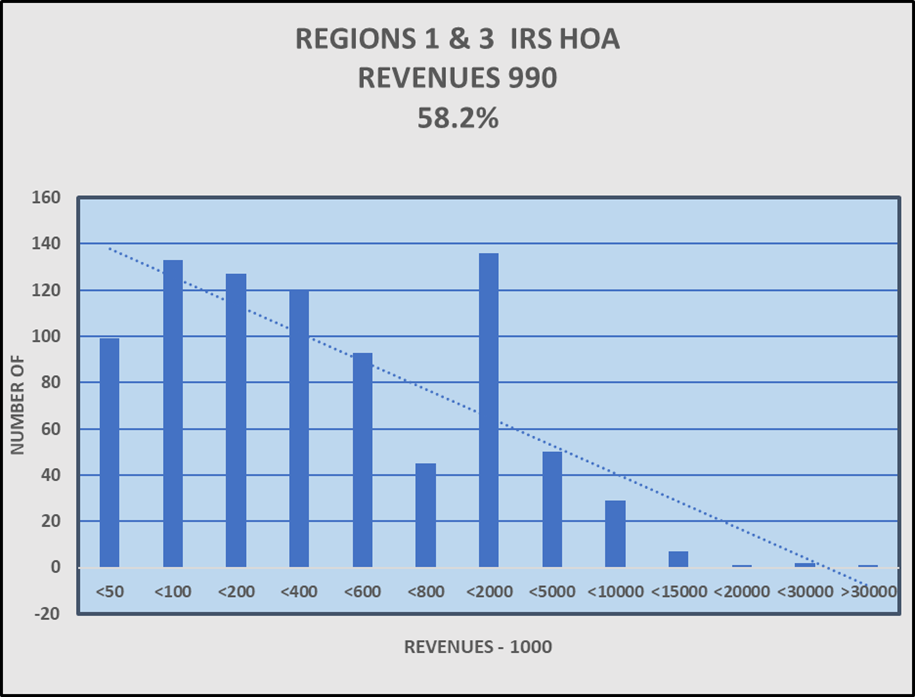
The data for the above charts was taken from the extensive IRS  EO BMF files[1] (over 1.8 million entries) and massaged using EXCEL. (The slanting line is the downward trendline showing fewer and fewer HOAs as their siz increases).  It is a list of all current tax exempt organizations from which coded ‘homeowners associations’ were selected.  Only 2 of the 3 Regions (representing 58.2%) were included in my research. Only a miniscule 843 organizations classified as a 501(c)4 social welfare organization (SWO) were found  meeting the 5 applicable sub-designations HOAs.

The  source of the IRS database came from mandated annual 990 tax filings, signed and certified like any other tax filing; unlike responses to polls and surveys. It is revealing that there are just 10.7% large-scale[2] HOAs (LSA) according to CAI’s definition, of all those SWOs on record and where CAI is most interested — it’s where the money is.   

What this tells me is that of the 351,000 HOAs in America, as claimed by CAI, these social welfare HOAs are “sub-atomic” dots in the playing field, either because they don’t care, they gain nothing so why file complex 200+ page forms, or it just doesn’t apply to them.  It seems only relevant to the larger moneyed HOAs that can gain a little tax benefit from telling the IRS that they really do social welfare work, when the common boilerplate CC&Rs do not indicate such activities for these private membership, contractual subdivisions. 

This emphasis on LSA becomes very meaningful when you take a broader perspective and step back away from the “trees” so you can see the “ugly forest” that CAI doesn’t want you to see.  In addition to the above findings on SWOs and LSA, and the extent of CAI’s presence and influence on HOA boards,[3]  the ugly HOA forest is exposed. 

Until CAI has been held accountable and made to answer for its conduct, advocates will continue to spin wheels and getting very little accomplished.

References


[1] Exempt Organizations Business Master File Extract (EO BMF). (May 10, 2021).

[2] Large Scale Associations CAI study, 2016.

[3] Who’s in charge of the larger HOA? The BOD or CAI?