HOAGOV EDUCATION SERIES: understanding the real lives of HOA members

My purpose for the Education Series, taken from a collection of my Commentaries (WordPress blog), is to present the other side of the HOA legal concept that has been intentional kept hidden from the public, the media, and the legislators.  Homeowners associations (HOAs) — generic for POAs, CIDs, planned communities, and condominiums — have become an institution and are unquestionably accepted as “that’s the way it is.”

Over the years, the general public has heard only the benefits of HOA regimes, but has heard nothing about the means to achieve these benefits. The rationale, I suppose, is that the end justifies the means. This quiet acceptance of the HOA private government regime came to be as a result of aggressive lobbying by the HOA special interests, also known as HOA stakeholders (homeowners not included). The media, that was granted 1st Amendment freedom of speech rights in order to ensure a properly informed electorate, failed its obligations by remaining silent.  Nothing bad, seriously bad, about HOAs is publicized by the media. As you can read in my post on George Orwell’s 1984, the Ministry of Truth (a 1984 agency) parallels Goebbels’ Ministry of Public Enlightenment and Propaganda:

The Ministry of Truth uses control over the education system and the communications media to keep the masses in a state of ignorance and incapable of perceiving the facts of their manipulation. By controlling all sources of information, and playing one ignorant group off against the other, they ensure that effective opposition does not arise. While the masses attempt to make sense of the false reality fed to them in the schools and on the telescreens, the elite manipulators that write the scripts laugh at their confusion.  (Freedom is Slavery, The Modern History Project, April 24, 2015).

The Commentaries listed below present a broad picture of the current conditions, culture and environment relating to living in an HOA controlled home.  Violations of the Constitution’s equal protection of the laws and inadequate due process protections, pro-HOA state laws, legislative support for HOAs, the national business lobbying organization misleading the public that it is an unbiased educational organization, and the HOA attorneys and managers are all presented and discussed in these posts.

For readers who are interested in the history of how HOAs came to be can read my 121 page analysis, with references and legal authorities: The Foundations of Homeowners Associations and the New America.

Become informed.   Please read on.

 READING MATERIALS (click on links to access posts)

 A.    Constitutional issues

  1. HOA Member Declaration of US and State Citizenship
  2. HOA Common Sense: rejecting private government (complete series as PDF)
  3. CC&Rs are a devise for de facto HOA governments to escape constitutional government
  4. HOAs violate local home rule doctrine and are outlaw governments
  5. The unconstitutional delegation of implied rulemaking powers to HOAs
  6. Unconstitutional delegation of power to HOAs
  7. HOA reforms needed to guarantee U.S. Constitutional protections
  8. model HOA regulatory agency bill

  B.   HOA oppression

  1. Why do people harm others in HOAs?
  2. George Orwell’s 1984 is alive and well in HOA-Land

  C.   Community Associations Institute (CAI)

  1. Misrepresentation:  CAI comes with unclean hands
  2. Will the real CAI standup: its contradictory beliefs, pronouncements and goals
  3. CAI: the HOA form of government is independent of the US Constitution
  4. HOA constitutionality will cause the collapse of CAI

George Orwell’s 1984 is alive and well in HOA-Land

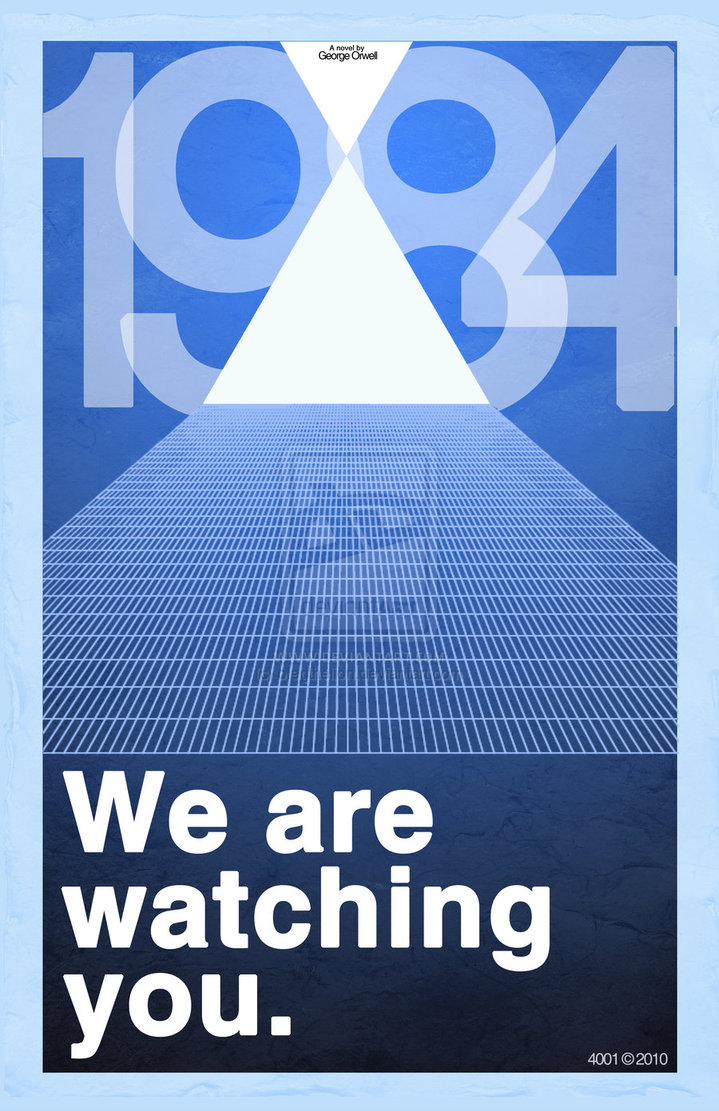
thought-policeIn 1949 George Orwell published 1984 where the fictional Oceania (formerly known as England) is a totalitarian state that has instituted a new society designed for the survival of the country.  Oceania had introduced methods and techniques designed to protect the government at all costs:  Big Brother is Watching You; Thought Police (don’t speak out or question, or else); Doublethink, creating the ability of the people to hold and accept two contradictory thoughts at the same time; Newspeak, the official language, replacing English, that redefines words and concepts; Ministry of Truth, the agency of propaganda and historic revisionism; and the Ministry of Love, the agency of regulations and enforcement.

Many can see the parallels and extensions of Orwell’s 1984 in the real 1984, and current world, of homeowner associations (HOAs) — authoritarian private governments.  Let’s take a look.

The principles of 1984 can be identified within the HOA regime: Ministries of Love, the boards and HOA managers, coerce compliance with outrageous fines and claims of violations.  The Thought Police, through1984_big brother the HOA vender organizations and lobbyists, use Doublethink and Newspeak to redefine everyday usage and meanings of words. Newspeak, or simply propaganda — lies and half-truths — to advance one’s interests, is extensively employed to defend the HOA regime. And, of course, there is the ever present all seeing eyes of the HOA — Big Brother is Watching You.

Of course, there are benefits to the state, the community and the residents, including the alleviation of irrational fears of the loss of property values.  But at what price?  At what cost?  At the cost of leaving the American Zone (as expressed by Shu Bartholomew in On the commons.com) and the loss of member rights, freedoms, privileges and immunities protected by the US Constitution and Bill of Rights.

The influence and acceptance of Doublethink has people believing that HOAs are democratic and not authoritarian regimes, because residents can vote – like in Cuba and China. That de facto HOA governments are businesses and not quasi-governments, because it is so declared.  That it’s the members’ fault for not making desired reforms to the HOA legal structure, which contains a very high bar to effective member participation in HOA governance. That the members’ are expressing their individual rights and freedoms by surrendering them and accepting that the authoritarian board speaks for them. However, the board is legally responsible to speak for the HOA corporation in accordance with the CC&Rs that do not recognize the rights of individuals as set forth in the Preamble to the US Constitution.

 Welcome to the New America of HOA-Land

I want you

I want YOU to

Join the HOA-Land Nation, today!

Read the complete paper at 1984

The unconstitutional delegation of implied rulemaking powers to HOAs

Here I present evidence of the explicit and implicit delegation of rulemaking powers to HOAs, which, if not unconstitutional, would alone establish HOAs as state actors.

In an earlier Commentary[1] I discussed the implied delegation of legislative functions to HOA private governments. Putting the issue in simple terms, I quoted Stephen Wermiel’s comments on a constitutional delegation case before the US Supreme Court,

The dispute before the [Supreme] Court . . . [involves] the even less well-known principle that Congress may not delegate legislative authority to private entities. . . . [T]he Justices must decide if the authority given to Amtrak by federal law is legislative in nature, and whether Amtrak is a private corporation or a public entity.[2]

“Rulemaking” is a term that deals with the grant of legislative powers to state agencies and, in a more restrictive mode, to private entities. It is the authority to adopt rules that have the effect of law, which can be found in the federal and state Administrative Procedures Acts (APA)[3]. The point is that the term “rulemaking” is a state agency process and is not found in the nonprofit corporation law even though these nonprofits have rules.

However, it has been applied to the supposedly nongovernmental, private nonprofit HOA corporation. In Tierra Rancho [4]  the court quoted The Restatement (3rd) Servitudes (the common law legal authority in the absence of statutory law) § 6.13(1)(b) and (c) in paragraph 25, “[the HOA has] the duty to ‘act reasonably in the exercise of its discretionary powers including rulemaking, enforcement, and design-control powers.’”  The HOA rulemaking powers are set forth in detail in § 6.7.

“§ 6.7 Power to Adopt Rules Governing Use of Property [my emphasis],

(1)        Except as limited by statute or the governing documents, a common-interest community has an implied power to adopt reasonable rules to

(b)        govern the use of individually owned property to protect the common property.”

Comment “b” to 6.7 (p. 141, second paragraph) goes even further,

Even in the absence of an express grant of authority, an association enjoys an implied power to make rules in furtherance of its power over the common property.  The association has no inherent power to regulate use of individually owned properties, however, except as implied by its responsibility for management of the common property.

And finally, examples of implied delegation of rulemaking powers can be found in state statutes.[5]

It is quite evident that the public policy of every state contains an implied delegation of legislative rulemaking powers to private HOA corporations.

Stephen Wermiel explained the non-delegation doctrine in Amtrak (my emphasis),

“[I]n theory delegation to the private sector can never be constitutional. . . . The Solicitor General argues that there is no unconstitutional delegation to a private entity because government officials retained control . . . . The Association of American Railroads (AAR) argues that the delegation to Amtrak is for actual rule-making authority and that Amtrak is . . . a private entity for purposes of the nondelegation doctrine.[6]

In regard to the Solicitor General’s argument, we know this is not true with HOA statutes.  As there is no oversight, no enforcement, and no effective penalties against HOAs that violate the law, there is no government control.[7]  Having the homeowner enforce the HOA laws does not constitute government control or oversight.  In regard to AAR’s argument, the above evidence supports an unconstitutional delegation of legislative rulemaking powers to private HOA entities.

No matter how you view the private entity non-delegation doctrine, HOA rulemaking is unconstitutional and the covenants are thereby invalid. (The Restatement, § 3.1, Validity of Servitudes, General Comments.)


References

[1] Unconstitutional delegation of power to HOAs.

[2] Stephen Wermiel, SCOTUS for Law Students: Non-delegation doctrine returns after long hiatus.  (SCOTUSblog Dec. 4, 2014)

[3]See federal Administrative Procedure Act (5 U.S.C. Subchapter II, § 551(4) and § 553).

[4] Tierra Ranchos HOA v. Kitchukov, 165 P.3d 173 (Ariz. App. Div. 1 2007).

[5] A sample of implied rulemaking statutes by state.  Arizona: ARS 33-1803(A) and (B) for HOAs; 33-1242(A)(1) for condos. California: Civil Code §§ 4340-4370 (Part 5, Chapter 3, Article 5, Operating Rules). Florida HOAs:  Title XL, § 720 et seq. do not explicitly address rules per se, but speak to enforceable “guidelines” and “standards”; Florida Condos:  Title XL, § 718 et seq. (in particular, § 718.1035, the general statement on “association rules”). Nevada: “NRS 116.31065  Rules.  The rules adopted by an association” (with 5 “musts” imposed on the HOA).

[6] Supra, note 2.

[7] In regard to the delegation of legislative powers to private entities, a review of the fuzzy case history of the Non-delegation doctrine indicates a constitutional requirement for governmental control or oversight of the private entity’s decisions and rules.  See “ A New Private Delegation Doctrine?”.

Unconstitutional delegation of power to HOAs

Article I. Section 1, of the US Constitution states that “All legislative powers herein granted shall be vested in a Congress of the United States” and nowhere in the Constitution is there any mention that Congress can delegate its exclusive law making powers to any other branch of the government or to any other organization.  State constitutions have similar wordings like that of Arizona, “The legislative authority of the state shall be vested in the legislature, consisting of a  . . . .” 

The legislative authority and powers of the state are past down to subdivisions of the state known as cities, towns, counties, taxing districts, etc.  These powers are said to be delegated from above to the subdivision, and it is common sense that if an entity does not have the power then it cannot delegate that power to anyone else.

This delegation of authority is carried out through a state’s municipal corporation and county laws (and to executive agencies by means of enabling acts of authority).  Reading the municipality laws reveals authority for a defined territory, large or small and often referred to as a community, to elect a governing body, establish courts, make laws and ordinances (rules and regulations), enforce laws, have courts, have a police department, establish fines for violations, have a jail, and to assess residents and collect taxes.  All under the approval and oversight of the state legislature.  These subdivisions are also known as state entities, public bodies or arms of the state.

We must first, once again, decide if HOAs are state actors and arms of the state like any other municipality, or are they just private nonprofit corporations. If found to be a state actor, the 14th Amendment applies and no further investigation into the constitutionality the delegation of legislative authority is necessary.

HOAs as state actors

Let’s start anew and compare state constitutions and city/town charters with the duties, powers and functions of the homeowners association governing body widely set forth in its declaration of conditions, covenants and restrictions (CC&Rs). The CC&Rs declares and defines the authority for the HOA to act in certain manners. We can easily see almost identical powers and duties with municipal corporations, far more so than can be found in a business charter, as CAI like to argue, or in a nonprofit charitable organization, or in a professional association, or in a trade association, or in a union charter, or in a for profit property management service business.

Seeking, attaching and using special meanings to common everyday words and concepts to fit a square peg in a round hole, as the pro-HOAs forces have made an art form, flies in the face of reality.  CAI likes to argue that assessments are not like taxes, that fines are not penalties for violations, rules and regs are not ordinances, etc. Dismissing these special definitions, HOA CC&Rs are almost identical to municipal charters of authority, which becomes quite apparent when we strip away these contrived definitions of words and look and the total picture that reveals the entire intent of the CC&Rs.  And that’s to govern the subdivision or community, to regulate and control the people within the subdivision.

In effect, HOAs are de facto political governments.  I choose the description of HOAs as a political entity and not a quasi or mini-government, because it more accurately describes the nature of the governing body – ruling over people in their homes. As I recently wrote,

The policy makers fail to understand that the terms and conditions of the HOA CC&Rs cross over the line between purely property restrictions to establishing unregulated and authoritarian private governments.[1]

The argument has been made that HOA governments are equivalent to municipalities with respect to powers, duties and authority and as such are indeed state actors subject to the 14th Amendment’s restrictions.


Unconstitutional delegation of legislative powers to HOAs

We must now address the argument that HOAs are not state actors, but private actors or entities not subject to the 14th Amendment.  We need to determine the legitimacy and constitutionality of these private actors, these private corporations formed under a private agreement. This takes us back to the question raised in the beginning of this paper of the constitutional delegation of legislative authority and powers not to agencies, but to private entities.

(The case where it is believed that there was no delegation to HOAs at all will be addressed below.)

This question of delegating legislative powers, or the non-delegation doctrine, has, like constitutional questions, undergone multiple court opinions resulting in a complex web of: what is the law?  To make things short, my layman’s summary comes down to deference to private entities, because they know better about their business or corporation than does the court.  And if the owners have elected a governing body, then that body speaks for the owners. A prime example of this judicial philosophy that should be familiar to most homeowners is the business judgment rule. The board knows best, unless it can be shown that it has acted unreasonably.

Sadly, the courts have shown less and less concern for constitutional intent and values or in protecting individual rights in favor of a money oriented practicality of efficiency of government — one that favors the privatization of legislative authority.  Yes, I know, confusing and unbelievable, but remember the quote from the Forward in The Restatement,Therefore this Restatement is enabling toward private government.”[2]  Private actors (unlike the executive branch) have virtually no public accountability, and legislatures may be too busy to address their misdeeds by repealing legislation. Checks and balances and government oversight are of little concern as we are quite familiar with their absence in HOA state laws.

I can hear CAI shouting, way over here, that there is no delegation of legislative powers to private HOAs!  Precisely! There are no enabling acts granting HOAs such legislative powers. That makes CC&Rs and HOAs an unconstitutional usurpation of legislative authority.  If municipal corporations, agencies and private entities must have delegated authority to act, no matter how broad or detrimental to individual rights, then how can HOAs not be outside our constitutional system of government?  Even a state’s most liberal adoption of the home rule doctrine requires allegiance to the state and US constitutions. (See HOAs violate local home rule doctrine and are outlaw governments).

Our government cannot look aside and ignore this assault on the foundations of our system of government!  We cannot tolerate everything goes, especially self-anointed political governments.

In defense of this unacceptable attitude by elected officials, it can be argued that even though there may not be explicit delegation there is an implied delegation of legislative powers, based on the nature and intent of the state’s HOA acts and statutes. These state laws permit those functions and powers of a municipal government, as stated in above, that regulate and control the peoples within a subdivision, large or small.

(Some states do have a statement of general government interest to overcome any judicial scrutiny as to constitutionality under the 14th Amendment, which can be challenged. The basis is that the statutes also contain serious harm to others.  In Shelly, “the States have denied petitioners the equal protection of the laws and that, therefore, the action of the state courts cannot stand”[3] and that constitutional rights were denied.)

US Supreme Court to address delegation to private entities

The question of the delegation of legislative powers to private entities is now before the US Supreme Court in DOT v. Association of American Railroads.[4]   Stephen Wermiel writes that “The Solicitor General argues that there is no unconstitutional delegation to a private entity because government officials retained control . . .[5]   We know this is not true with HOA statutes.

Wermiel continues,

The Supreme Court must decide if the delegation of authority to Amtrak is an unconstitutional grant of legislative powers to a private entity. To reach that decision, the Justices must decide if the authority given to Amtrak by federal law is legislative in nature, and whether Amtrak is a private corporation or a public entity.[6]

Either way, whether HOAs are de facto political governments and state entities, or are an unconstitutional delegation of legislative powers, they can only legally function as an arm of the state under the restrictions of the 14th Amendment.

References and authorities

[1] See CC&Rs are a devise for de facto HOA governments to escape constitutional government.

[2] Restatement Third, Property: Servitudes (American Law Institute 2000).  The full statement reads, from the Forward: “Professor Susan French [Reporter (chief editor/contributor) for this Restatement] begins with the assumption . . . that we are willing to pay for private government because we believe it is more efficient than [public] government  . . . . Therefore this Restatement is enabling toward private government, so long as there is full disclosure . . . .”

[3] Shelly v. Kraemer, 334 U.S. 1 (1948).

[4] DOT v. Association of American Railroads, No. 12-1080 (SCOTUS).

[5] Stephen Wermiel, SCOTUS for Law Students: Non-delegation doctrine returns after long hiatus.  (SCOTUSblog Dec. 4, 2014)

[6] Id.

model HOA regulatory agency bill

shockingThe attached was submitted to AZ legislators.  The model bill should be tailored to your state’s laws.  The sections under 41-2000 et seq. are the amendments that should be included as part of any similar effort to create a level playing field for homeowners.

 From: George

Sent: Monday, January 26, 2015 6:11 PM

Subject: department of HOA is desperately needed as DFBLS is doomed

Dear Arizona Legislators,

I quickly put together a solid bill (attached) based on a Florida bill and adapted to Arizona to help relieve continued legislative involvement in what should be handed by a bona fide regulatory agency.   I took pains to write a good bill in conformity with the drafting requirements and I hope it will ease your review.

I well understand the current atmosphere of no government interference, but the gross and shameful treatment of HOA members by the HOA stakeholders demands justice.  It is not a question of misplaced dogma, but of treating all the people equally under just and fair laws.

The proposed bill summary reads:

Summary.   This bill establishes a department of homeowners associations with full direct regulatory authority over Ch.9 and Ch. 16 associations under the direction of a commissioner. It provides for receiving complaints, investigations, filing legal actions, issuing civil penalties, rulemaking, and establishing an Advisory Board to provide recommendations to the commissioner.  Funding is provided by a $4 per unit fee per year.  The processing of HOA disputes by DFBLS is stricken.

My proposal brings a more level playing field in that the proposed Advisory Board will be balanced in favor of the members, and does not consist of any HOA stakeholder vendor lawyers or managers.  It’s the people’s vehicle for justice.

I urge you to stand behind the effort and sponsor the bill, and campaign for its passage.  I will be happy to meet with any legislator to explain the bill and answer any concerns.

Respectfully,

George K. Staropoli