
I think it’s well past due for someone of courage to remove the blindfold from the Lady so she can see the real HOA world as it is.
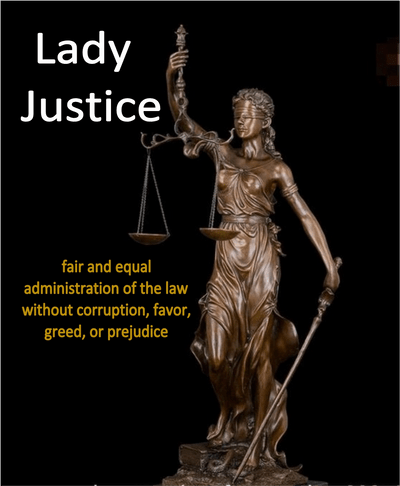
I think it’s well past due for someone of courage to remove the blindfold from the Lady so she can see the real HOA world as it is.
CONTINUING HOMEOWNER ENLIGHTENMENT, EDUCATION & REORIENTATION SERIES
CHEERS PODCASTS
Advocates and homeowners have failed to stand up to CAI because they, too, have been indoctrinated and have failed to acquire the knowledge and strategies to overcome their lack of credibility causing their lack of power.
“Blaming the wolf will not help the sheep much. The sheep must learn not to fall into the clutches of the wolf.” Gandhi.
Boards of directors need to be educated and reoriented on the principles of democracy, and on HOA constitutionality relating to violations of due process and the equal protection of the laws, because 1) the national lobbying entity, CAI, has indoctrinated boards of directors, the legislators, the courts, and the public with its CAI School of HOA Governance program that contains just lip service to constitutional questions, and 2) HOAs are a form of local government not subject to the Constitution.
This indoctrination, by teachings of The CAI School, of boards of directors and all HOA members prevents them from recognizing and accepting the true nature of HOA reality. Indoctrination “is the process of teaching a person or group to accept a set of beliefs uncritically.” Since the teachings are all that the indoctrinated ever see, they assume the School presents a true picture of HOA-Land. The actual reality! NOT SO!
The idea of the Continuing Homeowner Education & Reorientation Series is to find a way for the indoctrinated BODs and members to come into the “light” and attain enlightenment from the School’s conditioning practices. If they were to do this, they would be able to see HOA-Land for what it really is.
CHERS will provide this needed opposing voice. Listen to CHERS podcasts — 24 podcasts in 4 program levels of learning. See also CHERS series.
There is a mass psychology present in HOA-Land. Mass psychology is a study of how your behavior is influenced by large groups of people — “birds of the same feather flock together.” It is the result of the longtime conditioning and indoctrination into identifying with the principles and beliefs promoted by the CAI School of HOA Governance. Following the advice and guidelines of cult experts to focus on the need to reeducate cult followers, my Plan to restructure HOAs begins with the need to reorient the BOD and the members away from the CAI School doctrine. This is a critical first step toward substantive HOA reforms!
Everyone is vulnerable to cult recruitment. The followers cannot be held to blame because of their deceptive recruitment. There is a lack of awareness and information in regard to how the cult truly works and how it motives people.
Read the paper, Mass Psychology and Cult Behavior Within HOA-Land.

This commentary follows up on my plan to restructure HOA governance[1] that first requires addressing the attitudes and views of BODs, the members, and the public in general. The conditioning and indoctrination by the biased views of the national pro-HOA special interest entity must be de-conditioned by a program of reorientation.
Once again I provide valuable information on the proper functioning of HOA boards in serving their “constituents,” their members.

The management[2] of a country, a state, or a local government, including the private HOA association, is commonly known as politics. Politics is:[3]
“the practice and theory of influencing other people on a civic or individual level. More narrowly, it refers to achieving and exercising positions of governance — organized control over a human community, particularly a state.
“exercised on a wide range of social levels, from clans and tribes of traditional societies, through modern local governments, companies and institutions up to sovereign states.
“A political system is a framework which defines acceptable political methods within a given society.”
Managing a government disguised as a nonprofit association has its unique requirements and demands that, for the most part, have been ignored. The commonly found guidelines from the national pro-HOA lobbying entity speak to an authoritarian government with member interests and concerns being secondary to the survival of the association. It’s an unacceptable deviation from the intents and purposes of our constitutional government.[4]
First, let me address the requirements for the sound management of a nonprofit association. Drucker[5] focuses on the overall, broad purposes and responsibilities of the board of directors (BOD) or board of trustees.
The general term “nonprofit” does not apply to HOAs because it is not a business nor a public government, but “government controls.” The reality of the HOA association is that it controls as does a public government.
Drucker asks, what is the mission of the nonprofit? A mission statement has to focus on “what the nonprofit really tries to do.” It cannot be “a kind of hero sandwich of good intentions.” Strategies “convert intentions into action.”
Most HOAs, especially the smaller HOAs, do not have a sound strategy that addresses their mission, goals, and values. But the HOA has an explicit mission and purpose as set forth in the CC&Rs[6] and need to be revisited and made consisted with Drucker and Batts (see below).
Second, in an excellent book on the need for director orientation,[7] the author feels board orientation is lacking and instituting a guideline will improve the nonprofit’s mission and goals. In his succinct book, as applied to HOAs, Batt’s makes the following important points:
Key areas of board action are “strategy, oversight, and policy.” In keeping with Drucker, “boards and board members should not micromanage the affairs” of the HOA.
The BOD has “full and final authority” over the HOA association; they are “not merely advisors” to the manager, other wisely known as the CAM. It’s regrettable that all too often the BOD abdicates to the manager and/or attorney who often are members of the same business trade group advancing their own self-agendas.
There is “no individual authority” of a board member to act and the president can only act based upon the authority set forth in the governing documents. Most presidents act, especially in the small HOAs, without board approval.
There is a “duty of obedience” to the laws and governing documents that all too often is ignored by not only rogue BODs, but by BODs who falsely believe to do so is in the best interests of the HOA.
Notes
[1] George K. Staropoli, A Plan Toward Restructuring the HOA Model of Governance, StarMan Press, 2020.
[2] Peter F. Drucker, “Management is the application of a set of principles relating to the functions of planning, organizing, directing and controlling an organization to effectively achieve organizational goals,” The Practice of Management, Harper Row, 1954.
[4] See Roger L. Kemp, “Forms of Governance,” Managing America’s Cities: A Handbook for Local Government Productivity, McFarland & Co., (2007).
[5] Supra, n. 1.
[6] See “Restructuring HOAs – intents and purposes,” supra n.1.
[7] Michael E. Batts, Board Member Orientation, Accountability Press, 2011. It’s a short, to the point, and easy to read paperback. Batts has over 25 years on nonprofit boards and has served on several Washington panels.
The use of the words “shall” and “may” have generally accepted meanings in state laws and statutes.[1] Their use in bills and laws relating to HOA-Land raises the highly controversial question of: Are HOAs state actors? Wayne Hyatt — former CAI president – wrote in 1976 that HOAs were mini-governments.[2] In general, a state actor is an entity that is functioning as “an arm of the state” or “in place of the state.”[3] Does the use of “shall” that is defined as “mandatory” make the HOA an arm of the state?
In sum, the US Supreme Court criteria for classification of a state actor can be found in Brentwood:[4]
In regard to the institutionalization of HOAs, or as I refer to it, HOA-Land, the above tests 1 – 3, and 5 -6 would provide clear and convincing evidence that the policies of state legislatures, as demonstrated by the enacted pro-HOA laws, have created HOAs as state actors who willingly undertake state actions. Review your state laws for the use of “shall” and the consequences of that mandate on your individual property rights.
***
The pro-HOA laws enacted by state legislators, aside from other constitutional concerns with respect to the 14th Amendment protections of the equal protection of the law and valid due process, use “may” and “shall” that are permissive and mandatory obligations upon HOAs (and condos). “May” is commonly found as “the board may set the time of the annual meeting,” or “may charge . . .” The overlooked impact and consequence of this word is to legalize activities and actions that were all-to-fore not legal rights granted to the HOA.
They are now made a legal activity, if your BOD so chooses. Prior to a statute using “may” the action or activity had to be granted by the governing documents. If so, by including it in a statute lends “officialness” to the action, and a very difficult process to declare the statute invalid. It protects the governing documents if so permitted.
The right granted by the use of “may” to HOA boards (BOD) to fine or monetarily penalize members and filing a lien with the right to foreclose, for example, makes it a legal action not granted to other nonprofit organizations. Can you imagine PBS or United Fund placing a lien on your failure to not pay your pledge to support their existence? No way! Why allow HOAs this legal right? Which of the above criteria does it violate?
***
Now the heart of the matter focuses on the use of “shall” that is a mandatory order to the HOA to act on behalf of the state — fine those members and collect costs including attorney fees, etc. Not only is it a legal requirement for the HOA to act as ordered, the BOD has no choice, no discretion to do otherwise, nor can the members reject a potential amendment or rule change. So much for democracy at work in HOA-Land! Which of the above SC criteria does it violate?
It is well beyond the time for those public interest nonprofits touting their support for the Constitution and democratic values to get involved and stop this disgraceful and unconscionable legislation. Stop the legislation that coerces, encourages, and supports private government, authoritarian HOAs. Legislation that advances the view that the HOA “constitution” is a better deal than the 232-year-old US Constitution. Shameful!
***
The American experiment in democracy, as the youthful America was described by Alexis de Tocqueville[5], is being subverted by the HOA legal scheme supported by elected officials and academics parading as the nouveau Philosopher-Kings preaching to the elected government leadership. In 2009 I commented:
“I explore this failure of the American Experiment and the rise of independent HOA principalities in Establishing the New America of independent HOA principalities (see New America).”
Notes
[1] See “Legislative shall,” paper with quotes from Yale Law Journal and the Arizona bill drafting manual as a specific example.
[2] Read his 1976 statement in To be or not to be a mini or quasi government? Hyatt said ‘yes’.” (2015). Wayne Hyatt was a prominent figure in the promotion of HOA-Land as well as an important person in creating CAI in 1973, serving as its second president. I believe he had strong influence in drafting the Del Webb Declarations still in use today.
[3] In general. see arguments for state actors: HOA Case History: state actors or mini/quasi government (2011); Do state HOA Statutes Establish HOAs as State Actors? (2012); Judicial error regarding HOAs as mini-governments and state actors (2015), “This commentary, somewhat technical at times, demonstrates the failure of the courts to address the fundamental issues that HOAs are mini-governments, and that by the collective functions and actions of HOAs there is clear and convincing evidence to make the case that they are indeed state actors. The whole is greater than the sum of its parts.”
[4] Brentwood Academy v. Tennessee Secondary School Athletic Ass’n, 531 U.S. 288 (2001).
[5] Democracy in America, Alexis de Tocqueville (Vol. 1, 1832; Vol. 2 1840). Printed by Alfred A. Knopf (1972).
 HOA Constitutional Government