Combatting the CAI happiness in HOAs surveys

It is the CAI sponsored/conducted surveys of overall “happiness in HOAs” (my words) that advocates must come to deal with.  The surveys must be challenged and confronted, because the HOA lobbyists will show them, with a smile, to your state legislators. And then they will point out several other similar surveys. The legislators will simply glance at the data, smile, and say, “How can I help you?”

It is accepted doctrine, especially in the courts, that if a statement is not refuted it is taken as true. Same applies here when arguing for HOA reform legislation.  The surveys can be challenged on several points, such as, biased surveys even though the reputable Zogby conducts the actual survey under the sponsorship of CAI;  the questions asked and not asked; and the conclusions drawn from the data presented if you obtain access to the actual survey questionnaire and unedited responses. (Any reputable organization will provide this information as verification of its conclusions, as is standard operating procedure with any validly conducted research).

Take the latest CAI 2012 survey under “Association Rules”  that contained an assertion that 25% — note not 5% — had a  “significant” personal issue or disagreement” with their HOA. It also stated that just 42% were satisfied with the outcome. Yet, the survey concluded with the finding that just 8% dissatisfied with their board: “This strongly suggests that the vast majority of residents recognize and appreciate the net benefit of living in their communities—even when there are differences of opinion.”  The survey did not go into the nature of the disputes.  Were they trivial, or did they involve homeowner rights and the fair and just treatment of homeowners?

The following question was asked under “Pre-purchase Awareness:”  Did the fact that your current home is in a community association make you more likely to purchase or rent your home, make you hesitant about purchasing or renting your home or have no impact? An interesting question that indicates an awareness of advocate arguments that if they knew the whole truth about HOAs they wouldn’t buy into an HOA.  Of course the survey revealed that 64% indicated “no impact” and 29% indicated “more likely,” for a 93% positive view of HOAs.

However, no one was asked to read my Truth in HOAs Disclosure Agreement and its comments from readers, for example, that provided a lot of material information about HOA life.  What do you think the response would have been?  But, if nobody tells the legislators about the Truth in HOAs disclosure, or can get the local media to run a survey, then the legislators can pretend ignorance, or at least ignore the babblings of a few malcontents. 

It seems that the predominate attitude of the vast majority of state legislators is that the overall benefits of HOA legal scheme far outweigh any concerns for homeowner constitutional protections  – due process and the equal protection of the laws.

CAI’s Research Foundation makes the following broad claims in its Statistical Review (my emphasis),

Because of the fiscal challenges faced by many local municipalities, communities are often created with the stipulation that the developer will create an association that will assume many responsibilities that traditionally belonged to local and state government.  This privatization allows local jurisdictions to permit the continued development of needed housing without having to pay directly for that infrastructure through property taxes. . . . Community associations not only maintain home values, but also reduce the need for government oversight and expenditures by providing services, assigning payment responsibility to homeowners and being responsive to local concerns.

Read the above carefully!  Where are the protections for homeowner rights under the contractual, not public domain, nature of HOA governments?  There are no protections as one would expect under our system of democratic government.  That is inexcusable! And state legislators do not see any problems with private governments operating outside their state and US Constitutions.


If the above surveys and conclusions by CAI are not challenged, life will remain difficult for meaningful HOA reforms.
Arizona bill tells HOAs that they do not control public streets

[Please note that a previous post on this bill, SB 1278, was posted in error, referring to restrictions on mandating HOAs in new subdivisions.  An Arizona bill, SB 2292, that would have made this a law has been stalled in the Legislature and will die there.]

Arizona Session Law Ch. 103 (2013), SB 1278,  reaffirms local municipality control of public streets within an HOA.  It is a groundbreaking bill because it relegates HOA private governments to a rightful secondary status and subject to public government laws.  In a disgraceful rejection of the Constitution, courts see no problem with upholding the common law Restatement of Property (Servitudes) as controlling over Constitutional and contract law.

It’s a simply worded bill:

Be it enacted by the Legislature of the State of Arizona:

Section 1. Title 33, chapter 16, article 1, Arizona Revised Statutes, is amended by adding section 33-1818, to read:

33-1818. Community authority over public roadways: Applicability

A. NOTWITHSTANDING ANY PROVISION IN THE COMMUNITY DOCUMENTS, AFTER THE PERIOD OF DECLARANT CONTROL, AN ASSOCIATION HAS NO AUTHORITY OVER AND SHALL NOT REGULATE ANY ROADWAY FOR WHICH THE OWNERSHIP HAS BEEN DEDICATED TO OR IS OTHERWISE HELD BY A GOVERNMENTAL ENTITY.

B. THIS SECTION APPLIES ONLY TO THOSE PLANNED COMMUNITIES FOR WHICH  THE DECLARATION IS RECORDED AFTER DECEMBER 31, 2014.

While homeowners must wait until 2015, this bill is a giant step forward to curtail the unconsitutional reach of private regimes where homeowners are outside the protections of the US and Arizona Constitutions.  It speaks to putting a clamp on The New America of HOA-Land. The bill took 5 years of dedicated effort by HOA champion and State Senator Nancy Barto before it became law.

HOAs had raised feeble arguments that could and still can  be easily addressed by seeking ordinance variances.  The HOAs and their hired-hand venders have refused to avail themselves of this avenue of redress, which is available to all citizens.  No, this 4 year long battle was a battle for power and control.  Which form of government controls your public streets,  the municipality of the HOA regime?


Is Florida’s SB 596 a good bill? YES! Part 2

This post takes a closer look at some of the provisions of SB 596 with its intent “that the powers and authority granted to homeowners’ associations . . .  conform to a system of checks and balances in order to prevent abuses by these governing authorities.”  At the request of then Rep. Julio Robaina I testified at the Feb. 23, 2008 all-day legislative HOA hearing in Tampa, FL.  Public domain clips from this hearing, several of which can be found at the HOAGOV YouTube website, clearly show why checks and balances are sorely needed.

Aside from the introduction of effective enforcement provisions, the other changes of substance deal with regulating the conduct of what the HOA “can and can’t do.”  They are the payment of assessments, elections and proxies voting, and transfer of declarant control.

These substantive changes take the first 17 pages of the bill and is followed by non-substantive changes to 720.3024 creating the Ombudsman office and election monitoring, and HOA Study Council (720.3025). The other substantial changes include:  Section 720.3085, the “pay or die” section (my words), Section 720.306 dealing with meetings and substantial revisions to the elections and proxy voting processes, and changes to 720.307 relating to the transfer of power from the declarant that takes us to page 40 and the subsequent technical changes.

First, I will look at what I call the “pay or die” statutes regarding the continued payment of assessments even when payments are being disputed (720.3085(9)).  “Pay or die” meaning that if any homeowner doesn’t pay his assessments in a timely manner the HOA will die mentality.  I find this reprehensible, approaching an indentured servitude condition, and demonstrating a “close nexus” and a “symbiotic relationship” between the HOA and state, a “You do for me and I will do for you” relationship.  This statutory requirement to pay or else is sufficient alone to have the HOA declared a state actor!  Especially when the statutes also permit the HOA to deprive is member-residents of their rights, freedoms, privileges and immunities as citizens under the 14th Amendment.

However, the bill at least moves forward with checks on the unilateral foreclosure powers of the HOA.  It forces the HOA to prove the correctness of its claim, allowing the court to issue equity judgments that the HOA can’t add right, had sent the notices to the wrong address, refused to cash checks and/or held them past the deadline before cashing in order to demand late fees, just to name a few of the abusive practices.

Read the new subsection 720.3085(9) carefully.  A dispute of the amount would only require deposits of assessments during the legal action, and not the disputed amounts. The term “disputed” needs to be clarified to include abuse by the HOA as mentioned above and not limited to just amounts.  Of course, the justification for clauses (d) and (e), the HOA will die clauses, can be debated.

There are some issues with proxy voting (720.306), but the changes in the bill will serve the homeowners well. Subsection (9) deals with board elections and restricts members who are in arrears to the HOA cannot run for office.  That’s fair.  If a member cannot vote if he is in arrears, a member in arrears should not be allowed to hold office. Co-owners cannot both serve on the board, which give that unit excessive power.  I find the requirement to certify knowledge of the governing documents 90 after an election as preposterous and pro-HOA.  Want to be on the board?  Get educated first!

In regard to the transfer of power changes added in the bill serve to benefit the homeowner.  While not completely airtight, the term “in the ordinary course of business” would restrict the declarant from sitting on lots in order to retain control.  What is missing, as just occurred in Arizona, is the declarant’s modification of the governing documents before turning over its power to lock him in place for all practical purposes.  The usual introductory phrase, “notwithstanding anything in the governing documents to the contrary” should be added to the bill.

As for my views, the inclusion of effective enforcement authority overwhelming outweighs any concerns that I have mentioned above.

State legislatures and HOAs: When will they ever learn?

It should not come as a surprise to anyone that state legislators have allowed the HOA legal scheme, which they have played a strong hand in supporting, to deny the equal application of the laws for all, and the loss of constitutional protections. 

Free speech, flying the flag, due process, clean elections, etc. have been denied by HOA regimes.  Even noted CAI member attorney, Adrian Adams, speaking about HOAs in the Davis-Stirling online Newsletter article, Animal Sacrifice: Just as private organizations can restrict free speech, they could conceivably restrict religious practices that negatively impact other members.

The denial is basis on the specious and false argument of a “consent to agree.”  A consent that falls dismally short of meeting Supreme Court judicial scrutiny for constitutionality. All the HOA has to show is an HOA interest for the benefit of the entire community and the courts will find no problem, just as if the HOA were a government entity that has some legitimate interest in the issue.

Furthermore, legislators accept the argument that any validly passed CC&Rs amendment binds everyone including any dissenters, regardless of its relevance, bearing, or reasonable expectancy of the restrictions being imposed on owners.  It’s the “general government interest” approach. It appears that public government attributes are ascribed to the contractual HOA, with the contractual terms are being ignored.  All reform legislation is an attempt to restore those rights wrongfully denied the homeowners, on a case by case, HOA by HOA, state by state basis. 

HOAs are not de jure governments — not state entities.   But, they are de facto governments operating under state legislature protections, but in contrast to all other government entities, without constitutional protections.  HOAs are unrecognized governments as is Cuba, but functioning nevertheless every day.

When will legislatures learn?  When will they undertake an independent study of HOAs with a truly independent “think tank”?  Like the Arizona State’s Morrison Institute for Public Policy.[i]  When?  Perhaps never, since they don’t seem to really want to know, and perhaps because they know what the findings will show.


[i] “Morrison Institute provides public policy research for government agencies, private associations, nonprofit organizations, and communities. In conducting research, analysts draw upon a variety of disciplines and methods: collecting original data through public opinion surveys, interviews, and consultation with experts; and analyzing existing information through review of published research reports, current legislation, and statistical data.”  (See http://morrisoninstitute.asu.edu/about/about-the-morrison-institute).

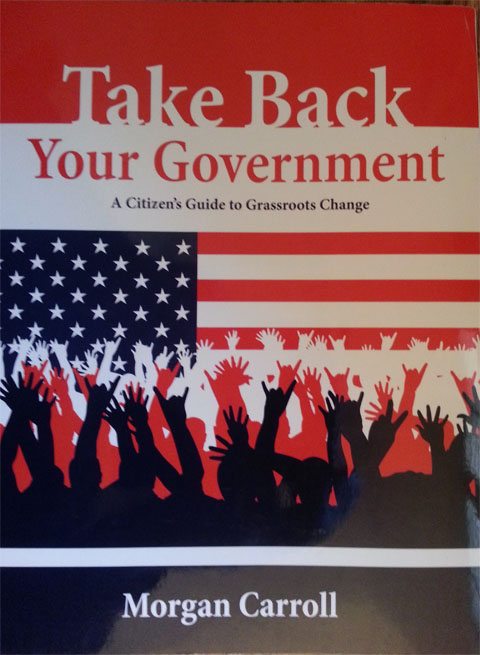
Colorado senator’s guide to effective HOA legislation

An excellent guide for citizens seeking to effectively lobby their legislature to bring about desired change. 

 Take-backThe author, Morgan Carroll, is an eight year Colorado legislator and is currently the Colorado Senate Majority Leader.  Take Back Your Government sends a strong message to citizens to get involved in the legislative process if they sincerely seek change, otherwise the paid, special interest hired-hand lobbyists will strongly influence the legislators. And set the tone for new laws and changes to existing laws.

Carroll’s opening chapter contains advice, such as, “We elect people to represent our interests, but our elected representatives cannot adequately represent you unless they hear from you. . . . If you don’t participate in your government, then the only remaining participants in the system are legislators and lobbyists.  And she reminds her readers that, “Democracy only works when citizens participate, engage and become informed voters.”  And that is why democracy is a farce in the authoritarian HOA private governments where apathy abounds for numerous reasons.

Part II, Advocacy for Beginners, is chock full of “dos and don’ts”  in contacting and dealing with bill sponsors, and how to draft and understand the wording and format of bills. The author provides advice for citizens such as, to “suggest a solution,” make your request “shorter and simpler,” and “summarize prior attempts to fix the problem.”   Her concern for the people include warnings that, “every right [permitted by law] should come with a remedy or an enforcement mechanism, or it’s an empty law.”  And there’s the commonly found use of “shall” and “may,” clarifying that “may” means “is permitted to” or “is authorized to,” both of which mean making the act legal.

And there is much, much more on how to get heard, how to contact legislators, how to testify, creating fact sheets to support your position, etc.  Definitely applicable, but not tailored just for HOA reforms. This book is must reading for advocates, especially HOA reform advocates who have faced a solid wall of indifference when seeking legislative change and who have been unsuccessful in the past. 

Thank you Senator Carroll.


Take Back Your Government; A Citizen’s Guide to Grassroots Change, Morgan Carroll (Fulcrum Publishing 2011).

Review by George K. Staropoli, a nationally recognized advocate for HOA reform legislation.