Unconstitutional laws and sanctions of invalid HOA powers


There are two Arizona bills dealing with substantive, constitutional HOA reforms:  SB 1170, the issue of who controls public streets, and SB 1148, the restoration of due process protections for homeowners by means of an independent tribunal adjudication of HOA disputes. Legislators need to understand the constitutional aspects of these bills and, by the failure of the Legislature to act, the sanctioning of HOA actions that are invalid, unconstitutional, or against public policy. “Sanctioning,” as used in the courts, is the statutory permission to act in a manner that the legislature does not deem illegal. The chief example of this sanctioning is the use of the word “may” in the statutes. While not a compulsory order by the Legislature, it is nevertheless a statement that any such acts are not illegal. A second common example of sanctioning, the error of omission, is the refusal to enact statutes to declare certain acts as illegal.


The crux of the opposition to these bills, with their “equal application of the laws” issue, has been the popular cry of protecting individual rights, specifically in regard to “freedom of contract” and “no government interference.”  The more elegant opposition can be stated by a quote from the Dec. of  Indep.:  governments are instituted among men, deriving their just powers from the consent of the governed.  The opposition would have legislators believe that this is the end all of the Constitution.  They believe that the HOA constructive notice “contract” is sacrosanct, inviolate, and there is no need for a “Truth in HOAs” law similar to other consumer protection laws, like truth in lending and truth in advertising.  However, the special consideration given to the HOA industry by pro-HOA,  no homeowner protections legislation, and the unconscionable adhesion contract nature of the CC&Rs — with its implicit and non-existent surrender of the homeowner’s rights, freedoms, privileges and immunities — can easily be seen as a violation of The Arizona Constitution :


Read the complete commentary at constitutional.
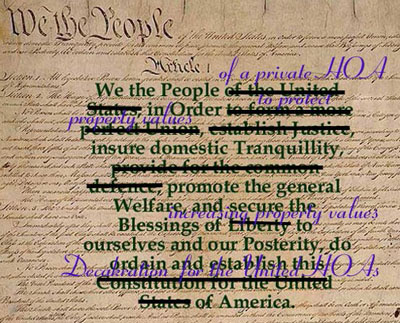
 

Analysis of AZ HB 2441, the HOA minority control bill


Opinion

This bill should not be heard in any committee!  

It is contradictory and confusing, and ideal for attorney involvement in the expected challenges to the interpretations of the statutes. Also, it is definitely aimed at destroying any vestige of democratic governance in homeowner and condo associations. This bill denies access to the courts.

Introduction

The Carpenter Hazlewood Delgado & Wood blog of Jan. 18, 2011, written by Scott Carpenter, “HB2441 – CC&R Amendments,” argues: This change would enable community association to change their documents without onerous approval requirements that count a failure to participate as a ‘no’ vote.” (Emphasis added).  The exercise of the democratic right to vote and to protect one’s private property is considered “onerous” by the CAI Legislative Action Committee co-chair, Scott Carpenter.

Carpenter’s Dec. 17, 2010 letter, titled  “Bad Documents,”  to CAI lobbyist DeMenna proposed a change in the laws.  The letter includes HB 2441, verbatim, under the title “Easier to Amend Bad Documents.”  This bill did not originate with the bill’s sponsors, but from the CAI lobbying organization that supports not you, the homeowner, but that legal corporate person known as the HOA.   The Sponsors are just the vehicle doing CAI’s bidding.

The title of the bill itself simply  reads:  “homeowners’ associations; declaration amendments,”  and the bill extends well beyond just changing the voting requirements to amend the CC&Rs.  Some of these changes are good for homeowner protection, but are offset by the draconian attack on homeowner property rights. CAI argues, in Carpenter’s letter to DeMenna, that the proposed voting procedure is just like public voting laws, but fails to provide the necessary public government protections, and ignores the legal fact of the private contract in operation here, the CC&Rs agreement. HB2441 is another top-down imposition of government interference, which otherwise in instances involving the protection of homeowner rights, is vehemently opposed by CAI.

As you read this bill, remember that the courts take the everyday meaning of the words used, and if not clear, or seemingly contradictory, the court will look to intent.  Courts have held that if word “x” was  not actually stated, then the drafters should have included word “x” if that was their meaning or intent.  Read the bill carefully as written, and think how your opponent could challenge the wording in the courts.


Analysis

The full document with its  detailed, 10-point analysis can be found at HB 2441.

AZ CAI attorney maintains that “the law cannot fix” abusive board problems

CAI lobbyist and LAC co-chair in Arizona, Scott Carpenter, made it quite clear in his 2011 Legislative Preview blog post, Jan. 11, 2011, that:  Community associations function worst when the elected directors act out of self-interest, play favorites, and work for their own political purposes” (see, there are indeed serious  problems in HOA-Lands).  And then declares, “The law cannot fix this problem directly any better than the law is capable of fixing conflict in families or marriages.”  Let me repeat that:  “The law cannot fix this problem directly any better than the law is capable of fixing conflict in families or marriages.”  Has he ever read the Constitution, the Bill of Rights or the Declaration of Independence?
 
Sarah Palin, in her video on the Arizona shooting this past Saturday, made reference to the Founding Fathers understanding of man’s  imperfect nature.  She quoted James Madison (Federalist Papers #10), “If men were angels there would be no need for government.”  (See Constitutional Local Government website, http://pvtgov.org).  It was that awareness by the Founding Fathers that led to the adoption of checks and balances and of a separation of powers.  But when there is no accountability, no check on private HOA governments by state government, one can only assume that those who become directors are blessed with perfection in all that they do.  And that the wise and learned legislators have the exceptional ability to see these angelic persons, and find it only fair and just to leave HOA matters to the HOA board.  Perhaps this is the real reason for the hands-off policy of the legislature.
 
It should be noted, however,  that Carpenter, in an about face,  fails to mention his Dec. 17, 2010 letter to the CAI lobbyist, DeMenna, that it’s a good idea for  a law that gives a minority of members the power to alter your CC&R contract at the time of purchase – 2/3 of 50% quorum =  33.5% of all the members. HOAs are contractual and are not public governments.  If Carpenter wants the HOA to function like a public government with its election laws, his justification for this proposed change in law, then he should argue for the modification the CC&Rs contract by member vote and not by legislative fiat.  Apparently legislative interference is a swinging door, depending on which side of the fence Carpenter is on.  He now seeks legislative interference that he otherwise rejects.  (While Carpenter takes pains to inform the reader that he speaks for himself, not CAI and not for the firm, the letter is signed by Carpenter “for Carpenter, Hazlewood, Delgado & Wood, PLC.”  Nor does he mention the fact that he remains co-chair for Arizona Central CAI chapter as he writes.) 
 
Carpenter closes with a strong statement that control of the HOA belongs with the members and directors, in contradiction of his above proposed changes by legislative fiat.  What is quite clear is:  Carpenter is opposed to the democratic functioning by the people, the members alone, within the HOA subdivision, with no recourse to state oversight of its operations to protect you, the homeowner. He  is strongly opposed to accountability to the civil government by private governments functioning under  an authoritarian form of government.  In fact, his law firm, Jason E. Smith the attorney of record,  has trice opposed the delegation of  authority by the legislature to a state agency (DFBLS/HOA) to hear HOA disputes. (See, in general,  https://pvtgov.wordpress.com).  He appears to want HOAs to be treated as independent principalities.
 
Carpenter has made his position quite clear. He is opposed, like CAI Central, to constitutional protections for homeowners.  He seems to be arguing that HOAs are a special class of utopian government that require no oversight by the state.  And sadly, like many other political statements on the national level, there are those true believers who see no wrong because it would not sit well with their own personal agendas. Or, they are declaring their preference for dogmatic principles, like a misguided support for “individual rights,” which they interpret to mean, “we can do anything the majority wants with no constitutional constraints.”
 
This secession from constitutional government must stop!

HOA Case History: state actors or mini/quasi government

  1. Cohen v. Kite Hill,142 Cal App 3d 642 (1983) (A homeowners association board is in effect “a quasi-government entity paralleling in almost every case the powers, duties, and responsibilities of a municipal government.”)
  2. Gerber v. Long Boat Harbour, 757 F Supp. 1339 (M.D. Fla. 1991) (court enforcement of private agreements in condo declarations is a state action; flag; free speech).
  3. Hudgens v. NLRB 424 US 507 (1976) (functions of a municipality, citing Marsh; shopping center)
  4. Marsh V. Alabama, 326 US 501 (1946) (company town and public functions)
  5. Shelly v. Kraemer 334 US 1 (prohibitive state actions by use of judicial enforcement as state was fully aware of the illegal use of the courts; judicial enforcement harms constitutional rights)
  6. Williamson v. Lee Optical, 348 US 483, (1954) (rational basis for scrutiny)
  7. Damon v. Ocean Hills Journalism Club,  85 Cal. App. 4th 468; (2000) (quasi-government; board meetings public forums similar to government body;defamation)
  8. Laguna Publishing Co. v. Golden Rain Found. of Laguna Hills, 131 Cal. App. 3d 182 (1982) (HOA has attributes that “in many ways approximate a municipality . . . close to a characterization as a company town.”)
  9. Surfside 84 v. Mullen Ct. of Special Appeals of Maryland, No. 495 (September 1984) (state action; procedural due process; lack of notice; CAI Reporter).
  10. Brock v. Watergate 502 So. 2d 1380 (Fla. 4 Dist. App. (1987)( public functiuons test; close nexus criteria; HOA lacks character of a company town)
  11. Committee for a Better Twin Rivers v. Twin Rivers, 929 A.2d 1060 (NJ 2007) (HOA not state actor per NJ Scmidt version of Marsh; Not US but NJ Const. case).
  12. Indian Lake v. Director of Revenue, 813 SW 2d 305 (not civic organization)
  13. Midlake v. Cappuccio, 673 A 2d 340, Pa. Super. (1996) (condo is a pvt organization, not muni govt; not a company town)
  14. Riley v. Stoves, 526 P.2d 747, Ariz. App. Div. 2 (1974) (state action; classification; enforce age restrictions;”court to enforce constitutional commands”; restriction was a permissible government interest).
  15.  S.O.C. v. Mirage Casino-Hotel, 43 P 3rd 243 (Nev. 2001) (state action; public functions; delegating functions to private persons; commericial advertising on private property).
  16. Terre Du Lac Ass'n, Inc. v. Terre Du Lac, Inc., 737 S.W.2d 206 (Mo. App. 1987). (quasi govt) (how a homeowner's association operates as a "quasi-governmental entity," not authority for the concept that an association's "quasi-governmental" actions are state actions;).
  17. Westphal v. Lake Lotawana, 95 SW 3d 144 (Mo. App. 2003) (no support for “close nexus” state action).

Note:

  1. The above cases in bold are color coded. Red is adverse to constitutional protections; Blue is favorable; black in neutral.
  2. There are 3 case against and 4 cases in favor. Two were not dispositive. The “against” cases were all based on a “public functions” test.
  3. The non-bold cases concern related issues not involving an HOA/condo, such as state action, public functions, or mini/quasi governments.
  4. The above findings are not exhaustive and reflect the analysis of some 153 HOA/condo , state action cases on a federal and state level.

States Rights: the transfer of power from Washington to private government HOAs

I am pleased to hear the whispers of substantive issues regarding the institution of HOAs that undermine our democratic principles of government as found in this Washington Post article. Among the Christmas cards to one homeowner, a warning, Several state courts have ruled that by agreeing to abide by homeowners association rules, home buyers relinquish some constitutional rights,and who points out there are some limits on HOAs. But, I would like to clarify that these few rights had to be fought for in each state legislature on a piecemeal basis – restoring those rights taken away by the HOA declaration “agreement.”


The media must follow in this reporter’s footsteps and stop being an active participant in the Unspoken Alliance of “No Negatives About HOAs!” The media must understand that “States Rights” is nothing more than the transfer of political power from Washington to the state legislatures. State legislatures who, in turn, openly and eagerly support the transfer of political power to local private governments — homeowners associations — unanswerable to the US Constitution as required of all public forms of civil government.


These unrecognized, de facto governments hold power by the mere filing of a subdivision declaration of covenants, conditions and restrictions (CC&Rs), which is necessary and sufficient to bind unsuspecting home buyers. Declarations that bind without the need for the buyer to have read or to have explicitly signed-off on these relinquishments of constitutional rights, privileges and immunities, absent of any equal protection of the laws, and absent of any due process protections loss of life, liberty and property.


Perhaps we shall see a second effort by a number of states to amend and rewrite the Fourteenth Amendment to the Constitution, one that attempts to justify and defend this disgraceful state of affairs by a country once held in high esteem as the ideal democracy. This second amendment would sanction “chartered” private governments with their imposed, unconscionable adhesion agreements that provide for the carte blanche surrender of constitutional rights, and with their powers that include the loss of private property rights by the votes of others without the need for the consent of the affected homeowners. This amendment would legitimize these declarations of CC&Rs that do not recognize any “inalienable rights” at the time of purchase, and that permit ex post facto amendments to render the so-called sacrosanct declaration a meaningless pieces of paper. A travesty of our American democracy.


Who will stand up and fight for Lady Justice? Qui Pro Domina Justitia Sequitur (“who prosecutes on behalf of Lady Justice?“, DOJ seal). Who will defend and preserve our principles of democratic government?