AZ tenants have more AG protection than property owners in HOAs

The current AZ Attorney General, Tom  Horne, proudly displays and offers a 48 page handbook for tenants, basically covering the Landlord and Tenant Act, ARS 33-1301 et seq. It contains 2 full pages of where to get help, and sample forms. It can be found under Publications/Handbooks. What about a handbook for homeowners living in HOAs covering Condo and planned communities acts?

Both the L & T and HOA acts deal with private contracts, so that can’t be the distinguishing excuse not to provide a warning guide or advisory, which I’ve repeatedly urged be developed and quickly offered to homebuyers and those already under HOA regimes. It’s not like there are no issues of material fact, like misrepresentation, consent to be governed, loss of individual property rights, freedoms, privileges and immunities; and private governments not subject to the Constitution. Or that problems do not continually appear in the media. Homeowners who have written the AG’s office, and the Real Estate Commissioner receive a standard, No my job. Get the Legislature to write new laws.

Unfortunately, the problem you complained about is not within our jurisdiction. Our office enforces the Consumer Fraud Act, however, the Act does not allow our office to pursue private disputes. Our office represents the state of Arizona and cannot act as a private attorney for individual citizens.

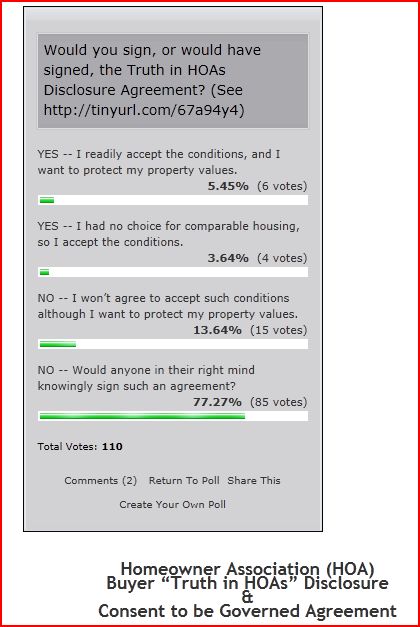
The position of the Arizona Attorney General is unacceptable. The public policy position of the State of Arizona is unacceptable. It strongly reflects HOA protectionism even to the extent that the State permits the denial of constitutional protections for the people. And in a state that has loudly and firmly urged support for the Constitution and the need to uphold the laws of the land! I offer my Truth in HOAs disclosure poll — please vote your conscience, showing a solid rejection of these hidden facts, and the KPHO, HOA Syndrome survey: YES, it exists!,poll showing that HOA boards do inflict emotional stress on homeowners who disagree with the board.

I urge the Legislature to require ADRE and the Attorney General’s Office to provide a Truth in HOAs handbook containing the facts, the negative aspects, of living in an HOA. Such a handbook must address the issues contained in the Truth in HOAs Disclosure Agreement as set forth in the poll mentioned above.

Arizona Tenants’ Rights and Responsibilities Handbook

Gross injustice: HOA declarations not a contract, but held binding as a contract

In Epernay CA v. Shaar the Texas appellate court again avoided declaring that a declaration of CC&Rs is a contract, but use the carefully worded, CC&RS are subject to the general rules of contract construction,” followed by, “In construing contracts. . .” Other courts have declared CC&Rs to be a contract without providing evidence, making the declaration a dicta (ipse dixit made by a judge). Others have referred to cases that, themselves, are also dicta utterances.


The reason for this is that HOA governments under CC&Rs are held to be subject to the laws of equitable servitudes, which simply requires the filing of the CC&Rs with the county in order to be binding on the unsuspecting homeowner. He doesn’t even have to read the CC&Rs or even explicitly consent to agree in general, or to agree with the surrender or waiver of all his rights stated or implied in the CC&Rs. If indeed CC&RS were to be considered a bona fide contract under contract law 101, they would be thrown out the window.


See the responses to the Truth in HOAs poll where 92% said they would not agree to the conditions in HOAs as disclosed in the Disclosure Agreement.


Additionally, if the requirement for the genuine consent with full knowledge, and the absence of misrepresentation, were applied under contract law, the CC&Rs would be thrown out the window.


Why have the courts followed servitude laws over constitutional law with its requirements for the equal application of the law – contract law – and due process protections against special laws for special private organizations? Why have the courts or state legislatures failed to declare HOA governments to be an unconstitutional delegation of legislative powers to private organizations? Or to be state actors under the criteria set forth by the US Supreme Court (and not the ancient and misplaced holding of the “public functions” test)?


If people can get together a draw a contract, call it CC&RS, and operate as private governments not subject to the 14th Amendment, why do we need constitutional government? That’s secession, isn’t it?

Truth In HOAs Poll update: 9% would surrender their rights to HOA

Aug. 15, 2011 results

The initial response after 1 day to my Truth In HOAs Poll of July 12th was a 98% vote of NO, they could not agree to the Disclosure Agreement. Only 1 YES vote was recorded. Understanding that this may reflect an anti-HOA audience, I allowed the Poll to remain open this past month (and will remain open) to record any change in attitude by the respondents, noting that pro-HOA polls sponsored by CAI and RIM have recorded a 70% “satisfied with their HOA” response.

The Truth In HOAs internet poll is freely available to all on the internet by simply visiting my Commentaries blog, and as notified by my numerous email list posts, my responses to homeowner inquiries, and links provided in my comments to many online media articles. It s not a telephone calling from a pre-selected list.

Within 2 weeks the YES votes for both categories dropped somewhat to 95% with a split between “YES, I would sign” regardless and “YES, I would sign, but I want property value protections.” Today, a month later with a small increment in respondents, the YES responses come to 9% and the NO response to 91%. The split in YES votes shows an small widening with the unconditional YES dominating.

It’s hard to believe that there are some people who have no concern for their rights. This 9% represents “hard-liners or “true believers.” The results are unmistakably clear as homeowner rights advocates have been shouting for years – the support for a valid consent to be governed by the courts and state legislatures is based on a false and misguided view of the authoritarian, private government HOA regimes that are unaccountable to the legitimate and legal constitutional public government.

The HOA supporters, including CAI, do not have clean hands! It’s well beyond time to stop this mockery of the Constitution and mockery that HOAs represent the true voice of the people. And, the state legislatures well know that there are existing statutes that permit “private communities” to exist yet be accountable to Constitutional public government as a state entity, and retain the perceived benefits of restricted amenities, “ordinances,” community “taxes,” etc. (See a Proposal for the Muni-zation of HOAs).

I invite any and all online media, and those public interest organizations who fight for individual rights, to duplicate this poll for their viewers. Let’s get to the whole truth by publishing this poll, or stop telling your viewers that you tell the truth!!!

It should be noted that another marked rebuttal to these “satisfied” polls was a recent Phoenix CBS affiliate, KPHO, poll on whether or not an HOA Syndrome – a PTSD resulting from living in an HOA, diagnosed by Dr. Gary Solomon – was real. The KPHO internet poll results showed a 69% response that the HOA Syndrome was alive in HOAs. (See HOA Syndrome survey: YES, it exists!).

Please freely distribute this commentary/email to interested parties and your local media.

Exercises in futility – demanding the HOA to comply

Over the years I’ve heard many, many stories that were, unfortunately, exercises in futility. These stories followed the same basic pattern, except the names and places changed. A homeowner in a dispute with his HOA exchanges emails/letters/calls with the board or HOA attorney or manager, one or all, citing blatant violations of the governing documents and/or state laws.

The responses from the board or its hired hands repeatedly deny any wrongdoing or failure to comply with its legal obligations. The HOA responses often include extreme positions and interpretations of its obligations, and ludicrous defenses of its position. Further exchanges only serve to increase the anger and frustration of the homeowner with a good possibility of additional attorney fees for answering his emails.

The bottom line is that the homeowner must sue to get the HOA to meet its obligations under the law – no state agency is going to get involved. These exchanges only serve as evidence of the board’s bad faith actions and flagrant violations of its obligations. And that’s all they are good for. Showing them to the media, and if they air the story, has no legal effect on the HOA. Showing them to your fellow neighbors gets you nowhere as many have discovered.

Unless these exchanges are geared to possible and eventual legal action, they are otherwise exercises in futility.

Possibly, only possibly, can these documented exchanges become useful when sent to your state representative demanding legislation for state enforcement of HOA board violations. Homeowners must demand substantial penalties and fines against the board and individual board members, if warranted.

The continued presumption by state legislatures that the HOA will act in good faith and obey the law and governing documents has been disproven time and time by the HOA’s wanton abuse of the laws. This desired response by the legislature will only happen when a sufficiently large volume of documented complaints are received from many homeowners.

Montana Supreme Court rules CC&Rs may be adhesion contracts

This very important Montana Supreme Court opinion concerns the explicit issue of CC&Rs as adhesion contracts. Sadly, once again, the gentlemen in black fail in their understanding of the true nature and practicality of the effectiveness of those “grandiose” covenants within the CC&Rs. This judicial blindness to reality and the acceptance of the written word as gospel — “so let it be written and so it is done” — is a mockery of justice as one would expect from banana republic courts.

While the Court ruled the CC&Rs in this case were not adhesive, others may argue that CC&Rs are adhesion contracts.  Plaintiff had failed to address all the requirements of an adhesion contract.

I’ve excerpted relevant parts of the opinion below. Read the discussion on “reasonable expectations.” Be sure to read Justice Nelson’s disagreement at the end of the opinion (emphasis added).

¶ 9 The CCRs here are not a contract of adhesion. First, the CCRs are not a standard form contract without negotiable terms. Further, Graziano has the ability to change the terms of the CCRs. Graziano may not have had the ability to negotiate the terms of the original CCRs, but it is within his power to change and amend the CCRs in accordance with the amendment provisions in Section XVII of the CCRs. . . . ;

[W]e do not foreclose the possibility that a future plaintiff could demonstrate that land use covenants, conditions, and restrictions are adhesive. We simply find that given the facts of this case, the CCRs in question are not adhesive.

<¶ 20 Even if the CCRs did constitute a contract of adhesion, that alone does not make the arbitration clause unenforceable. Assuming a contract of adhesion exists, Graziano must still show the arbitration clause either (1) was not within his reasonable expectations, or (2) was within his reasonable expectations, but when considered in context, is unduly oppressive, unconscionable, or against public policy. Id. Graziano has only argued the first prong; therefore, we limit our analysis to whether or not the arbitration clause was within Graziano’s reasonable expectations.

¶ 22 We conclude, given all the surrounding circumstances, the arbitration clause was within Graziano’s reasonable expectations. First, and significantly, Graziano had notice of the CCRs. While he claims the CCRs were not mentioned in the letter accompanying the original packet of materials sent by Stock Farm, that alone is not dispositive. Both the buysell agreement and the title report indicate the Lot was encumbered by CCRs and easements of record. The buy-sell agreement also states that “Seller has delivered or made available to “Buyer [Graziano] copies of the covenants, conditions, restrictions . . . .” Graziano had actual notice, before finalizing his purchase, that the Lot was encumbered by CCRs. Even if this did not constitute actual notice, Graziano is still charged with ;”>constructive notice< because the CCRs were recorded.

¶ 24 . . . In an affidavit submitted to the District Court, Graziano states that no one explained the CCRs to him, that he did not know the CCRs contained language that would affect his rights, and that he was not represented by counsel. Graziano does not say he did not know of or read the CCRs, only that they were not explained by Stock Farm or the Association. We find Graziano’s affidavit self-serving in light of his extensive business experience and that it constitutes “weak evidence” regarding his understanding of his purchase of the Lot.

¶ 25 After reviewing all the surrounding circumstances, we conclude the CCRs are not a contract of adhesion, and the arbitration provision contained within the CCRs was within Graziano’s reasonable expectations. Therefore, we agree with the District Court’s funding that the arbitration provision is valid and enforceable.

Justice James C. Nelson, specially concurs.

¶ 37 I agree with the result of the Court’s Opinion. I do not necessarily agree that the CCRs here were not adhesive, nor do I agree that, as a general proposition, land use covenants, restrictions and conditions imposed unilaterally by the developer or owner upon a subdivision cannot be adhesive. In my view, upon appropriate proof of the criteria set forth in Woodruff v. Bretz, Inc., 2009 MT 329, ¶ 8, 353 Mont. 6, 218 P.3d 486, a plaintiff could prevail on a claim that land use covenants, restrictions and conditions are adhesive. Imposing and enforcing pre-dispute arbitration requirements in such circumstances is nothing more than a means of depriving landowners of their constitutional rights of access to the courts and to a jury trial under Article II, Sections 16 and 26, respectively, of the Montana Constitution.

¶ 38 That said, in this case I agree that, even assuming that the CCRs were adhesive, the arbitration provisions were within Graziano’s reasonable expectations . . . .

¶ 39 Land use covenants, restrictions and conditions might arguably benefit the land, and the landowner may be granted some illusory—albeit impossible, as a practical matter— method of amending the covenants, restrictions and conditions. Nonetheless, the landowner should not be bound by a pre-dispute arbitration clause imposed by the developer without negotiation on what amounts to be a “take it or leave it”—or, rather, “buy it and you’re stuck with them”—basis. A landowner should retain the right to have disputes over the interpretation and enforcement of land use covenants, restrictions and conditions resolved in court with a jury; forcing mandatory pre-dispute arbitration on landowners should not be a prerequisite to property ownership.

GRAZIANO v. STOCK FARM HOMEOWNERS ASSOCIATION, INC., 2011 MT 194,No. DA 10-0580 (Mont. 2011).