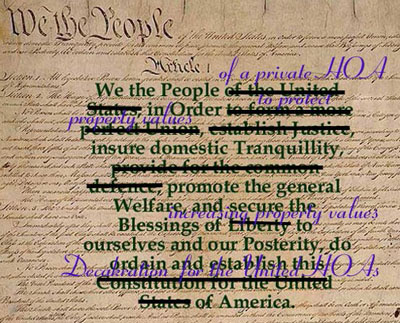
To the valiant advocates fighting for HOA reforms:

Some words of encouragement on this President’s Day.

The task of educating the legislators, the courts, the media and the public as to all the factors inherent in the HOA legal scheme is a dauntless task.  Advocates have been doing battle against a fortified adversary with funds that has indoctrinated the many into accepting certain benefits, and instilling fear into the many of dire consequences.

The national lobbying trade group alleges that, if the HOA legal scheme is made to conform and adhere to our American system of government, where individual rights and freedoms come first before the objectives of the “state”, the HOA, all would be lost.  This same trade group claims to have  an educational mission, yet only instructs the people on how to live and accept the authoritarian HOA regime under its adhesion contract and under pro-HOA special laws.  Yet, it maintains legislative action committees in all 50 state legislatures to insure that its teachings and view of the new American political and social systems continues to prevail.

Do not falter, do not dishearten, as you continue to battle before the legislature for your rights as an American.  Take heart from the words of President Theodore Roosevelt in a speech made in 1910: 

 The credit belongs to the man who is actually in the arena, whose face is marred by dust and sweat and blood; who strives valiantly; who errs, who comes short again and again, because there is no effort without error and shortcoming; who spends himself in a worthy cause; who at the best knows in the end the triumph of high achievement, and who at the worst, if he fails, at least fails while daring greatly, so that his place shall never be with those cold and timid souls who neither know victory nor defeat.

Courage, and remember:  Illegitimati non Carborundum.  Don’t let the bastards wear you down!  Gen. Joseph Stillwell, WW II.


AZ Supreme Court accepts advocate’s amicus brief in challenge to HOA statute

The Arizona Supreme Court has accepted my amicus curiae brief in support of constitutionality of the DFBLS/OAH due process statutes (Gelb v. DFBLS, CV 10-0371-PR). The Court has yet to decide if it will hear the Petition from the homeowner. Neither party objected to my brief, not even the CAI HOA law firm that received harsh treatment. I had presented background facts and arguments in an effort to assist the Court in understanding the disgraceful state of affairs with HOAs.

Responses to my brief, if any, are due within 20 days. For over 10 years I’ve been waiting for the CAI HOA attorneys to debate the substantive, constitutional issues with me for all to see.  I await their response.

The excerpt below makes a strong accusation against the Arizona Legislature, which can be applied to all state legislatures. Given this posture,  I would like to thank those all too few individual legislators who had come forth over the years, in several states, to do battle for homeowner justice, but who were not sufficient to overcome the opposition in their legislatures. Your efforts are very much appreciated.

From the first paragraph of my Conclusion:

It is quite evident that an Arizona homeowner living within an HOA governed subdivision cannot look to the Attorney General, the Legislature, DFBLS, or ADRE (real estate dept.) for due process protections and the equal application of the laws. Even the lower courts are suspect. With all due respect, it remains to this Court to stand behind the promises and covenants between our system of government and the people as set forth in the U.S. and state Constitutions.

See Advocate submits amicus brief in AZ supreme court appeal of HOA due process, and for a copy of the amicus brief, Amicus.

Unconstitutional laws and sanctions of invalid HOA powers


There are two Arizona bills dealing with substantive, constitutional HOA reforms:  SB 1170, the issue of who controls public streets, and SB 1148, the restoration of due process protections for homeowners by means of an independent tribunal adjudication of HOA disputes. Legislators need to understand the constitutional aspects of these bills and, by the failure of the Legislature to act, the sanctioning of HOA actions that are invalid, unconstitutional, or against public policy. “Sanctioning,” as used in the courts, is the statutory permission to act in a manner that the legislature does not deem illegal. The chief example of this sanctioning is the use of the word “may” in the statutes. While not a compulsory order by the Legislature, it is nevertheless a statement that any such acts are not illegal. A second common example of sanctioning, the error of omission, is the refusal to enact statutes to declare certain acts as illegal.


The crux of the opposition to these bills, with their “equal application of the laws” issue, has been the popular cry of protecting individual rights, specifically in regard to “freedom of contract” and “no government interference.”  The more elegant opposition can be stated by a quote from the Dec. of  Indep.:  governments are instituted among men, deriving their just powers from the consent of the governed.  The opposition would have legislators believe that this is the end all of the Constitution.  They believe that the HOA constructive notice “contract” is sacrosanct, inviolate, and there is no need for a “Truth in HOAs” law similar to other consumer protection laws, like truth in lending and truth in advertising.  However, the special consideration given to the HOA industry by pro-HOA,  no homeowner protections legislation, and the unconscionable adhesion contract nature of the CC&Rs — with its implicit and non-existent surrender of the homeowner’s rights, freedoms, privileges and immunities — can easily be seen as a violation of The Arizona Constitution :


Read the complete commentary at constitutional.


Analysis of AZ HB 2441, the HOA minority control bill


Opinion

This bill should not be heard in any committee!  

It is contradictory and confusing, and ideal for attorney involvement in the expected challenges to the interpretations of the statutes. Also, it is definitely aimed at destroying any vestige of democratic governance in homeowner and condo associations. This bill denies access to the courts.

Introduction

The Carpenter Hazlewood Delgado & Wood blog of Jan. 18, 2011, written by Scott Carpenter, “HB2441 – CC&R Amendments,” argues: This change would enable community association to change their documents without onerous approval requirements that count a failure to participate as a ‘no’ vote.” (Emphasis added).  The exercise of the democratic right to vote and to protect one’s private property is considered “onerous” by the CAI Legislative Action Committee co-chair, Scott Carpenter.

Carpenter’s Dec. 17, 2010 letter, titled  “Bad Documents,”  to CAI lobbyist DeMenna proposed a change in the laws.  The letter includes HB 2441, verbatim, under the title “Easier to Amend Bad Documents.”  This bill did not originate with the bill’s sponsors, but from the CAI lobbying organization that supports not you, the homeowner, but that legal corporate person known as the HOA.   The Sponsors are just the vehicle doing CAI’s bidding.

The title of the bill itself simply  reads:  “homeowners’ associations; declaration amendments,”  and the bill extends well beyond just changing the voting requirements to amend the CC&Rs.  Some of these changes are good for homeowner protection, but are offset by the draconian attack on homeowner property rights. CAI argues, in Carpenter’s letter to DeMenna, that the proposed voting procedure is just like public voting laws, but fails to provide the necessary public government protections, and ignores the legal fact of the private contract in operation here, the CC&Rs agreement. HB2441 is another top-down imposition of government interference, which otherwise in instances involving the protection of homeowner rights, is vehemently opposed by CAI.

As you read this bill, remember that the courts take the everyday meaning of the words used, and if not clear, or seemingly contradictory, the court will look to intent.  Courts have held that if word “x” was  not actually stated, then the drafters should have included word “x” if that was their meaning or intent.  Read the bill carefully as written, and think how your opponent could challenge the wording in the courts.


Analysis

The full document with its  detailed, 10-point analysis can be found at HB 2441.

co-opting the HOA “homeowners bill of rights”


In 2008 the 1994 UCIOA (Uniform Common Interest Ownership Act) was modified to accommodate the outcry from homeowner rights advocates.  This shortened version is known as the Uniform Common Interest Ownership Bill of Rights Act (UCIOBORA), and is a political maneuver to co-opt the real meaning and intent of a “bill of rights.”  Here’s an explanatory excerpt from UCIOBORA:


Further, ULC [Uniform Law Commissioners] acknowledges that it will often not be feasible to enact UCIOA 3.0, in part because of the difficulty drafters in the States may encounter in integrating any new adoption of the existing Uniform Acts with the laws that may already exist in a particular state.  For these reasons, ULC  promulgated a free-standing and relatively short Uniform Act that addresses all of the ‘association versus unit owner’ issues touched on during the drafting of the 2008 UCIOA amendments. The free-standing Act is known as the Uniform Common Interest Owners Bill Of Rights Act or “UCIOBORA”. While not all sections of UCIOBORA are identical to UCIOA 3.0, the concepts underlying each Act are the same, and are adjusted simply to recognize the simplified nature of UCIOBORA.
 
 
In short, UCIOA wasn’t selling.  It seems that UCIOBORA is the sad result of the political motives to get UCIOA selling again. It’s a document that does not at all read like the US Bill of Rights, or any state constitution’s Declaration of Rights (state constitution equivalent of the Bill of Rights), or even the Declaration of the Rights of Man and Citizen (France, 1793).  Far from it.  Rather it reads like your current CC&Rs and UCIOA with a number of concessions to reality.  However, it lacks substantive protections of homeowner rights, such as: a fair and just due process by means of an independent tribunal; fair elections procedures with equal and fair access to membership lists, and equal opportunity appearances in the HOA newsletter/website; restrictions on the right to foreclose, since the HOA is not in the same position as a lender who had advanced hard cash; and enforcement by means of penalties against board violations of the governing documents, otherwise all such laws are just recommendations dependent on the goodwill of the affected persons.
 
A homeowners bill of rights is necessary because the Constitution with its Bill of Rights amendments does not apply to private HOA governments.  HOA governments operate outside the Constitution, which is greatly desired and defended by HOA supporters as they would not be able to act in ways that a civil government cannot act.  A statement in a declaration that says that the HOA is subject to the Constitution is meaningless, since the Constitution does not apply to private entities.  What is necessary is a statement that the HOA acknowledges the Constitution as the supreme law of the land and irrevocably agrees to be subject to it  as if it were indeed a government entity.
 
 
Short History
In 1997, Elizabeth McMahon of AHRC filed a Homeowners Bill of Rights with the California Law Review Commission looking into revising California’s HOA statutes.  In 2000, George K. Staropoli submitted a statement to the Arizona Interim HOA Committee, Homeowner’s Declaration of Independence from the HOA system of government.  In 2006, AARP produced a public policy statement, A Bill of Rights for Homeowners in Associations, written by Houston attorney David Kahne.  In 2006 the legal-academic aristocrats (lawyers for the real estate interests) at a Texas senate hearing proposed a Texas Uniform Planned Community Act (TUPCA).  Responding to Texas homeowner rights advocates, the committee was told that UCIOA (the model act for TUPCA) was being modified to include a bill of rights section.  In 2008, George K. Staropoli informed the California Law Review Commission of a proper Members Bill of Rights section to the Davis-Stirling Act (This section was later  dropped from the revision).