Gross injustice: HOA declarations not a contract, but held binding as a contract

In Epernay CA v. Shaar the Texas appellate court again avoided declaring that a declaration of CC&Rs is a contract, but use the carefully worded, CC&RS are subject to the general rules of contract construction,” followed by, “In construing contracts. . .” Other courts have declared CC&Rs to be a contract without providing evidence, making the declaration a dicta (ipse dixit made by a judge). Others have referred to cases that, themselves, are also dicta utterances.


The reason for this is that HOA governments under CC&Rs are held to be subject to the laws of equitable servitudes, which simply requires the filing of the CC&Rs with the county in order to be binding on the unsuspecting homeowner. He doesn’t even have to read the CC&Rs or even explicitly consent to agree in general, or to agree with the surrender or waiver of all his rights stated or implied in the CC&Rs. If indeed CC&RS were to be considered a bona fide contract under contract law 101, they would be thrown out the window.


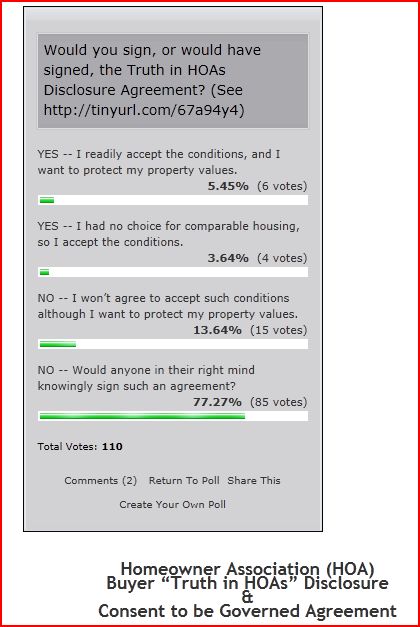
See the responses to the Truth in HOAs poll where 92% said they would not agree to the conditions in HOAs as disclosed in the Disclosure Agreement.


Additionally, if the requirement for the genuine consent with full knowledge, and the absence of misrepresentation, were applied under contract law, the CC&Rs would be thrown out the window.


Why have the courts followed servitude laws over constitutional law with its requirements for the equal application of the law – contract law – and due process protections against special laws for special private organizations? Why have the courts or state legislatures failed to declare HOA governments to be an unconstitutional delegation of legislative powers to private organizations? Or to be state actors under the criteria set forth by the US Supreme Court (and not the ancient and misplaced holding of the “public functions” test)?


If people can get together a draw a contract, call it CC&RS, and operate as private governments not subject to the 14th Amendment, why do we need constitutional government? That’s secession, isn’t it?

Making substantive HOA reform legislation happen

A few years ago I produced the Rules of Engagement designed for advocates to combat the undue influence of CAI and other pro-HOA activists who had controlled the legislative playing field for years. Simply put, the Rules call for challenging, confronting, and exposing the issues with the facts based on fundamental principles. The Rules have proven successful, at least in Arizona and with CAI Central where they have been applied.


Once our opponents realize that they no longer control the playing field, as they must pause and defend their positions, they will become less outspoken in the media and be more circumspect in what they say and claim. This leveling of the playing field is a direct result of advocates having demonstrated the validity and strength of their positions. Its a basic necessity that the legislators, the media, and public be educated.


However, CAI and its paid minions still have a strong influence in the legislatures that must be overcome – I call it “walking the halls of the legislature and whispering in the ears of the legislators.” They are paid lobbyists and we are just citizen advocates. California and Florida have strong Evil Empire contingents, with other states having varying degrees of opposition. You know the strength of your opposition.


To overcome the opposition in the legislature, advocates must clearly understand and accept the fact that no legislature in any state is a friend of homeowner rights advocates. History has shown that to be the case, loud and clear. What has occurred is a relatively small number of legislators taking on the cause of the homeowner against the political party leadership opposition to reforms. I say again: the political party leadership is opposed to substantive HOA reform legislation.

In order to make a difference and obtain substantive legislative reforms, homeowners must find a legislative champion with courage, perseverance and political abilities to successfully fight our cause and make reform legislation happen. And these legislative White Knight champions, in order to be successful, must find outspoken support from the people and the media.


Advocates must find a media personality or reporter who can overcome the opposition from its editors and media owners to sally forth and expose the goings on and opposition from legislators. They must make news and force the opposition to defend its positions in public, using the statements and arguments of the advocates.


And, in order to accomplish the above, an advocate champion, preferable with many followers, must speak out with unassailable facts and arguments in the media, on the internet, and wherever he can have his voice heard. The best approach is to base these reform arguments in fundamental principles of democratic government, justice and in basic American values and beliefs. Remember that “maintaining property values,” or “no government interference,” or “HOAs are the voice of the people” are not fundamental values.


(As an important aside, one function of government is to maintain an orderly society by establishing justice where one faction does not dominate a weaker faction. See The Federalist Papers, #51. Who else can do this in the absence of legitimate public government? Vigilantes? Reliance on the goodwill of your HOA board that has no legal obligation to do so?).


Reform legislation can happen! Following the above guidelines will help make it happen, sooner rather than later, or never. Your state and your situation are not any different from all that that has gone before you across the country. As George Santayana wrote, “Those who cannot remember the past are condemned to repeat it.”

Truth In HOAs Poll update: 9% would surrender their rights to HOA

Aug. 15, 2011 results

The initial response after 1 day to my Truth In HOAs Poll of July 12th was a 98% vote of NO, they could not agree to the Disclosure Agreement. Only 1 YES vote was recorded. Understanding that this may reflect an anti-HOA audience, I allowed the Poll to remain open this past month (and will remain open) to record any change in attitude by the respondents, noting that pro-HOA polls sponsored by CAI and RIM have recorded a 70% “satisfied with their HOA” response.

The Truth In HOAs internet poll is freely available to all on the internet by simply visiting my Commentaries blog, and as notified by my numerous email list posts, my responses to homeowner inquiries, and links provided in my comments to many online media articles. It s not a telephone calling from a pre-selected list.

Within 2 weeks the YES votes for both categories dropped somewhat to 95% with a split between “YES, I would sign” regardless and “YES, I would sign, but I want property value protections.” Today, a month later with a small increment in respondents, the YES responses come to 9% and the NO response to 91%. The split in YES votes shows an small widening with the unconditional YES dominating.

It’s hard to believe that there are some people who have no concern for their rights. This 9% represents “hard-liners or “true believers.” The results are unmistakably clear as homeowner rights advocates have been shouting for years – the support for a valid consent to be governed by the courts and state legislatures is based on a false and misguided view of the authoritarian, private government HOA regimes that are unaccountable to the legitimate and legal constitutional public government.

The HOA supporters, including CAI, do not have clean hands! It’s well beyond time to stop this mockery of the Constitution and mockery that HOAs represent the true voice of the people. And, the state legislatures well know that there are existing statutes that permit “private communities” to exist yet be accountable to Constitutional public government as a state entity, and retain the perceived benefits of restricted amenities, “ordinances,” community “taxes,” etc. (See a Proposal for the Muni-zation of HOAs).

I invite any and all online media, and those public interest organizations who fight for individual rights, to duplicate this poll for their viewers. Let’s get to the whole truth by publishing this poll, or stop telling your viewers that you tell the truth!!!

It should be noted that another marked rebuttal to these “satisfied” polls was a recent Phoenix CBS affiliate, KPHO, poll on whether or not an HOA Syndrome – a PTSD resulting from living in an HOA, diagnosed by Dr. Gary Solomon – was real. The KPHO internet poll results showed a 69% response that the HOA Syndrome was alive in HOAs. (See HOA Syndrome survey: YES, it exists!).

Please freely distribute this commentary/email to interested parties and your local media.

Montana Supreme Court rules CC&Rs may be adhesion contracts

This very important Montana Supreme Court opinion concerns the explicit issue of CC&Rs as adhesion contracts. Sadly, once again, the gentlemen in black fail in their understanding of the true nature and practicality of the effectiveness of those “grandiose” covenants within the CC&Rs. This judicial blindness to reality and the acceptance of the written word as gospel — “so let it be written and so it is done” — is a mockery of justice as one would expect from banana republic courts.

While the Court ruled the CC&Rs in this case were not adhesive, others may argue that CC&Rs are adhesion contracts.  Plaintiff had failed to address all the requirements of an adhesion contract.

I’ve excerpted relevant parts of the opinion below. Read the discussion on “reasonable expectations.” Be sure to read Justice Nelson’s disagreement at the end of the opinion (emphasis added).

¶ 9 The CCRs here are not a contract of adhesion. First, the CCRs are not a standard form contract without negotiable terms. Further, Graziano has the ability to change the terms of the CCRs. Graziano may not have had the ability to negotiate the terms of the original CCRs, but it is within his power to change and amend the CCRs in accordance with the amendment provisions in Section XVII of the CCRs. . . . ;

[W]e do not foreclose the possibility that a future plaintiff could demonstrate that land use covenants, conditions, and restrictions are adhesive. We simply find that given the facts of this case, the CCRs in question are not adhesive.

<¶ 20 Even if the CCRs did constitute a contract of adhesion, that alone does not make the arbitration clause unenforceable. Assuming a contract of adhesion exists, Graziano must still show the arbitration clause either (1) was not within his reasonable expectations, or (2) was within his reasonable expectations, but when considered in context, is unduly oppressive, unconscionable, or against public policy. Id. Graziano has only argued the first prong; therefore, we limit our analysis to whether or not the arbitration clause was within Graziano’s reasonable expectations.

¶ 22 We conclude, given all the surrounding circumstances, the arbitration clause was within Graziano’s reasonable expectations. First, and significantly, Graziano had notice of the CCRs. While he claims the CCRs were not mentioned in the letter accompanying the original packet of materials sent by Stock Farm, that alone is not dispositive. Both the buysell agreement and the title report indicate the Lot was encumbered by CCRs and easements of record. The buy-sell agreement also states that “Seller has delivered or made available to “Buyer [Graziano] copies of the covenants, conditions, restrictions . . . .” Graziano had actual notice, before finalizing his purchase, that the Lot was encumbered by CCRs. Even if this did not constitute actual notice, Graziano is still charged with ;”>constructive notice< because the CCRs were recorded.

¶ 24 . . . In an affidavit submitted to the District Court, Graziano states that no one explained the CCRs to him, that he did not know the CCRs contained language that would affect his rights, and that he was not represented by counsel. Graziano does not say he did not know of or read the CCRs, only that they were not explained by Stock Farm or the Association. We find Graziano’s affidavit self-serving in light of his extensive business experience and that it constitutes “weak evidence” regarding his understanding of his purchase of the Lot.

¶ 25 After reviewing all the surrounding circumstances, we conclude the CCRs are not a contract of adhesion, and the arbitration provision contained within the CCRs was within Graziano’s reasonable expectations. Therefore, we agree with the District Court’s funding that the arbitration provision is valid and enforceable.

Justice James C. Nelson, specially concurs.

¶ 37 I agree with the result of the Court’s Opinion. I do not necessarily agree that the CCRs here were not adhesive, nor do I agree that, as a general proposition, land use covenants, restrictions and conditions imposed unilaterally by the developer or owner upon a subdivision cannot be adhesive. In my view, upon appropriate proof of the criteria set forth in Woodruff v. Bretz, Inc., 2009 MT 329, ¶ 8, 353 Mont. 6, 218 P.3d 486, a plaintiff could prevail on a claim that land use covenants, restrictions and conditions are adhesive. Imposing and enforcing pre-dispute arbitration requirements in such circumstances is nothing more than a means of depriving landowners of their constitutional rights of access to the courts and to a jury trial under Article II, Sections 16 and 26, respectively, of the Montana Constitution.

¶ 38 That said, in this case I agree that, even assuming that the CCRs were adhesive, the arbitration provisions were within Graziano’s reasonable expectations . . . .

¶ 39 Land use covenants, restrictions and conditions might arguably benefit the land, and the landowner may be granted some illusory—albeit impossible, as a practical matter— method of amending the covenants, restrictions and conditions. Nonetheless, the landowner should not be bound by a pre-dispute arbitration clause imposed by the developer without negotiation on what amounts to be a “take it or leave it”—or, rather, “buy it and you’re stuck with them”—basis. A landowner should retain the right to have disputes over the interpretation and enforcement of land use covenants, restrictions and conditions resolved in court with a jury; forcing mandatory pre-dispute arbitration on landowners should not be a prerequisite to property ownership.

GRAZIANO v. STOCK FARM HOMEOWNERS ASSOCIATION, INC., 2011 MT 194,No. DA 10-0580 (Mont. 2011).

Constitutional intents and purposes: HOAs vs. America

The Preamble to the US Constitution contains the intentions, purposes, and guiding principles of the Constitution.

We the People of the United States, in Order to form a more perfect Union, establish Justice, insure domestic Tranquility, provide for the common defence [sic], promote the general Welfare, and secure the Blessings of Liberty to ourselves and our Posterity, do ordain and establish this Constitution for the United States of America.

The constitutions, commonly known as the CC&Rs or Declaration, of the HOA private government regimes, while not standardized, contain the following intents and purposes:


  • All contain: To maintain property values
  • Most contain: to enforce the provisions of the CC&Rs (more commonly found in the powers of the HOA or Board of Directors)
  • Some contain: to promote the general welfare and well-being of the community
  • A few even contain: subject to the US Constitution, which is meaningless, as is currently held, the Constitution does not apply to privately contracted governments


Since the CC&Rs, the HOA constitution, is held to be contractually binding, sight unseen, we must apply the common meaning of the explicit, written words and avoid applying meanings and intents not explicitly set forth. If there are some vagueness to the meanings of the explicit wordings, then the intent of the drafters of the CC&Rs are investigated in order to obtain some guidance in the intended meanings of these vague wordings. This is the standard judicial procedure for interpreting contracts.


It is plainly obvious from the above that the HOA constitutions are lacking in several relevant objectives of substance: establish justice, insure domestic tranquility, and secure the blessings of liberty. Legally, one cannot apply political and governmental intentions that are no where implied in any manner whatsoever, such as these silent objectives.

In other words, there is no legal obligation on HOA boards to be just, to insure domestic tranquility, or to allow for the exercise of your liberties. To demand these non-HOA rights and freedoms carries no weight in the courts, unless, as a result of specific legislation or a court holding, a specific right is restored to homeowners in HOAs. This is the intent of substantive reform legislation — removing second-class citizenship.


It is also plainly obvious from the nature of reform legislation, lawsuits, and the public statements and positions of the pro-HOA supporters that the HOA board is not concerned “to insure domestic tranquility,” or “to promote the general welfare,” or to “secure the blessings of liberty.” They are not legally bound to do so, nor can constitutional governments demand such concerns without declaring the HOA regime a state entity subject to the 14th Amendment as required for all government entities.


And, as long as the courts and state legislatures stand behind the myth of a valid waiver or surrender of your rights, especially those not implied, or a reasonably expected waiver, or those not even remotely found in the HOA constitutions, good people in HOAs are governed by the independent HOA principality.


This is the current state of affairs in America today.  Only the voice of the people, your voice, can bring about change.