HOAs undermine principles of democratic America

The immediate reaction to the title of this editorial comment from the vast majority of readers, is as I suspect,

Unbelievable, wild statement; No way; I love my HOA; the volunteers work for the community; the board of directors has my interests at heart; I can vote for the directors and on other matters, And anyway, I really don’t care, I’m happy with the amenities, facilities, and protection of my property value.

This blindness toward compliance with the US Constitution and the laws of the land can be traced to the culture of the HOA-Land Nation as I presented in Part 1 of The HOA-Land Nation Within America. As for the false argument that because members can vote for a board of directors makes the HOA democratic, ignores the reality of Cuba, China, Russia, North Korea and other countries where people can also vote for their leaders.  Voting alone does not make a democracy.

Other aspects of the HOA model of government that illustrate departures from public government, the Constitution and laws of the land can be found in the HOA-Land Nation publication: lack of oversight protections and the absence of a separation of powers, especially there is no independent judicial function for fair hearings; an absence of meaningful  penalties against acts of the Board amounting to absolute immunity; and inadequate fair election procedures as found in public elections.

In all practicality, the HOA private government is based on a business model and not a municipality model, and whoever described a business as being democratic?  As such, following the business model, the HOA is a one-party government; the party of the incumbents who control the selection of candidates, who can vote, and the election procedures designed to keep the establishment in power.

Here’s what Gandhi had to say about one-party governments and democracy. With the independence of India from British control in 1947, Mahatma Gandhi reflected on the dominance of the Indian National Congress Party over the newly formed government.

“[Gandhi] realized that a one-party system could actually be a no-party system, for when the government and party are one, the party is a rubber stamp and leads only to a fictitious existence.

‘Without free criticism and potent opposition, democracy dies.

‘Without political criticism and opposition, a nation’s intellect, culture and public morality stagnate; big men are purged and small men become kowtowing pygmies. The leaders surround themselves with cowards, sycophants and groveling yes-men whose automatic approval is misread as a tribute to greatness.’”

(The Life of Mahatma Gandhi, Louis Fischer, The Eaton Press, collector’s edition (1988, initially 1950).

The common culture within the HOA-Land Nation treats any criticism, any opposition, any independent thought not supported or approved by the board of directors as subversive. The members are inculcated into adopting and supporting this attitude and treat such views as harmful to the peace and harmony of the community.  Committees of members — opposing political parties – are attacked and treated with hostility. Free political speech and dissent is not tolerated.  

With 23% plus Americans living in HOA-Land, the HOA culture has had its effect on national, state and local politics; ignoring the Constitution and laws of the land are easily acceptable and do not constitute a problem for HOA members. 

Lost HOA Constitution webinar complete videos

This post allows access to 3 webinar videos on Restoring the Constitution to HOA-Land. The quality improves as I go on — it’s the content, the material, that’s important to learn and understand.

For best viewing press the ‘expand’ icon (lower right) for full screen viewing. Place cursor over video to select menu.

HOAs are not a club; they are legally binding agreements

HOAs are not a club.  They are legally binding adhesion agreements in favor of the HOA government, the BOD, and seriously detrimental to homeowner property interests and member fundamental rights.   Members are at risk because the private “contractual” CC&Rs have been held superior to the US Constitution by the courts.  The facts are there in the public records and state HOA statutes known as “Acts.”

It is in the best interest of the members not to obediently agree to all the BOD says they should, but to get educated and discover the truth for themselves. If they can handle the truth. Discover for yourselves.

My seminal book, The HOA-Land Nation Within America  describes the collection of HOAs throughout America as “HOA-Land.” It identifies HOA-Land as a nation within America based on its culture, beliefs, values, and commonality of contractual CC&Rs acting as its constitution.

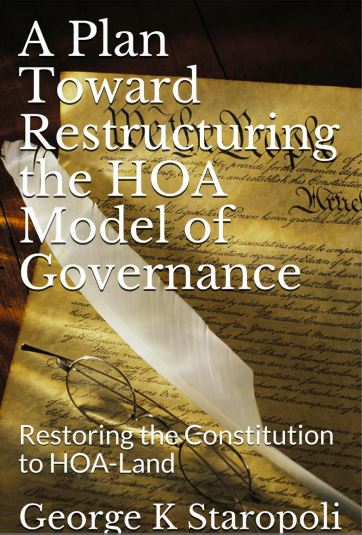
My sequel to HOA-Land Nation, A Plan Toward Restructuring the HOA Model of Governance, another seminal work,  presents the case for the restructuring of the HOA model of governance. It seeks to bring the private government HOA into compliance with and subject to the Constitution as required of all local governments.

undefined

For important information, please see HOA board education in constitutionality

Restructuring HOAs: “CAI School and member benefits” pt. 2

Mentoring: “CAI School of HOA Governance”

Part 2 addresses the heavy influence of the CAI and its affiliated, shill, organizations functioning as supporters of HOAs and the questionable claim of also supporting homeowners.

CAI heavy influence

Several HOA attorneys have maintained that the expression of the common interest of all the members is found 1) in the Declaration that they all agreed to be bound by and 2) because the members still remain a resident and a member of the HOA. It is through the Declaration itself that provides their benefits and the BOD is not derelict in its duties and obligations to the members. And that’s all there is to it!

However, herein and in my intents and purposes paper[1] I argued that the BOD’s mission statement, vision and values are one-sided and heavily influenced by the mindset created by the CAI School of HOA Governance[2] that neglects constitutional protections for the members. The alleged benefits for the members as contained in the CC&Rs do very little to provide the benefits of a democratic government. In fact, they restrict or deny the application of constitutional rights and freedoms, and the privileges and immunities of citizens of this country and their state.[3]

The policy makers have failed to understand that the HOA CC&Rs have crossed over the line between purely property restrictions to establishing unregulated and authoritarian private governments.”

In order to correct these serious defects in the HOA legal model the HOA must be restructured to conform to and be subject to the Constitution and laws of the land. It must begin with a declaration of citizenship to be made a covenant in all declarations, charters, bylaws and other governing HOA documents. State laws and CC&Rs must be amended according as proposed in my HOA Member Declaration shown in part below:

Therefore, the members of the association, having not waived or surrendered their rights, freedoms, privileges and immunities as citizens of the United States under Section 1 of the Fourteenth Amendment, and as citizens of the state within which they reside, the CC&Rs or Declaration for any planned community, condominium or homeowners association shall state that, or be amended to comply . . . .”[4]

In order for this revision to become a reality the BOD and HOA members must be reoriented away from the teachings of the CAI School and toward the forgotten and neglected principles and values of democratic America. The CAI School needs to be replaced with a qualified program of education and training on municipal government: its structure, objectives and mission, functions and operations.

CAI support of HOAs

Why does CAI oppose holding HOAs subject to the Constitution? How can CAI take this stance and still assert that it’s supportive of the homeowners? It seems by adopting the WW II Fascist philosophy of Italy’s Il Duce, Benito Mussolini, who proclaimed, “All within the state, nothing outside the state, nothing against the state.”[5] And who described Fascism a being “for the State; and it is for the individual in so far as he coincides with the State[6] Just substitute “HOA” for “state” and it all makes sense. Essentially, this is CAI’s true position on HOA governments.

While there is much to support and justify the need to remove the heavy influence by CAI over HOA-Land, a few instances are provided.

In the context of community associations, the unwise extension of constitutional rights to the use of private property by members . . . raises the likelihood that judicial intervention will become the norm.”[7] (NJ).

In other words, CAI doesn’t want our constitutional judicial system to be applied to HOAs. They can rule themselves without judicial oversight. All other forms of local government, including the most liberal of self-government charters under the home rule doctrine are subject to the Constitution.

AGAINST

[CAI] Kathe Barnes, Self(02/10/2020); Jason Barraza, AZ ASSN OF COMMUNITY MANAGERS (AACM)(02/10/2020); Terry Carstens, Self(02/23/2020); Quinten Cupps, Self(02/06/2020); [CAI, AACM] Mary Jo Edel, Self(02/06/2020); Alexis Glascock, COMMUNITY ASSOCIATIONS INSTITUTE(02/09/2020); [CAI attorney] Lynn Krupnik, Self(02/06/2020); [AACM] Linda Lang, Self(02/10/2020); Mark Logan, Self(02/10/2020); Dave Norton, Self(02/06/2020); Jeff Sandquist, AZ ASSN OF COMMUNITY MANAGERS (AACM)(02/10/2020); Vicki Sears, Self(02/06/2020); [AACM] Mark Wade, Self(02/06/2020); Donna Wood, Self(02/06/2020); [AZ]

The above quote represents the persons and/or organizations against Arizona Senate bill SB 1412 (2020). The bill would bring homeowner protections for HOA political activity and free speech rights. Note the absence of any identification of several persons who are members of one or the other mentioned organizations, CAI and AACM (AACM is a spin-off from CAI in 2003). That’s 8 out of 14 persons in opposition. Please also note that none of these persons have identified themselves with any HOA. Where are the HOA directors or presidents?

California’s SB 323 (2019) introduced fair elections procedures for HOAs that protect homeowner voting rights. It addressed one of my 6 substantive defects in the HOA legal scheme.[8]   It has become California law. Long time California lawyer Adrian Adams is heavily involved in CAI policy and management at the HQ and chapter levels. He writes:

Last year, the Center for California Homeowner Association Law (CCHAL), an organization hostile to community associations . . . The train wreck legislation . . . The bill also forces members . . . In another hostile move against associations . . . The California Legislative Action Committee (CLAC) is a volunteer organization consisting of homeowners and professionals serving homeowner associations by monitoring legislation, educating lawmakers, and protecting the interests of those living in community associations.[9]

CAI’s California LAC:[10]

The California Legislative Action Committee (CLAC) is a committee of Community Associations Institute (CAI), a national not-for-profit educational and resource organization dedicated to fostering vibrant, competent, harmonious community associations. CLAC consists of homeowners and professionals serving community associations.

We worked hard to defeat SB 323 and we came very close, especially on the Assembly Floor where the bill passed and was sent to the Governor. . . . Let’s work closely together to make sure legislators understand the negative consequences SB 323 potentially will have on community associations.

It should be obvious by now that CAI is not a friend of the homeowner in spite of its lofty, high sounding pronouncements, policies and Best Practices. The acts of its members both in CAI HQ and in the numerous state chapters speak an entirely contradictory message. CAI is there to support the HOA and the BOD that is the real person representative of the HOA association. It is obvious that granting and admitting individual rights and freedoms to the homeowners presents an obstacle to its personal agenda; CAI is a business trade tax-exempt nonprofit entity to make money for its members, the attorneys and managers for the most part, the

After consideration of the above and earlier posts under Restructuring HOAs, I ask and answer: Does the Declaration provide covenants that implement and accomplish the intents and purposes of the HOA that serve the interests of the members? My answer is NO. It raises the question of why BODs accept the HOA model of local government and resist revisions in order to bring the HOA within the Constitution for the protection of its members?

Notes

[1] See “Restructuring HOAs – intents and purposes,” George K. Staropoli, HOA Constitutional Government (Feb 2020).

[2] The basis for a definition can be found in “CAI claims Factbook 2018 at home with Democracy in America.”, in HOA Constitutional Government, footnote 9.

[3] See “Would the HOA legal scheme collapse under a democratic form of government?” in HOA Constitutional Government (2014); “HOA-Land and the decline in democratic institutions” in HOA Constitutional Government (2019).

[4] See “HOA member Declaration of US and State citizenship” in HOA Constitutional Government (2012).

[5] See Benito Mussolini: What is Fascism, 1932.

[6] Fundamental Ideas of Fascism,” Benito Mussolini, Souciant, Inc. (2016).

[7] CAI amicus curiae brief in CBTR v. Twin Rivers, 890 A.2d 947 (NJ Super. App. Div. 2006).

[8] See HOA Common Sense: rejecting private government, Democratic elections, No. 5. (2019).

[9] Adams Stirling Newsletter, Adrian Adams, Esq. (Feb. 24, 2019). Adams is a member of CAI’s Community Association Research Foundation, CAI chapter director and CLAC delegate.

[10] CAI-CLAC Feb. (2020).


Restructuring HOAs – intents and purposes

Mentoring: Purposes, intents, and mission of HOAs[1]

The larger HOAs, especially those that are planned master HOAs or resort style or active adult HOAs,[2] may contain explicit mission and vision statements as well as a declaration of values. Most other HOAs, also created as nonprofits, generally do not explicitly offer such statements. Here’s are shortened but typical examples of such statements used by an active adult, resort style HOA in Arizona.

Mission Statement:

To provide residents with a high-value community with resort-style amenities,

To maximize our investments.

Vision Statement: To become the premier active, age-restricted community in Arizona.

Values: We believe in a community culture having high standards and principles of conduct and behavior.

These boards of directors (BODs) believe that they are doing the right thing. Addressing nonprofit organizations, eminent management consultant Peter F. Drucker wrote: “The first job of the leader is to think through and define the mission of the institution.”[3] He makes the point that the worthiness of a mission statement lies in leading to “right action.” It has to be operational, otherwise it’s just good intentions. They set the policies that serve to guide the organization’s activities and conduct toward effective performance.

HOA contractual mission

We can ask: How are the HOAs doing with regard to accomplishing their mission? But first we must discover if the BOD is operating under its contractual CC&Rs obligations rather than adopted intentions. In HOA-Land, regardless of any explicitly adopted statements, all HOA nonprofits do contain a contractual statement of purpose and intent. They can be found in the CC&Rs usually in the opening paragraphs or in the articles relating to the duties, powers, etc. of the association.

In my sampling of CC&Rs of both large and small HOAs I found boilerplate wording that focused on “maintaining property values” or “for the overall development, administration, maintenance and preservation of the Properties.” Almost all, but not everyone, contain a statement directed toward the member: “shall inure [take effect] to the benefit of the member” [or “each owner”], and “be mutually beneficial.” I came across this one-sided statement: “intended to benefit the Association.” The most liberal and progressive statement of purpose mimics the Preamble to the Constitution “to promote the health, safety and general welfare of the residents of the Properties” (the general welfare clause). The inclusion of “health and “safety” are redundant in that “general welfare” includes these concerns.

Unlike other nonprofit organizations, the HOA comes with these contractual obligations and is not free to conjure up any mission that does not conform to the CC&Rs. What is quite clear is the absence of a frame of mind that addresses the requirement to benefit the members. The conduct, actions, intents and policies of the HOA must benefit the members just as our public government must serve the people.

Now it can be argued that that’s just what the CC&Rs and bylaws do is to benefit the members because of its enforcement powers, architectural guidelines, use restrictions, the right to fine, and the draconian right to foreclose. As Drucker maintains, the mission statement must lead to “right action,” which can only be such action that conforms to the HOA’s mission and leads to the effective and productive performance.

Best interests of their members?

Do the members really believe that their best interests lie with an authoritarian, contractual private government that denies fundamental and constitutional protections in the broadest applications of a deprivation of “life, liberty, or property without due process of law” and a denial of “the equal protection of the laws.”? I don’t believe so!

Yes, the above powers maybe necessary to maintain an orderly society, but where are the constitutional protections of the rights of a member that are required for legitimate and valid governmental powers?

Find out more about restructuring the HOA model and “inuring to the benefit of the member” in my sequel soon to follow.


Further reading:


References

[1] This is the first Commentary under the category of Mentoring. Mentorship is a relationship in which a more experienced or more knowledgeable person helps to guide a less experienced or less knowledgeable person. See About StarMan Group for credentials.

[2] I’ve classified HOAs as to resort style, retirement, and pure residential according to their CC&RS and operations and amenities. For a further discussion of types of HOAs, see Are there vibrant, competent, harmonious HOAs?; the CAI perspective, HOA-Land “one size fits all” injustice. The CAI 2005 survey showed 26.8% were resort and 44.3% were residential.

[3] Peter F. Drucker, Managing the Nonprofit Organization: Principles and Practices, HarperCollins (1990).