State supreme court cases favor member rights and freedoms over HOA

I would like to thank Deborah Goonan on her post[1] covering two especially important state supreme court HOA cases, and her excellent reporting and analysis of the issues. My review and comments follow.

WDIS, LLC v. Hi-Country Estates Homeowners Ass’n, Phase II, 2022 UT 17 (Utah 2022)

Raised in this landmark case, but not directly addressed, is the constitutional validity of the CC&Rs that contain implicit waivers and surrenders of fundamental rights and freedoms that are available to and protect all Americans under the Constitution. At issue, as stated by the Utah SC in WDIS,

“More relevant to this case, future owners of parcels or homes within the jurisdiction of any HOA are not required to formally sign onto the restrictive covenants when they are first created. Instead, consumers (be they buyers, heirs, or lenders) are merely entitled to a take-it-or-leave-it option to accept ownership of the property, subject to whatever covenants and restrictions are on file in County records. By taking possession of the property, an owner is presumed to have accepted the restrictions as valid and enforceable.”

The “Landowners” raised the especially prominent issue of freedom of contract, raising the charge of CC&Rs as an unconstitutional contract. The Utah Supreme Court concluded:

“The protective covenants at issue were not contractual” because “they did not involve two parties agreeing to perform acts in relation to each other. We conclude that applying the presumption is appropriate.”

“The freedom to contract is implicated because the question we are resolving is whether parties “of full age and competent understanding” are free either to accept or reject those covenants later on. And there are other reasons, beyond the freedom of contract, to apply the presumption.”  

* * * *

Belmont Ass’n v. Farwig,  No. 214A21, 2022 NCSC 64 (N.C. 2022)

First, with respect to outwardly friendly HOA member legislation let me point out what we see here,  the bill/law usually contains an offsetting exception or exclusion that renders the homeowner benefits questionable or negates them under practical application. Obviously, anybody seeing solar panels on roofs know that they will be seen by the public. How can a court ignore that?

Also, watch out for Rules that cannot be supported by the CC&Rs and are invalid as the SC pointed out regarding an ARC rule. HOAs cannot add restrictions or conditions not specified or prohibited by the CC&Rs without a CC&Rs amendment.

Second, as I’ve repeatedly stated, state legislatures favor the HOA over member rights and constitutional protections. Thank God there are some courts who do seek justice like the NC  Supreme Court in this case that saw, in plain English, the subterfuge of “friendly” HOA member law.

Read the full post here:

  1.  HOA Lawsuits: Property owner challenges to HOA boards (Part 2) – Independent American Communities, Deborah Goonan, Aug. 5, 2022.

proposed HOA constitutionality bill

“Now is the time for all good homeowner advocate leaders to come to the aid of member-owners”

 living in HOAs and suffering abuse, financial and emotional distress as a result of BODs being  protected by Arizona laws. These abuses are easy to understand and support! (See HOA Common Sense: rejecting private government and The HOA-Land Nation Within America).

A quick and simple — but highly effective — bill that was proposed in March 2011 and will bring relief to homeowners being treated a second-class citizens by state laws in support of the HOA legal scheme. It was ignored by Arizona advocates and dismissed by the Legislature.

“No provision of any contract or any declaration of covenants, conditions, and restrictions . . . is enforceable in this state unless the party seeking to enforce the provision proves by clear and convincing evidence that 1) the provision being enforced was knowingly and voluntarily agreed to by all parties . . . . Any representation or statement offered as clear and convincing evidence . . . shall include a signed statement containing the following, beginning with “I understand that I can ask that the following be read and explained to my satisfaction.”

So reads an excerpt from my proposed “Truth in HOAs” statute that should be made law in each and every state. That is, if indeed the legislature stands by the Declaration of Independence and the US Constitution, which we are hearing so much about in the media nowadays.”

The “The Truth in HOAs Act,” as I called  it,  allows each state to modify the proposal in accordance with its state HOA/condo acts — shown in square brackets [].  Also, subsection (3) contains a list of acknowledgements  that can be tailored to each state’s advocate lobbying efforts.  See Arizona Truth in HOAs statute (pvtgov.org).  The essential bill section is contained in subparagraph (4).

Therefore, in reference to subsection 3(d) above, the CC&Rs or Declaration for any planned community, condominium association or homeowners association shall state that, “The association hereby waivers and surrenders any rights or claims it may have, and herewith unconditionally and irrevocably agrees to be bound by the US and State Constitutions and laws of the State as if it were a local public government entity.

 The real estate subdivision or condominium will not be affected by requiring HOAs to join with other forms of local government and be subject to the Constitution as a home rule entity.  See HOAs violate local home rule doctrine and are outlaw governments.

This 2022 legislative session offers a unique, one-time opportunity to get the message across and to educate the legislators. Remaining silent on the issues only plays into the pro-HOA hands of CAI and offers excuses by the media not to cover HOA abuse.  Not only will you find “ammunition” in support of your arguments as contained in the 2 above publications, but also in my Arizona Supreme Court  amicus brief filed and accepted in Tarter v. Bendt (see note (vi) in Can HOA members expect justice in Arizona courts?).

My arguments are summarized in the Commentary.  As is my approach, my arguments are supported by legal authority and hard evidence documents, which CAI ignores and YOU lose!  They must be exposed if the legislators are to be fully informed on the reality of HOA-Land.  As leaders who are internet publishers,  actions speak louder than words!


Arizona HB 2052 restores homeowner constitutional speech protections

The Arizona HB 2052 (2021)  bill (sponsored by Rep. John Kavanagh) is an update to Arizona’s SB 1412[i] which died in Rules last year as a result of postponements due to the COVID-19 virus.  Essentially, its

“Overview Stipulates that a unit owner’s association or a planned community association (association) may not prohibit a unit owner or member (member) from peacefully assembling and using private or common elements of the community.”[ii]

The list of AZ GE committee RTS names against HB 2052 shows only AACM and not CAI, who I believe is hiding from severe criticism of its support for unconstitutional HOA legal scheme.[iii]  However, the long time activist CAI member firm, Carpenter Hazlewood et al.,  with several lawyers also being CAI activists, opposes this bill that seeks to restore political free speech to members in HOAs that was taken away by ab initio  — from the beginning making the agreement null and void from the start — unconstitutional declarations of CC&Rs.

“We encourage our association clients to review HB2052. We encourage all board of directors to contact their representatives to discuss its association’s position on HB2052. If you have any questions for Carpenter Hazlewood about HB2052, please feel free to contact the firm’s Legislative Team.”[iv]

CAI dominates HOA board as a result of its CAI School of HOA Governance[v] indoctrination over the years.  What is your board going to do? Stand by CAI’s opposition or obey its legal duties to do right by the members.[vi]  It can only reject this bill on the grounds that it feels granting its members constitutional rights of free political speech — that all other Americans have —  will harm the HOA government.

WHAT DO YOU SAY?

Do not allow your board to speak for you before government committees without a vote of all the members granting such powers.  I have no doubt, based on my years of dealing with CAI on constitutional issues, that its email has been sent to your president your manager, and directors.

Stand by the Constitution!  Contact your state representative and urge him/her to support HB 2052, which will soon come to a vote in the House.

Looking at the role Washington must play, see America cannot be completely unified with HOAs.

References


[i] See in general, AZ SB 1412 reflects move to HOA constitutional reforms (Jan. 2020); Authorities for protected HOA political speech — SB 1412 poll (Jan. 2020); AZ fair elections reform bill SB 1412 moves on (May 2020).

[ii] HB 2052 summary.

[iii] In the Twin Rivers case, the CAI amicus brief to the NJ appellate court warned about “the unwise extension of constitutional rights to the use of private property by members [in HOAs].”CBTR v. Twin Rivers, 929 A.2d 1060 (2007); In reply to my amicus curiae brief, CAI responded with, “It is clear that the amicus curiae simply wants to impose constitutional protections on members in homeowners associations. The law has never supported that proposition.”(CAI/Smith amicus response.); CAI maintains HOAs are protected by and do not violate the Constitution — not so!

[iv] “CHDB Legislative Alert!!! AZ House Bill 2052,” Carpenter, Hazlewood email, January 21, 2021.

[v] CAI School of HOA Governance: The foundation and principles of the School can be traced back to CAI’s Public Policies, The CAI Manifesto (its 2016 “white paper”), its numerous seminars and conferences, its Factbooks and surveys, its amicus briefs to the courts, and its advisories, letters, emails, newsletters, blogs etc. I have designated these foundations and principles collectively as the CAI School of HOA Governance.

[vi] In my sampling of CC&Rs of both large and small HOAs I found boilerplate wording that focused on “maintaining property values” or “for the overall development, administration, maintenance and preservation of the Properties.” Almost all, but not everyone, contain a statement directed toward the member: “shall inure [take effect] to the benefit of the member” [or “each owner”], and “be mutually beneficial.” I came across this one-sided statement: “intended to benefit the Association.” The most liberal and progressive statement of purpose mimics the Preamble to the Constitution “to promote the health, safety and general welfare of the residents of the Properties” (the general welfare clause). The inclusion of “health and “safety” are redundant in that “general welfare” includes these concerns. See “HOA contractual Mission” in Restructuring HOAs – intents and purposes.

Uniform Law Commission rejects subjecting HOAs to Constitution

Today I received a telephone rejection from ULC on my proposal for an HOA Members Bill of Rights.  It comes a day after my Commentary on ASU Law silence containing a statement that there has not been a ULC response, some 3 weeks after ULC’s Oct. 29 meeting.

“I am waiting for a response from The Uniform Law Commission (ULC) that is drafting updates to UCIOA. Its Scope Committee is reviewing my request for ULC study of my proposal for an HOA Member Bill of Rights; it will meet again in January.”

Nothing in writing, nothing formal, just a phone call. The essentials of the call, after a short debate where we could not reach an eye-to-eye understanding of what my point was, is very disappointing.

“I appreciate your call and our discussion on my rejected proposal.  I think we are too far apart at this time: ‘not functionally useful for lawyers,’ and ‘not workable.’”   The Scope Committee and editorial board “had difficulty in seeing HOAs as a government.”

In this call I stressed my proposed statute that would mandate HOAs to be subject to the Constitution like any other local government; the response was, “they didn’t see how that would help.

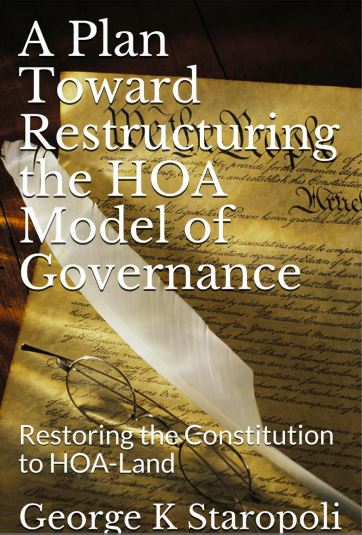
Long ago The Founding Fathers rejected the patchwork approach to modifying the Articles of Confederation and replaced it with a complete rewrite — The US Constitution and the Bill of Rights. It’s well beyond time that the HOA “constitution,” the CC&Rs, be replaced in its entirety as proposed in A Plan Toward Restructuring the HOA Model of Governance.

ULC apparently doesn’t believe so!

Effective HOA board governance

This commentary follows up on my plan to restructure HOA governance[1] that first requires addressing the attitudes and views of BODs, the members, and the public in general.  The conditioning and indoctrination by the biased views of the national pro-HOA special interest entity must be de-conditioned by a program of reorientation.

  Once again I provide valuable information on the proper functioning of HOA boards in serving their “constituents,” their members.

The management[2] of a country, a state, or a local government, including the private HOA association, is commonly known as politics.  Politics is:[3]

“the practice and theory of influencing other people on a civic or individual level. More narrowly, it refers to achieving and exercising positions of governance — organized control over a human community, particularly a state.

“exercised on a wide range of social levels, from clans and tribes of traditional societies, through modern local governments, companies and institutions up to sovereign states.

“A political system is a framework which defines acceptable political methods within a given society.”

Managing a government disguised as a nonprofit association has its unique requirements and demands that, for the most part, have been ignored.  The commonly found guidelines from the national pro-HOA lobbying entity speak to an authoritarian government with member interests and concerns being secondary to the survival of the association. It’s an unacceptable deviation from the intents and purposes of our constitutional government.[4]

First, let me address the requirements for the sound management of a nonprofit association. Drucker[5] focuses on the overall, broad purposes and responsibilities of the board of directors (BOD) or board of trustees. 

The general term “nonprofit” does not apply to HOAs because it is not a business nor a public government, but “government controls.” The reality of the HOA association is that it controls as does a public government.

Drucker asks, what is the mission of the nonprofit?  A mission statement has to focus on “what the nonprofit really tries to do.”  It cannot be “a kind of hero sandwich of good intentions.” Strategies “convert intentions into action.”

Most HOAs, especially the smaller HOAs, do not have a sound strategy that addresses their mission, goals, and values. But the HOA has an explicit mission and purpose as set forth in the CC&Rs[6] and need to be revisited and made consisted with Drucker and Batts (see below).

Second, in an excellent book on the need for director orientation,[7] the author feels board orientation is lacking and instituting a guideline will improve the nonprofit’s mission and goals. In his succinct book, as applied to HOAs, Batt’s makes the following important points:

Key areas of board action are “strategy, oversight, and policy.”  In keeping with Drucker, “boards and board members should not micromanage the affairs” of the HOA. 

The BOD has “full and final authority” over the HOA association; they are “not merely advisors” to the manager, other wisely known as the CAM. It’s regrettable that all too often the BOD abdicates to the manager and/or attorney who often are members of the same business trade group advancing their own self-agendas.

There is “no individual authority” of a board member to act and the president can only act based upon the authority set forth in the governing documents. Most presidents act, especially in the small HOAs,  without board approval.

There is  a “duty of obedience” to the laws and governing documents that all too often is ignored by not only rogue BODs, but by BODs who falsely believe to do so is in the best interests of the HOA.

Notes

[1] George K. Staropoli, A Plan Toward Restructuring the HOA Model of Governance, StarMan Press, 2020.

[2] Peter F. Drucker, “Management  is the application of a set of principles relating to the functions of planning, organizing, directing and controlling an organization to effectively achieve organizational goals,” The Practice of Management, Harper Row, 1954.

[3]Politics,” Wikipedia.

[4] See Roger L. Kemp, “Forms of Governance,” Managing America’s Cities: A Handbook for Local Government Productivity, McFarland & Co., (2007).

[5] Supra, n. 1.

[6] See  “Restructuring HOAs – intents and purposes,”  supra n.1.

[7] Michael E. Batts, Board Member Orientation, Accountability Press, 2011. It’s a short, to the point, and  easy to read paperback.  Batts has over 25 years on nonprofit boards and has served on several Washington panels.
