HOAs and unauthorized practice of law

I just received a copy of a letter from a homeowner in which the HOA manager explains the rights of the homeowner under the CC&Rs.  This is not an uncommon occurrence, where untrained and uneducated managers, even if they are  a Certified Legal Document Preparer (independent paralegal), make such statements in response to a homeowner’s request  “to know”.  The average homeowner is not familiar with the law and usually doesn’t understand what the rules mean or say.  And, obviously, the same goes for these HOA managers, including those with those CAI “certified” as to training designations — PCAM, AAMC, etc.
 
The manager, in defense of a board rule change, had misdirected the homeowner by quoting a section of the CC&Rs that grants the board to the right to create rules and regulations.  However, the issue at hand and pointed out to the manager, limiting the number or dogs, is not specified in the CC&Rs, which simple says dogs may be kept.  Consequently, the CC&Rs would have to be modified accordingly to specify any limitation, not by a vote of the board, but by the members.  This is both unethical and an outrageous unauthorized practice of law, which I shall say once more, occurs all too frequently under HOA regimes.
 
The letter did not contain a disclaimer that, “I am not giving legal advice or opinion, and I am not an attorney nor employed by an attorney.  You should seek independent legal advice from a competent attorney.”  (Remember that the HOA attorney is just that, the attorney for the fictitious HOA and not for the opposing party, the homeowner.) This simple disclaimer never appears on statements made by HOA managers, in violation of Arizona, and all other state UPL (Unauthorized practice of law’) restrictions.  Under  the Arizona Rules of the Supreme Court, R 31(a)(2)(A), “‘Practice of law’ means providing legal advice or services to or for another by: (5) negotiating legal rights or responsibilities for a specific person or entity.”
 
Rule 31(a)(2)(B) states:  “‘Unauthorized practice of law’ includes but is not limited to:  (1) engaging in the practice of law by persons or entities not authorized to practice pursuant to paragraphs (b) or (c)”
 
 
Subsections (b) and (c) state that UPL occurs when a person is not a member of the State Bar, including a disbarred or restricted Bar member.
 
 
IMPORTANT
 
If you receive any such letter from a manager or management firm employee, and that letter does not contain a disclaimer, please file a UPL complaint against the manager.  This is the only way to stop this practice.  It is a small thing you can do to help yourself and all other people living in an HOA.  If a director writes such a letter, then he risks personal liability for his error since he did not consult an attorney.  If he claims “acting on the advice of the attorney”, demand to see it in writing!  If he does not provide it, then he is not acting in good faith as required of directors of nonprofit corporations.


Qui Pro Domina Justitia Sequitur 

 (“who prosecutes on behalf of Lady Justice?“, DOJ seal)


Legal Disclaimer
 
The information contained in this written or electronic communication, and our associated web sites
 and blog, is provided as a service to the Internet community, and does not constitute legal advice.
We try to provide quality information, but we make no claims, promises or guarantees about the
accuracy, completeness, or adequacy of the information contained in or linked to this web site and
its associated sites. As legal advice must be tailored to the specific circumstances of each case, and
laws are constantly changing, nothing provided herein should be used as a substitute for the advice
of competent counsel. No person associated with AHLIS or Citizens for Constitutional Local
Government, Inc. is an attorney nor is employed by an attorney. 


2010 US Census ignores HOA demographics

With an estimated 20% of the population (based on industry data) residing in homeowners associations,  a percentage higher than either that of Black of Hispanic categories, the demographics of HOAs remains a mystery.  Who lives in homeowners associations?


The only hint at HOA demographics comes from the 2007 industry survey on HOA satisfaction, sponsored by the Community Associations Institute (CAI) trade group[i].  This sample of some 709 phone calls revealed a significant difference between the sample and the 2000 US Census data[ii]


Category HOA Survey US Census
Age 50+ 61% 27%
Education: college + 68% 24%
Minority 11% 25%
Incomes over $50,000 79% 42%


This difference can be explained by one of two alternatives.  One is that the sample is biased in order to bring about the most highly favorable results for CAI.  The other is that the sample does reflect the norms of  homeowners associations, and reveals that the HOA population represents a distinct class or subset of American society: the senior, educated, white, well-off segment of America. 


The demographics of this survey should be of concern to the policy makers.  If the sample demographics are representative of HOAs, then the claims of HOAs as “affordable housing” should be replaced with the more accurate description, “discriminatory housing.”   Then the public policy that requires only HOA subdivisions for all new housing in an increasing number of towns and cities is discriminatory.  Unless, of course, the above demographics are not representative of homeowner associations.


It would seem that the time has come for “the acceptance of a quiet innovation in housing”[iii] to be exposed to the sunlight, and that a more thorough survey of homeowner association demographics is in order.  Who lives in HOAs?  Are HOAs, aided and abetted by local government mandatory HOAs for new housing,  establishing a class division within America?  


Notes


[i] As of this writing, all online links, either on the CAI or Zogby sites, to the details of this study are missing. The Jan. 19, 2008 analysis, see n. 2, references this web address: Survey.  A copy of the methodology was downloaded at that time and can be viewed here, http://pvtgov.org/pvtgov/downloads/survey-2007.pdf.

[ii] See Who lives in an HOA? Public officials take notice  (Jan. 2008).

[iii] Taken from the title of the CAI co-funded book, Community Associations: The Emergence and Acceptance of a Quiet Innovation in Housing. Donald R. Stabile (Greenwood Press 2000).

HOA lobbyist CAI facing financial problems?

Audited Consolidated Financial Statements
and Other Financial Information
COMMUNITY ASSOCIATIONS


INSTITUTE & SUBSIDIARY
June 30, 2009

L. ACCUMULATED DEFICIT

 
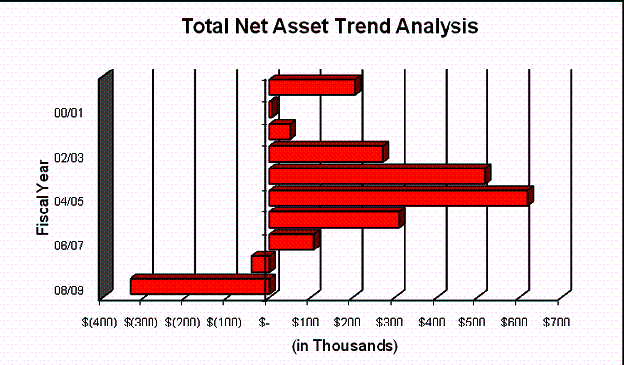
As indicated in the accompanying statement of financial position, CAI has reported recurring losses which have generated a deficit in undesignated net assets of $611,972 and $395,589 as of June 30, 2009 and 2008, respectively. Continued deficits threaten to undermine CAI’s  ability to continue its current level of operations in the future. The consolidated financial statements do not include any adjustments that might be necessary in the event that CAI is unable to continue its current operations.

Management’s plan to alleviate the deficit includes supporting and advancing manager licensing legislation in more states expanding and creating new international partnerships; developing a new virtual membership category and reducing personnel and overhead costs.

In accordance with the approved three year financial plan, the Board of Directors has approved a budget for the year ending June 30, 2010, which projects net income of approximately $42,000. However, there can be no assurance of the success of these efforts.

How good are the CAI member HOA attorneys?

Ever wonder if the CAI member HOA attorneys are worth their fees? How good are they? What’s their Win – Loss stats? This data is very difficult to come by from the trial courts, and even from the appellate courts where records are kept. Of course, we wouldn’t want to get these stats from CAI unless their source data is provided for independent inspection, which is a problem based on the recent CAI “satisfaction surveys” lacking in such material disclosures.

Fortunately, detailed records are available from the Arizona Office of Administrative Hearings (OAH) where proceedings are recorded and decisions posted on the internet. For the short period of 28 months (from September 2006 to February 2009), this state agency was permitted to adjudicate HOA disputes, and decided 52 out of 66 petitions.  Although this is a limited sampling not related to civil court cases — where the Rules of Civil Procedure come into play against the Pro Per — these OAH hearings present a leveling of the litigation playing field. An analysis of these cases will provide a good clue to the litigation value of an HOA attorney, and to whether or not engaging a CAI member attorney resulted in improved success.

A colleague gathered the data, which showed the following prevailing party percentages:

HOA                    53.8%
Homeowner   40.4%
Split                      5.8%

This is quite surprising given that in almost all the cases the homeowner was a Pro Per and the HOA was represented by an attorney; and given the fact that the state laws are clearly pro-HOA, and the governing documents amount to an adhesion contract in favor of the HOA. What the percentages seem to be saying is that “black letter” provisions of the statutes or governing documents — it’s right there, in black and white — were violated by the HOA. That an unambiguous provision had been violated and yet the HOA and its attorney failed to “own up” and voluntarily correct these obvious violations. That it took a hearing by the victimized homeowner in order to obtain justice.

The question before us to be answered is: did using a CAI member attorney improve the stats? Roughly 38% of the petitions, 20 out of 52, involved one of four CAI member attorney firms, with

CAI prevailed                            55.0%
Homeowner prevailed           45.0%

Intuitively, and supported by statistical analysis, engaging CAI member attorneys had no impact on the outcome of the hearings. We then ask: What role, if any, do these attorneys play in HOA disputes? And the answer, partly addressed in the highlighted sentence in the earlier paragraph, and from the prolific advisories from one CAI member firm, Carpenter Hazlewood, is: to seek and promote loopholes and technicalities in the law and governing documents that would lead to adversarial litigation.

CAI continues the civil vs. private HOA government "turf wars"

Arizona CAI is at it again, fighting every little “turf war” to control the powers and authority over the members of the community, regardless of what the common law, real estate law, or constitutional law may hold.

HB2345

We go from controlling parking issues on public streets to restricting access to one’s home. Under the law, every owner has the right to ingress and egress to his home, and the right of visitors and family members to have access to his home.   Under the right to advertise the sale of a home, Scott Carpenter has spied a loop-hole in the new HB 2345 bill signed into law, where is advises his faithful followers that, you know, you can prevent open houses in gated communities. He is cautious to state, “But nothing in HB 2345 requires an association to provide access to potential buyers when the access protocol in place would not permit their entry.”   And he stops there without qualifying things like, signing in, like placing a sticker on the dash, etc., but leaves readers to the false conclusion that they can stop open houses in some way. 

This is an outright failure to recognize the intent of the legislature, and to “stir up the pot”, knowing full well that any such harassment of potential buyers and visitors would be seen as an outright “restraint on alienation” under property law —  a clause that seeks to prohibit the recipient from selling or otherwise transferring his interest in the property.

HB 2768

Here, Carpenter attempts to muddle the waters with respect to transfer fees.  He says to the HOA boards, go forth and amend your CC&Rs (and we will be glad to show you how), at our usual fee) to make the fees for reserve purposes a “legitimate” covenant. “By virtue of the exception, HB2768 will not prohibit the enforcement of “transfer fee covenants” in governing documents if the fee or charge is to be used “exclusively for the purpose authorized in the document”   And Carpenter also points, hey guys, collect these fees for recreational purposes, which the law still allows.  Once again, ignoring the intent of the legislature on behalf of their separatist, secessionist private principalities.
 

These “turf wars” will continue  until the legislature finally takes a strong hand to properly restrain these lawyers and HOA boards, and assert the supremacy of civil government over contractual, private governments that reject the Constitution.

Source:  http://blog.carpenterhazlewood.com/scott/ HB 2345 and HB 2768.