Can HOA members expect justice in Arizona courts?

“HOA members in Arizona should not expect justice from the courts”

If you are a member of an Arizona HOA/condo, or soon plan to be one, you should pay heed to the above quote made in response to the Arizona Supreme Court’s denial to hear the Bendt appeal petition for review.[i]  In my Commentary, trying to understand the rationale for the denial,

“The homeowner, Bendt, is punished for speaking out, in admittedly harsh terms, [relating to issues of HOA governance]. Yet the judicial system stands by looking at a distance and allowing Trump and his followers to function as vexatious litigants; allowing them to  raise allegations, which are not only laughable but blatantly false under Rule 11, is shameful conduct.[ii]

What message is being sent by this disturbing decision? To the public? To the homeowners in HOAs seeking the equal protection of the laws under the Constitution? To the national lobbying trade group, CAI, who can breathe easy with respect to any challenges to the constitutionality of the HOA legal scheme that  contains denials of fundamental rights and privileges?

Professor Randy Barnett wrote, speaking of justice and judicial legitimacy,

A constitution that lacks adequate procedures to ensure the justice of valid laws is illegitimate even if it was consented to by a majority …. A law may be ‘valid’ because it was produced in accordance with all the procedures required by a particular lawmaking system, [the HOA amendment procedure, for example] but be ‘illegitimate’ because these procedures were inadequate to provide assurances that a law is just.[iii]  

And we must not ignore the effect of precedent on court opinions. Hansford and Spriggs found [that] the doctrine of stare decisis, itself, falls victim to the preferences of the judges. The closer the precedent was to the judges views, the more the precedent would be followed, and vice versa. Additionally, the research found that “the justices are more likely to negatively treat [modify or reject] a precedent they dislike on ideological grounds if that precedent is quite vital [how often cited in support]” by the judges (p. 75).[iv]  Bad HOA laws abound leading to favorable anti-homeowner decisions.

And still we see “Equal justice under the law” emblazoned on the façade of the US Supreme Court building. It contains a major defect, a misleading fallacy,  and a presumption of supreme court infallibility [without error].  Bad laws — unjust laws — will not produce justice for all!  And that is just what we face in the HOA-Land Nation.

I have argued (2009) for a judicial system that adhere to the following:

Before we can decide, we must examine some of the myths and realities of the American judicial system.  First, we have the concept of justice, the very foundation of any judicial system, although some have argued it is to uphold the law.  Philosophically, a judicial system cannot exist in a democracy if it does not uphold justice and correct the wrongs of the past.  In fact the people are told “Equal Justice Under Law”, the motto on the Supreme Court building; “to secure justice”, the commonplace stated purpose of court rules of procedure;   “to establish justice”, the opening purpose in the Preamble to the US Constitution; and we designate the members of the Supreme Court as “justices”. Notice that “to uphold the law” is not included in the above.  This is the argument, along with the insistence on precedent, used by those special interests who favor unjust laws.[v]

. . . .

So, in particular, what is wrong with the AZ  supreme court denial in Bendt?  A lot!

An amicus brief is submitted, and subject to approval by the Court and the parties, to advise the Justices in better understanding the conditions and factors relevant its opinion that it may not be aware of. The following is a summary of arguments presented in my amicus brief[vi] seeking the Court to review the petition in the name of justice for the homeowner, Bendt, and for all other citizens living n Arizona HOAs.

“The Hannaman 2002 study (NJ) was quite frank and revealing describing problems and complaint still in existence some 19 years later in spite of efforts by the self-proclaimed HOA experts and educators, national CAI. “

“[Referring to Nevada Supreme Court in Kosor v. Olympia Companies, 478 P.3d 390 (2020)]. Because we conclude that each of Kosor’s statements was “made in direct connection with an issue of public interest in a place open to the public or in a public forum,” we reverse the district court’s decision to the contrary and remand for further proceedings consistent with this opinion.

“As our [California] Supreme Court has recognized, owners of planned development units ” ‘comprise a little democratic subsociety . . . .’ ” (citations omitted).” (Damon v. Ocean Hills Journalism Club, 102 Cal. Rptr. 2d 205 (Ct. App. 2000) at “A. Public Forum”).

“Among its findings [South Carolina HOA study committee] were . . . While the Community Association Institute (CAI) and other private entities offer educational resources to homeowners and managers, state government cannot place the sole responsibility of educating homeowners and board members on a private entity.

“Although not presented by the Appellant where three plaintiffs who] are lawyers, and based on claims of false and inexcusable character assassination against Tarter . . . this Court has reasonable suspicion to remand the case for a determination the validity of an anti-slapp motion.

“This Court, or any court, cannot allow a group of individuals or organizations to create a devise in order to escape constitutional protections and enter into a contract, constitutionally valid in all other aspects, to form private local governments whose members remain citizens of this country as well as of their respective states. It, as it stands in regard to HOAs, makes a mockery of the Constitution and our principles of a democratic society.

“The free speech issues of limited-purpose public figure and of HOAs and social media as public forums with respect to political HOA governance issues have been raised and need to be addressed.

“As with Brown [v. Bd of Educ.], America’s culture and environment has changed dramatically from 1964’s Homes Association Handbook and the formation in 1973 of Community Associations Institute (CAI) to deal with rising HOA problems and constitutional concerns after only 9 years. In 1992 CAI dropped its 501(c)3 educational status for 501(c)6 trade organization so it could lobby state legislators.”

I cannot understand the Supreme Court’s denial of Bendt’s petition and the opportunity to rule or to further investigate these issues, by orders or by request to the Legislature — as it has so ordered in the past —  and thereby fulfilling its obligation to defend the Arizona and US Constitutions.  Instead, it seems that the Justices have allowed their opinions to be guided by the prevailing public policy favoring private government HOAs that are independent of the two Constitutions.[vii]

References


[i] See AZ supreme court denies hearing HOA case raising limited-purpose public figure doctrine.

[ii] Id.

[iii] Randy Barnett, Restoring the Lost Constitution, Princeton Univ. Press, (2004).

[iv] Hansford and Spriggs, The Politics of Precedent on the U.S. Supreme Court, Princeton Univ. Press (2006).

[v] See in general,  HOAs, justice, and judicial myth and precedent.

[vi] Staropoli Amicus brief Tarter  v. Bendt

[vii] See in general, The HOA-Land Nation Within America and Establishing the New America of Independent HOA Principalities.
Business judgment rule not right for sui generis HOAs

This examination of the business judgment rule is a supplement to my amicus curiae brief to the AZ Supreme Court (Taylor v. Bendt, CV-21-0049, awaiting decision to hear case) in which I provided guidance in regard to 1) HOAs are sui generis created by rejecting Constitutional protections and instituting and supporting  separate laws for special organizations, 2) HOA-Land has been under the heavy influence and domination of the national lobbying entity, Community Associations Institute (CAI), and 3) as a result of the above a pro-HOA mindset has crept into our judicial system resulting in bad laws setting  bad precedent.

You can read the complete 30 page treatise (15 pages of argument plus apprendices) here .

Desert Mountain opinion (AZ) constitutionality part 1

The Arizona appellate court ruling in Nicdon v. Desert Mountain[1] needs to be appealed to the AZ supreme court on color of law denial of fundamental rights to property; on violations of the equal protection of the laws.  While the issue at hand was an amendment to restrict short-term rentals to just 30 days, it raised several constitutional concerns.

It is unfortunate that the Court relied on earlier HOA case law as precedent.  When these older decisions are quoted and cited, they must be reviewed and rebutted along constitutional concerns. 

Disclaimer: Understanding that in spite of my 20+ years reading hundreds of federal and state supreme court and appellate court opinions, I am not a lawyer nor am I employed by a lawyer; I only offer my views.

. . . .

With respect to Desert Mountain, the following are quotes from the opinion  that I find contentious and worthy of constitutional challenges.

1.  “By accepting a deed in the Desert Mountain planned community, Nicdon became bound by the Declaration, including properly adopted amendments. . . . when [a] homeowner takes [a] deed containing restriction allowing amendment by majority vote, homeowner implicitly consents to any subsequent majority vote to modify or extinguish deed restrictions”.

Surprise! Surprise! “Implicit consents”  means not clearly stated. This is a reality hidden from and not made known to the buyer at closing by the builder, the HOA, or the real estate agent, thus raising full disclosure of material facts violations. Meanwhile the courts, and CAI, have repeatedly upheld the validity of the CC&Rs as a bona fide contract against homeowners.

2.  “In addition, in interpreting contracts, “we attempt to reconcile and give effect to all terms . . . to avoid any term being rendered superfluous.”  The Court accepts CC&Rs as a valid contract.  Based on (1) above, this is an unequal protection of the laws and a due process violation resulting from misrepresentation of material facts.

3.  “In adopting the Amendment, Desert Mountain properly followed the procedures laid out in its governing documents.”  Under contract law this can be seen as an invalid “agreement to agree.”   The homeowner raised the issue of an unreasonable addition to the CC&Rs, but the Court saw it differently.  The real argument, in my mind, was the invalid agreement to agree and therefore,  a taking of personal property without compensation not permitted under the federal and Arizona constitutions.

Although no such restrictions explicitly appeared in the Declaration when Nicdon’s principals purchased their home, they could have reasonably anticipated further restriction or expansion on matters within the scope of the Declaration’s regulation.”

There are no grounds for holding that a member “could have reasonably anticipated further restriction or expansion on matters. . . .”  It’s dictum.  The governing documents are not set up for handling agreements to agree on broad and unreasonable amendments that are NOT negotiated with the members. Voting for the amendment is not negotiating. Many members speaking out on contract matters is not negotiating one-to-one. But, in order to make the HOA work, the amendment process, following public processes, rejects contract validity.  We have unequal protection of the law.

Also, is this an open-ended procedure  making the covenant invalid? “Some courts have concluded that an agreement to negotiate at a later date is an unenforceable agreement to agree. . . . But other courts have distinguished unenforceable agreements to agree from valid agreements to negotiate in good faith.”[2]

4.  “Given these provisions, as well as the comprehensive nature of the Declaration and its amendment procedures, a prospective purchaser of a lot in the community would reasonably be on notice their property would be regulated by extensive use restrictions, including limitations on renting of homes, subject to amendment in accordance with the Section 5.20 process.”

I would argue that a buyer would “reasonably be on notice their property would be regulated by extensive use restrictions” is  an abuse of discretion in that reasonableness is with regard to the content of the amendment and not the notice of an amendment.  It is obvious that there is no provision for negotiations with the homeowner.  The governing documents amendment provisions are set up as if it were a local government and not a one-to-one contract. It needs further explanation.

5.  “A restrictive covenant is generally valid unless it is illegal or unconstitutional or violates public policy” was quoted from the Restatement (Third) of Property (Servitudes) § 3.1(1). 

The Court added §3.1(1)),

 “this concept “applies the modern principle of freedom to contract,” which generally means that courts will enforce parties’ agreements “without passing on their substance.”. . . .  A restriction may violate public policy for several reasons, including if the restriction is “arbitrary, spiteful, or capricious.

I will forego a discussion of freedom to contract[3] and the reliance on the Restatement of Servitudes,[4] which I find biased in its support of HOA and not an independent reporter on common law and court decisions.  Part 2 will go into these complex but highly relevant constitutional issues relating to the HOA legal scheme.

. . . .

What has been lacking in HOA litigation over the years, with all due respect to homeowner champion lawyers, is constitutional law expertise.  I’ve read too many cases that touched upon constitutional arguments like free speech, due process, and equal protection of the laws but failed to delve deeply into these defects in the HOA legal scheme.

  The broad approach successfully used by Justice Ruth Bader Ginsburg in her women’s rights litigation needs to be adopted here. And, as usual, CAI was there representing the HOA or by filing amicus curiae briefs.

References


[1]   Nicdon v. Desert Mountain, No. 1 CA-CV 20-0129 (April 29, 2021).

[2] The Lawletter Blog, The National Legal Research Group, (April 30, 2021).

[3] The question of  “freedom to contract” is explored by Randy Barnett where he argues that there are limitations. Restoring the Lost Constitution: The Presumption of Liberty, Randy E. Barnett, Princeton University Press, (2004).

[4] Restatement (3rd) Property: Servitudes (American Law Institute 2000).


HOA constitutionality Plan supplement – BOD education

The Plan Toward Restoring the HOA Model of Governance[1] called for both a systemic restructuring of the HOA legal scheme and the need to reorient the BODs and legislators. The long ignored and inexcusable questions of constitutionality that continue to harm members and the greater communities across this country must be exposed, understood and accepted.

hoa-const.jpg

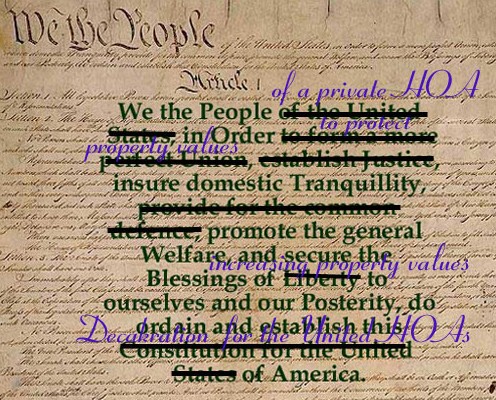
The above picture reflects the rewrite of the Preamble to the Constitution as applied to the HOA-Land nation. It reads,

“We the people of a private HOA, in order to protect property values, insure domestic tranquility, promote the general welfare, and secure the blessings of increased property values to ourselves and our posterity, do ordain and establish this Declaration for the United HOAs of America.”

Why is there a need for board of directors education on HOA constitutionality? Why? Because:

  • HOAs are a form of local government not subject to the Constitution, and have created divisiveness and a separation from the greater public community resulting in member confusion regarding the law and their constitutional rights and protections;
  • the national lobbying entity, CAI, has indoctrinated the legislators, the courts, and the public with its CAI School of HOA Governance program that contains just lip service to constitutional questions, for example,

“A global nonprofit 501(c)(6) organization, CAI is the foremost authority in community association management, governance, education, and advocacy. Our mission is to inspire professionalism, effective leadership, and responsible citizenship—ideals reflected in community associations that are preferred places to call home.”[2]

while opposing the application of the Constitution in its numerous amicus curiae briefs to the courts, for example,

“In light of these statutory, contractual and common law standards protecting the interests of community association members, they need not claim constitutional protection from the conduct of governing boards to exercise their rights with respect to the associations.”[3]

  • The Findings, Section II, Education for Homeowners Associations and Board Members, of the North Carolina HOA study report to the NC General Assembly recommended,

“In order to provide accurate and readily available resources to educate homeowners, board members, and interested persons about the duties and responsibilities of property ownership in an HOA community, the General Assembly . . . to seek reliable and unbiased information available from private entities . . . and provide for published and online documents and programs offering HOA education . . . .”[4]

  • Privatopia: Homeowner Associations and the Rise of Residential Private Government, the 1994 landmark book based on the research of UIC Prof. McKenzie, and highly appropriate today, called the reader’s attention to,

“CIDS [HOAs] currently engage in many activities that would be prohibited  if they were viewed  by the courts as the equivalent of local governments.

“In a variety of ways, these private governments are illiberal and undemocratic. Most significantly boards of directors operate outside constitutional restrictions because the law views them as business entities rather than governments. . . . [They] are inconsistent not only with political theories of legitimacy but with the normal process by which governments are created. . . . Thus these ‘private governments’ may violate the equal protection clause of the Fourteenth Amendment.” (Chapter 6).

  • A Table of Authorities,[5] not all inclusive, supporting the Restoring the Lost Constitution.
  • Unanswered questions on HOA constitutionality:

CAI Common Ground Editor Durso mentioned my 2006 “‘open e-mail questionnaire to CAI’ containing four questions.”  Below is a copy of those questions initially addressed to the AZ Legislature a year earlier.  I never had any answer, either from the Legislature or CAI, nor any debate on the issues.

In a 2011 email to the North Carolina Legislature House HOA Committee I asked, “the legislators, the public interest organizations and policy makers to consider the following questions.” And I concluded with, “I await your reply, or a reply from any of the legal-academic aristocrats.”[6] Still no answer.

    • Can a legislature delegate its functions, not government services but functions, to private entities without oversight or compliance with the Constitution, as required of all government entities?
    • Can private parties enter into contractual arrangements using adhesion contracts and a constructive notice consent that serve to regulate and control the people within a territory (an HOA), to circumvent the application of the Constitution?

 A webinar is in the plans that summarizes and follows the materials – the text — comprising the HOA educational series to reorient HOA boards and the public in general. The text is available online under the collection, “Restoring the Lost Constitution to HOA-Land.” Will be coming soon.

Notes

[1] See https://tinyurl.com/sr27yq3.

[2] About Community Associations Institute, April 4, 2020). https://finance.yahoo.com/news/community-associations-institute-cai-provides-181931116.html. April 4, 2020).

[3] CAI amicus brief, Jan. 3, 2013, Dublirer v. 2000 Linwood Avenue Owners Assn, N.J. Docket 069154 (2014).

[4] “Study On Homeowners Associations”, Luke A. Rankin, Chair, South Carolina General Assembly (December 18, 2015). (http://www.scstatehouse.gov/CommitteeInfo/HomeownersAssociationStudyCommittee/HOAStudyCommitteeFinalReport12182015.pdf). April 27, 2020).

[5] http://starman.com/m…/restructureHOA/restructure-reading.pdf.

[6] See Too hot for NC HOA committee – withdraws legal-academic “experts, George K. Staropoli, HOA Constitutional Government (Nov. 17, 2011). https://pvtgov.wordpress.com/2011/11/17/too-hot-for-nc-hoa-committee-withdraws-legal-academic-experts/

“Rules of Engagement” apply to CAI

Many may feel from all my criticism that I unjustifiably have it in for CAI.  Well folks, you decide whether the CAI propaganda statements and publications that are PR releases is in conflict with its numerous acts before state legislators and the courts.  These contradictory stances are revealed in CAI’s amicus briefswhat I say I don’t do [1].

Advocates have failed to apply the Rules of Engagement to such Doubletalk[2] from CAI allowing the legislators, the media and the BODs to see no evil, hear no evil speak no evil.  These Rules are a very important weapon to discredit CAI and stop the policymakers from trusting their misleading statements; to start believing in the validity of the positions and arguments for HOA reforms coming from homeowners and homeowner advocates.

As a prime example, and there are many others found in the numerous CAI briefs dealing with constitutional HOA issues, is the NJ Supreme Court case in Dublirer.[3] It involved the free speech rights of a homeowner to equal access the HOA facilities in order to distribute BOD election materials to his neighbors – an exercise of his rights in a democracy. Allow me to repeat my quotes[4] from CAI’s NJ Supreme Court amicus brief in Dublirer.[5]

CAI-NJ’s concern is the attempt to convert private communities into constitutional actors and to open such communities to access not only to speakers from within the community but also to the public, while ignoring contractual agreements and non-constitutional protections.

The relationship between the plaintiff and the defendants here is that of a business corporation and so is similar to that involved in any other business corporation. A shareholder who wishes to run for a position on a corporate board has no right to post campaign signs on the corporation’s property. . . . He has no constitutional right to distribute his campaign materials within the cooperative’s property simply because mailing them to the other tenant/shareholders may cost him money”.

In plain English, this is secessionist and a rejection of the Constitution. CAI’s position says the people in an HOA will decide what laws to follow or not to follow. It is an incredulous statement from the organization that claims to be the one and only voice on HOAs, but apparently does not understand or simply ignores constitutional law. The CAI position is in opposition to the  long-standing legal doctrine on the delegation of legislative (lawmaking) powers to private persons.

In order to win, advocates must muzzle CAI’s lack of “candor to the tribunal.”[6]  Judicial and legislative  doctrines hold that an allegation or argument that goes unanswered is held to be true.  That’s why, it seems, advocates are viewed as unbelievable,  because of their repeated silence resulting from a lack of knowledge on how to respond.  This must change!


References

[1] See in general, Will the real CAI standup: its contradictory beliefs, pronouncements and goals.

[2] From George Orwell’s novel, 1984, where a person holds two contradictory statements at the same time.

[3] Dublirer v. 2000 Linwood Avenue,  103 A.3d 249 (NJ 2014).

[4] See my Commentary for additional quotes: CAI: the HOA form of government is independent of the US Constitution.

[5] Dublirer CAI Amicus.pdf.

[6] Attorney Rules of Professional Conduct, Rule 42, E.R. 3.3