Is AZ ADRE violating 1st Amendment free speech on HOA public issues?

Regarding Arizona’s real estate department’s (ADRE) promotion of the HOA special interest organizations, CAI and AACM, in its Resources category on its HOA Due Process web page, there are no opposing homeowner rights views on HOA-Land.  Nada!

These pro-HOA groups sustain, and continue to offer and promote the same failed arguments and “solutions,” of the past 23 years in Arizona. They are on record opposing due process and the equal protection of the laws for HOA members. It seems that they have adopted the view that the goals and objectives of the state, meaning the HOA government, supersedes the individual rights of the people, the HOA members. (See CAI manifesto: CAI’s plan for HOA-Land in America, a commentary on CAI’s “white paper.”

At a meeting with ADRE I argued for ADRE to remove CAI and AACM from or to add references to opposing views, well supported by evidence, to its web page.  I suggested that my Constitutional Local Government or HOA Constitutional Government would provide a factual based view, and give the general public a “full disclosure” of life in HOA-Land.   Let’s be fair! Let the homeowner choose after he has all the facts and not those of self-interested private vendor groups.  This would be in keeping with ADRE’s mission “to protect the interests of the general public.”

If we are to make progress for HOA members, the policymakers move past what CAI and AACM have been saying in their voluminous promotional and marketing sayings — like its Factbook — and to what the CAI/AACM members are actually saying before state legislatures and the courts. The contradictions between the two are stark; one is talk, the other is action, as outlined in the materials presented to ADRE.


I am awaiting the decision of the ADRE Commissioner.  It has been a month — a reasonable time to make two line changes on their web page — since I first contacted ADRE with the above request to remove the vendor organizations, or to add homeowner rights websites as a balanced recommendation.  I hope that ADRE will act very quickly on this important request granting free speech to all sides of the controversial HOA issue.

The US Supreme Court decision in Con Ed v. Public Service Comm’n of NY (447 U.S. 530 (1980)) sheds some important light on ADRE’s unreasonable delay in acting on my request, which can only be interpreted as a denial.  In Con Ed a state agency prohibited the inclusion of political material by a public utility company in its monthly billing statements.  Among other things, the Court held: (my emphasis)

But when regulation is based on the content of speech, governmental action must be scrutinized more carefully to ensure that communication has not been prohibited merely because public officials disapprove the speaker’s views.” (Part III(A)).

As a general matter, “the First Amendment means that government has no power to restrict expression because of its message, its ideas, its subject matter, or its content. . ..  To allow a government the choice of permissible subjects for public debate would be to allow that government control over the search for political truth. (Part III(B)).

The denial of opposing homeowner rights website inclusion on its Resources web page would constitute a First Amendment violation.

Homeowners can play a significant role by speaking out.  Write about the quality of advice received from these organizations as to resolve problems with your HOA.  Was it helpful?  Were you satisfied? Please be sure to provide solid evidence – solid documentation – to support your request for help; no whining, no crying we was robbed.

Address these matters to Dan Gardner (dgardner@azre.gov), and send a copy to me at info@pvtgov.org with complete confidentiality.

It’s time to lower the AZ agency HOA dispute fees to that of superior court

Last month I met with Arizona’s Real Estate (ADRE) Commissioner Judy Lowe, Deputy Commissioner Louis Dettorre, and Constituent Manager, Dan Gardner to discuss what ADRE can do to help homeowners buying and living in HOAs.  As many may not know, ADRE’s involvement with HOAs increased with the 2016 re-assignment of HOA dispute processing by OAH.

Among other things, we discussed 1) a clarification of the OAH costs that warrant the $500 filing fee, and 2) ADRE’s listing of CAI and AACM (HOA managers association, a split-off from CAI in 2003) on its web page as resources (subject of another Commentary in the works).

Regarding OAH fees, with which the Commissioner had some concerns, from the very beginning in 2006 OAH was to operate on a cost recovery basis. The initial fee was set at $500 with later reviews. The Commissioner has the authority to change the fee.  (Many of the cases were filed by homeowners, mostly without an attorney.)

The requirement for this fee stemmed from the fear mongering of the special interests who claimed that the courts and OAH would be swamped with complaints. It seems that the alleged 95% good people now have turned, in a NY minute, to 95% bad people.

After 11 years in operation, we find that HOA petitions (54) amount to an insignificant .8% of all 5,251 OAH cases as reported in OAH’s 2016 report.  Is the $500 fee justified?  Consider that many of the extended cases are the result of actions initiated by the HOA attorney, which would drive up the costs of HOA claim processing. Also, OAH states that it is seeking a standard average charge-back cost to all agencies of approximately $174.  Something doesn’t add up!

In response to my Public Records request, OAH provided the following data on the costs of HOA dispute processing:

OAH FYE June 2017 totals

524 hours spent on 54 cases, or 9.7 hours per case

$36, 069 spent on 54 cases, for an average cost of $668 per case. The first half -year cost came to $750 per case, and $607 per case for the second half-year.

In addition to the hourly fees, there is an agency “flat filing fee,” sort of an overhead fee, charged to ADRE in the approximate amount of $175, which appears to be the charge-back fee mentioned above.

The Superior Court (Maricopa County) fee for filing a complaint is just $322.  Why does it cost more for OAH to handle HOA claims than for Superior Court?

After 11 years, it’s time for a thorough review of the statutes relating to HOA fees.  HOA homeowners are not getting a fair deal as set forth in the 2011 statutes reviving OAH handling of disputes. It required (Sec.4, Legislative Findings and Intent, AZ Sess. L. Ch. 185),

[O]wners are often unable to afford the cost of formally litigating their disputes in the superior court. . .. [OAH] will provide an important consumer protection for owners . . . without the expense, formality and difficulty of requiring a trial in the superior court in every instance . . ..”

By law, today, the ADRE Commissioner sets the filing fee for HOA disputes. I am hoping that the Commissioner will set things right and propose legislation to address this gross injustice suffered by the good people living in HOAs. 

Homeowners can play a significant role by speaking out and addressing this matter to Dan Gardner (dgardner@azre.gocv).  Arizona homeowners must act now!


A California true HOA Bill of Rights

CA Chapter 236 (SB 407) (2017), just passed into law.  A true Homeowner Bill of RightsThank you Senator Wieckowski.


The people of the State of California do enact as follows:

SECTION 1. Section 4515 is added to the Civil Code, to read:

  1. (a) It is the intent of the Legislature to ensure that members and residents of common interest developments have the ability to exercise their rights under law to peacefully assemble and freely communicate with one another and with others with respect to common interest development living or for social, political, or educational purposes.

(b) The governing documents, including bylaws and operating rules, shall not prohibit a member or resident of a common interest development from doing any of the following:

(1) Peacefully assembling or meeting with members, residents, and their invitees or guests during reasonable hours and in a reasonable manner for purposes relating to common interest development living, association elections, legislation, election to public office, or the initiative, referendum, or recall processes.

(2) Inviting public officials, candidates for public office, or representatives of homeowner organizations to meet with members, residents, and their invitees or guests and speak on matters of public interest.

(3) Using the common area, including the community or recreation hall or clubhouse, or, with the consent of the member, the area of a separate interest, for an assembly or meeting described in paragraph (1) or (2) when that facility or separate interest is not otherwise in use.

(4) Canvassing and petitioning the members, the association board, and residents for the activities described in paragraphs (1) and (2) at reasonable hours and in a reasonable manner.

(5) Distributing or circulating, without prior permission, information about common interest development living, association elections, legislation, election to public office, or the initiative, referendum, or recall processes, or other issues of concern to members and residents at reasonable hours and in a reasonable manner.

(c) A member or resident of a common interest development shall not be required to pay a fee, make a deposit, obtain liability insurance, or pay the premium or deductible on the association’s insurance policy, in order to use a common area for the activities described in paragraphs (1), (2), and (3) of subdivision (b).

(d) A member or resident of a common interest development who is prevented by the association or its agents from engaging in any of the activities described in this section may bring a civil or small claims court action to enjoin the enforcement of a governing document, including a bylaw and operating rule, that violates this section. The court may assess a civil penalty of not more than five hundred dollars ($500) for each violation.

the media must stop falling into the clutches of the HOA special interests

My letter to the AZ Central authors, and others:

To authors, Jessica Boehm & Catherine Reagor,

A great in-depth article (HOAs foreclosing on hundreds of Phoenix-area homeowners for as little as $1200) on foreclosure!  About time!   However, some comments.

I am disturbed that you quote a Florida advocate and ignore all my work on the inequities of HOA foreclosures.  And, you quote HOA attorney Bolen of CAI and the AACM HOA managers – not licensed by ADRE — who are special interest vendors to HOAs.  This is very disturbing and reflects a bias in the media. I hope that Commissioner Lowe takes notice of the media failing to report the whole truth about HOA foreclosure.

See Draconian punishment and intimidation, No. 8 in my HOA Common Sense: rejecting private government.  Here’s an excerpt for your edification:

 “An award of more than the 10 times for punitive damages was held by the US Supreme Court in State Farm v. Campbell[iii]  to be a cruel and unusual punishment in violation of the 8th Amendment.  This right to [HOA] foreclose is unjust and draconian taking away a person’s home and leaving him with nothing!   

It is unconscionable and discriminatory as explained below. . . . [quoting CAI member attorney] If the property is not subject to a mortgage or there is a minimal first mortgage, foreclosure is a viable option as there is likely equity in the property. . . . Even if the property is subject to a recorded first mortgage and there is no equity in the property, foreclosure still may be a viable option. Sometimes the threat of foreclosure alone is enough to get a delinquent owner’s attention”

In short, the HOA only gets money if there is sufficient equity in excess of the mortgage, otherwise it gets nothingIt ain’t fair!  It’s discriminatory and punitive.

I keep on hoping that investigative reporters do their job – fully investigate the issues without fear of telling it like it is!


CAI 2016 Factbook: looking into the ‘facts’

In 2007 I analyzed CAI’s Factbook at that time and found that CAI was a miniscule minority (See CAI miniscule minority dominates public policy).  I found that .03% of the people living in HOAs are CAI members as compared to some 50% +/- of seniors are AARP members.  Also, that .07% of HOA units have a CAI member.

Since that was 10 years ago, I’ve updated my statistical analysis using the CAI Statistical Review 2016, Factbook Part 4, adding additional explanations.  A number of concerns are raised.

MY FINDINGS:

HOAs, units, residents

  1. The percent HOA units to total US units rose from 16.9% in 2000 to just 19.1% in 2016.
  2. The percent people (residents) in HOA to total US people in homes rose from 16.1% in 2000 to 21.4% in 2016.
  3. People per HOA unit was fairly consist at about 2.5, in line with US Census data for people in units.
  4. Unexpectedly, the average number of people per HOA was also fairly consistent about 200 people, +/- 3.
  5. Similarly, the average number of units in an HOA was fairly consistent at about 80 units per HOA.
  6. As a check on (4) above, I choose data from 6 states[1] provided in the Factbook state summary, both large and small, as a comparison.  The number of people per HOA in these 6 states came to about the same 200.

CAI membership stats

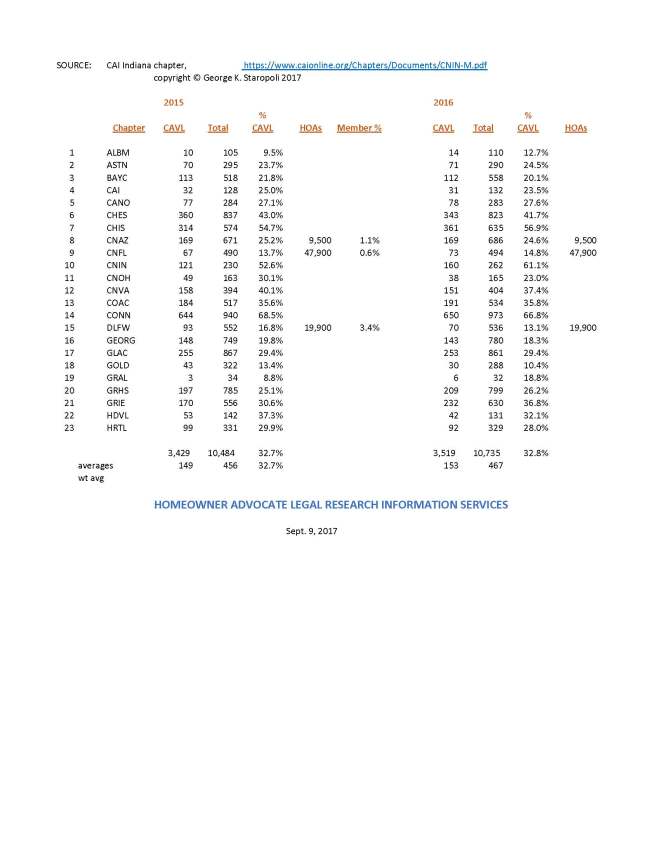
  1. Being concerned about the frequency of fixed ratios found in (A), I came across data from the CAI Indiana chapter for 2015 and 2016.[2] The percent ‘volunteers’ per HOA for both years was 32.7% and 32.8%, respectively. Very consistent.
  2. Of the 69 M people in HOAs, CAI membership, at most, consists of a miniscule .05% (.00048).
  3. Of the 33,000 CAI members, a minority of some 10,800 are ‘volunteers’ and not attorneys or managers.
  4. ‘Volunteers’ (CAVL) represent a miniscule .016% (.00016) of HOA members.

CONCLUSIONS:

We can safely say that, assuming some 342,000 HOAs,

  1. if each CAI member came from a different HOA, then 9.6% of the HOAs contain a CAI member,
  2. and a mere 3.2% of HOAs contain an HOA ‘volunteer’;
  3. at most then, CAI ‘volunteers’ have a presence in a mere 3.2% of HOAs across the country;
  4. CAI’s claims to speak for members and even HOAs with its less than a 10% presence is highly misleading.


Factbook issues

The following discussion uses the Excel charts found in Exhibit 1.

What I found disturbing in A4 and A5 above were the fixed ratios of residents and units to the number of HOAs; namely roughly 200 and 80, respectively.  Note that these 2 numbers have a fixed ratio of about 2.5.  This did not seem natural to me or a result of freely occurring human behavior. The same ‘200’ ratio appears in the 6 individual states in the CAI state factbook, which does not have “units” data for comparison.

CAI’s Residents and “Units” figures have a fixed 2.5 ratio, reflecting the long-standing US Census ratio of the number of residents to the number of units in general for all housing. Consequently, once either of the units or residents are known, the other statistic is just a mathematical calculation. As for the missing “units” figures for the individual state stats, they can easily be calculated by dividing the residents number by 2.5.  It’s as simple as that.

Notice the natural, expected variation in data found in the Indiana chart (Exhibit 1, p. 2) for both CAVL and total members.  This variation also shows in the “communities” column for the six states on page 1 of the Exhibit, but is absent from the main CAI historical summary page for “communities.”  The other data on the summary page flow from the fixed ratios mentioned above.

It can now be asked: How reliable is the data for CAI’s “Communities” figures?  As shown in the chart on p. 1 of the Exhibit, the HOA growth is a steady 15,000 annual increase over 17 years, from and including 2000 to 2016. I don’t feel comfortable with this constant rate of growth; it’s not natural or to be expected.  But, it may well be.  Who knows?


References

[1] Arizona, California, Colorado, Florida, Illinois and Texas.

[2] CAI Indiana chapter document.


EXHIBIT  1

page 1

CAI 2016 p1 stats

page 2


CAI 2016 p2 stats