
Is there anything wrong with this expression of art and individuality?? I mean, HOAs can only think in terms of shades of tan, grey or white, setting new architectural standards for America. In Austin, TX and HOA looking to sue.
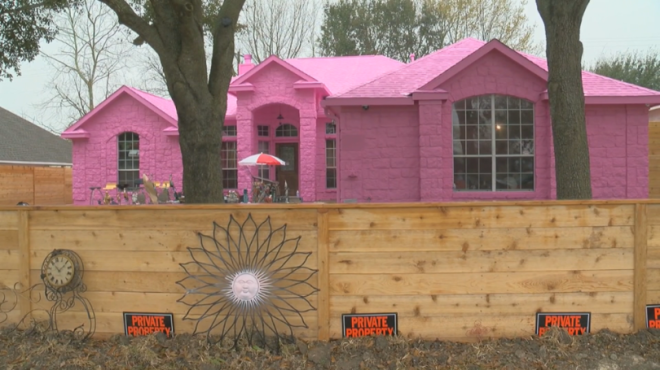
Is there anything wrong with this expression of art and individuality?? I mean, HOAs can only think in terms of shades of tan, grey or white, setting new architectural standards for America. In Austin, TX and HOA looking to sue.
Let’s forget about the controversy surrounding SB 320 for the moment and look at the bill itself. It applies to Title 8, Chapter 2, Article 1, Part 1 that deals with water concerns and has nothing to do with “building design elements” or zoning.
The bill reflects a power struggle between the developers of private government HOAs and constitutional government that’s occurring in many states besides Georgia. There is the Georgia Constitution and Code (Title 36, Chapter 35, HOME RULE POWERS) that grants municipal powers with certain restrictions. The Georgia Home Rule code grants restricted freedoms and powers to local government but holds them accountable under the state constitution and laws. This is not so with HOAs that go by and large unregulated. The bill makes them more so!
“The Georgia Constitution specifically provides for “home rule” for counties and municipalities in Georgia. While county home rule is constitutionally prescribed, cities may be granted the same right by the state legislature. In both cases the county or city is authorized to adopt “clearly reasonable ordinances, resolutions, or regulations . . . for which no provision has been made by general law and which is not inconsistent with” the Constitution of Georgia.” (“Home Rule and Ordinances,” New Georgia Encyclopedia).
SB 302 supports, in my view, easier HOA approvals by the municipality planning board. Code section 8-2-5 adds (c)(2), the bill does not “Affect the validity or enforceability of private covenants or other contractual agreements among property owners relating to building design elements.” The definition of zoning (Section 2 of the bill) is reworked in Code section 36-66-3. The prohibition of the municipality to regulate “building elements” (Section 1 of the bill) is necessary to allow developer a full play as presented by Section 2.
A reading of Section 2 of the bill allows the perception that it is an attempt to grant HOA developers and their created subdivisions a host of building features and elements, which they can take before the municipality to get rubber stamped. Planning board approvals are basically granted unless there is citizen opposition, or the subdivision plan violates some aspect of the law.
Guess what? SB 302 puts the law on the developer’s side!
Since has been some time since I checked CAI’s membership breakdown, here’s some surprising news I just uncovered, right from CAI Central’s own mouth. HOA representation through “volunteers” (since HOAs per se are not allowed) consists of a mere 36%, and yet CAI has the gall to say they speak for homeowners to federal agencies, to state legislators, to the media and to the public at large!
As I’ve said all too often, board members are targeted by CAI through discount fees based on the number who join from an HOA. In my view, all HOA directors who are CAI members are conflicted as to whom they owe their allegiance. To the vendor organization whose members feed off them, or to the unit owner, members as required by the CC&Rs contract?
“Business partners” means, for the most part, attorneys; “managers” total 42%.
See CAI Marketing Opportunities, CAI Member Breakdown, page 3. I suspect the announced increase to 40,000 came from international growth.

According to CAI, 9 states have adopted UCIOA (Uniform Common Interest Ownership Act), 14 the UCA (Uniform Condominium Act, and 1 state, Pennsylvania, the UPCA (planned community act)?[i] Why is it that only 1 state, Kansas,[ii] has adopted the Uniform Common Interest Ownership Bill of Rights Act (UCIOBORA) in 2008?[iii]
The Bill of Rights Act was released as a separate act independent of the basic and initial UCIOA, and from the above state adoptions we can see why. Apparently, except for Kansas, none of the states care for a Bill of Rights for HOAs!
Why then did the BORA come to pass with only one “buyer”? Allow me to provide some background as to why BORA came about. In the years preceding its 2008 appearance, there was an outcry for a homeowners’ bill of rights with yours truly, among others, playing an important role in demanding homeowner rights. Among the demands were Texas attorney David Kahne who co-wrote the AARP Member Bill of Rights in 2006[iv]; and yours truly who argued for homeowner rights to CLRC that was conducting a rewrite of California’s CID act, the Davis-Stirling act (2005 – 2008).[v]
CAI is an avid supporter of UCIOA even to this day, probably because it’s based on the HOA legal scheme and structure introduced in the 1964 Homes Association Handbook.[vi]
Let’s see what pro-HOA state legislators and the national lobbying entity may have felt quite disturbed about its covenants. (A hint is given when ULU chose to make it free-standing).
UCIOBORA excerpts:
“The Need for a Free-Standing Home Owner Bill of Rights. . . . The reason is that each of these complex Acts has its detractors who have historically blocked adoption of these Acts in any state. . . . [And] of the difficulty drafters in the States may encounter in integrating any new adoption of the existing Uniform Acts with the laws that may already exist in a particular state. For these reasons, ULC promulgated a free-standing and relatively short Uniform Act that addresses all of the ‘association versus unit owner’ [hints at similarity of ‘management vs employees’] issues touched on during the drafting of the 2008 UCIOA amendments.[vii]
(5) shall establish a reasonable method for unit owners to communicate among themselves and with the executive board concerning the association;
(6) may suspend any right or privilege of a unit owner that fails to pay an assessment, but may not: (B) suspend a unit owner’s right to vote (Section 8(a), powers of HOA). (a) In the performance of their duties, officers and members of the executive board appointed by the declarant shall exercise the degree of care and loyalty to the association required of a trustee (Section 9, Executive Board).
(b)(5) determine the qualifications, powers, duties, or terms of office of executive board members (Section 9).
(a)(4) specify the powers the executive board or officers may delegate to other persons or to a managing agent (Section 10, Bylaws);
(Section 11, Owners meeting). (c) The notice for any meeting must state the time, date, and place of the meeting and the items on the agenda, including: (1) a statement of the general nature of any proposed amendment to the declaration or bylaws;
(f) The declaration or bylaws may allow for meetings of unit owners to be conducted by telephonic, video, or other conferencing process, if the alternative process is consistent with Section 12(g).
(g) Except as otherwise provided in the bylaws, meetings of the association must be conducted in accordance with the most recent edition of Roberts’ Rules of Order Newly Revised.
(Section 12, Executive Board meetings). (g) Unless the declaration or bylaws otherwise provide, the executive board may meet by telephonic, video, or other conferencing process if: (1) the meeting notice states the conferencing process to be used and provides information explaining how unit owners may participate in the conference directly or by meeting at a central location or conference connection; and (2) the process provides all unit owners the opportunity to hear or perceive the discussion and to comment as provided in subsection (d).
(Section 14, Voting). (d) Unless prohibited or limited by the declaration or bylaws, an association may conduct a vote without a meeting. In that event, the following requirements apply: (3) The ballot must set forth each proposed action and provide an opportunity to vote for or against the action.”
OK, where are we? The sampling above is not in the same spirit and intent as our constitutional and properly named, Bill of Rights.
“THE Conventions of a number of the States having at the time of their adopting the Constitution, expressed a desire, in order to prevent misconstruction or abuse of its powers, that further declaratory and restrictive clauses should be added: And as extending the ground of public confidence in the Government, will best insure the beneficent ends of its institution.”
On the other hand, UICOBORA addresses the governing documents as if they were the HOA’s constitution in its attempt to bring more fairness and justice to homeowner issues and complaints. The Uniform Law Commission (ULC) had good intents. However, the two BOR are like apples and oranges. UCIOBORA should be more aptly named Homeowners Rights and Responsibilities. Instead appears to look as if it were supporting a genuine BOR for HOA homeowners based on our Constitution.
Furthermore, don’t get confused with CAI’s Rights and Responsibilities for Better Communities,[viii] which consists of “ought to” advice and prescriptions for better communities, with nothing that you can go to court on. Excerpts:
“Homeowners have the right to: Honest, fair and respectful treatment by community leaders and managers, Receive all documents that address rules and regulations governing the community association,
“Homeowners have the responsibility to: Read and comply with the governing documents of the community, Treat association leaders honestly and with respect, Vote in community elections and on other issues, Pay association assessments and charges on time.
“Community leaders have the right to: Respectful and honest treatment from residents., Receive support and constructive input from owners and non-owner residents;
“Community leaders have the responsibility to: Conduct open, fair and well-publicized elections, Conduct open, fair and well-publicized elections, Encourage events that foster neighborliness and a sense of community.”
The good intentions of the Uniform Law Commission were found unacceptable by all the states except Kansas. Nationally, we have UCIOA, the Uniform Common Interest Act replacement to America’s Constitution with a deceptive bill of rights for homeowners as contained in UCIOBORA. Yet, HOA-LAND[ix] continues to grow and represents a secession from the Union without a shot being fired. These subdivisions and condos portrayed as “communities” function outside the US Constitution and have substituted their governing documents as the community’s supreme law of the land.
by: George K. Staropoli
References
[i] “CAI State Advocacy, Uniform Acts.”
[ii] “Kansas Legislative Research Department”, Common Interest Statutes, March 2018).
[iv] AARP HOA Bill of Rights, David Kahne.
[v] See California CLRC proposal for state assistance to HOAs, Homeowner Rights are an important issue for California’s CLRC, CLRC proposes changes to HOA laws without a bill of rights. Also involved in the quest for a CA Bill of Rights were Donie Vanitzian (see Staropoli letter to CLRC) and Elizabeth McMahon (“In 1997, Elizabeth McMahon of AHRC filed a Homeowners Bill of Rights with the California Law Review Commission looking into revising California’s HOA statutes); both are no longer with us.
[vi] See Analysis of The Homes Association Handbook.
[vii] Supra n. iii, Prefatory Note, page 1.
[viii] CAI’s Rights and Responsibilities.
[ix] Definition of HOA-LAND: HOA-Land is a collection of fragmented independent principalities within America, known in general as “HOAs” that are separate local private governments not subject to the constitution; and collectively constitute a nation within the United States.
Long ago in 1994 Professor McKenzie wrote, “HOAs currently engage in many activities that would be prohibited if they were viewed by the courts as the equivalent of local governments.”[i] There is no better example of HOA independence than prejudiced HOA election procedures. In 2013 I wrote,
“HOA members have been repeatedly told that they can change things in their HOA by voting for board members and even by changing the governing documents; that HOAs are democratic because members can vote to make these changes happen. . . . Without fair elections procedures that contain enforcement against HOA board wrongful acts, including retaliatory acts and intimidation by the board, voting in an HOA is a mockery of democracy.[ii]
CAI, on the other hand, maintains in its Public Policy statement that,
“Community associations are one of the most representative and responsive forms of democracy in America today. Residents of a community freely elect neighbors to serve on the board of directors of the community.[iii]“
Let me give a prime example of far these pro-HOA procedures can go to deny members a fair and just voting process, one that subtly favors the HOA Board. In this large scale HOA in Arizona with over 9,000 homes and some $20 million in revenues, amendments to the CC&RS and bylaws are needed to be approved by 67% of the membership.
The governing documents have an unusual, non-standard voting procedure that allows for “consent” by the members, in addition to an actual vote, which constituts a vote and are counted in the approval requirement. Members just have to fill out a form and submit it. Surprisingly, in contrast to the public voting procedures, this procedure contains
This method of voting by the HOA would not pass muster in the public realm. So much for democracy in action. This election process is rigged in favor of approval, is unjust and negates any choice by the members who may wish to submit a NO vote. It’s a no-lose approach for the Board since the Form does not allow for NO votes! It would never fly under the public realm’s fair elections requirements.
In Wittenburg v. Beachwalk HOA,[iv] the California appellate court held that a board is engaged in advocacy when it supported and urged an approval vote in its materials and communications. The Court’s view was that opposing parties must be given equal opportunity to advocate against the proposition, which is being denied in the above instance, by not allowing a no vote and the open-ended voting process of form submissions with only YES votes.
The Court held that the relevant statute was in the public interest and it sought to
“provide substantial new voting protections” to members of homeowner associations designed to “guarantee that basic democratic principles are in place during elections,” which had previously been “contaminated by manipulation, oppression and intimidation of members, as well as outright fraud.”[v]
Yet, overwhelmingly, according to the CAI surveys, HOA members standby their HOA even though it operates outside of constitutional protections and the laws of the land. They seem to believe that, like a King, their board can do no wrong; that, contrary to James Madison’s view that “If angels were to gvern men, neither internal nor external controls on government would be necessary,” their board must consist of angels.
The HOA legal scheme as set forth in the governing documents and pro-HOA state laws, does not contain a fundamental principle of our constitutional system of government: checks and balances. The HOA board basically has, for all practical purposes, a free hand to function as an authoritarian government.
By: George K. Staropoli
References
[i] Evan McKenzie, Privatopia: Homeowners Associations and the Rise of Residential Private Governments, Yale Univ. Press, 1994.
[ii] “Democratic Elections No. 5,” George K. Staropoli, HOA Common Sense: rejecting private government.
[iii] Section 8 in An Introduction to Community Association Living (2006).
[iv] Wittenburg v. Beachwalk HOA, 217 Cal.App.4th 654 (2013).
[v] Id.
 HOA Constitutional Government