Preliminary HOA – public survey report

Allow me to offer some important background so you can better understand the objective, method and results being sought. You have noticed that this survey is quite unique for an HOA problem/satisfaction survey. It is a survey of RWA – Right Wing Authoritarianism. (It is not a political measure and does not reflect political parties or conservative- liberal orientation).

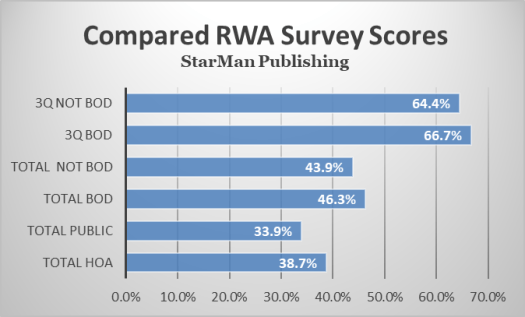
results graph 9-6-19


View the report.


Survey asks: Do HOA members differ from the general public?

The US Constitution, the Bill of Rights and our democratic system of government are bigger than any of us, bigger than businesses, organizations, groups, nonprofits and local private governments.  They are the fabric that holds this country, the states and the local governments together to maintain an orderly society — an orderly community. Otherwise there is chaos or dictatorship.

sp_logo_newStarMan Publishing* is conducting a survey to assess whether there are differences in personalities and character between persons living in HOA communities from those living in traditional residential communities.  Do the members of an HOA constitute communities or societies distinguishable from public communities?  It is estimated that some 23% of US population live in an HOA of some kind.

Twenty short questions are asked to form this assessment.  All questions must be answered —  there is a “not sure” response.  It is estimated to take only 5 minutes for this important survey. For those respondents who live in an HOA, an additional eight questions are asked with respect to the respondent’s attitude toward the HOA.   All responses and email addresses will be kept confidential. Results may be used in research studies.  Recipients are urged to participate.


Take this important survey HERE.

Results will be updated from time to time.

                  “With malice toward none; with charity for all


* StarMan Publishing, LLC is a nonprofit producer of books and videos relating to homeowners associations, their legal structure and model of private government. George K. Staropoli, is a homeowner rights advocate for over 18 years and the publisher and editor.


High RWA followers can be found in HOA members

This commentary is a copy of my Amazon review of Robert Altemeyer’s 2007 book, The Authoritarians.  “RWA”  is the author’s term for Right-Wing Authoritarian followers, where the term ‘right-wing”  is used to designate people who “traditionally submit to authority.” Altemeyer writes,

Followers submit too much to the leaders, trust them too much, and give them too much leeway to do whatever they want–which often is something undemocratic, tyrannical and brutal.

My concern focused on the blind, to me, acquiescence to whatever the BOD told the members what it wanted approved, especially when it involved amendments to the governing documents. When presented with hard, concrete evidence of violations of the law or governing documents, the majority of the members just gave the BOD a blank check. The conduct of the BOD and numerous members echoed the behavior described by Altemeyer in the opening chapters of his book: a defense of the board, attacking the “whistleblower,” refusal to discuss, or debate or hear any opposition, with the ultimate dogmatic final defenses coming into play.

Reading the opening chapters of The Authoritarians immediately brought to mind the conduct of HOA members. Chapter 6 on legislative RWAs also hit the button since state legislators fell into the same defense of HOA-Land (the fragmented collection of HOAs across the country) with a dogmatic reaction. Chapter 7 on “What to do” was not surprising as I’ve attempted his short-term suggestions and failed just as Altemeyer stated. If I had been aware of Altemeyer 10 years ago I would have saved a lot of time.

My own analysis of this blind obedience is presented in my book, HOA-Land Nation Within America, (Part 1, “The Cultural Dynamics of HOA-Land”) and fell short of making a solid case for this behavior. HOA right or wrong rested on the pro-HOA national lobbyist indoctrination into its authoritarian model of HOA governance. Altemeyer gives me solid ground to explain this behavior and his suggestions on how to combat it in the long term.

What is needed to confirm my analysis, however, is to run the RWA scale against HOA members and BODs, and to survey their views on a number of HOA aspects, as Altemeyer did with his students and state legislators.

If you truly want to understand how HOA-Land is undermining American democracy, The Authoritarians explains the contributions by the majority of the 23% Americans living in HOAs. He offers a path to returning to the fundamental values and principles of The Founding Fathers.


The validity of legal dicta in HOA court decisions

Too often I’ve come across the use of dicta by judges in highly controversial cases involving questions of HOAs a mini or quasi-government, as a state actor, and agreed to be bound and CC&Rs as a contract. Dicta are too often viewed by the average person to be a valid, legal precedent to be followed by the judge. Unfortunately, dicta are statements characterized by the lack of evidentiary support or authority and is essentially a side comment.

In short, “dictum” (singular of dicta) is “a comment by a judge in a decision or ruling which is not required to reach the decision . . . an opinion by a court on a question that is not essential to its decision it does not have the full force of a precedent.”[1] Unfortunately, it can be cited as to what a judge stated in his discussion, which can be the cause of a serious misunderstanding of its importance.

Take for instance the clarification of such a misunderstanding in Orchard Estate Homes[2] in which the homeowner plaintiffs mistook a statement by the trial court judge as law and used it as the basis for an appeal. The appellate court held, “we conclude Alliance [plaintiff] has incorrectly construed statements made in dicta in some authorities regarding the purpose of the statutory procedure.”  The misconstrued dicta read (emphasis added),

The purpose of [the statute] is to provide homeowners associations with the `ability to amend [their] governing documents when, because of voter apathy or other reasons, important amendments cannot be approved by the normal procedures authorized by the declaration.

However, the actual statute made no reference or a requirement to show voter apathy and consequently the plaintiff’s argument for a failure to show apathy was moot — not relevant.

* * *

With respect to the controversial issues mentioned above, I’ve found judges making dicta stating that HOAs are not state actors, CC&Rs are a contract or are interpreted as a contract, and “agreed to be bound,” all without any case history or statute in support of such a broad statement. There are implied assumptions in each of these cases that make these dicta subject to misleading legal statements: that the legal model of HOAs does not meet the US Supreme Court criteria for state actors/actions; satisfies legal scrutiny, that the CC&Rs are a valid contract according to contract law and not equitable servitudes doctrine; that the agreement to be bound is a bona fide and valid consent according to contract law. No law, statute, code or court opinion are cited to support these dicta.

With respect to HOAs not being mini-governments, however, it is obvious that the creation of the HOA is by means of nonprofit corporation law and not municipal corporation law, which would not make any court statement dicta – it is a fact and not an unsupported opinion. However, the fact that an entity was given explicit statutory identification as a nonprofit organization and not an agency of the state was overruled by SCOTUS[3] (US Supreme Court). It held that the actual operation and functioning of the entity determined its status as an agency and not as a nonprofit corporation. This reasoning has not been applied to HOAs as nonprofit or mini-governments.

(Mini or quasi-government status is meaningless as it implies a municipal government. It is more appropriate to classify the HOA as a state actor — an arm of the state.)

As Chief Justice Marshall wrote long ago, dicta are “less likely to be accurate statements of law,”[4] And that is the danger facing homeowners seeking justice in the courts. Plaintiff homeowners need to challenge such dicta that have been wrongfully treated as precedent.

* * * * *

Did you know: “HOAs currently engage in many activities that would be prohibited if they were viewed by the courts as the equivalent of local governments. . . . This often leads to people becoming angry at board meetings and claiming that their “rights” have been violated – rights that they wrongly believe they have in the [HOA]. (Prof. Evan McKenzie, Privatopia, 1994).

To learn more about your loss of these rights and freedoms see The HOA-Land Nation Within America.

References

[1] Dicta is Latin for “remark, “a comment by a judge in a decision or ruling which is not required to reach the decision, but may state a related legal principle as the judge understands it. While it may be cited in legal argument, it does not have the full force of a precedent (previous court decisions or interpretations) since the comment was not part of the legal basis for judgment. The standard counter argument is: “it is only dictum (or dicta).” (https://dictionary.law.com/Default.aspx?selected=514). Chief Justice Marshall provides an instrumental justification for the maxim that dicta need not be followed. Dicta are less carefully considered than holdings, and, therefore, less likely to be accurate statements of law.

[2] Orchard Estate Homes v. Orchard Homeowner Alliance, 32 Cal.App.5th 471 (2019).

[3] DOT v. Assn of American Railroads, 135 S.Ct. 1225 1233 (2015).

[4] Supra n. 2./span>

HOA representative government and consent of the governed

George Washington wrote in his Farewell Address (1796), the Constitution “is the offspring of our choice, uninfluenced and unawed, adopted upon full investigation and mature deliberation, completely free in its principles . . . .”  The Declaration of Independence asserted “that to secure these [inalienable] rights Governments are instituted among men, deriving their just powers from the consent of the governed.”

These two quotes contain the fundamental principles of representative democracy adopted by means of a social contract, the Constitution, which are freedom of choice, ”just powers,” and “consent of the governed.” By virtue of these fundamental principles of democracy, HOAs cannot be considered as democratic governments. Period!

In his article explaining the meaning of the Constitution,[1] Edwin Meese III explains that “consent is the means whereby arbitrary power is thwarted. The natural standard for judging if a government is legitimate [and hence just] is whether that government rests on the consent of the governed.” 

In order for HOA governments to be just, legitimate and compatible with the Constitution these fundamental principles must be honored and supported. HOA “constitutions,” those CC&Rs, are not compatible with the US Constitution.

Meese further addresses the differences between “consent of the governed” and “will of the majority” that is a pro-HOA mantra. “The ‘consent of the governed’ describes a situation where the people are self-governing in their communities . . . into which the government may intrude only with the people’s consent.”

He explains that the “Will of the majority” is a political mechanism for decisions to be made by the government. In other words, the BOD makes decisions on behalf of the members based on its view of the majority will or some survey of the members. In short, in a representative democracy, like that attempted by the HOA legal structure, not all of the members are in agreement with or consent to the decisions of the BOD. It raises the issue of ‘the tyranny of the majority’ when the minority is not given due respect nor the ability to freely and equally speak out on HOA governmental issues.

Meese contends that the Founding Fathers[2] understood this weak point in a democratic government and the need to “insure domestic tranquility.”[3]

[A] government [must rest] not only on the consent of the governed, but also on a structure of government wherein the views of the people and their civic associations can be expressed and translated into public law and public policy. . . . Through deliberation, debate, and compromise, a public consensus is formed about what constitutes the public good. It is this consensus on fundamental principles that knits individuals into a community of citizens.

The structure of HOA governance is not based on and contradicts fundamental American principles and traditional values.  Furthermore, the CC&R are not even based on contract law 101 with its requirements for freely entered into, full disclosure, and explicit agreement to be bound,  but on the real estate doctrine of equitable servitudes.

To learn more about your loss of these rights and freedoms see The HOA-Land Nation Within America.


References

[1] Edwin Meese III, “What the Constitution Means,” The Heritage Guide to the Constitution (2005). Meese was the US Attorney General under Ronald Reagan.

[2] See in general, The Federalist Papers, #51, James Madison who explained, “Justice is the end [goal] of government. It is the end of civil society.”

[3] Preamble to the Constitution.