
CAI’s early awareness of HOA constitutionality, public mini-government

It appears that CAI has adopted a “see no evil, hear no evil, speak no evil” attitude toward HOA constitutionality and public mini-government issues that are still prevalent today.  And it spread to the policy-makers.

Wayne S. Hyatt’s 1975 Emory Law Journal article, Condominium and Home Owners Associations:  Formation and Development, 2 years after the formation of CAI, presents his highly influential view on HOA constitutionality while recognizing that HOAs are mini-governments.

Wayne Hyatt “the most prominent advocate in CAI” serving as a 1975 “homeowners representative” and a former president (1978-79) (Privatopia, p. 219, 138 respectively). Hyatt  devoted his practice to working with developers of condominiums, master planned communities, resorts . . . to create community governance structures and community stewardship organizations.

While actively practicing law, he was also a member of 1) the American Law Institute (that wrote the pro-HOA Restatement of Servitudes, 2) the College of Community Association Lawyers (CAI affiliate) , the Community Associations Institute (CAI, created in 1973 by the National Association of Home Builders [grant of]  $30,000), and  3) ULI – the Urban Land Institute (sponsor of the 1964 “HOA bible,” The Homes Association Handbook) and served as a ULI Trustee.

He also served as an Advisor 1) to the Restatement of the Law (Third) Property: Servitudes, and 2)  to the Special Committees on a Uniform Condominium Act and a Uniform Planned Community Act of the National Conference of Commissioners on Uniform State Laws (Uniform Law Commission, UCIOA and UCA).  Hyatt received several awards from CAI.

Hyatt developed many of the Dell Webb’s master planned and resort/active adult association CC&Rs over the years.

His 1975 Emory Law Journal article gives readers a good idea of constitutionality and local government concerns that seemed to have evaporated over the years as CAI’s influence increased dramatically.  A few important excerpts:

  • “The California Code provides for an association and affords it the powers and duties of the mini-government.” {T]he [Georgia] legislature has in effect provided a large measure of home rule for what is in essence a category of small municipalities, and each has established a system of officers and directors in the nature of a mayor and council to oversee the exercise of this rule.” (At 988). 
  • “‘Has the state permitted, even by inaction, a private party to exercise such power over matters of a high public interest that to render meaningful’ constitutional rights, private action must be public?”(Footnote 33 at 983). [In simple terms, private government HOAs must be subject to local government protections].
  • “The Declaration is not a contract but, as a covenant running with the land, is effectively a constitution establishing a regime to govern property held and enjoyed in common.  It further sets forth procedures to administer, operate, and maintain the property. . . . the declaration and particularly the by-laws create not only a corporate structure but also a governmental authority that requires and deserves competent, experienced persons . . .” (at 990).
  • “The power of ‘levy’ is a distinctive characteristic of the association and removes it from a mere voluntary neighborhood group. . . . The imposition of penalties, whether fines . . . or a denial of use of facilities enforced by injunction, certainly represents quasi-judicial power to affect an individual’s property rights. . . . The possession and exercise of such power has substantial consequences with clear constitutional implications.  The courts have not yet considered a direct constitutional challenge to an association’s action.” (at 983).
  • “[T]he constitutional issue is most acute in rule enforcement; however the association’s established procedures, declaration, and by-laws should insure compliance with at least rudimentary constitutional principles, and there must be a procedure to protect members’ rights.” (at 984).

Nowhere will you find any equivalent discussion of HOA constitutionality, or HOAs as mini-governments or as a form of local public government. Not in its Manifesto, Community Next 2020 and Beyond (2016);  not in its Public Policies: Private Property Protection, Government regulation of Community Associations, and Rights and Responsibilities For Better Communities (July 15, 2021).

And not in any of its anti-constitution amicus briefs: Twin Rivers NJ appellate (2004), Dublirer NJ Supreme Court (2011);  Surowiecki, WA Supreme Court (2021) (business judgment rule overrides judicial review); Turtle Rock AZ appellate (2017); Foreshee WI appellate (2017).

HOA attorneys support coercive HOA laws over member justice

Yesterday, June 24, I attended a ZOOM meeting with a number of attorneys from across the country who were debating 1) whether or not new HOA laws should be applied retroactively to all HOAs even those that were formed prior to the effective date of the new law, and 2) should draft versions of the HOA minutes, from member and board  meetings, be made available to the members and when. 

The general attitude was that new  laws should be made retroactive for the “comfort” of judges and BODs — too many old laws was a pain. But America has existed for over 234 years  with restrictions on ex post facto laws, and more generally, restrictions on civil retroactive laws. While the consensus would allow for individual pre-law HOAs  formed prior to the effective date to opt-out of retroactive application, failure to do so would automatically subject the HOA to the new version of the law a few years later, regardless. The rationale was that the HOA had an opportunity to remove itself from the law.  The general consensus was to adopt the retroactive law in spite of the fact that it was coercive in nature.  HOAs were promoted with this privacy aspect and objections to top-down government interference of one size fits all.

Allow me to explain, if an act, either by the HOA or by  member,  was valid at that time a subsequent version of that law would apply.  Applying the new law could make such a pre-law act invalid with potential financial consequences for the member.  For example, putting a then valid storage bin in the backyard is now invalid if over  a specified footage, and must be removed at the member’s expense.  Or forced to paint his home because the new law gave the HOA permission to require new painting for the good of the community. These ex post facto laws, like the ex post facto HOA amendments, make your alleged contract at closing a mere piece of paper and your rights surrendered to the whims and views of your neighbors.  These retroactive laws are coercive and do not serve member justice nor reflect a home rule doctrine where deference is given to the local community.

In regard to draft minute access, concerns centered around practicability and protecting the HOA, even though many states have laws allowing for verbatim videoing of these meetings — a growing trend toward transparency. I called to their attention that making draft versions available served as a check and balance on BOD conduct and that it would make the BOD’s actions more circumspect. I also raised my concern with regard to the timing of draft and approved minutes since delays of over a  month are an obstacle for effective member response – limiting any after the fact opposition.  In general, it was felt that the member should attend these meetings if concerned, which also raised practicality issues.  There was substantial support  for draft availability.

Overall, the attitude was toward protecting the HOA over BOD transparency.

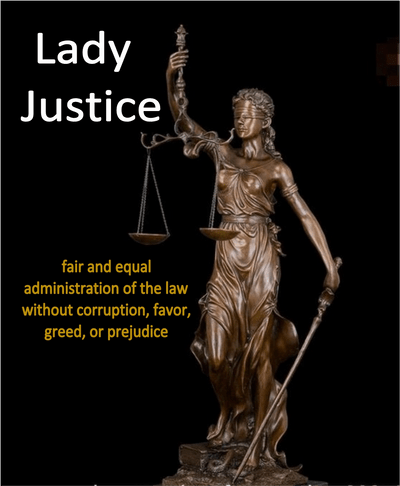
Lady Justice is blind to HOA justice

I think it’s well past due for someone of courage to remove the blindfold from the Lady so she can see the real HOA world as it is.

Knowledge is power to stand up to CAI

CONTINUING  HOMEOWNER ENLIGHTENMENT, EDUCATION  &  REORIENTATION  SERIES

CHEERS  PODCASTS

Advocates and homeowners have failed to stand up to CAI because they, too, have been indoctrinated and have failed to acquire the knowledge and strategies to overcome their lack of credibility causing their lack of power.

“Blaming the wolf will not help the sheep much.  The sheep must learn not to fall into the clutches of the wolf.”  Gandhi.

Boards of directors need to be educated and reoriented on the principles of democracy, and on HOA constitutionality relating to violations of due process and the equal protection of the laws,  because 1) the national lobbying entity, CAI, has indoctrinated boards of directors, the legislators, the courts, and the public with its CAI School of HOA Governance program that contains just lip service to constitutional questions, and 2) HOAs are a form of local government not subject to the Constitution. 

This indoctrination, by teachings of The CAI School, of boards of directors and all HOA members  prevents them from recognizing and accepting the true nature of HOA reality.  Indoctrination “is the process of teaching a person or group to accept a set of beliefs uncritically.”  Since the teachings are all that the indoctrinated ever see, they assume the School presents a true picture of HOA-Land. The actual reality!  NOT SO!

The idea of the Continuing Homeowner Education & Reorientation Series is to find a way for the indoctrinated BODs and members to come into the “light” and attain enlightenment from the School’s conditioning practices.  If they were to do this, they would be able to see HOA-Land for what it really is.

CHERS will provide this needed opposing voice.  Listen to CHERS podcasts — 24 podcasts in 4 program levels of learning.  See also CHERS series.

Preface to HOA Common Sense

PREFACE

The title of this pamphlet, “Common Sense,” was chosen to identify and relate to the aims and purposes of the original 1776 pamphlet by Thomas Paine, Common Sense. Prior to the American Revolution it was Paine who provided the reasons and justifications for overthrowing the oppression government of King George III. He raised the consciousness of the colonists as to their second-class citizenship with respect to the British Empire, and something had to be done about. It was widely read by the Founding Fathers who did do something about it.

With a similar object in regard to oppressive, authoritarian HOA regimes, I present a summary of the essential issues that must be similarly remedied to bring about substantive changes to planned community/condo private governance.

Clarifications of meanings and concepts

A nation consists of a distinct population of people that are bound together by a common culture, history, and tradition who are typically concentrated within a specific geographic region. The common, binding element of HOAs is its organic law foundation, from which flow all state laws and the declarations of CC&Rs boilerplate, is based on The Homes Association Handbook of 1964.


An HOA is the governing body of a condominium or planned unit development (PUD) functioning for all intents and purposes as a de facto local political community government, but not recognized as such by state governments.

An organic law is a law, or system of laws, that form the foundation of a government, corporation or any other organization’s body of rules. A constitution is a particular form of organic law for a sovereign state. The US has indeed a set of documents constituting its organic law.

Definition of HOA-LAND: HOA-Land is a collection of fragmented independent principalities within America, known in general as “HOAs,” that are separate local private governments not subject to the constitution, and that collectively constitute a nation within the United States.

Read the book: HOA Common Sense: rejecting private government, a summary of 6 constitutional defects.