Neo-liberalism, communitarism and HOA government

I was quite disturbed reading the Introduction,written by Robert W. McChesney, to Chomsky’s book, Profit Over People (1989). I will let his words speak for themselves:

“Neoliberalism is the defining political economic paradigm [model or philosophy] of our time — it refers to the policies and processes whereby a relative handful of private interests are permitted to control as much as possible of social life in order to maximize their personal profit.”

Just think what has been written about the real estate special interests, “HOAs are a business” (CAI CEO, Tom Skiba), and CAI’s motive to make money for its members. Read on, keeping in mind your knowledge of HOAs, and the charges and arguments that were made here and elsewhere against HOAs and planned communities. My annotations are found in square brackets.

For the good of everyone:

“A generation of corporate-financed public relations efforts has given these terms and ideas a near sacred aura. At their most eloquent, proponents of neoliberalism sound as if they are doing poor people, the environment, and everybody else a tremendous service as they enact policies on behalf of the wealthy few [we have seen the courts use equitable servitudes and its defense of ‘for the good of the community’ against homeowner rights]. Neoliberalism . . . is indeed capitalism with the gloves off [a reference to evils of unrestrained big business at the turn of the 20th century]”.

On democracy:

“Neoliberalism works best when there is formal electoral democracy, but when the population is diverted from the information, access, and public forums necessary for meaningful participation in decision making [as witnessed by the ‘don’t give an inch to any homeowner who’s against the HOA’ attitude]. Democracy is permissible as long as the control of business is off-limits to popular deliberation or change, i.e. so long as it isn’t democracy. The neoliberal system therefore has an important and necessary byproduct [a consequence] — a depoliticized citizenry marked by apathy and cynicism. In sum, neoliberalism is the immediate and foremost enemy of genuine participatory democracy.”

The ‘conspiracy of silence’:

“This is no formal conspiracy by powered interests: it doesn’t have to be. Through a variety of institutional mechanisms [namely, lobbying efforts of government agencies and representatives, and the use of public interest organizations sharing], signals are sent to intellectuals, pundits, and journalists pushing them to see the status quo as the best of all possible worlds, and away from challenging those who benefit from the status quo [CAI, the real estate special interests, local government].”

The leading proponent of communitarism — individual rights must be weighed against the good of the community — is Amitai Etzione of George Washington University in Washington, DC (http://www.gwu.edu/~icps/who.html). In this post I will only say that the neoliberalists found an ally in the communitarian view that we need more community and less individualism in America.
CAI speaks of homeowner honor: where's the HOA honor?

The CAI Nov/Dec 2006 Common Ground magazine has a reply to AARP Bill of Rights. (See AARP). It speaks of honor, demanding that the CC&Rs be honored by homeowners.

As to seniors paying their fair share, CG says,

“But it’s also true that collections are fundamental and necessary. . . . Accordingly it’s reasonable to expect all homeowners to honor their promise.”

For CAI is an honorable man, So are they all, all honorable men.

CAI assumes the purchase was above board made openly and freely, with access to all the information to make an informed choice; and that CAI has no prior knowledge that the CC&Rs take away fundamental rights and freedoms of Americans who believe the false promises of carefree living. Yet, the purchase process itself is not honorable, and the CC&Rs are unconscionable adhesion contracts.

How dare CAI demand that homeowners, alone, honor the CC&Rs when it knew all the while truth of the matter. Can anyone really believe that its legal counsel and its legal authorities had, and have, no inkling of the unconscionable adhesion contract nature of the CC&RS? And, as such are contrary to public policy and unenforceable?

The truth of the matter can be found in the bible that laid the groundwork for the mass merchandising of HOAs, the ULI Homes Association Handbook, TB#50, published in 1964. For a commentary on this publication, and on the role of CAI as the national lobbyist for planned communities and UCIOAs, see The Truth.

CAI speaks of homeowner honor: where’s the HOA honor?

The CAI Nov/Dec 2006 Common Ground magazine has a reply to AARP Bill of Rights. (See AARP). It speaks of honor, demanding that the CC&Rs be honored by homeowners.

As to seniors paying their fair share, CG says,

“But it’s also true that collections are fundamental and necessary. . . . Accordingly it’s reasonable to expect all homeowners to honor their promise.”

For CAI is an honorable man, So are they all, all honorable men.

CAI assumes the purchase was above board made openly and freely, with access to all the information to make an informed choice; and that CAI has no prior knowledge that the CC&Rs take away fundamental rights and freedoms of Americans who believe the false promises of carefree living. Yet, the purchase process itself is not honorable, and the CC&Rs are unconscionable adhesion contracts.

How dare CAI demand that homeowners, alone, honor the CC&Rs when it knew all the while truth of the matter. Can anyone really believe that its legal counsel and its legal authorities had, and have, no inkling of the unconscionable adhesion contract nature of the CC&RS? And, as such are contrary to public policy and unenforceable?

The truth of the matter can be found in the bible that laid the groundwork for the mass merchandising of HOAs, the ULI Homes Association Handbook, TB#50, published in 1964. For a commentary on this publication, and on the role of CAI as the national lobbyist for planned communities and UCIOAs, see The Truth.

AARP Amicus Curiae brief in Twin Rivers NJ constitutionality suit

This brief is a must read, and should be brought to the attention of your legislators. A few excerpts:

“The Hannaman Report [NJ agency report, 10 years ago]is notable for its candor and its breadth.

For example, Mr. Hannaman states: “It is obvious from the complaints [to DCA (Dept of Consumer Affairs)] that that [home]owners did not realize the extent association rules could govern their lives.” Pa237. Mr.Hannaman goes on to set forth at length numerous examples of abuse of homeowner rights by New Jersey ineffectual and inadequate safeguards prevent and remedy such abuse.” P.4.

“Perhaps most alarming is the revelation that boards, or board presidents desirous of acting contrary to law, their governing documents or to fundamental democratic principles, are unstoppable without extreme owner effort and often costly litigation.” P. 5.

“It is no answer to say (as Appellants do) that private contractual agreements, or the “business judgment rule,” somehow trump constitutional principles, and that New Jersey community association residents have no constitutional rights because of some sort of “waiver” arising from the documents they signed when purchasing their homes.” P. 20.

The proposition that residents of Twin Rivers have no less a right to speak than nonresidents flows inexorably from these core principles. And the same result obtains by application of the “unconstitutional conditions” doctrine, and by application of the principle that servitudes that are either contrary to public policy or unconstitutional are unenforceable. P. 24.

The entire amicus curiae brief can be found here: AARP

Note: The NJ Supreme Court has yet to accept the amicus application. The HOA strongly opposes the filing of the brief, yet it had no objection to a brief by Community Associations Institute, CAI, that has a strong, non-neutral, stance with respect to the outcome of the Court’s decision.

Death by HOA Foreclosure: Collateral damage of the New Social Order


Not many people knew Sabina Anna Prioletta, a single, 37 year-old female on government disability, weighing some 100 pounds at 5-2. She was trying to survive at the poverty level on the disability payments.

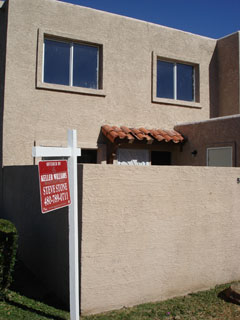
In 2001 she inherited enough money to buy a 924 square foot, 2 story attached home in Phoenix at Camelback and west 41st avenue, built in 1972 (one of the Hallcraft Villas subdivisions). Not the best part of town, but decent, and it was the only thing she could call her own, the only asset she had, her home.

Sabina wanted to be secure in her future and paid full price for home, some $35,000. Unfortunately, it was in a homeowners association.

For more, download this attached sad account (PDF).

“There, but for the grace of God, go I”