Why is there a need for a Homeowners Bill of Rights?

As James Madison wrote in The Federalist No. 51, “If men were angels, no government would be necessary. If angels were to govern men, no internal or external controls on government would be necessary. “

Preamble to the US Bill of Rights

“THE Conventions of a number of States, having at the time of adopting the Constitution, expressed a desire, in order to prevent misconstruction or abuse of its powers, that further declaratory and restrictive clauses should be added:  And as extending the ground of public confidence in the Government, will best insure the beneficent ends of its institution:”

PVTGOV Proposed Homeowners Bill of Rights

1.      The HOA is subject to the Fourteenth Amendment to the US Constitution as are all over government entities subject.

2.      The HOA, and HOA directors, officers and committee chairs are subject to the municipality and state laws wherein the HOA resides.

3.      No “ex post facto” amendments to the governing documents shall be permitted without the consent of all homeowners.

4.      The taking of a homeowner’s property rights by the HOA as a result of an amendment to the governing documents or rules and regulations, if any, without a judicial order and without fair compensation is prohibited.

5.      The HOA right to foreclose on a homeowner as a result of failure to pay any fines, penalties, costs or other charges not a bona fide assessment is prohibited.

6.      Recognizing that the HOA does not stand in the same position as a mortgagor that has a substantial monetary investment in the home, or in the case of a mechanic’s lien where the homeowner possesses greater powers over the mechanic, foreclosure shall not be permitted for amounts less than 80% of the fair market value of the home, with the balance of the sale proceeds belonging to the homeowner.

7.      The directors, officers and committee chairs shall be residents and members of the HOA community.

8.       . . .

9.       . . .

10.   . . .

Read Sen. McCain’s comments on limited govrnment and more on the purpose of a homeowner bill of rights
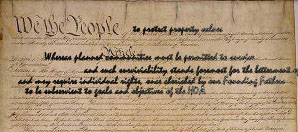
The New Supreme Law of the Land: Property servitudes

The implication (Restatement Third, Property, § 3.1) is that a servitude can be consistent with public policy if it reasonably violates a fundamental constitutional right, and is therefore valid.   An attempt to find a clarification brings the reader to “comment h”, which reads in part,The question whether a servitude unreasonably burdens a fundamental constitutional right is determined as a matter of property law, and not constitutional law.”

    How can a covenant, a servitude, that violates the US and state constitution not be illegal and invalid? It cannot, unless the courts adopt the position that servitudes are the supreme law of the land.  The courts have allowed amendments to the CC&Rs to deprive a homeowner of his property without compensation, and have validated ex post facto amendments.

Read complete eEditorial at Supreme Law.

Validity of AZ HOA Fee Questioned

Pursuant to statute, a request was made for an agency review of the fee to file a complaint against HOAs.  Last year, a new law allowed complaints to be filed against HOAs and  heard by the Arizona Office of Administrative Hearings (OAH). This was an effort to level the playing field so homeowners can have complaints heard without having the HOA attorney utilize the Rules of Court against the less informed homeowner.

The basis for the request to the Director of the AZ Dept. of Fire, Building and Life Safety (DFBLS) (that receives the complaint filing), included,

There have been no amendments by the legislature to alter this amount, nor bills passed into law. In fact, on November 15, 2006, pursuant to Sec. 12 of Sess. L. ch. 324 (2006) a review was held by JLBC whereby it was decided not to change the fee amount,

While 2198.01(B) allows DFBLS to charge a fee, the specific amount is not set in the statute: “The petitioner shall file a petition with the department and pay a nonrefundable filing fee in an amount to be established by the director.” It is unreasonable to believe that it was the intention of the legislature to allow the director of DFBLS an open-ended freedom to “pick any amount” he may so decide.

Setting a fee is considered a Rule under ARS §41-1001, paragraph 17, and consequently, is subject to the rulemaking procedures of APA under ARS §41-1030(A). A review of the Administrative Registers from November 15th to date shows no notice or preamble filings for a change in this fee amount.

In short, the statute permits the Director to set fees, but the APA rulemaking statutes tells him how to do it – public notice and hearings.

Statements made by the Director refer to a few cases taking longer than anticipated, raising the cost of the administration of justice. This position has no bearing on the authority of the Director to set a fee, since the statutes were established to permit public notice and input to the setting of any agency rule or fee.

OAH heard some 7,360 cases last year with a budget of $1,165,900, or $158.41 per case, far below the original fee of  $550 and making the new $2,000 fee outlandish – a “poll tax”.  There were only 22 HOA cases, all filed by homeowners seeking justice, when this fee increase was put into effect.  Agencies that account for 78% of OAH adjudications pay no fees!

Advocates see this increase as another effort to silence the problems with HOA private governments.  Advocates continue to hope that the HOA mess would be cleaned up by legislators at the insistence of public interest organizations demanding a return to good government.

Arizona Curtails HOA Complaints with 400% Fee Increase

Quite unexpectedly, as of this morning, the Arizona Dept. of Building, Fire and Safety increased the non-refundable filing fee from $550 to $2,000, effective until April when it will once again be reviewed. This is outrageous, and an attempt to stifle homeowner justice as revealed by my case summaries. It reminds me of the 1950s Poll Tax in the South to prevent blacks from registering to vote.

Word is from BFS that, out of some 7,000 – 8,000 a year heard by OAH (Office of Administrative Hearings), the 22 cases to date in the first 5 months during which OAH could hear HOA disputes are overburdening the judges, who need to spend extraordinary amounts of time finding out how to make a decision on HOA disputes. So, these 22 cases require a 400% increase in order to provide justice to homeowners against HOAs, while all other civil complaints can be funded out the state coffers. This is outrageous! This is an attempt to coverup problems created by pro-HOA legislation and unconscionable adhesion contracts known as CC&Rs.

In 2004, when a bill was proposed to have JP courts decide the disputes, fears of outlandish costs that would overpower the JPs caused the bill to be defeated. Well, it turns out to be just some 50 cases for the year. I guess HOAs are just to much for our system of justice to handle, whether JP or OAH, and we should just let HOAs continue to be independent principalities operating outside the Constitution and state laws.

OAH adjudication has been working to bring justice to homeowners against abusive HOAs. OAH has had the additional benefit to expose the types of injustice, and attitudes of HOA boards and attorneys that are quite contrary to their pronouncements before the legislature and the media of a democratic community working to create vibrant, harmonious communities.

This filing fee increase should and must be paid for from state coffers to remove this scandalous bar to justice.

(Originally posted February 16, 2007).

Colorado Legislature defiantly protects HOAs

Ever wonder how a territory was granted authority from the federal government to be a state?  Here’s how Colorado got its authority. Contrast this to CCIOA  (UCIOA), CRS 38-33.3.101 et seq, that reflects the state’s entwinement in the operation, the encouragement and support of planned communities, and its coercion of the homeowners (See Brentwood citation below).  In other words, how Colorado establishes authoritarian, private governments that are treated as independent principalities. Let’s look at the misleading and somewhat defiant and arrogant Annotation to CCIOA.


Colorado Revised Statutes, 38-33.3-102, Annotation

There is no support for the proposition that enactment of a legislative scheme governing the operation of homeowners’ association thereby transforms such homeowners’ association into cities or other governmental entities.

Read the complete commentary at Colorado.