The Constitutionality of state protected homeowners associations

The acclaimed and illustrious homeowner association expert, Wayne S. Hyatt, wrote on the need to reinvent homeowners associations in a September 2008 John Marshall law review article. This was somewhat surprising since Hyatt was an early Community Associations Institute (CAI) president in the 70s, and drafted several HOA declarations here in Arizona. Hyatt is also attributed with classifying HOAs as “mini-governments.”

Hyatt acknowledges the need for reinvention of HOAs with efforts

to reconcile community associations’ negative aspects [that] requires a candid admission that negative aspects exist” [and that] many [members] will be irritated by restrictions on property rights that the government traditionally protects. Residents will expect rights and processes as experienced in the public realm.

Yet, as shown by the Arizona declaration of unconstitutionality of OAH due process for HOA disputes, our government believes in supporting HOA restrictions that governments normally protect, rather than providing the expected public realm protections. The state is at fault, too, for failing to inform the public of their loss of rights and freedoms that comes with living in an HOA, while having the audacity to permit local communities to mandate such authoritarian subdivisions.

Hyatt, and others, have acknowledged that HOAs are a “sui generis”, that is, a one of a kind thing, not a public government and not a typical private nonprofit entity. “Analysts miss the essential point: community association law is a sui generis, essentially quite new, and predominately judge-made law that is itself evolving.” And it has been this judge-made new law over the past 44 plus years, argued and supported by such illustrious “legal-academic aristocrats” like Hyatt, all real estate/land use lawyers, that has resulted in an overwhelming pro-HOA decisions that can be found in the third edition (2000) of the Restatement of servitudes.

The article also addresses those questions of constitutionality and state actions that I have repeatedly raised over the years. Hyatt writes,

This is particularly true when the conduct prohibited would be constitutionally protected if the regulation were imposed by a government. The basis for these arguments generally is that the actions of the community association constitute “state action” on one or more of several theories. These theories are generally referred to as “judicial enforcement,” “sufficiently close nexus,” “symbiotic relationship,” or the “public function” theory.

Unfortunately, Hyatt reveals his true affiliations and beliefs, and rejects application of constitutional protections and state actions in his proposed “resolutions.” He prefers the violation of state constitutions approach, which is the preferred CAI approach because, as the national special interest lobbying organization, CAI dominates state legislatures. And the legislatures make the pro-HOA laws. A CAI lobbying committee exists in every state of the union! Just recall the defeat of last year’s HB2824 and SB1162 attempt to level the litigation playing field, and the superior court default decision on unconstitutional OAH adjudication.

Sadly, Hyatt did not address those fundamental questions that I had raised earlier, and that need to be addressed so we can proceed with a solid legal foundation:

1. Can a legislature delegate its functions, not government services but functions, to private entities without oversight or compliance with the Constitution, as required of all government entities?
2. Can private parties enter into contractual arrangements using adhesion contracts and a constructive notice consent, which serve to regulate and control the people within a territory (an HOA), within the state, to circumvent the application of the Constitution?
3. In 2009, should HOAs, as a sui generis private government, be held as state actors under the US Supreme Court criteria as a result of state protective statutes reflecting a cooperation, support or coercion; a symbiotic relationship; a close nexus; or an entwinement between state and HOA?


The State of Arizona will not protect buyers of HOA homes!

      The Arizona Superior Court special action appeal of an administrative law judge decision upheld, and affirmed last week, the order that the  administrative hearing adjudication of HOA disputes was unconstitutional.  This affirmation was made one day before the time limit for a response set by the Superior Court Judge, and on the same day a letter introducing new facts in the case was received by the judge. The facts showed that there were no real parties in interest prior to the filing of the appeal and that the case was “fictitious.”  There is no acknowledgement of the letter nor a response to these important facts by Judge McMurdie. This is a gross miscarriage of justice!


This case, LC2008-000740 Maricopa Superior Court (Merrit), reflects an Arizona public policy that permits the denial of the equal protection of the laws in favor of private party adjudication of HOA disputes.   It appears that the Attorney General, the Legislature, and the Judiciary itself see no problem with private party adjudication of disputes that can impose financial harm on homeowners, but will not allow an independent government agency to adjudicate these disputes.  This turns the Constitution on its head!   This is but a taste of  what to expect living in the HOA-lands in the New America, in which not only the functions of government itself are privatized, but the judicial functions as well.  What, then, is the purpose of public government and the Constitution? 


This total disregard of my letter follows a flat denial, without explanation, of my February 11, 2009 Motion to Intervene, which was an abuse of discretion by Judge McMurdie.  Perhaps it was because I had included the Attorney General’s defense of the constitutionality of the statute in a prior case (which would have caused a trial and an embarrassment to the AG), LC2007-00598 (Waugaman), given that the AG and Legislature now failed to defend the statute in this case.  Why?  Maybe it was because I had made strong arguments (in my required Answer)  against the CAI-HOA attorney argument that an agency had to possess regulatory functions.  Such a requirement is not found to be a mandatory criteria in the Bennett  four-fold test that was used in the Cactus-Wren and Hancock cases.  These cases served as the basis of Judge Downey’s order in Waugaman, whose order was included as part of the Merrit complaint.


You be the judge of the events and decisions in this effort to attain a fair trial adjudication of HOA disputes. How much has politics come into play?  The relevant court filings are available at the links listed below.  A Statement of Facts summary and Timeline can be found under the “summary of events” link  below.


It is the policy of Arizona to favor the HOA industry with special laws and privileges that deny its citizens “fair trial” due process and the equal application of the law.  Perhaps in these times of financial hardship on the state, and on developers, homebuyers should speak out with their pocketbooks and buy homes at substantial discounts that are not in HOAs.  Homebuyers, avoid the mismanagement of HOAs; the blind adherence to arbitrary rules by “political machine” ruling boards; the divisiveness caused by the HOA attorneys who insist on enforcement, with no compassion; the lack of support and protection from your public government; and without having to be married to your neighbors who will not join in your just  fight for fair treatment against board abuse.  Ask yourself, “Who needs it?” 


summary of events


Court filings:


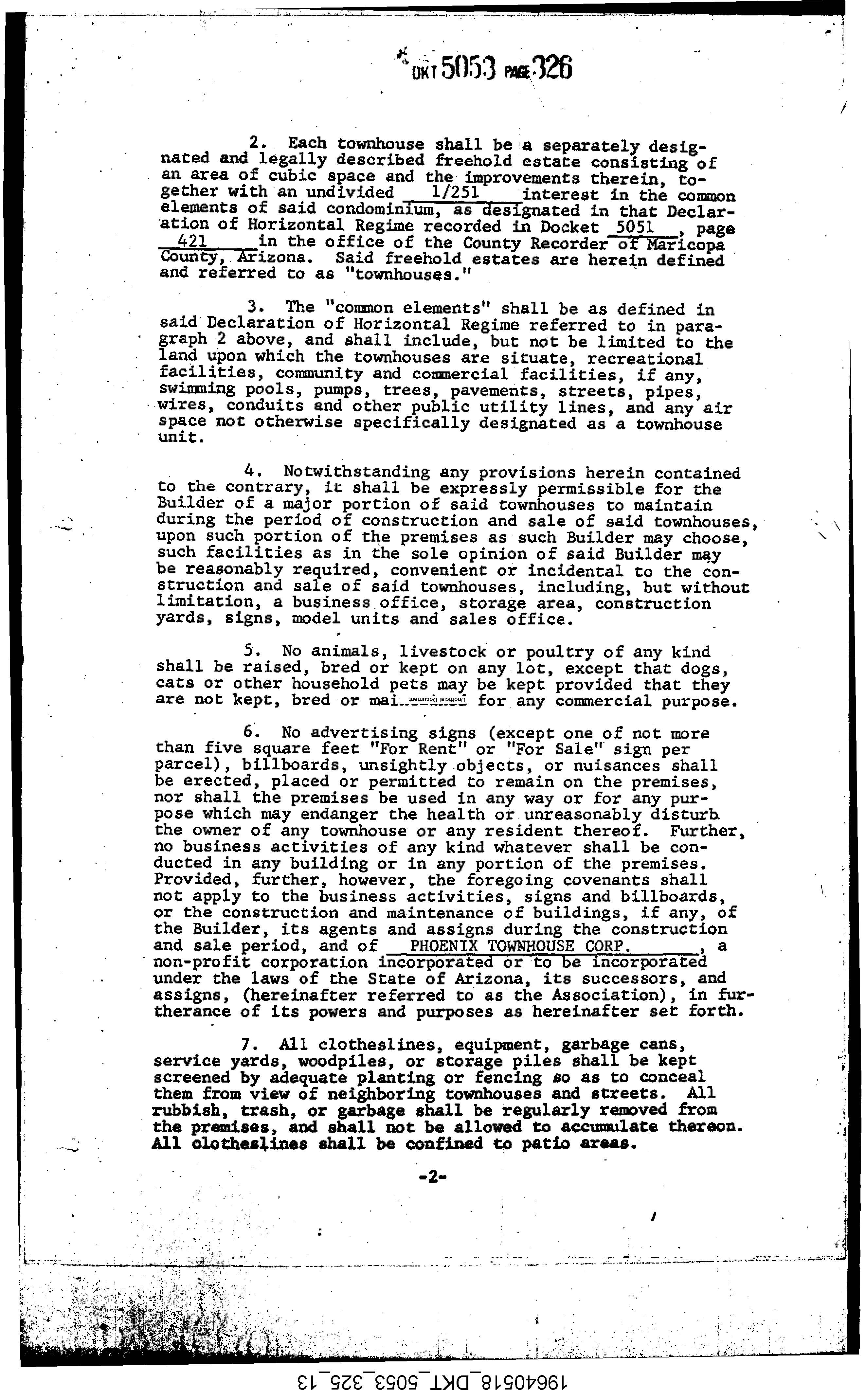
HOA declaration:                               

merrit-quitclaim                   

OAH petition                          

Complaint                                          

Summary disposition                 

Injunction order               

Intevernor motion                        

Intervernor answer                       

Intervenor-order               

Fact letter of new facts         

Judge’s Response           

time to reply                          

order affirming injunction      

Waugaman AG brief                                  

Waugaman decision


New facts in AZ HOA due process constitutionality decision

Please note that Judge McMurdie’s failure to provide an explanation of his denial of my Motion to Intervene (Intervenor motion denied in OAH fair trial constitutionality case), which is necessary in order for a Mover to determine the grounds for an appeal, is itself appealable as an abuse of discretion. However, the following letter had to be first delivered to the attention of Judge McMurdie:


If I had been permitted to intervene, these facts, discovered subsequent to filing the Motion to Intervene, would have been presented appropriately. Rule 60(c) states that  “This rule does not limit the power of a court to entertain an independent action to relieve a party from judgment, order . . . or to set aside a judgment for fraud upon the court.” 


HOA-landers of New America win by default AZ 'fair trial' unconstitutionality case

Motion to Intervene by Arizona HOA member denied without reason!

With a simple statement, the Court has permitted a default judgment, that the OAH adjudication statute is unconstitutional, to stand!   By a default decision, the national CAI/HOA lobbyists have struck down a statute without any argument by the real parties in interest, the homeowners, or by the Arizona Legislature, or by the Attorney General.  In spite of the Attorney General’s brief in favor of constitutionality that was submitted in the underlying Waugaman case. Who will defend the people?  As our President said during his campaign,  “You are on your own!” 

 
The HOA-landers of New America won a decisive battle, a battle where the State of Arizona failed to stand up and defend constitutional protections for “equal justice under the law.”  With no rationale supplied, the judge makes it difficult to argue for an appeal.
 
“MINUTE ENTRY [2/18]
The Court has received and considered the Motion to Intervene by George K. Staropoli.
IT IS ORDERED denying the Motion.”
 
In my motion, filed as a member of an Arizona HOA, I wrote, in part,
 
“Furthermore, the failure of any of the defendants to respond and defend the constitutionality of  the statute allows intervention under R 24(a), ‘unless the applicant’s interest is adequately represented by existing parties.’   Because an intervenor of right may be seriously harmed if not permitted to intervene, the court should be reluctant to dismiss a request for intervention.’  Winner Enterprises, Ltd v. Superior Court, 765 P.2d 116 (1988).  The Winner court held that because the time frame was shortened by the special action [as this case] and that other parties would not be prejudiced, it allowed the intervention even though a judgment had been rendered.” 
 
 
The Motion and decision are available by clicking as indicated.

HOA-landers of New America win by default AZ ‘fair trial’ unconstitutionality case

Motion to Intervene by Arizona HOA member denied without reason!

With a simple statement, the Court has permitted a default judgment, that the OAH adjudication statute is unconstitutional, to stand!   By a default decision, the national CAI/HOA lobbyists have struck down a statute without any argument by the real parties in interest, the homeowners, or by the Arizona Legislature, or by the Attorney General.  In spite of the Attorney General’s brief in favor of constitutionality that was submitted in the underlying Waugaman case. Who will defend the people?  As our President said during his campaign,  “You are on your own!” 

 
The HOA-landers of New America won a decisive battle, a battle where the State of Arizona failed to stand up and defend constitutional protections for “equal justice under the law.”  With no rationale supplied, the judge makes it difficult to argue for an appeal.
 
“MINUTE ENTRY [2/18]
The Court has received and considered the Motion to Intervene by George K. Staropoli.
IT IS ORDERED denying the Motion.”
 
In my motion, filed as a member of an Arizona HOA, I wrote, in part,
 
“Furthermore, the failure of any of the defendants to respond and defend the constitutionality of  the statute allows intervention under R 24(a), ‘unless the applicant’s interest is adequately represented by existing parties.’   Because an intervenor of right may be seriously harmed if not permitted to intervene, the court should be reluctant to dismiss a request for intervention.’  Winner Enterprises, Ltd v. Superior Court, 765 P.2d 116 (1988).  The Winner court held that because the time frame was shortened by the special action [as this case] and that other parties would not be prejudiced, it allowed the intervention even though a judgment had been rendered.” 
 
 
The Motion and decision are available by clicking as indicated.