Government is defined by a “social contract”; HOAs by the new social contract, the CC&Rs

In order to clarify just what a government is, I added the following material to Part III, “American Political Governments”, of The Foundations of HOAs. The complete Part III booklet can be found at Governments

Government is defined by a “social contract”, and CC&Rs define the new social contract (p.31 – 33)

The current view of the controversy that HOAs are governments make use of these similarities of purpose and functions between other legal entities and HOAs to argue that the homeowners association is not a government. However, since the “evidence” presented clearly demonstrates that governments and HOAs share these attributes, this comparison also serves the argument that a government is a business. This comparison argument, promoted by the pro-HOA special interests, places credence on the much quoted, yet archaic and misplaced 1946 Supreme Court holding (Marsh v. Alabama), “public functions” test that compared functions, services, and public access territories (the issue in this case was not about whether or not HOAs are governments, but on the application of free speech to company towns). It fails in face of the stark reality that state laws do not impose any such requirements on the incorporation of a town or village.

Given the prevalence of this misguided public functions test, I’ve repeatedly made use of a basic definition of government: a government is: “the person or group that controls and regulates the people within a territory.” While the functions and provided services of a government are shared with many other entities, both businesses per se and nonprofit organizations, this definition “separates the chaff from the wheat.” What has been absent from any debate on this controversial topic has been the subject of purpose: what is the purpose of the organization? Businesses per se, have a profit motive. Nonprofit entities have a multitude of purposes ranging from a purely educational focus to providing a united support group for a particular trade or industry or to providing some form of charitable assistance to the public.

The question to be addressed, and that has not been addressed, is: What is the purpose of government that distinguishes it from all these other organizational forms? If none can be found, then what is the point of a government? Can we really say that American government is a business like any other business? But, before we proceed any further, an examination of the loosely used term “government” or more precisely, “public government” is in order. After all, all organizations, if viable, have some form of government or governing body. Keeping it simple, a number of related definitions from Black’s Law Dictionary will clarify my definition of a government.

Under “government”, Black’s simple definition says: “The structure of principles and rules determining how a state or organization is regulated.” And, to clarify by what is meant by a “state”, Black’s speaks in the same terms of the differences in function that distinguishes an association from that of the state, and of the need to determine the “essential and characteristic” activities and purposes of a state. A state is a community of people established for “securing certain objectives . . . a system of order to carry out its objectives.” Nothing new here, but Black’s then goes on to say: “Modern states are territorial; their governments exercise control over persons and things within their frontiers.” And cautions not to confuse the “state” with other communities of people in other forms of organizations designed to accomplish other objectives.

With this understanding, we can now move forward to examine the distinguishing essentials and characteristics of public, or state government. And the answer to the question raised above can be uncovered in the political and democratic philosophies and fundamental principles written centuries ago, in the writings of Rousseau, Voltaire, Locke, Montesquieu, Thomas Jefferson, James Madison and the other Founding Fathers. In short, and stated simply, they are the surrender of the rights and freedoms possessed by man living in “the state of nature” (which is a long forgotten condition and environment, yet, unrecognized, is still a condition actively desired in today’s society), under a “social contract” that establishes the quid pro quo for this surrender.

Read more . . . American governments: HOAs under servitudes & Public government under the Constitution

Legislative "good conscience" non-consent to support HOA reforms

Following up on my last post, “Are legislatures sovereigns who can do no wrong?“, the failure of legislators to obey, uphold and enforce the laws is a serious example of the non-consent by our public representatives to be governed by the laws of the land.  This non-consent, with the implied legislators’ “all good conscience”, is usually accompanied some simplistic rational justification, such as with HOA reform bills: “The homeowners agreed to follow the rules”, “They are trying to get out of a contract”, “HOAs are a good thing for he people “,  or “Why change the law for a few malcontents?”  This non-consent serves as the basis for their acts of commission and omission in opposition to HOA reforms.

 I find it hypocritical that while legislators justify their failure to deal fairly with and to provide “equal justice under the law” for homeowners in HOAs, they do not admit to or accept homeowner non-consent, “in all good conscience”, to be governed by the HOA regime.  This homeowner non-consent is based on arguments well founded in fact, and supported in law or in the extension of the law.

 And, it should be well understood that the legislatures, and the courts, must stop hiding behind their rationale that homeowners associations are not government entities, because they are not chartered under state municipality laws or delegated such authority by the legislature.  They must begin to recognize that HOAs are indeed de facto governments that have been allowed, by the acts of commission and omission by the legislatures and courts themselves, to operate outside constitutional restrictions and protections of homeowner rights.

 Subjecting theses private governments to the Constitution would fulfill the “equal justice under the law” and due process protections of the 14th Amendment.  And, within this act of  “joining the union”, HOAs can still retain their private use and private lands nature of the subdivision by simply using the special taxing district model —  those in the subdivision pay for the privacy of occupation and use of amenities.  And with their own “ordinances.” 

 These private “contracts” would then not violate good public policy, would not be unconscionable, and would not violate the Constitution.  HOA laissez-faire regulation and interference into private property rights would end with accountability to the state, as required of all other government entities.  How could the legislatures and courts not consent in all good conscience to such a plan?  The Constitution is, after all, much more than that disjointed contract interference clause of paragraph 1, sec. 10 of Article I: No State shall . . . pass any . . . law impairing the obligations of contracts.”


Legislative “good conscience” non-consent to support HOA reforms

Following up on my last post, “Are legislatures sovereigns who can do no wrong?“, the failure of legislators to obey, uphold and enforce the laws is a serious example of the non-consent by our public representatives to be governed by the laws of the land.  This non-consent, with the implied legislators’ “all good conscience”, is usually accompanied some simplistic rational justification, such as with HOA reform bills: “The homeowners agreed to follow the rules”, “They are trying to get out of a contract”, “HOAs are a good thing for he people “,  or “Why change the law for a few malcontents?”  This non-consent serves as the basis for their acts of commission and omission in opposition to HOA reforms.

 I find it hypocritical that while legislators justify their failure to deal fairly with and to provide “equal justice under the law” for homeowners in HOAs, they do not admit to or accept homeowner non-consent, “in all good conscience”, to be governed by the HOA regime.  This homeowner non-consent is based on arguments well founded in fact, and supported in law or in the extension of the law.

 And, it should be well understood that the legislatures, and the courts, must stop hiding behind their rationale that homeowners associations are not government entities, because they are not chartered under state municipality laws or delegated such authority by the legislature.  They must begin to recognize that HOAs are indeed de facto governments that have been allowed, by the acts of commission and omission by the legislatures and courts themselves, to operate outside constitutional restrictions and protections of homeowner rights.

 Subjecting theses private governments to the Constitution would fulfill the “equal justice under the law” and due process protections of the 14th Amendment.  And, within this act of  “joining the union”, HOAs can still retain their private use and private lands nature of the subdivision by simply using the special taxing district model —  those in the subdivision pay for the privacy of occupation and use of amenities.  And with their own “ordinances.” 

 These private “contracts” would then not violate good public policy, would not be unconscionable, and would not violate the Constitution.  HOA laissez-faire regulation and interference into private property rights would end with accountability to the state, as required of all other government entities.  How could the legislatures and courts not consent in all good conscience to such a plan?  The Constitution is, after all, much more than that disjointed contract interference clause of paragraph 1, sec. 10 of Article I: No State shall . . . pass any . . . law impairing the obligations of contracts.”


Are legislatures sovereigns who can do no wrong? Must they delegate authority to HOA regimes?

The Arizona Legislature, this past regular session, withheld transmitting bills to the Governor after having been duly passed.  The Governor claimed political gamesmanship and obtained an Arizona Supreme Court order that declared that bills must be submitted to the Governor in a reasonable time, and that the actions by the Legislature were unconstitutional.

With the Republican leadership now asking for a “recount” by the Supreme Court on the budget order, it appears that they are uneasy about flaunting the law. The legislature has  disregarded the Supreme Court’s order that a  bill must be submitted to the Governor within a reasonable time.

Now, of course, there are also those other questions about “internal” procedures by the “sovereign of the state of Arizona”, the Legislature, as it seems that the Legislature firmly believes that the “sovereign can do no wrong.”  Let’s see, there was the June 7, 2008 invention of a new floor rule to defeat the gay marriage bill.  And just the other day, an alleged one voiced vote by Senate President Burns in his Rules committee, which was sufficient to pass the budget bill.  What happened to the rules on majority  vote?

And, of course, there are all those failures to pass HOA reform bills to restore the rights, privileges and immunities supposedly granted to ALL citizens, whether or not living in an HOA.  It appears that no legislative oversight is necessary of HOA governing regimes, holding HOAs to be  unaccountable under the Constitution, but the regulation  and control of citizens by these private organizations in place of legislative authority is permitted.  Is this the new world order?  Is this, too, an unconstitutional usurpation of legislative authority?

Part III (p . 29  -30), American Local Governments  (of The Foundations of Homeowners Associations and the New America),  recounts some of the relevant principles and philosophy of democratic, representative government. Quoting John Locke (Ch. IX, Of the Ends of Political Society and Government, § 141, Second Treatise of Civil Government, John Locke, 1690).

The legislative, or supreme authority, cannot assume to its self a power to rule by extemporary arbitrary decrees, but is bound to dispense justice, and decide the rights of the subject by promulgated standing laws, and known authorized judges;

The legislative cannot transfer the power of making laws to any other hands: for it being but a delegated power from the people, they who have it cannot pass it over to others. The people alone can appoint the form of the common-wealth, which is by constituting the legislative, and appointing in whose hands that shall be. And when the people have said, We will submit to rules, and be governed by laws made by such men, and in such forms, no body else can say other men shall make laws for them; nor can the people be bound by any laws, but such as are enacted by those whom they have chosen, and authorized to make laws for them.

I believe that the legislature is answerable not to just half the people, but to all the people, and takes an oath to uphold the both the US and their respective state constitutions.

American governments: HOAs under servitudes & Public government under the Constitution

Part III.  American Political Governments:  HOAs under servitude law & public government under constitutional law.    HOAHist-cover

This examination into HOA history is not light reading, and more than a quick run through is necessary for a good understanding of the arguments and concepts.   Supporting authoritative and references abound in the footnotes that should be read as they serve to clarify and expand the topic.

 Available at this time in Microsoft eBook format* at Part III, and as a PDF at PDF version

Excerpt:

It is an inescapable conclusion that we live today in a New America consisting of private government HOAs subject to servitudes law, and of democratic public government subject to the US Constitution.  HOAs have been allowed to secede from state government, with the “sovereign’s” blessings.  If the Southern States only had recourse to servitudes law in 1861, our Civil War could have been avoided.

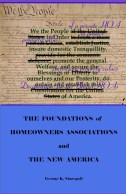
The Foundations of Homeowners Associations and the New America, which was comprised of two parts: 

 Part I.  The Mass Merchandising of Planned Communities: How Americans lost their constitutional and property rights. Available in Microsoft eBook format* at Part I.

 Part II.  National Lobbyist for HOA Principalities.  Available in Microsoft eBook format* at Part II.

 All Parts are available together in PDF format at HOA_History

 *  This format was designed to be read almost like a book on a PC or a mobile device, like a pocket PC or tablet.  A free and easily installed software download is required, and can be obtained from Microsoft at Microsoft Reader.