Effective HOA board governance

This commentary follows up on my plan to restructure HOA governance[1] that first requires addressing the attitudes and views of BODs, the members, and the public in general.  The conditioning and indoctrination by the biased views of the national pro-HOA special interest entity must be de-conditioned by a program of reorientation.

  Once again I provide valuable information on the proper functioning of HOA boards in serving their “constituents,” their members.

The management[2] of a country, a state, or a local government, including the private HOA association, is commonly known as politics.  Politics is:[3]

“the practice and theory of influencing other people on a civic or individual level. More narrowly, it refers to achieving and exercising positions of governance — organized control over a human community, particularly a state.

“exercised on a wide range of social levels, from clans and tribes of traditional societies, through modern local governments, companies and institutions up to sovereign states.

“A political system is a framework which defines acceptable political methods within a given society.”

Managing a government disguised as a nonprofit association has its unique requirements and demands that, for the most part, have been ignored.  The commonly found guidelines from the national pro-HOA lobbying entity speak to an authoritarian government with member interests and concerns being secondary to the survival of the association. It’s an unacceptable deviation from the intents and purposes of our constitutional government.[4]

First, let me address the requirements for the sound management of a nonprofit association. Drucker[5] focuses on the overall, broad purposes and responsibilities of the board of directors (BOD) or board of trustees. 

The general term “nonprofit” does not apply to HOAs because it is not a business nor a public government, but “government controls.” The reality of the HOA association is that it controls as does a public government.

Drucker asks, what is the mission of the nonprofit?  A mission statement has to focus on “what the nonprofit really tries to do.”  It cannot be “a kind of hero sandwich of good intentions.” Strategies “convert intentions into action.”

Most HOAs, especially the smaller HOAs, do not have a sound strategy that addresses their mission, goals, and values. But the HOA has an explicit mission and purpose as set forth in the CC&Rs[6] and need to be revisited and made consisted with Drucker and Batts (see below).

Second, in an excellent book on the need for director orientation,[7] the author feels board orientation is lacking and instituting a guideline will improve the nonprofit’s mission and goals. In his succinct book, as applied to HOAs, Batt’s makes the following important points:

Key areas of board action are “strategy, oversight, and policy.”  In keeping with Drucker, “boards and board members should not micromanage the affairs” of the HOA. 

The BOD has “full and final authority” over the HOA association; they are “not merely advisors” to the manager, other wisely known as the CAM. It’s regrettable that all too often the BOD abdicates to the manager and/or attorney who often are members of the same business trade group advancing their own self-agendas.

There is “no individual authority” of a board member to act and the president can only act based upon the authority set forth in the governing documents. Most presidents act, especially in the small HOAs,  without board approval.

There is  a “duty of obedience” to the laws and governing documents that all too often is ignored by not only rogue BODs, but by BODs who falsely believe to do so is in the best interests of the HOA.

Notes

[1] George K. Staropoli, A Plan Toward Restructuring the HOA Model of Governance, StarMan Press, 2020.

[2] Peter F. Drucker, “Management  is the application of a set of principles relating to the functions of planning, organizing, directing and controlling an organization to effectively achieve organizational goals,” The Practice of Management, Harper Row, 1954.

[3]Politics,” Wikipedia.

[4] See Roger L. Kemp, “Forms of Governance,” Managing America’s Cities: A Handbook for Local Government Productivity, McFarland & Co., (2007).

[5] Supra, n. 1.

[6] See  “Restructuring HOAs – intents and purposes,”  supra n.1.

[7] Michael E. Batts, Board Member Orientation, Accountability Press, 2011. It’s a short, to the point, and  easy to read paperback.  Batts has over 25 years on nonprofit boards and has served on several Washington panels.

HOA bill of rights history updated

A brief history[i]

It should be noted when reading this brief history that in 1992 Community Associations Institute (CAI) modified its tax-exempt status from education (501(c)3) to a business trade entity (501(c)6) with increased  lobbying rights.[ii]

Prior to 2000

In 1992, Roger Dilger wrote,

For example, most of those who advocate the formation of RCAs HOAs] assume that RCAs  . . . incorporate all the rights and privileges embodied in the US Constitution, including . . . the rights of due process and equal protection under the law found in the Fourteenth Amendment;[iii]

In 1994 Evan McKenzie said it plainly, and is true today,

T]he property rights of the developer, and later the board of directors, swallow up the rights of the people, and public government is left as a bystander. . . . [Consequently,] this often leads to people becoming angry at board meetings claiming that their ‘rights’ have been violated – rights that they wrongly believe they have in a [HOA]. (p. 148).[iv]

Editors Barton and Silverman published Common Interest Communities in 1994, a report on 12 early HOA (CID) research studies addressing the debate between HOAs as private governments in relation to public government.[v] Their conclusions in regard to the environment and culture of HOAs included:

Our research shows the tension created by combining neighboring and political  social relations into this form of organization [common interest homeowner’s association].

This means that the association’s objectives can only be decided on through [sic] discussions among the homeowners. As a result, the homeowners’ association needs to meet the basic democratic standards of openness, fairness, and representativeness to its members.

The model of the informed consumer choosing the mandatory homeowners’ association and its detailed restrictions, the ‘servitude regime’, fails to describe reality.

[T]hey [certain homeowners] reacted with strong, negative emotions to apparent infringements on their own rights as private property owners. These residents treated the governing bard of directors not as trustees of the public interest but as neighbors who had unfair powers over them.

Our findings pf pervasive conflict and fear of conflict, accompanied by apathy and avoidance within the community, run counter to the normal picture of community organization.

Steven Siegel wrote in 1998,

Many RCAs exercise powers traditionally associated with local government. . . . Although the traditional view of RCAs is that each homeowner consents to the regime or chooses to reside elsewhere, Siegel rejects this view and suggests instead that RCAs are the product of forces other than consumer choice, including local government land use policies and fiscal pressure on local governments leading to the privatization of local government services. Because of the traditional view, RCAs rarely have been deemed state actors subject to the requirements of the Constitution. As private entities, RCAs regulate behavior in a way that is anathema to traditional constitutional strictures.[vi]

As early as 1999 homeowner advocates,  the late Lois Pratt and Samuel Pratt, made their case for a homeowner bill of rights, writing,[vii]

The association shall exercise its powers and discharge its functions in a manner that protects and furthers the health, safety and general welfare of the residents of the community’[citing NJ law]. . . .  In essence, this is the standard that defines the fundamental right of homeowners and the obligation of those in power. Every action of an association must conform to the standard: Does it promote the welfare and protect the rights of the members of the association?

While the topic of ‘Homeowner Rights and Responsibilities’ is frequently presented for discussion – in books, articles, and conferences on RCA management and operations, in state laws, in association by-laws, and in board minutes – the focus of attention consistently turns to the obligations of homeowners, and scant attention is given to homeowners’ rights. To date we have found no document that presents a thorough treatment of homeowner rights.

2000 and later

In 2000, before the Arizona Legislature’s HOA hearing committee I made an appeal for a member bill of rights:

[Homeowner rights advocates] first looked to the existing government, the HOA Board, and having failed to obtain satisfaction therein, must seek other means of redress – a radical change in the concept and legal structure of the homeowner association and its controlling document, the CC&Rs. What is needed is an inclusion of a homeowners Bill of Rights and the removal of such onerous provisions that make the homeowner nothing more than an indentured servant, living at the suffrage of the board – pleased if the board is benevolent; living in fear if the board is oppressive.[viii]

In 2005, some 5 years after my introductory statement to the Arizona Legislature, HOA member rights — an HOA Bill of Rights, a constitutional issue — took hold.  Nothing developed until The California Law Review Committee (CLRC), in 2005, timidly announced a “Chapter 2, Members Rights, Article 1, Bill of Rights,” in its preliminary draft to revising the applicable Davis-Stirling Act.  It immediately disappeared from the initial draft of revisions, but upon repeated exchanges on homeowner rights by the late Mrs. Elizabeth McMahon and Donnie Vanitzian, and yours truly,

CLRC finally responded in 2005: “CLRC responded with, ‘However, a bill of rights would probably go beyond the substantive rights that are currently provided in the law’ (MM05-03),” and,

George Staropoli objects [2008] to the lack of any substantive extension of homeowner rights. In particular he objects to the lack of any provision addressing the relationship of CID law to the state and federal constitutions. See Exhibit p. 1. As indicated at Exhibit p. 2, Mr. Staropoli first raised these issues in 2005 and was informed at that time that they were beyond the scope of the recodification project. (First Supplement to Memorandum 2008-12).

In July 2006 AARP released its A Bill Of Rights For Homeowners In Associations: Basic Principles of Consumer Protection and Sample Model Statute, authored by Texas attorney, David A. Kahne.[ix]

Furthermore in 2006,

CAI’s Tom Skiba thinks Staropoli’s logic is flawed. ‘The fact is that by statute, common law, contract, and decades of practice, community associations are not-for-profit entities,’ Skiba says, ‘and are and should be subject to the relevant and applicable business law, contract law, and specific community association or common-interest-development law in each state.’[x]

In 2007 I urged the need for an HOA Bill of Rights, citing the intents and purposes of The Preamble to the US Bill of Rights:[xi]

THE Conventions of a number of States, having at the time of adopting the Constitution, expressed a desire, in order to prevent misconstruction or abuse of its powers, that further declaratory and restrictive clauses should be added:  And as extending the ground of public confidence in the Government, will best insure the beneficent ends of its institution:”

In 2007 a currently active CAI member and former President had this to say,

Thus, the question of whether a particular covenant in a contractually-created community violates an owner’s constitutional rights of expression finds its answer in well-established property law jurisprudence.

In 2008, after a few years drafting, the Uniform Law Commission produced it bill of rights, Uniform Common Interest Bill of Rights Act (UCIOBORA) as a result of pressures from homeowner rights advocates, AARP, and others to provide homeowners with a bill of rights.

The Need for a Free-Standing Home Owner Bill of Rights. . . . The reason is that each of these complex Acts has its detractors who have historically blocked adoption of these Acts in any state. . . . [And] of the difficulty drafters in the States may encounter in integrating any new adoption of the existing Uniform Acts with the laws that may already exist in a particular state.  For these reasons, ULC promulgated a free-standing and relatively short Uniform Act that addresses all of the ‘association versus unit owner’ [hints at similarity of ‘management vs employees’] issues touched on during the drafting of the 2008 UCIOA amendments.[xiii]

Tom Skiba, again in an unbelievable 2008 doubletalk statement declared:

Community associations are not governments — many years of legislation and court rulings have established that fact beyond a reasonable doubt. Yet they are clearly democratic in their operations, electing their leadership from among the homeowners on a periodic basis. . . . The solution to that problem is not to replace democracy with tyranny, royalty, or some other form of government, but to work to make the democratic process better and to hold those elected accountable.[xiv]

In 2008 Paula Franzese and Steven Siegel wrote with respect to the NJ Supreme Court opinion in Twin Rivers,

The laissez-fare approach to CIC regulation is reflected in the statutory law, which affords exceedingly few rights and protections to homeowners association residents.[xv]

In 2015 Deborah Goonan appealed to homeowners to write their Congressmen about the injustices in HOA-Land.[xvi] Her sample letter included,

“We have become a nation obsessed with property values to the exclusion of traditional American values,” and

“Governance of HOAs is not currently required to be bound by Constitutional law, thereby resulting in a nation where 67 million people are not subject to equal protection under the law. In HOAs, The Bill of Rights Need Not Apply. The resulting inequality contributes to abusive governance, frequent conflict and abuse of the legal system.”

Goonan again in 2020, referencing Arizona’s SB 1412 (held in Rules due to COVID-19 premature session closing)  and addressing Florida’s SB 623 (having since failed) wrote,

“It’s a 52-page bill that, among other things, seeks equal protection of Constitutional rights for all residents of HOA-governed communities. . .  The Bill of Rights would apply to all Florida HOA-governed communities.”[xvii]

The 2008 Uniform Law Commission’s HOA bill of rights, UCIOBORA, is a document that does not at all read like the US Bill of Rights, or any state constitution’s Declaration of Rights (state constitution equivalent of the Bill of Rights), or even the Declaration of the Rights of Man and Citizen (France, 1793).  Far from it.  Rather it reads like your current CC&Rs and the basic UCIOA with just a number of concessions to reality”[xviii].

The spirit of the US Bill of Rights must be made to prevail over the HOA-Land Nation.

NOTES

[i] Adapted from “HOA Bill of Rights redux,” George K. Staropoli, HOA Constitutional Government (2020).

[ii] Evan McKenzie, supra n.1, pp. 115 -119; Donald R. Stabile, Community Associations: The Emergence and Acceptance of a Quiet Innovation in Housing, p. 144 (2000). Funded by CAI and ULI.

[iii] Roger Jay Dilger, Neighborhood Politics: Residential Community Associations in American Governance, p. 160, New York Univ. Press (1992). Formerly WVU Prof. Political Science and Director of Political Affairs.

[iv] Evan McKenzie, supra n. 1.

[v] Stephen E. Barton & Carol J. Silverman, eds., Common Interest Communities: Private Governments and the Public Interest, Ch. 13, section, “Private Property and Public Life in the Common Interest Development,” Institute of Government Studies Press, Univ. of Calif., Berkeley (1994).

[vi] Steven Siegel, “The Constitution and Private Government: Toward the Recognition of Constitutional Rights in Private Residential Communities Fifty years After Marsh v. Alabama,” Wm & Mary Bill of Rights J., Vol. 6, Issue 2 (1998).

[vii] Lois Pratt and Samuel Pratt, A Bill Of Rights For Homeowners In Residential Community Associations (1999).

[viii] Homeowner’s Declaration Of Independence, George K. Staropoli, statement to the Arizona HOA Interim Hearing Committee, Sept. 7, 2000.

[ix] [1] David A. Kahne “AARP HOA Bill of Rights,” AARP Public Policy Institute (2006).

[x]Call &Response,” Christopher Durso, Ed., Common Ground — July – August 2006.

[xi] See “Why is there a need for a Homeowners Bill of Rights?,” George K. Staropoli, HOA Constitutional Government.

[xii]Former CAI president reaffirms property law superior to Constitution.” (2007). Article on NJ Twin Rivers decision, 2007; Link to CAI blog not found Sept. 9, 2020.

[xiii]  UCIOBORA, Prefatory Note, page 1.

[xiv] CAI CEO Skiba in his April 2, 2008 Ungated blog entry.

[xv]  Paula A. Franzese and Steven Siegel, “The Twin Rivers Case: Of Homeowners Associations, Free Speech Rights And Privatized Mini-Governments”, 5 RUTGERS J.L. & PUB. POL’Y 630 (2008).

[xvi]Let’s Get Some National Attention on HOA, Housing Issues,” Deborah Goonan, Independent American Communities (2015).  

[xvii]Florida Legislature Considers HOA ‘Equal Protection’ Bill,” Deborah Goonan,  Independent American Communities (February 7, 2020).

[xviii] See “co-opting the HOA ‘homeowners bill of rights.’”, George K. Staropoli, HOA Constitutional Government (2011).

Authoritarianism in the HOA-Land Nation

“There are a lot of Americans who do not care for democracy. They do not mind [failing] to follow the Constitution, or that [it] poses a danger to democracy.[1]

The HOA legal structure and scheme is basically authoritarian in nature: strong central power, limited political freedoms, no accountability, and under the rule of man, not law. 

There are some people [authoritarian followers] for whom the system of checks and balances are bothersome and annoying, and dislike the noise and chaos of democracy”.[2]  

“People who score high in authoritarianism, when they feel threatened, look for strong leaders who promise to take whatever action necessary to protect them from outsiders and prevent the changes they fear.”[3]

The HOA is truly a totalitarian democracy.

“A totalitarian democracy . . . retains full power of . . .  the right of control over everything and everyone. Maintenance of such power, in the absence of full support of the citizenry, requires the forceful suppression of any dissenting element except what the government purposely permits or organizes.”[4]

The authoritarianism of HOA-Land [5] is masked by a thorough indoctrination[6] that the real estate subdivision is a democratic community because the members are allowed to vote, as meaningless as it is. It seems that the more predisposed to authoritarian control the more the member acts as a diehard, dogmatic, true-believer in the BOD.

In 2019  I conducted a limited study on authoritarian followers in HOAs following the stablished research procedures[7] to determine the extent of authoritarianism in the HOA  setting.[8]  I found that,

“High RWA followers can be found in HOA members. My concern focused on the blind, to me, acquiescence to whatever the BOD told the members what it wanted approved, especially when it involved amendments to the governing documents. When presented with hard, concrete evidence of violations of the law or governing documents, the majority of the members just gave the BOD a blank check.”

The above chart (responses to 30 questions)  shows the degree of authoritarianism based on percentages: the higher, the stronger the authoritarian presence. “3Q” reflects HOA responses to 3 strict “control” preference questions in the survey, as a BOD member or not. The middle 2 bars reflect all the results from all HOA respondents and the lower 2 reflect HOA members or not – the public. 

The prevalence of authoritarian followers is clearly indicated with respect to the HOA’s “enforcement” attitude. The authoritarian culture of HOA-Land contributes to the decline in American democracy. “[Authoritarians] seek to . . . rewrite social contracts, and, sometimes, to alter the rule of democracy so they never lose power. Alexander Hamilton warned against them.”[9]

This study on HOA-Land authoritarianism is consistent with research findings with respect to the general public and political leanings.[10]  “[Authoritarians] understand their role, which is to defend the leaders, however dishonest their statement, however great their corruption, and however disastrous their impact on ordinary people and institutions.”[11]

References


[1] Verdict” email from Justia.

[2] Anne Applebaum, Twilight of Democracy: The Seductive Lure of Authoritarianism, Doubleday (2020).

[3] Amanda Taub, “The rise of American authoritarianism,” Vox (March 1, 2016).

[4] George K. Staropoli, “HOA political dynamics: totalitarian democracy,” The HOA-Land Nation Within America, StarMan Publishing (2019). J. L. Talmon quote.

[5] Authoritarianism: favoring complete obedience or subjection to authority as opposed to individual freedom..

[6] CAI’s effect on the BOD, the members — especially the loyal “followers” — and the public in general stems from 45 years of indoctrination by means of the CAI School of HOA Governance. See in general, Restructuring HOAs: “CAI School and member benefits” pt. 2 (2020).

[7] Bob Altemeyer, The Authoritarians, 2007.

[8] George K. Staropoli, “Preliminary HOA – public survey report,” HOA Constitutional Government (2019). Links to detailed report.

[9] Supra, n.2, p. 20.

[10] Supra, n. 3.

[11] Supra, n. 2., p. 25.

Lost HOA Constitution webinar complete videos

This post allows access to 3 webinar videos on Restoring the Constitution to HOA-Land. The quality improves as I go on — it’s the content, the material, that’s important to learn and understand.

For best viewing press the ‘expand’ icon (lower right) for full screen viewing. Place cursor over video to select menu.

HOA constitutionality Plan supplement – BOD education

The Plan Toward Restoring the HOA Model of Governance[1] called for both a systemic restructuring of the HOA legal scheme and the need to reorient the BODs and legislators. The long ignored and inexcusable questions of constitutionality that continue to harm members and the greater communities across this country must be exposed, understood and accepted.

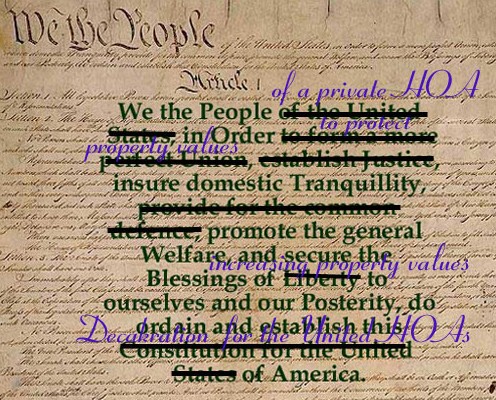
hoa-const.jpg

The above picture reflects the rewrite of the Preamble to the Constitution as applied to the HOA-Land nation. It reads,

“We the people of a private HOA, in order to protect property values, insure domestic tranquility, promote the general welfare, and secure the blessings of increased property values to ourselves and our posterity, do ordain and establish this Declaration for the United HOAs of America.”

Why is there a need for board of directors education on HOA constitutionality? Why? Because:

  • HOAs are a form of local government not subject to the Constitution, and have created divisiveness and a separation from the greater public community resulting in member confusion regarding the law and their constitutional rights and protections;
  • the national lobbying entity, CAI, has indoctrinated the legislators, the courts, and the public with its CAI School of HOA Governance program that contains just lip service to constitutional questions, for example,

“A global nonprofit 501(c)(6) organization, CAI is the foremost authority in community association management, governance, education, and advocacy. Our mission is to inspire professionalism, effective leadership, and responsible citizenship—ideals reflected in community associations that are preferred places to call home.”[2]

while opposing the application of the Constitution in its numerous amicus curiae briefs to the courts, for example,

“In light of these statutory, contractual and common law standards protecting the interests of community association members, they need not claim constitutional protection from the conduct of governing boards to exercise their rights with respect to the associations.”[3]

  • The Findings, Section II, Education for Homeowners Associations and Board Members, of the North Carolina HOA study report to the NC General Assembly recommended,

“In order to provide accurate and readily available resources to educate homeowners, board members, and interested persons about the duties and responsibilities of property ownership in an HOA community, the General Assembly . . . to seek reliable and unbiased information available from private entities . . . and provide for published and online documents and programs offering HOA education . . . .”[4]

  • Privatopia: Homeowner Associations and the Rise of Residential Private Government, the 1994 landmark book based on the research of UIC Prof. McKenzie, and highly appropriate today, called the reader’s attention to,

“CIDS [HOAs] currently engage in many activities that would be prohibited  if they were viewed  by the courts as the equivalent of local governments.

“In a variety of ways, these private governments are illiberal and undemocratic. Most significantly boards of directors operate outside constitutional restrictions because the law views them as business entities rather than governments. . . . [They] are inconsistent not only with political theories of legitimacy but with the normal process by which governments are created. . . . Thus these ‘private governments’ may violate the equal protection clause of the Fourteenth Amendment.” (Chapter 6).

  • A Table of Authorities,[5] not all inclusive, supporting the Restoring the Lost Constitution.
  • Unanswered questions on HOA constitutionality:

CAI Common Ground Editor Durso mentioned my 2006 “‘open e-mail questionnaire to CAI’ containing four questions.”  Below is a copy of those questions initially addressed to the AZ Legislature a year earlier.  I never had any answer, either from the Legislature or CAI, nor any debate on the issues.

In a 2011 email to the North Carolina Legislature House HOA Committee I asked, “the legislators, the public interest organizations and policy makers to consider the following questions.” And I concluded with, “I await your reply, or a reply from any of the legal-academic aristocrats.”[6] Still no answer.

    • Can a legislature delegate its functions, not government services but functions, to private entities without oversight or compliance with the Constitution, as required of all government entities?
    • Can private parties enter into contractual arrangements using adhesion contracts and a constructive notice consent that serve to regulate and control the people within a territory (an HOA), to circumvent the application of the Constitution?

 A webinar is in the plans that summarizes and follows the materials – the text — comprising the HOA educational series to reorient HOA boards and the public in general. The text is available online under the collection, “Restoring the Lost Constitution to HOA-Land.” Will be coming soon.

Notes

[1] See https://tinyurl.com/sr27yq3.

[2] About Community Associations Institute, April 4, 2020). https://finance.yahoo.com/news/community-associations-institute-cai-provides-181931116.html. April 4, 2020).

[3] CAI amicus brief, Jan. 3, 2013, Dublirer v. 2000 Linwood Avenue Owners Assn, N.J. Docket 069154 (2014).

[4] “Study On Homeowners Associations”, Luke A. Rankin, Chair, South Carolina General Assembly (December 18, 2015). (http://www.scstatehouse.gov/CommitteeInfo/HomeownersAssociationStudyCommittee/HOAStudyCommitteeFinalReport12182015.pdf). April 27, 2020).

[5] http://starman.com/m…/restructureHOA/restructure-reading.pdf.

[6] See Too hot for NC HOA committee – withdraws legal-academic “experts, George K. Staropoli, HOA Constitutional Government (Nov. 17, 2011). https://pvtgov.wordpress.com/2011/11/17/too-hot-for-nc-hoa-committee-withdraws-legal-academic-experts/