IL Supreme Court holds HOAs “are a creature of statute,” and not contractual

Last month the IL Supreme Court opinion in Spanish Court[1] reversed the right of an owner to withhold assessments in view of the HOA’s failure to fix and maintain.[2] In its argument, frequently making use of pro-HOA activist and CAI CCAL attorney in Florida, Gary Poliakoff, the Court stated,


Although contract principles have sometimes been applied to the relationship between a condominium association and its unit owners based on the condominium’s declaration, bylaws, and rules and regulations . . . the relationship is largely a creature of statute, defined by the provisions of the Condominium Act. . . . Although these duties may also be reflected in the condominium declaration and bylaws, as they are in this case, they are imposed by statute and exist independent of the association’s governing documents. Accordingly, a unit owner’s obligation to pay assessments is not akin to a tenant’s purely contractual obligation to pay rent, which may be excused or nullified because the other party failed to perform. ¶ 21.

So much for the sanctity of the CC&Rs contract! The Court, guided not only by Poliakoff, but by a CAI amicus curiae brief,[3] rolls with the punches and chooses when and when not to uphold the contractual nature of the governing documents.

The Court avoided dealing with the equitable aspects of withholding assessments just like withholding rent, rejecting the favorable appellate decision that held,

[T]he obligation to pay assessments, and the obligation to repair and maintain the common elements, as mutually exchanged promises, and concluded that under principles of contract law, a material breach of the repair obligation could warrant nonpayment of assessments. ¶ 7.

Adding fuel to the fire, the Illinois Supreme Court followed the CAI propaganda that the HOA’s survival depends on assessments being paid immediately and without question.

This section [of the IL condo act] was adopted to provide a constitutionally permissible, quick method for collection of assessment arrearages. . . . The necessity of a “quick method” for collection of past due assessments, unencumbered by extraneous matters, is manifest when we consider the manner in which condominium associations operate . . . . the condominium form of property ownership only works if each unit owner faithfully pays his or her share of the common expenses. When a unit owner defaults in the payment of his or her assessments, the resulting forcible entry and detainer action is thus brought “for the benefit of all the other unit owners.” ¶¶ 29 -30.

Permitting a unit owner’s duty to pay assessments to be nullified would thus threaten the financial stability of condominium associations throughout this state. . . . For the same reason that taxpayers may not lawfully decline to pay lawfully assessed taxes because of some grievance or claim against the taxing governmental unit, a condominium unit owner may not decline to pay lawful assessments. Trustees of the Prince Condominium Trust v. Prosser, 592 N.E.2d 1301.” ¶ 32.


Here we have the alleged dicta [non-supported court opinions], and becoming part of the Illinois public policy, that the survival of the HOA/condo is first and foremost. The HOA rises to the same level as a public entity, with the questionable governing documents now having contractual validity and court support to deny homeowner rights, freedoms, privileges and immunities.


Welcome to the New America of HOA-Land.

References


[1] http://www.state.il.us/court/Opinions/SupremeCourt/2014/115342.pdf.

[2] See appellate decision Court decisions: HOA Enlightenment Movement vs. the Dark Ages.

[3]Spanish Court Condominium Association II vs. Carlson (Illinois),” CAI Amicus Curiae Activity 2013.

AZ legislature fails to remove invalid statutes from its ARS web page

“Because the [right] to rule is rather the appearance of justice rather than justice itself, the appearance of injustice defeats every [right] to rule.”[1]

While the SB 1454/HB 2371 redux bills SB 1482 and HB 2695 appear to be dead this session, there is still no bill to repeal the amended statutes in Sess. L. Ch. 254 (2013);[2] those declared unconstitutional and invalid by the Arizona court, and agreed to in a settlement agreement with the Arizona Legislature.[3] The Legislature is intentionally misleading the public as to the legitimacy of the Arizona Revised Statutes in what appears to be a slap at the separation of powers doctrine – we will ignore the ruling of the court.

The following was sent to the Arizona legislative leaders (March 19, 2014 email).

“Dear Legislators,

 “I cannot understand why the SB 1454 statutes declared invalid, and agreed to in a settlement agreement, are not being repealed?  ARS show them as valid laws, without any annotation, which misrepresents their validity to the public.

 “I cannot understand why the HOA HB 2371 redux bills this year, HB 2695 and SB 1482, provide for their repeal contingent on the passing of these omnibus bills?  There is no ‘standalone’ bill to set the record straight.   These invalid statutes cannot remain on the books for another year!”


The following was sent to Secretary of State Bennett.  (March 21, 2014 SOS form).

 “Sess. Laws Ch. 254 (2013) was declared unconstitutional in court and certain statutes were found to be invalid. See Staropoli v. State of AZ, CV2013-009991.  An agreement with the AG representing the Legislature was signed and accepted by the court.

“Yet Ch. 254 shows the invalid statutes and there is no annotation that certain statutes are invalid. THIS MISLEADS THE GENERAL PUBLIC!

 “I believe Session Laws and ARS must be corrected to reflect the true status of the statutes.”


In HOA SB 1454 progeny: passing SB 1482/HB 2695 would be an act of tyranny by the AZ Legislature (February 25, 2014), I wrote:

“No choice to repeal statutes found unconstitutional

“These statutes were declared unconstitutional by agreement with the AG, representing the Legislature, and an order by the court accepting the settlement agreement.  However, the Arizona Revised Statutes (ARS) still shows these statutes as if they were valid and enforceable laws, which is deceptive to the public accessing the official Legislature’s website, ALIS. There are no annotations to advise the public otherwise.

“The repeal of these unconstitutional statutes is conditioned upon bill approval. A failure to pass both bills will still leave these statutes on the books. There is no stand-alone bill that repeals these unconstitutional statutes as would be expected by a legitimate legislature acting with integrity as representatives of the people, and not as representatives of the special interests. Apparently the defiant eight-hundred pound gorilla, the special interest HOA stakeholders (CAI, AAR, AACM and AHBA),  has flexed its muscle, and the sponsors have reacted accordingly.”

This is incredulous! It is unthinkable that legislative leaders would succumb to the shadow government of the HOA stakeholder special interests, and openly mislead and misinform the public! Furthermore, after being given sufficient notice, the failure to correct ARS can only be viewed as intentional.

What other rational explanation can there be? Perhaps the participating legislator – special interest organization ALEC (American Legislative Exchange Council) was involved? People for the American Way[4] describes ALEC as,

The American Legislative Exchange Council, is a one-stop shop for corporations looking to identify and cultivate friendly state legislators and then work with them to get special-interest legislation introduced and passed.

The American Legislative Exchange Council, serves as a voice for corporate special interests in state legislatures across the country. Its corporate executives, lawyers and lobbyists, along with member legislators, draft, lobby for, and secure passage of a wide array of bills designed to promote corporate interests.

For more information about ALEC see United States of ALEC. (Bill Moyers 30 minute video in 2012 on ALEC. AZ is right up front.)

References

[1] W. B. Allen, “Machiavelli and Modernity,” The Prince, Niccolo Machiavelli, p. 108.

[2] http://www.azleg.gov//FormatDocument.asp?inDoc=/legtext/51leg/1R/laws/0254.htm&Session_ID=110.

[3] http://pvtgov.org/pvtgov/downloads/order-final.pdf.

[4] http://www.pfaw.org/media-center/publications/alec-arizona-voice-corporate-special-interests-halls-arizonas-legislature.

Defending the Constitution: VA, yes; AZ, no

With the removal of the statutory imposed right of an HOA to fine members from Virginia’s  HB 791, the VA legislature demonstrated that it stood behind the separation of powers doctrine of the US and VA constitutions.

I had written VA Rep. Suorvell and Senator Petersen, who opposed the bill as it was written, about the Virginia Supreme Court’s findings in Gillman v. Unit Owners, which said HOA fines were unconstitutional.

In Gillman the Virginia Supreme Court held,

We do not agree that it was ever the intent of the General Assembly of Virginia that the owners of units in a condominium be a completely autonomous body, or that such would be permitted under the federal and state constitutions. Admittedly, the Act is designed to and does permit the exercise of wide powers by an association of unit owners. However, these powers are limited by general law and by the Condominium Act itself.

The imposition of a fine is a governmental power. The sovereign cannot be preempted of this power, and the power cannot be delegated or exercised other than in accordance with the provisions of the Constitutions of the United States and of Virginia. Neither can a fine be imposed disguised as an assessment. . . . We think it clear that the Gillmans were being punished, not assessed, and hold the action of the Association to have been impermissible.

 And very importantly from a constitutional point of view (my emphasis), “A condominium restriction or limitation, reasonably related to a legitimate purpose, does not inherently violate a fundamental right and may be enforced if it serves a legitimate purpose and is reasonably applied.”

Sadly, the Arizona Legislature is still trying to pass for a 4th and 5th time (two versions of last year’s trice defeated HB 2371/SB 1454).  It would allow unlicensed and untrained HOA property managers to represent HOAs in small claims court and in administrative hearings;  but not allow the homeowner a third-party representative, violating the equal application of the laws and no special laws for special groups provisions of the US and AZ  constitutions.

What is the legitimate AZ government purpose to selectively deny homeowner equal representation?  Does it reasonably promote good public policy?

rate of growth of HOAs declines sharply nationwide

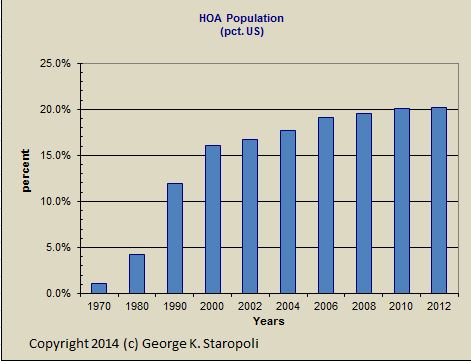
pop-hoaHere is one statistic that the CAI 2012 survey failed to mention.  The stats are from CAI’s “industry Data” and US census.  Graph shows % US population living in HOAs.  The period of 2004 – 2006 was the beginnings of the Enlightenment Period during which the statutory HOA disclosures were shown to be biased, incomplete, and misleading, and during which the Truth in HOAs began being publicized.

The biennial rate of growth from 2004 to 2012 decreases from 1.4% to .15%

2004 –6        1.4%

2006 –8          .46%

2098 – 10       .49%

2010 – 12        .15%

It seems that the advocates’ The Homeowners of HOA-Land media stories have had an effect on the public. The continued pro-HOA special interest (aka HOA Stakeholders) dominance of state legislatures will only accelerate a sharper decline, especially as they react with ‘get tough’ vehemence. State legislatures can no longer bury their heads in the sand with  a “we didn’t know” attitude and continue to support the misguided virtues of oppressive HOA private governments.

HOA SB 1454 progeny: passing SB 1482/HB 2695 would be an act of tyranny by the AZ Legislature

“The tyranny of the legislature is really the danger most to be feared.”  Thomas Jefferson

Summary

  1. HOA mirror omnibus bills, SB 1482 and HB 2695, — while there are some concessions to those concerned with criminal activities — are materially the trice defeated HB 1454/HB 2371 bills of last session. They leave statutes declared unconstitutional on the ARS books regardless of pass or not-pass. The public is thereby being deceived as to the validity of ARS, which continues to report unconstitutional statutes.

  2. The log-rolling, something for every HOA special interest, aka HOA stakeholder, includes a separation of powers issue with respect to amendments to the Supreme Court UPL rules, Rule 31. Petition for rule change, R13-0041, to allow exceptions for HOA manager representation of HOAs was withdrawn last year upon the unconstitutionality decision. The 2011 request, R11-0001, which contained the same exception for HOA manager representation, was rejected by the Supreme Court.

  3. The cooperation with the HOA stakeholders, the 800-pound gorilla, by the bills’ sponsors and the passage by their committees is iconic of the tyranny of the legislature under the extreme dominance of HOA special interests.

sen_Gov gorilla

HOA omnibus SB 1454/HB 2371 redux

The Arizona Legislature would be making a strong statement this 2014 session: no one challenges the Legislature, itself, and a legislator, of intentionally violating the Arizona Constitution — and wins in court.[1] There are two mirror bills, SB 1482, Senator Griffin again, and HB 2695, Representative Ugenti again, that are a resurrected HB2371 from the last session. HB 2371 was a bill that twice failed, but was snuck into and unconstitutionally attached to SB1454[2] in the closing hours of last year’s session  — an omnibus bill having something for all special interest HOA stakeholders. 

Rep. Ugenti’s opening statement on HB 2371, before Senator Griffin’s committee, stated that she combined all those bills,

Working through a stakeholder process and allowing the stakeholder process to filter the proposed legislation   . . . representing a consensus from the AZ realtors, and AACM [AZ Association of Community Managers, the beneficiary of this bill]. . . . I do feel responsible to the many stakeholders and representatives in the bill.   [Homeowners were not included among the “stakeholders.”] 


No choice to repeal statutes found unconstitutional

These statutes were declared unconstitutional by agreement with the AG, representing the Legislature, and an order by the court accepting the settlement agreement.  However, the Arizona Revised Statutes (ARS) still shows these statutes as if they were valid and enforceable laws, which is deceptive to the public accessing the official Legislature’s website, ALIS. There are no annotations to advise the public otherwise.  

The repeal of these unconstitutional statutes is conditioned upon bill approval. A failure to pass both bills will still leave these statutes on the books. There is no stand-alone bill that repeals these unconstitutional statutes as would be expected by a legitimate legislature acting with integrity as representatives of the people, and not as representatives of the special interests. Apparently the defiant eight-hundred pound gorilla, the special interest HOA stakeholders (CAI, AAR, AACM and AHBA)[3]  has flexed its muscle, and the sponsor has reacted accordingly. 

Grant of unconscionable special powers to HOA managers

As to the  content of the amendments, it is inexcusable that these bills would bless willful violations of UPL as uncovered by the Arizona Supreme Court’s action against AAM, LLC[4], a CAI and AACM member HOA management firm. Among its findings of numerous UPL violations, the court added (my emphasis), The Board would add AAM also should have known better than to let its certified legal document preparer employees perform in a representation function in violation of Rule 31 and ACJA 7-208(1).”  It seems that AACM forgot about the rejection in 2011 of a request for HOA manager representation, R11-0001. Its conduct in 2012 can be seen as a direct flaunting of the laws of the State of Arizona.

The bill offers no justification for the special treatment of HOA managers to allow them to represent HOAs without any licensing or training in spite of the numerous violations revealed by the AAM findings.  The Court action followed upon the March 2012 State Bar UPL Opinion, 12-01,[5] in which six questions pertaining to HOA manager conduct were addressed. Question 6:May CAM [community association manager] personnel negotiate legal matters on behalf of the Association with Association members?”  The answer: NO!  Not even licensed and educated Certified Legal Document Preparers can!

Machiavelli wrote: “Because the [right] to rule is rather the appearance of justice rather than justice itself, the appearance of injustice defeats every [right] to rule.”  Unlike SB 1062 where the public is genuinely divided, these bills are the special agendas of the HOA stakeholders alone, and not of the people. Because the sponsors chose an omnibus approach to log-rolling yes-votes for acceptance, rather than to allow free choice on each issue, these bills must be defeated.

I sincerely hope that the Arizona Legislature finally stands up to the 800-pound gorilla, the HOA stakeholders, and does the right thing:  not allowing these bills to become law and to repeal the unconstitutional statutes of Ch. 254 (2013).


References


[3] CAI – Community Associations Institute; AAR – Arizona Association of Realtors; AACM – Arizona Association of Community Managers; AHBA – Arizona Home Builders Association.

[4]In re: Certified Legal Document Preparer v. AAM, LLC, No. LDP-NFC-09-L094, LDP-NFC-10-L026, p. 4 (May 24, 2012). Not available online at Supreme Court, but copy at http://pvtgov.org/pvtgov/downloads/upl12-01.pdf.