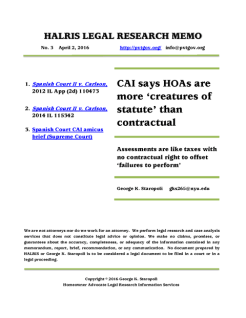
CAI says HOAs are more ‘creatures of statute’ than contractual

Memo 3This Research Memo focuses on the Illinois Supreme Court opinion in Spanish Court. Excerpts from the Memo —

Assessments are like taxes with no contractual right to offset ‘failures to perform.’

[CAI argued]

Although contract principles have sometimes been applied to the relationship between a condominium association and its unit owners based on the condominium’s declaration, bylaws, and rules and regulations the relationship is largely a creature of statute, defined by the provisions of the Condominium Act.

For the same reason that taxpayers may not lawfully decline to pay lawfully assessed taxes because of some grievance or claim against the taxing governmental unit, a condominium unit owner may not decline to pay lawful assessments.

The very real impact of the Second District’s  decision [appellate court validating the withholding of assessments for the HOA’s failure to perform] is peculiarly analogous to our government’s need to collect taxes free from objection by individual taxpayers. Surely, if people could refuse to pay taxes and then defend against their collection based upon a claim that the government had been negligent in the maintenance of public spaces and providing services, the government would find itself in dire financial straits and unable to fulfill its obligations.

Read the full Research Memo No. 3.


Activist judges & implied HOA covenants

As a general principle, it is a self-feeding cycle whereby unjust, pro-HOA laws serve to further create unjust judicial precedent.  Homeowner justice is repeatedly denied as more and more cases rely on bad court opinions based on unjust laws, solidifying the strength and weight of these earlier cases that serve as precedent.  It is a primary cause of the failure to obtain justice for homeowners in HOAs.

Reflecting this considerable body of law, the newest version of the Restatement of Property (Servitudes) provides that “a common-interest community has the power to raise the funds reasonably necessary to carry out its functions by levying assessments against the individually owned property in the community….” Restatement (Third) of Property: Servitudes § 6.5(1)(a) (2000). In addition, as explained in a comment to that section, the power to levy assessments “will be implied if not expressly granted by the declaration or by statute.” Id. at § 6.5 cmt. B.

(Florida Supreme Court opinion in Evergreen Village).

Read the full Research Memo, No. 2

Landmark HOA legislation restores homeowner property rights

In state legislatures rejecting HOA “ex post facto” amendments I mentioned 2 bills that gave limited protection to homeowner property rights in regard to ex post facto amendments that constitute an eminent domain taking.  Idaho’s HB 511 was signed into law by the Governor on March 24th, and Arizona’s HB 2382 is a technical done-deal as the House agreed to accept the Senate’s technical corrections, which would then be sent to the Governor for signing.

Idaho HB 511:  “No homeowner’s association may add, amend or enforce any covenant, condition or restriction in such a way that limits or prohibits the rental . . . unless expressly agreed to in writing at the time of such addition or amendment by the owner of the affected property.”

Arizona HB 2382“AN AMENDMENT TO A DECLARATION MAY APPLY TO FEWER THAN ALL OF THE LOTS OR LESS THAN ALL OF THE PROPERTY . . . (b) IF THE AMENDMENT RECEIVES THE AFFIRMATIVE VOTE OR WRITTEN CONSENT OF  ALL OF THE OWNERS OF THE LOTS OR PROPERTY TO WHICH THE AMENDMENT APPLIES.”

Idaho’s bill needs no explanation. It is a property right of the owner to lease his home if he so desires, and that constitutional right cannot be taken away by the HOA.

Typical applications of Arizona’s bill could in regard to no longer permitting certain trees landscaping and a mandatory removal of these unacceptable landscaping, or disallowing certain home colors or external features like shutters or attached awnings, etc.  How about lot owners facing a drainage ditch or right of way road that was maintained by the HOA and is now to be maintained by those homeowners?

Just one no vote by a homeowner whose CC&RS at the time of purchase said that the HOA was responsible would kill the amendment.  Keep in mind that there may have been several earlier versions of the CC&RS as a result of prior amendments, which would then make the attempted amendment applicable to less than all lots or owners.  Or, not all units have an outdoor deck.

Please note the absence of compensation for the loss of property rights.  Heaven forbid that the law, in the interest of justice and fair play, would ask the HOA to pay money to affected homeowners.  While America survived for over 240 years with this requirement, the defective HOA scheme needs the legislature to bail it out and not require fair compensation.

Gee, the HOA might fail.  The other members would not pay for it under their version of “it ain’t fair” mantra.  HOAs would lose their appeal.  Oh my gosh, plead the legislatures, we can’t let that happen. We got a good thing going here.

Judicial acceptance of HOA ex post facto laws

This 2002 Florida Supreme Court  case study reveals how the application of pro-HOA laws and, as a consequence, subsequent court decisions form the court’s opinion and rationale as related to the acceptance of HOA ex post facto laws and eminent domain takings.  This case, supporting such amendments as valid, touches on important constitutional questions of due procFL case studyess and the equal protection of the laws.

Unfortunately, the owners failed to raise these extremely important questions before the Florida Supreme Court. And to the detriment of homeowner rights advocates and HOA members, these questions are still not being raised in the courts.

Read the complete paper here.

state legislatures rejecting HOA “ex post facto” amendments

The Idaho Governor was given a bill to sign, HB 511, that prevents HOAs from restricting rentals if the owner doesn’t agree with CC&Rs amendment.  If the CC&Rs did not have rental restrictions, the HOA cannot add one without the affected homeowner’s consent. A victory that applies ex post facto law restrictions, as set forth in the Constitution, to HOAs. This is a victory in which homeowner rights are restored on a case by case basis after being summarily denied by invalid and unconstitutional CC&Rs alleged contracts, with state legislators looking the other way.

Betsy Russell’s article in the Spokesman-Review[1] states that HB 511 declares,

“No homeowner’s association may add, amend or enforce any covenant, condition or restriction in such a way that limits or prohibits the rental, for any amount of time, of any property, land or structure … unless expressly agreed to in writing at the time of such addition or amendment by the owner of the affected property.”

According to Russell a supporter of the bill commented,

 “It’s not an imposition on a contract,” he said. “That contract is being applied in ways never intended, never understood, that devalue the property by taking away fundamental rights to the use and enjoyment of that property after the purchase. That’s the question. Is it appropriate for them to take it away without the consent of the purchaser.”

Of course, the author presents the old refrain by an opposition legislator, “To me, you signed on to a deal, and now we’re giving you an out – that it doesn’t have to be enforced. That doesn’t make sense to me. I’ll be voting no.”  As I wrote in “CAI flexes its muscle[2]”, enforcing invalid contracts makes a mockery of the law.

Also in the legislative hopper, having passed the House, the Arizona Senate is ready to vote on another ex post facto restoration bill, HB 2382[3], that would prevent CC&Rs amendments from being enforceable if the affected homeowner does not consent to the amendment.  This bill is a much broader bill pertaining to any amendment that affects less than all members. The effect of an HOA ex post facto amendment could be an eminent domain “taking” violation as the owner is not compensated by the “takings” amendment, which would bring the HOA in line with constitutional government.

 Advocates must get in the faces of their legislators and remind them who they work for: We the People, not the special interests, and definitely not their political party!


Notes

  1. Senate narrowly backs legislation to keep HOA’s from barring AirBnB or other short-term rentals,” Betsy Z. Russell, The Spokesman-Review, March 20, 2016.
  2. CAI flexes its muscle in Congress arguing constitutional law and judicial review.
  3. Arizona’s HB 2382 is an unconstitutional violation of eminent domain law.