
In 2007 I analyzed CAI’s Factbook at that time and found that CAI was a miniscule minority (See CAI miniscule minority dominates public policy). I found that .03% of the people living in HOAs are CAI members as compared to some 50% +/- of seniors are AARP members. Also, that .07% of HOA units have a CAI member.
Since that was 10 years ago, I’ve updated my statistical analysis using the CAI Statistical Review 2016, Factbook Part 4, adding additional explanations. A number of concerns are raised.
MY FINDINGS:
HOAs, units, residents
- The percent HOA units to total US units rose from 16.9% in 2000 to just 19.1% in 2016.
- The percent people (residents) in HOA to total US people in homes rose from 16.1% in 2000 to 21.4% in 2016.
- People per HOA unit was fairly consist at about 2.5, in line with US Census data for people in units.
- Unexpectedly, the average number of people per HOA was also fairly consistent about 200 people, +/- 3.
- Similarly, the average number of units in an HOA was fairly consistent at about 80 units per HOA.
- As a check on (4) above, I choose data from 6 states[1] provided in the Factbook state summary, both large and small, as a comparison. The number of people per HOA in these 6 states came to about the same 200.
CAI membership stats
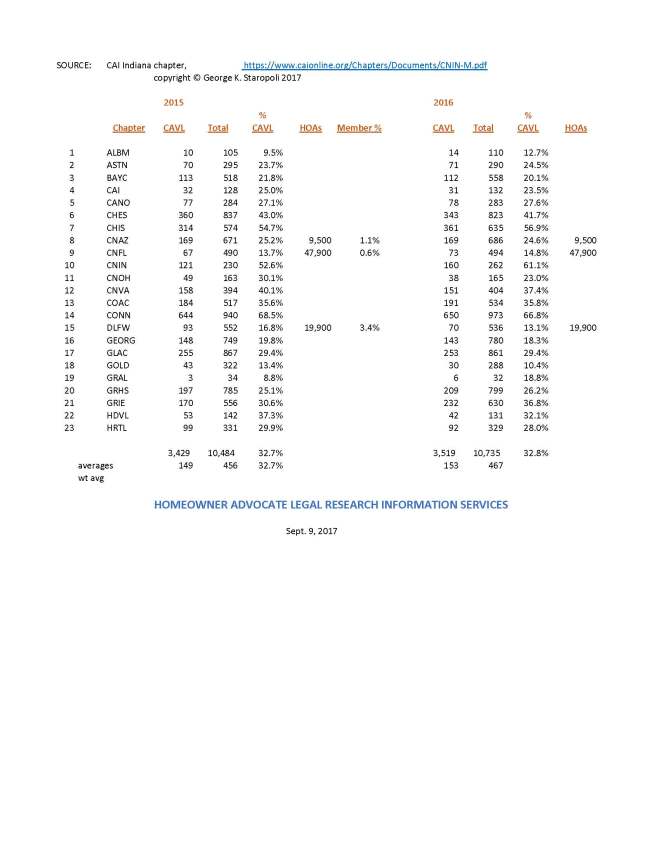
- Being concerned about the frequency of fixed ratios found in (A), I came across data from the CAI Indiana chapter for 2015 and 2016.[2] The percent ‘volunteers’ per HOA for both years was 32.7% and 32.8%, respectively. Very consistent.
- Of the 69 M people in HOAs, CAI membership, at most, consists of a miniscule .05% (.00048).
- Of the 33,000 CAI members, a minority of some 10,800 are ‘volunteers’ and not attorneys or managers.
- ‘Volunteers’ (CAVL) represent a miniscule .016% (.00016) of HOA members.
CONCLUSIONS:
We can safely say that, assuming some 342,000 HOAs,
- if each CAI member came from a different HOA, then 9.6% of the HOAs contain a CAI member,
- and a mere 3.2% of HOAs contain an HOA ‘volunteer’;
- at most then, CAI ‘volunteers’ have a presence in a mere 3.2% of HOAs across the country;
- CAI’s claims to speak for members and even HOAs with its less than a 10% presence is highly misleading.
Factbook issues
The following discussion uses the Excel charts found in Exhibit 1.
What I found disturbing in A4 and A5 above were the fixed ratios of residents and units to the number of HOAs; namely roughly 200 and 80, respectively. Note that these 2 numbers have a fixed ratio of about 2.5. This did not seem natural to me or a result of freely occurring human behavior. The same ‘200’ ratio appears in the 6 individual states in the CAI state factbook, which does not have “units” data for comparison.
CAI’s Residents and “Units” figures have a fixed 2.5 ratio, reflecting the long-standing US Census ratio of the number of residents to the number of units in general for all housing. Consequently, once either of the units or residents are known, the other statistic is just a mathematical calculation. As for the missing “units” figures for the individual state stats, they can easily be calculated by dividing the residents number by 2.5. It’s as simple as that.
Notice the natural, expected variation in data found in the Indiana chart (Exhibit 1, p. 2) for both CAVL and total members. This variation also shows in the “communities” column for the six states on page 1 of the Exhibit, but is absent from the main CAI historical summary page for “communities.” The other data on the summary page flow from the fixed ratios mentioned above.
It can now be asked: How reliable is the data for CAI’s “Communities” figures? As shown in the chart on p. 1 of the Exhibit, the HOA growth is a steady 15,000 annual increase over 17 years, from and including 2000 to 2016. I don’t feel comfortable with this constant rate of growth; it’s not natural or to be expected. But, it may well be. Who knows?
References
[1] Arizona, California, Colorado, Florida, Illinois and Texas.
[2] CAI Indiana chapter document.
EXHIBIT 1
page 1

page 2
 HOA Constitutional Government