Please see the poll in the left margin, below my picture.
Question: As de facto community governments, should HOAs be subject to the Constitution as are all other local governments?
Posts by GKS
Please see the poll in the left margin, below my picture.
Question: As de facto community governments, should HOAs be subject to the Constitution as are all other local governments?
ACLU raised the following question:
“One of the core purposes of the First Amendment is to allow people, regardless of their views, to hold the government accountable through expression. So, if your elected representative has an official Facebook page where she invites comments, can she block you from commenting because you criticize her work?[I]”
By extension, this same question can be asked of de facto private government HOAs and their elected officials.
In Davison v. Randall,[ii] Defendant Randall is a municipal representative who maintained a Facebook page related to her government activities, which was open to comments. Plaintiff Davison’s critical comments were blocked by Randall, and so he brought this first amendment suit. ACLU wrote:
“On Monday, the Fourth Circuit Court of Appeals ruled that the interactive portion of a public official’s Face book page is a “public forum,” so an official cannot block people from it because of the opinions they hold.
“Indeed, the right to criticize the government is at the heart of the First Amendment. The court specifically recognized blocking as infringing on that right, noting that blocking someone in order to silence criticism of government work is itself evidence of government action.”
(ACLU, n. i).
By extension, this decision by the circuit court can be applied to the de facto private government HOAs and their elected officials. Very importantly and on point, the NJ Supreme Court in Mazdabrook v. Khan[iii] held in favor of HOA homeowner free speech rights regarding signs.[iv]
“Moreover, [the Plaintiff] did not waive his constitutional right to free speech. To be valid, waivers must be knowing, intelligent, and voluntary, and a waiver of constitutional rights in any context must, at the very least, be clear. Khan was not asked to waive his free speech rights; he was asked — by different rules in three documents — to waive the right to post signs before getting Board approval, without any idea about what standards would govern the approval process. That cannot constitute a knowing, intelligent, voluntary waiver of constitutional rights. . . . . Instead, the exercise of those rights can be subject to reasonable time, place, and manner restrictions. Finally, covenants that unreasonably restrict speech may be declared unenforceable as a matter of public policy. (P. 5).
“The proliferation of residential communities with standard agreements that restrict free speech would violate the fundamental free speech values espoused in our Constitution.”
As is quite prominent, this violation is ripe in all those rogue HOA boards of directors because state legislatures have given HOAs a carte blanche, hands off right to function outside constitutional protections. In short, HOAs function as independent principalities within America![v]
References
[i] Court Rules Public Officials Can’t Block Critics on Facebook, Vera Eidelman, ACLU (2019). Reference to Davison v. Randall. See infra, n. ii. ACLU filed an amicus brief.
[ii] Davison v. Randall, Nos. 17-2002 & 17-2003 (4th Cir. 2019, VA).
[iii] Mazdabrook v. Khan, 46 A.3d 507 (2012). Note that the NJ ACLU had filed an amicus brief by Frank Askin.
[iv] See “CC&Rs and waivers of constitutional rights in HOA-Land.”
[v] See Establishing the New America of Independent HOA Principalities, Amazon, ISBN-13: 978-0974448831, ISBN-10: 0974448834. (2008).
Based on my HOA Common Sense, here’s a graphic of the 6 substantive HOA defects as I see them. Please feel free to use provided proper credentials are included.

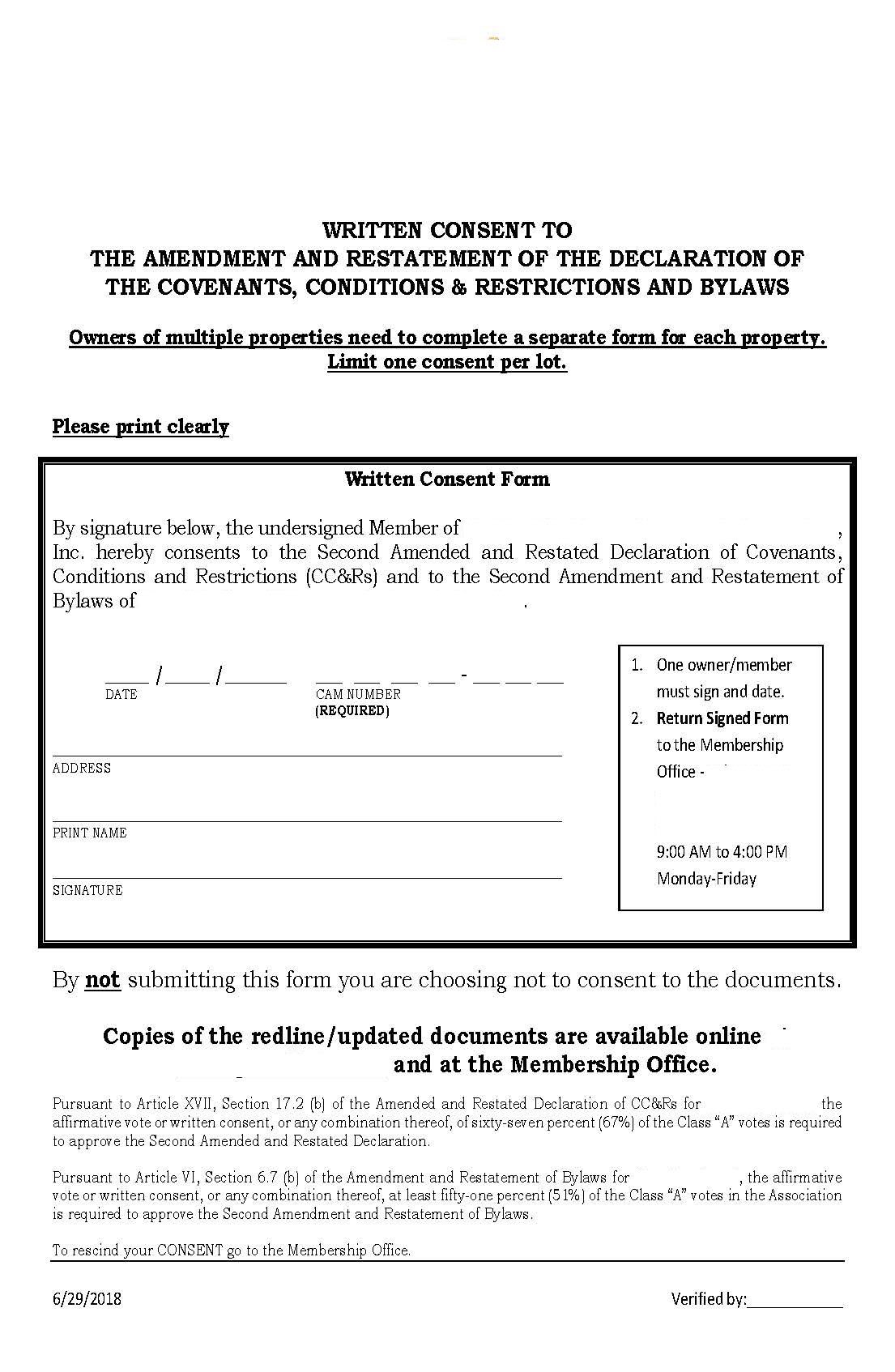
A large, upscale HOA in Arizona, with a CAI member attorney, is using a voting procedure to approve amendments that employs Consent Forms.
The distributed Consent Form is, in reality, a vote by ballot: a rose by any other name is a rose. As such, it does not conform to the law, ARS section 33-1812. The relevant subsection is (A), paragraphs (1), (2) and (4), require that the ballot itself set forth each proposal, that the member be able to vote for each proposed amendment instead of a blanket “all or nothing,” and a date for submission of the ballot must be provided in order to be counted, respectively.
Furthermore, contrary to established democratic election procedure, the Consent Form has no set “cutoff date” for tabulating the ballots; it’s an open-ended procedure that hopes to obtain a quorum of votes and an approval, no matter how long it takes — maybe in 2 months, a year, or in 5 years.
In addition, there is no option for a NO vote on the Consent form, the members being told that not submitting the Consent is a NO vote. Not so! In effect, it could be an actual NO vote, or an I don’t care vote. It doesn’t make sense to promote non-voting by suggesting not to send in the form. Unheard of!
With the open-ended procedure the HOA will continue to influence and pressure the members to do what’s good for the HOA, in the Board’s mind, and submit their Consent. It’s electioneering without an opportunity for a voice by the opposition. That’s outrageous!
“In mid-February, watch for mailing to those homeowners whose consents have not “yet been recorded by Membership. The mailing is being sent to make certain everyone knows of the Consent Process and serves as a reminder to those who might have misplaced the Consent Form or have delayed signing in their busyness of life in xxxx.”
Being allowed to submit a NO vote easily settles the matter for the member to exercise his voting rights. It also allows the NO member to avoid undue influence. But the procedure doesn’t allow the member to submit his NO decision.
In short, the HOA election procedure disenfranchises the membership and makes a mockery of the governing document’s right to a meaningful vote. Is it a valid voting procedure?
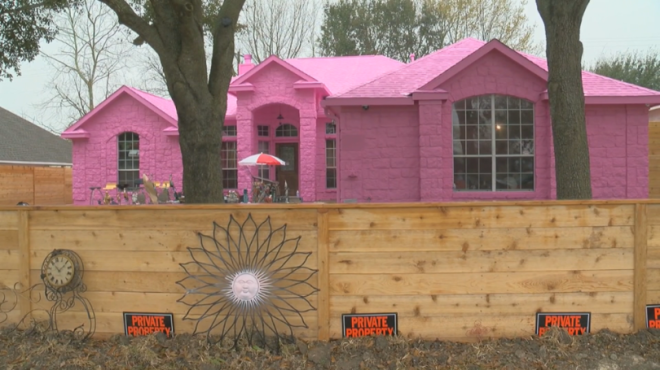
Is there anything wrong with this expression of art and individuality?? I mean, HOAs can only think in terms of shades of tan, grey or white, setting new architectural standards for America. In Austin, TX and HOA looking to sue.
 HOA Constitutional Government