“Rules of Engagement” apply to CAI

Many may feel from all my criticism that I unjustifiably have it in for CAI.  Well folks, you decide whether the CAI propaganda statements and publications that are PR releases is in conflict with its numerous acts before state legislators and the courts.  These contradictory stances are revealed in CAI’s amicus briefswhat I say I don’t do [1].

Advocates have failed to apply the Rules of Engagement to such Doubletalk[2] from CAI allowing the legislators, the media and the BODs to see no evil, hear no evil speak no evil.  These Rules are a very important weapon to discredit CAI and stop the policymakers from trusting their misleading statements; to start believing in the validity of the positions and arguments for HOA reforms coming from homeowners and homeowner advocates.

As a prime example, and there are many others found in the numerous CAI briefs dealing with constitutional HOA issues, is the NJ Supreme Court case in Dublirer.[3] It involved the free speech rights of a homeowner to equal access the HOA facilities in order to distribute BOD election materials to his neighbors – an exercise of his rights in a democracy. Allow me to repeat my quotes[4] from CAI’s NJ Supreme Court amicus brief in Dublirer.[5]

CAI-NJ’s concern is the attempt to convert private communities into constitutional actors and to open such communities to access not only to speakers from within the community but also to the public, while ignoring contractual agreements and non-constitutional protections.

The relationship between the plaintiff and the defendants here is that of a business corporation and so is similar to that involved in any other business corporation. A shareholder who wishes to run for a position on a corporate board has no right to post campaign signs on the corporation’s property. . . . He has no constitutional right to distribute his campaign materials within the cooperative’s property simply because mailing them to the other tenant/shareholders may cost him money”.

In plain English, this is secessionist and a rejection of the Constitution. CAI’s position says the people in an HOA will decide what laws to follow or not to follow. It is an incredulous statement from the organization that claims to be the one and only voice on HOAs, but apparently does not understand or simply ignores constitutional law. The CAI position is in opposition to the  long-standing legal doctrine on the delegation of legislative (lawmaking) powers to private persons.

In order to win, advocates must muzzle CAI’s lack of “candor to the tribunal.”[6]  Judicial and legislative  doctrines hold that an allegation or argument that goes unanswered is held to be true.  That’s why, it seems, advocates are viewed as unbelievable,  because of their repeated silence resulting from a lack of knowledge on how to respond.  This must change!


References

[1] See in general, Will the real CAI standup: its contradictory beliefs, pronouncements and goals.

[2] From George Orwell’s novel, 1984, where a person holds two contradictory statements at the same time.

[3] Dublirer v. 2000 Linwood Avenue,  103 A.3d 249 (NJ 2014).

[4] See my Commentary for additional quotes: CAI: the HOA form of government is independent of the US Constitution.

[5] Dublirer CAI Amicus.pdf.

[6] Attorney Rules of Professional Conduct, Rule 42, E.R. 3.3

Chaps Paladins: supporting HOA reforms

Join the upstart group, COALITION FOR HOMEOWNER ADVOCATE PALADINS (CHAPS). Be a part of a greater HOA member community, independent of HOA board and attorney influences.

PALADIN-CHAPSYou are needed to identify yourself as a supporter of HOA reforms in your state and across the country.  Your legislature and Congress are more apt to pay attention when presented with a large group of persons behind HOA reforms.
As a Paladin you are identifying yourself as such a person, helping your position as well as being part of a larger, true community of HOA members working for the benefit of all homeowners.

Consider joining CHAPs Paladins as if you were responding to a poll saying you support HOA reforms. If you have an important issue for others to know, we do welcome links and posts on the big reform issues, especially constitutional due process or equal protection of the law issues.  Significant court cases and HOA legislation that can apply to all HOAs in every state are welcome.


Today, CAI continues to claim it speaks for HOAs and its members!  However, CAI cannot have HOAs as members, because it would violate their tax-exempt status as a business trade group (501(c)6) whose members make $$$ from consumer HOAs. Don’t let the legislators, the media, and the public accept this misleading claim by CAI.

JOIN CHAPS PALADINS TODAY!


AZ SB 1094 legislative intent mocks the legislature

Legislative intents are frowned upon according to the AZ bill drafting manual. However, ARS 41-1107 does require a statement of intent by the legislature.

“All legislation that diminishes a previous grant of authority to a political subdivision of this state shall contain an intent clause that explains the reason for the diminution of authority.”

The expressed intent is not the view of the sponsor, but a statement of opinion by all the legislators’ justifying the bill. This bill, as argued earlier in Sun Cities rec centers: politics at the AZ legislature, removes the authority of the Arizona Legislature to make law and gives it to the homeowners. The AZ decision in McLoughlin (McLoughlin v. Pima County (CA-CV 2001-0198, Div. 2, 2001) ) spells out the well-settled doctrine prohibiting the legislative delegation of authority to private parties.

The intent of this bill, as expressed, is laughable and mocks the integrity of the Arizona Legislature as a just and fair supporter of our democratic system of government. It’s a special bill for 2 HOAs out of some 10,000 in Arizona, plain and simple.


HOA constitutionality issues increase

I am pleased to see that more and more court cases and legislation in many states directly addressing the unconstitutionality of the widespread Declarations of CC&Rs, which all flow from the 1964 HOA “bible,”  The Homes Association Handbook.[1]  The topic here is Montana’s SB 300 bill[2] that has CAI really worried.  In its advocacy CAI quotes, “Randall Snyder Testimony –SB 300 is unconstitutional’  and ‘Simkins Holdings, LLC, developer of the Big Sky Town Center – ‘As a real estate developer, SB 300 violates our ability to contract with our current members’ among others.[3]

SB 300 is a short bill that is “on point” with respect to making the CC&Rs agreement, held by the courts to be a contact, to abide by Contract Law 101 with respect to the requirement that both parties, the HOA and the homeowner, must agree to any changes and amendments.  Under the general boiler plate CC&Rs amendments that alter your contract at the time of closing can become effective without your consent.   The US Constitution prohibits ex post facto laws. In the public domain under contract law and common law this is not allowed, it’s a No-No.

Section 1  of the bill —

“(1) A homeowners’ association may not enter into, amend, or enforce a covenant or condition in such a way that imposes more onerous restrictions on a member’s basic rights to use the member’s real property than those restrictions that existed when the member acquired the member’s interest in the real property.”

“(4) Nothing in this section invalidates existing covenants of a homeowners’ association or creates a private right of action for actions or omissions occurring before [the effective date of this act]. However, after [the effective date of this act].”

Subsection 4 prohibits what I have referred to as “ex post facto” amendments,[4] making the HOA “constitution” compatible with the US Constitution.

The rational for the courts upholding ex post facto amendments has been the amendments clause of the CC&Rs whereby the homeowner agrees to the vote of the members if it meets the approval requirements.  (See my full rebuttal as contained in note 4, “HOA Principalities”).

“But, they [the courts] want you to ignore the other side of due process — substantive due process where the HOA “law” is itself a violation of our system of government.  And forget about any question of a buyer’s “reasonable expectation” as a requirement for a valid amendment.    Or that there is no explicit waiver of the surrender of any property rights.”[5]

HOA constitutionality issues are an effective means to attaining HOA reforms as it will force an open, public discourse on these violations. It will force the legislators and CAI to defend their positions in public or remain silent.  Advocates must make repeated recourse to these issues, and make sure that the media publicizes these valid arguments.

Promotional

PALADIN-x2

Support HOA reforms  Coalition of Homeowner  Advocate Paladins (CHAPs).


Notes

[1] See Analysis of The Homes Association Handbook.

[2] Montana SB 300:

[3] Stop SB 300; A Bad Bill.  CAI Advocacy Take Action, April 4, 2019.

[4] In general, see HOA principalities where there’s no ex post facto or eminent domain protections; state legislatures rejecting HOA “ex post facto” amendments; AZ court ends open-ended “ex post facto” HOA amendments.

[5] Id, see “HOA Principalities.”

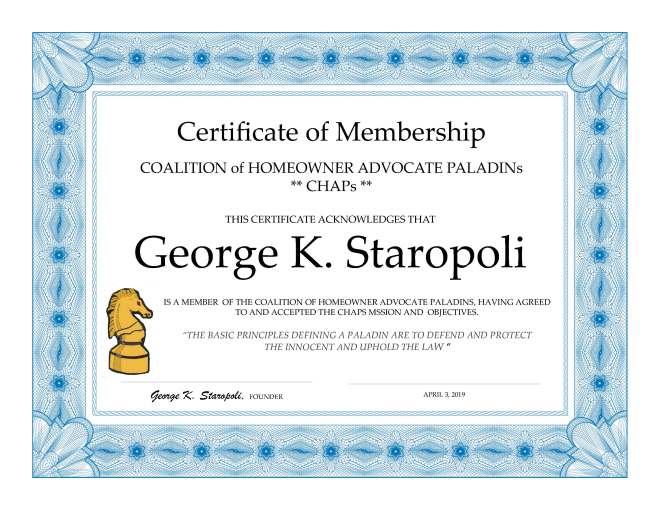
CHAPs PALADIN certificate


When you sign up as a Paladin (click on JOIN) you will be able to download your membership certificate as a WORD document. Just add your name and date of membership.

As an extra, for those who remember the western TV series, Paladin, you will enjoy the CHAPs version of his business card.

Paladin cardchaps certificate