Too often I’ve come across the use of dicta by judges in highly controversial cases involving questions of HOAs a mini or quasi-government, as a state actor, and agreed to be bound and CC&Rs as a contract. Dicta are too often viewed by the average person to be a valid, legal precedent to be followed by the judge. Unfortunately, dicta are statements characterized by the lack of evidentiary support or authority and is essentially a side comment.
In short, “dictum” (singular of dicta) is “a comment by a judge in a decision or ruling which is not required to reach the decision . . . an opinion by a court on a question that is not essential to its decision it does not have the full force of a precedent.”[1] Unfortunately, it can be cited as to what a judge stated in his discussion, which can be the cause of a serious misunderstanding of its importance.
Take for instance the clarification of such a misunderstanding in Orchard Estate Homes[2] in which the homeowner plaintiffs mistook a statement by the trial court judge as law and used it as the basis for an appeal. The appellate court held, “we conclude Alliance [plaintiff] has incorrectly construed statements made in dicta in some authorities regarding the purpose of the statutory procedure.” The misconstrued dicta read (emphasis added),
The purpose of [the statute] is to provide homeowners associations with the `ability to amend [their] governing documents when, because of voter apathy or other reasons, important amendments cannot be approved by the normal procedures authorized by the declaration.
However, the actual statute made no reference or a requirement to show voter apathy and consequently the plaintiff’s argument for a failure to show apathy was moot — not relevant.
* * *
With respect to the controversial issues mentioned above, I’ve found judges making dicta stating that HOAs are not state actors, CC&Rs are a contract or are interpreted as a contract, and “agreed to be bound,” all without any case history or statute in support of such a broad statement. There are implied assumptions in each of these cases that make these dicta subject to misleading legal statements: that the legal model of HOAs does not meet the US Supreme Court criteria for state actors/actions; satisfies legal scrutiny, that the CC&Rs are a valid contract according to contract law and not equitable servitudes doctrine; that the agreement to be bound is a bona fide and valid consent according to contract law. No law, statute, code or court opinion are cited to support these dicta.
With respect to HOAs not being mini-governments, however, it is obvious that the creation of the HOA is by means of nonprofit corporation law and not municipal corporation law, which would not make any court statement dicta – it is a fact and not an unsupported opinion. However, the fact that an entity was given explicit statutory identification as a nonprofit organization and not an agency of the state was overruled by SCOTUS[3] (US Supreme Court). It held that the actual operation and functioning of the entity determined its status as an agency and not as a nonprofit corporation. This reasoning has not been applied to HOAs as nonprofit or mini-governments.
(Mini or quasi-government status is meaningless as it implies a municipal government. It is more appropriate to classify the HOA as a state actor — an arm of the state.)
As Chief Justice Marshall wrote long ago, dicta are “less likely to be accurate statements of law,”[4] And that is the danger facing homeowners seeking justice in the courts. Plaintiff homeowners need to challenge such dicta that have been wrongfully treated as precedent.
* * * * *
Did you know: “HOAs currently engage in many activities that would be prohibited if they were viewed by the courts as the equivalent of local governments. . . . This often leads to people becoming angry at board meetings and claiming that their “rights” have been violated – rights that they wrongly believe they have in the [HOA]. (Prof. Evan McKenzie, Privatopia, 1994).
To learn more about your loss of these rights and freedoms see The HOA-Land Nation Within America.
References
[1] Dicta is Latin for “remark, “a comment by a judge in a decision or ruling which is not required to reach the decision, but may state a related legal principle as the judge understands it. While it may be cited in legal argument, it does not have the full force of a precedent (previous court decisions or interpretations) since the comment was not part of the legal basis for judgment. The standard counter argument is: “it is only dictum (or dicta).” (https://dictionary.law.com/Default.aspx?selected=514). Chief Justice Marshall provides an instrumental justification for the maxim that dicta need not be followed. Dicta are less carefully considered than holdings, and, therefore, less likely to be accurate statements of law.
[2] Orchard Estate Homes v. Orchard Homeowner Alliance, 32 Cal.App.5th 471 (2019).
[3] DOT v. Assn of American Railroads, 135 S.Ct. 1225 1233 (2015).
[4] Supra n. 2./span>


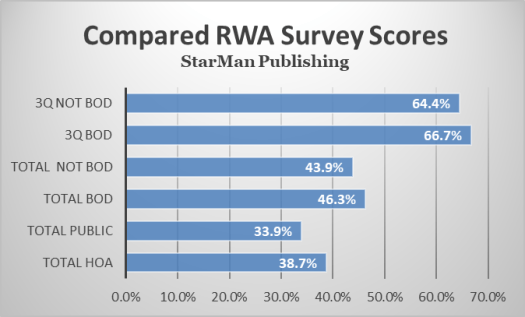
 StarMan Publishing* is conducting a survey to assess whether there are differences in personalities and character between persons living in HOA communities from those living in traditional residential communities. Do the members of an HOA constitute communities or societies distinguishable from public communities? It is estimated that some 23% of US population live in an HOA of some kind.
 HOA Constitutional Government