Error of law by 7th Circuit in Horist opinion?

The US Court of Appeals (7th Cir.) in Horist v. Sudler[1] held that a homeowner has no “right to action” against the management firm and its subcontractors. The issue involved the plaintiff’s charge that the management ( Sudler) charged excessive fees for document disclosure preparation that exceeded the Illinois statute’s limitation on such fees.[2]

The crux of the opinion was based on the Illinois statute that spoke only of restrictions on fees by “the association or its Board of Managers” may charge the unit owner a ‘reasonable fee,’ but the complaint did not involve the HOA or board as a party.” Therefore, the Court reasoned that “The statute doesn’t provide an express private remedy [against the manager], so the plaintiffs advance an argument that a right of action exists by necessary implication,” which was rejected.

In an astounding opinion, to nonlawyer me, at least, the Court held that “This argument [complaint] distorts basic agency law; it is essentially ‘the reverse of vicarious liability’” which is based on respondeat superior doctrine.[3] The Court maintained that,

a court “may not impute a duty the principal owed to a third party to an agent merely acting pursuant to duties it, in turn, owed to the principal.” Id. (applying Illinois law). Put slightly differently, “[w]hile the acts of an agent may be considered to be acts of the principal, acts of the principal are never imputed to the agent. For an agent to be liable in tort to a third party harmed by the agent’s conduct, the agent must breach an independent duty that he owes to the third party.”

In other words, a homeowner cannot sue the HOA manager because there was no contract between the homeowner and manager to create a right to action. This opinion leaves the homeowner out in the cold because the HOA manager is an independent contractor under agency law, and the HOA is not liable for the wrongful acts of the manager-agent.

This makes the Illinois statute restricting disclosure fees by the HOA an empty statute with no meaning. This holding is contrary to statute interpretation doctrine that the legislature does not enact meaningless, empty laws. Furthermore, it sets precedent for a rogue HOA board to delegate functions to the manager to avoid any liability to either the HOA or to the manager!

Missed agency law

Returning to basic agency law that holds that a principal (the HOA) allows another person, the agent (the HOA manager), to act on his or her behalf. However, without the authority as an agent of the HOA the manager has no legal right to bill the homeowner. That right stems from the HOA contract. The agent is subject to the principal’s control and must consent to its instructions. Furthermore, the agent cannot do what its principal cannot do. The Court also missed the fact, for the manager to have a right to bill, there exists an implied contract between the manage and homeowner.

So, either the board consented to the excessive fees by its agent or the agent committed a wrongful act by acting above and beyond its authority to bill for document preparation. If the HOA/board consented, then it was breaking the law on excessive fees; if the manager acted wrongfully then it can indeed be sued.

Additionally, the holding that there is no relationship between homeowner and manager is without merit simply because the manager is standing in for and acting for the HOA. Therefore, the Illinois statute should control although the complaint does not explicitly mention the HOA or board, which should speak for itself. To hold otherwise makes the fundamental legal basis of an agent meaningless.

In an earlier decision by the Illinois appellate court in Friedman,[4] Justice Walker dissented on the question of the status of the manager as an agent of the HOA and therefore the Illinois statute controls – the manager cannot exceed the statutory limitation. Walker agreed with the Landau holding that

An agent may incur liability if “he takes some active part in violating some duty the principal owes to a third person’ . . . . The agent takes an active part in violating the duty the board owes to the owner when it charges an excessive amount for the documents.

Citing Cotton, Walker further argues that

The Condominium Property Act’s purpose of assuring that the owner can obtain the required documents at a limited price “would be completely defeated through a construction of Act that would allow [owners] to be charged more than the reasonable copying and mailing costs if the providers hire others to perform the task of supplying the records.

CAI amicus curiae brief influence

Unfortunately, it appears that the 7th Circuit court did not entertain above line of argument and followed the same argument advanced by pro-HOA CAI attorneys in its amicus curiae brief, which was accepted by the Court in spite of the plaintiffs’ rejection.[5] The brief “advised” the Court, in part:

The plain language of Section 22.1 of the Condo Act does not provide a private right of action by a selling condominium unit owner against his/her former association’s managing agent or other third-party company.[6]

This nonlawyer strongly believes that the Court’s opinion is an abuse of discretion and an error of law. An appeal should be filed by the plaintiffs.


References

[1] Horist v. Sudler et al, No. 18-2150, 7th Cir. (IL Oct. 21, 2019).

[2] Illinois Condominium Act, Section 22.1.

[3] Vicarious Liability: “a liability that a supervisory party (such as an employer) bears for the actionable conduct of a subordinate or associate (such as an employee) based on the relationship between the two parties.”  Respondeat superior: “A legal doctrine, most commonly used in tort, that holds an employer or principal legally responsible for the wrongful acts of an employee or agent, if such acts occur within the scope of the employment or agency.” Respondeat superior applies to employees, but not to independent contractors.” Legal Information Institute, Cornell Law School.

[4] Friedman v. Lieberman Management Services, p 15 -16, No. 18-0059, 2019 IL App (1st) 189959-U.

[5] See also criticism of the role of CAI’s brief in CAI amicus brief continues to assert homeowner representation.

[6] CAI amicus brief, Table of Contents, I(A).

CAI amicus brief continues to assert homeowner representation

CAI continues to file amicus curiae briefs before the courts, federal and state, alleging that it is an educational and advocacy organization and that it represents homeowners. It repeatedly asserts in its amicus brief[1] (US Court of Appeals case, Horist v. Sudler,[2] that CAI is an international organization dedicated to providing information, education, resources, and advocacy. The brief asserts that

  • “[CAI] will provide important assistance to the Court by presenting a broader view of how the outcome of this case will affect the entire community association industry”;
  • “These [information] formats include conducting seminars, online learning, and webinars”;
  • “The purpose of CAI is to provide guidance for both the creation and operation of community associations.”

CAI Mission

Nowhere in this 13 page brief do the CAI attorneys — Gabriella R. Comstock and J. Philip Calabrese — state that CAI is a tax exempt, 501(c)6 business trade entity[3]. Understand that a business trade entity cannot have consumers – in this case the HOAs – since this would be a conflict of interest. CAI implies and suggests that its activities are in the best interests of a tax exempt entity, as the IRS states, whose general purpose “must be devoted to improving business conditions.” But HOAs are not businesses and they, too, are organized by charter or articles of incorporation as nonprofits themselves.

CAI’s 1973 Articles, Third states: “The corporation is organized for the following educational and scientific purposes.”

However, its 2018 Bylaws states it purpose is the success of HOAs (emphasis added):

CAI has been founded as a non-profit tax exempt membership association dedicated to advancing the success of community associations and those involved in or serving community associations as set forth in its Articles of Incorporation, including, without limitation, research, education and advocacy regarding community associations.

Adding to the confusion, this purpose differs significantly from its amicus description (emphasis added):

CAI is an international organization dedicated to providing information, education, resources, and advocacy for community association leaders, members, and professionals with the intent of promoting successful communities through effective, responsible governance and management.

CAI Membership categories, revised

Furthermore, way back in 2005 CAI had to abandon HOAs per se as members but added “volunteer members” (now “Homeowner Leaders”), loosely referring to this category as individual homeowners, members, board members, association leaders and “residents who live in a community association.” The Bylaws defined these volunteers as being a member of the HOA, of any governmental board, council, committee, news editor or unspecified volunteer. However, the 2018 CAI Bylaws confuses just who are Leaders and who are volunteers, allowing managers who are also members to be eligible as a Leader, as well as remaining their CAI manager membership, but not as a Volunteer.[4] Manager influence is increased over pure members by the 2018 Bylaws.

The majority of CAI members are its attorneys and managers/firms with “volunteers” having only 2 seats on its 12 member Board of Trustees from the membership categories (the President, President-elect and Immediate Past President are also Trustees).[5] It is quite clear that CAI is extremely biased toward the survival and acceptance of the HOA legal scheme, from whom its members derive their revenues, and that its claim to membership representation is grossly without merit.

Yet the US appellate court in Horist was never told this side of the story about CAI. In my view, this brief violates the Rules of Professional Conduct for attorneys under Rule 42, E.R. 3.3, Candor Toward the Tribunal (ABA rule as well as state Bar rules including Illinois). The amicus presented to the Court promoted CAI: “A contrary holding would adversely affect the interests of CAI members in Illinois and lead to increased costs and other unintended consequences.” The brief also states that “The purpose of CAI is to provide guidance for both the creation and operation of community associations,” which essentially provides for services by CAI member attorneys and HOA managers to the consumers of its member services. It is a conflict of interest that serves CAI best.

And to the point, CAI proclaims that “Each year CAI advocates on behalf of community associations and their residents before legislatures, regulatory bodies, and courts” (emphasis added). This is an outright conflict of interest and an attempt to be the protector of the HOA entity’s interest as well as its members! Using the business management / employee analogy, CAI represents the management faction and not the employee faction. Employee — HOA member – representation must be by means of a true member “union” or professional association.

Court integrity

Although I am not a lawyer and I am not giving legal advice or opinion, it is my understanding that an amicus brief is submitted to each party for approval, and if rejected by a party the Court determines its acceptance. In Horist the Court accepted the highly prejudiced brief in favor of the HOA thereby giving legitimacy to the statements and clear misrepresentations contained therein.  The CAI brief argued the “right to action” issue (see Note 2, Table of Contents, Arguments, I(A)).

If the courts are to maintain their impartiaity and integrity, they must cease giving deference to CAI and its member attorneys, stepping outside the CAI box and getting all the facts. In a democracy the fundamental basis of the law is justice for the people!


References

[1] Horist v. Sudler et al, No. 18-2150, 7th Cir. (IL Oct. 21, 2019).

[2] CAI amicus brief.

[3] See CAI 2018 IRS tax exempt form 990. See also, see IRS, Business Leagues.  Trade associations and professional associations are business leagues. To be exempt, a business league’s activities must be devoted to improving business conditions of one or more lines of business as distinguished from performing particular services for individual persons.”

[4] CAI 2018 Bylaws, Article VI, Section 3(B).

[5] Id., Article III, Section 3(A)).

Trump, a role model for HOA presidents

El Presidente is a role model, in my view, for rogue HOA presidents who seem to also believe as El Presidente spoke in yesterday’s Cabinet meeting.

“’It’s so illegitimate. This cannot be the way our great founders meant this to be,’ Trump said. ‘It’s a very bad thing what they’re doing, the president of the United States should be allowed to run the country, not have to focus on this kind of crap while, at the same time, doing a great job . . . and all of the other things that we’re doing.’”

[Editor’s note: “crap” as used herein relates to restraints and restrictions on the conduct and activities of the President as set forth in the Constitution and Federal laws. Just as rogue HOA presidents are subject to and intentionally ignore or dismiss the law of the land and the governing documents.]

L A Times, Politics, Oct. 21, 2019

TRump rule

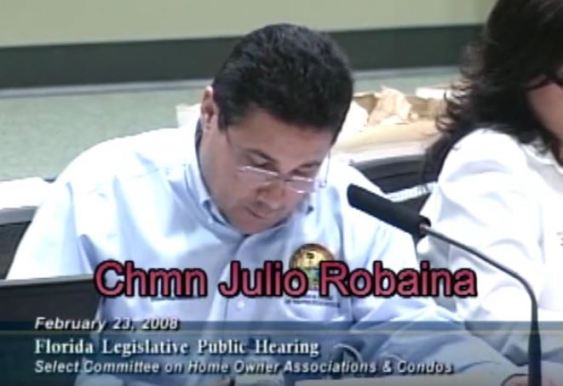
In-your-face Florida HOA reform Champion Julio Robaina.


I’m glad to see former Florida Rep. Julio Robaina becoming active again and appearing on OntheCommons.us with Shu Bartholomew on Oct. 12.

Back in February 2008, at the invitation of Julio, I testified at his Tampa, FL HOA hearing and produced several video clips of the all-day hearing. See this true HOA Reform champion’s in-your-face investigation into HOA wrong-doing.  Visit HOAGOV Videos on Youtube.

Robaina 2008

Home rule doctrine vs. HOA governments

I find it disturbing that under our federal form of government — national government and state governments – the states have permitted home rule statutes, which stand in contradiction to our federalism under the Constitution. In essence, home rule statutes give local governments extraordinary powers to regulate and control the people within their territory. In my mind, it creates a condition of who’s in control and what entity governs certain events and conditions.

What is home rule? In simple terms, it is a grant of authority and power from the legislature to local communities. Only 10 states allow ‘pure’ home rule statutes that do not required legislative authority beyond granting home rule status. The prevalent version is guided by Dillon’s Rule: It states, “that local governments get their authority, and no other authority, from the legislature enacting general laws and not special laws, much like an executive branch agency.”  However, home rule allows for restricted freedoms: “Most states grant a portion of their governing power . . . to establish laws, levy taxes, and administer government on a local level . . . without obtaining legislative approval.””[1]

Given this existing legal mechanism for strong local control, why didn’t the HOA “bible”[2] use this legal doctrine and choose authoritarian private governments? Governments that are essentially outlaw governments since they exist outside the US Constitution. It would be meaningless to argue that outlaw governments are permitted by the Constitution,. Why then is there the need for the Constitution? (A controversary today at the national level).

Keep in mind, this acceptance of home rule doctrine offers a justification for the freedom and independence of HOA governments, except that home rule governments are created by grants of the state legislature and are subject to the constraints and restrictions – local rule only. State legislatures have created this shameful and irresponsible violation of the Constitution and must be made to fix it!

This argument must be advanced in no uncertain terms when seeking all and every HOA reform legislation – the legislature must return HOA governments to the Union of states known as the US of A. In doing so, the special laws for special entities, violating the equal protection of the law, and the mockery of due process (HOA hearings covenants) be replaced with a fair and just due process to protect the members of the HOA.

Let’s put an end to what rights have been denied the membership and what rights are enforceable. All Americans would be subject to the same laws unless the state can justify, which it hasn’t, the need for these constraints on the rights of HOA members.

References

[1] See   Anthony C. Nicholas, “A Discussion of Home Rule in Nevada, February 18, 2010 referenced in HOAs violate local home rule doctrine and are outlaw governments, George K. Staropoli, (2014).

[2] See in general,The Homes Association Handbook (1964): Guide for Creating HOAs (2007) and Analysis of The Homes Association Handbook (2006), George K. Staropoli.