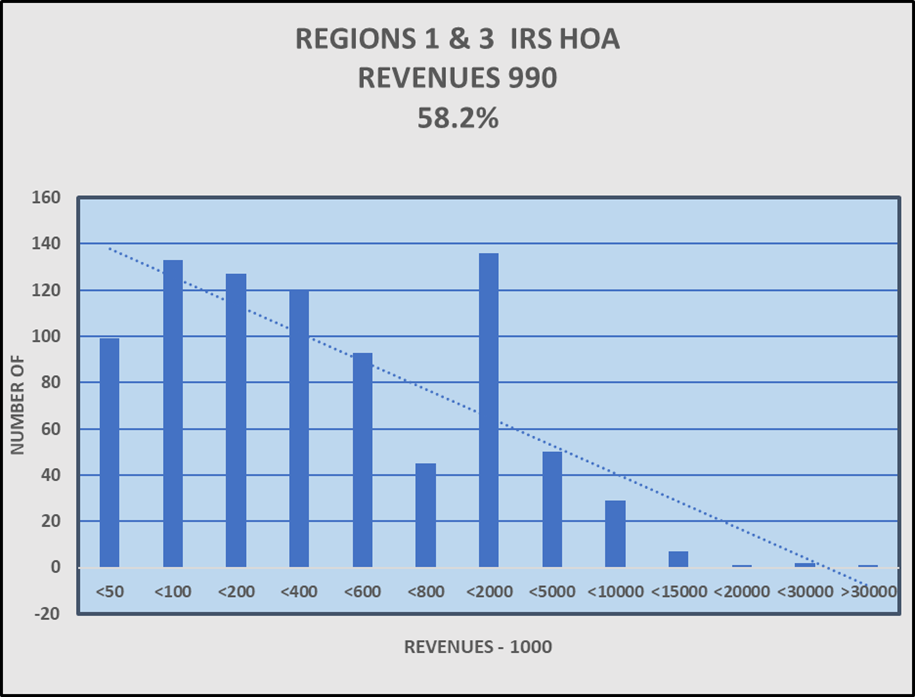
What is the range of HOAs by revenue?

In this post I will not be discussing CAI’s dominance and influence on HOA-Land, its legalities, environment or culture, but setting the CAI record straight.

All that I now about HOAs I learned from CAI,

from its polls, surveys,  and fact sheets going back as far as 2005.  All of which revealed some 70% plus  happy and contented homeowners in their land of milk and honey

I have been concerned about several issues not addressed by CAI’s findings, one of which was the distribution — number of HOAs in each category by size — according to population, by preference, or by revenues as used in this study.

The data for the above charts was taken from the extensive IRS  EO BMF files[1] (over 1.8 million entries) and massaged using EXCEL. (The slanting line is the downward trendline showing fewer and fewer HOAs as their siz increases).  It is a list of all current tax exempt organizations from which coded ‘homeowners associations’ were selected.  Only 2 of the 3 Regions (representing 58.2%) were included in my research. Only a miniscule 843 organizations classified as a 501(c)4 social welfare organization (SWO) were found  meeting the 5 applicable sub-designations HOAs.

The  source of the IRS database came from mandated annual 990 tax filings, signed and certified like any other tax filing; unlike responses to polls and surveys. It is revealing that there are just 10.7% large-scale[2] HOAs (LSA) according to CAI’s definition, of all those SWOs on record and where CAI is most interested — it’s where the money is.   

What this tells me is that of the 351,000 HOAs in America, as claimed by CAI, these social welfare HOAs are “sub-atomic” dots in the playing field, either because they don’t care, they gain nothing so why file complex 200+ page forms, or it just doesn’t apply to them.  It seems only relevant to the larger moneyed HOAs that can gain a little tax benefit from telling the IRS that they really do social welfare work, when the common boilerplate CC&Rs do not indicate such activities for these private membership, contractual subdivisions. 

This emphasis on LSA becomes very meaningful when you take a broader perspective and step back away from the “trees” so you can see the “ugly forest” that CAI doesn’t want you to see.  In addition to the above findings on SWOs and LSA, and the extent of CAI’s presence and influence on HOA boards,[3]  the ugly HOA forest is exposed. 

Until CAI has been held accountable and made to answer for its conduct, advocates will continue to spin wheels and getting very little accomplished.

References


[1] Exempt Organizations Business Master File Extract (EO BMF). (May 10, 2021).

[2] Large Scale Associations CAI study, 2016.

[3] Who’s in charge of the larger HOA? The BOD or CAI?

Desert Mountain opinion (AZ) constitutionality – part 2

Introduction

This 2-part Commentary on the H-O-A amendment boilerplate process entails a number of complex constitutional issues that are interlinked.  Discussing one results in discussing another, etc. in order to fully understand the validity of the H-O-A legal scheme.  [quote — ]You can’t see the forest for the trees[  –unquote  ] is the result of this complexity obfuscated by the Restatement and by the national pro-H-O-A special interest lobbyists.

In Part 1 I discussed 5 selected views by the appellate court that I see as constitutional challenges.   Herein Part 2 I present constitutionality challenges in regard to 1)  the bias found in the  Restatement of Servitudes,[1] a legal authority on court decisions and common law in favor of the H-O-A legal scheme, and 2) the freedom to contract doctrine[2] and its bearing on whether people are truly free to enter an H-O-A private government contract.

The Arizona appellate court ruling in Nicdon v. Desert Mountain[3] with respect to a CC&Rs amendment needs to be appealed to the AZ supreme court. In Part 1,  I raised the question of an on color of law denial of fundamental rights to property; on violations of the equal protection of the laws.   

Disclaimer: Understanding that in spite of my 20+ years reading hundreds of federal and state supreme court and appellate court opinions, I am not a lawyer nor am I employed by a lawyer; I only offer my views.

. . . .

Restatement of Property: Servitudes

In Item 5 of Part 1, I raised my concern that the Court relied on the Restatement of Servitudes quoting, [quote — ]A restrictive covenant is generally valid unless it is illegal or unconstitutional or violates public policy[  –unquote  ].[4]  The Restatement (American Law Institute) is accepted as legal authority even though it seems to be advancing ought to be or societal goals rather than reporting the law and factual court decisions.  

[quote — ]The Institute’s mission is [quote — ]to promote the clarification and simplification of the law and its better adaptation to social needs, to secure the better administration of justice, and to encourage and carry on scholarly and scientific legal work.[  –unquote  ] It achieves this goal through the development of Institute projects, which are categorized as Restatements, Codes, or Principles. . . . Restatements are primarily addressed to courts and aim at clear formulations of common law and its statutory elements, and reflect the law as it presently stands or might appropriately be stated by a court.[  –unquote  ][5]

The opening sentence above is the heart of the problem.  It presumes that justice is accomplished through ALI’s promotion of current court decisions, which in turn, are the reflection of a bias as  to what constitutes [quote — ]a better adaption to social needs.[  –unquote  ]  It flies in the face of  long standing constitutional doctrine on the legitimacy of the law and the consent of the governed.   It opens up to the controversy regarding the extent to which people may associate and establish contracts under freedom to and freedom of contract.

This 2000 update and marked rewrite began in 1987, 13 years ago. It is now another 21 years of substantive changes in the laws and public policy; H-O-As have now been institutionalized and accepted as [quote — ]this is he way it is.[  –unquote  ]  This is quite clear from the Forward (emphasis added):

 [quote — ]Professor Susan French [Reporter (chief editor/contributor) for this Restatement] begins with the assumption . . . that we are willing to pay for private government because we believe it is more efficient than [public] government  . . . . Therefore this Restatement is enabling toward private government, so long as there is full disclosure . . . .[  –unquote  ]

And we know there is an absence of full disclosure that amounts to misrepresentation.  Sadly, there is evidence of contradictory statements aiding and abetting this misrepresentation even in the Restatement that is used as legal authority by the courts. While the Court quoted comment a of §3.1[6] (see [quote — ]Contractual freedoms[  –unquote  ] below), it omitted comment h, which reads, [quote — ]in the event of a conflict between servitudes law and the law applicable to the association form [its private contractual nature], servitudes law should control.[  –unquote  ]

In addition, while the court referenced §6.10 it unbelievably failed to reject §6.13, comment a, which states: [quote — ]The question whether a servitude unreasonably burdens a fundamental constitutional right is determined as a matter of property law, and not constitutional law.[  –unquote  ]

Need I say more about securing the [quote — ]better administration of justice[  –unquote  ]?  Certainly not for the affected people — the H-O-A homeowners.  ALI is guilty of bias against the homeowners, the [quote — ]patients,[  –unquote  ] as analogous to the medical profession with its high degree of specialization where, working on the same body, the left hand doesn’t know about, or doesn’t care about, what the right hand is doing at the same time. 

If it is true and believable that laws are to provide justice, as widely proclaimed, the courts and the lawmakers must consider the effects of both hands on the patient. ALI must adjust its approach and remove these pro-H-O-A views and make references to applicable constitutional law.  ALI must also recognize that H-O-As are another form of local government that is not subject to the Constitution, and remove §6.13, comment a. 

The policy makers have failed to understand that the H-O-A CC&Rs have crossed over the line between purely property restrictions to establishing unregulated and authoritarian private governments.

Section 6 of the Restatement, Part D, Governance of Common – Interest Communities, attempts to deal with the governance of H-O-As in general. Section 6.16 addresses representative government.  It does not read at all like the Declaration of Independence, the Constitution, or the Bill of Rights.

Contractual freedoms and consent to be bound

Let’s begin with the excerpt from Desert Mountain opinion  in Part 1(1) linking the binding of the CC&Rs [quote — ]contract[  –unquote  ] by deed acceptance to the implicit consent to be bound in a single quote (emphasis added),

[quote — ]By accepting a deed in the Desert Mountain planned community, the [homeowner]  became bound by the Declaration, including properly adopted amendments. . . . when [a] homeowner takes [a] deed containing restriction allowing amendment by majority vote, homeowner implicitly consents to any subsequent majority vote to modify or extinguish deed restrictions[  –unquote  ].

By this doctrine, contract law 101 is ignored in favor of servitude law, as the Restatement advises  and an implicit waiver and surrender of a fundamental property right is accepted as valid, thereby treating the homeowner as a second-class citizen.  It does not do justice for the homeowner and should be held as an illegitimate exercise of police power by the legislature.

 In Item 5 of Part 1, I also raised the matter of the freedom to contract doctrine as contained in comment (a) of  the Restatement’s §3.1  that I now discuss in some detail here due to its constitutional complexity.

‘‘In general, parties may contract as they wish [freedom to contract] , and the courts will enforce their agreements without passing on the substance . . . The principle of freedom of contract is rooted in the notion that it is in the public interest to recognize that individuals have broad powers to order their own lives.’[  –unquote  ]   

In opposition to the above, I raised the following questions  years ago in 2005,

[quote — ]When did ‘whatever the people privately contract’ dominate the protections of the U.S. Constitution?  Please state what, if any, are the government’s interests in supporting H-O-As that deny the people their constitutional rights?[  –unquote  ]

I have not received an answer from any party including constitutional think tanks, state legislators, attorney generals, or the media.  It’s obvious that in any reply they [quote — ]would be defending the indefensible![  –unquote  ]

Freedom to contract; implied consent to be bound

The simplistic argument that remaining in the H-O-A implies consent is answered, in general,  by political scientist, professor of constitutional law, and author Randy Barnett,

Simply remaining in this country, however, is highly ambiguous. It might mean that you consent to be bound by the laws . . . or it might mean that you have a good job and could not find a better one [elsewhere] . . . or that you do not want to leave your loved ones behind. It is simply unwarranted that to conclude from the mere act of remaining . . . that one has consented to all and any of the laws thereof.[  –unquote  ][7]

I broadly address the consent issue in H-O-A Common Sense, No. 4: Consent to be governed[8]  (2008).  A deeper discussion can be found in H-O-A consent to agree vs. [quote — ]the will of the majority[  –unquote  ] (2019) wherein I quote constitutional scholars Randy Barnett, Keith E. Whittingham, and Edwin Meese.[9]

The important, selected, noteworthy quotes shown below bear directly on the defects in the top-down, take it-or leave it CC&Rs:

[quote — ]Tacit consent purports to provide a rationale for obligating those of us, by chance or choice, have not made their approval of the government explicit [Whittingham].[  –unquote  ]

[quote — ]The [quote — ]consent of the governed[  –unquote  ] stands in contrast to [quote — ]the will of the majority[  –unquote  ] . . . consent is the means whereby arbitrary power is thwarted [Meese].[  –unquote  ]

[quote — ]A law may be ‘valid’ because it was produced in accordance with all the procedures required by a particular lawmaking system, [the H-O-A amendment procedure, for example] but be ‘illegitimate’ because these procedures were inadequate to provide assurances that a law is just’ [Barnett].[  –unquote  ]

US Supreme Court must decide

I have informed readers about the  sticky-wicket that ties all these constitutional questions together as applied to the H-O-A legal structure and scheme; a sticky-wicket that must be resolved once and for all by the US Supreme Court.

References


[1] Restatement (3rd), Property: Servitudes, Susan F. French, Reporter, American Law Institute (2000).

[2] The question of  [quote — ]legitimacy of consent[  –unquote  ] is explored by Randy Barnett in his publications where he argues that there are limitations.  Restoring the Lost Constitution: The Presumption of Liberty, Randy E. Barnett, Part 1, Princeton University Press, 2004). 

[3] Nicdon v. Desert Mountain, No. 1 CA-CV 20-0129 (April 29, 2021).  

[4] Supra n.1, §3.3(1).

[5] [quote — ]How the Institute Works,[  –unquote  ] American Law Institute (ALI),website (May 3, 2011).

[6] This section of the Restatement, Validity of Servitude Arrangements, speaks to unconstitutional servitudes (§3.1(d)) and servitudes violating public policy (3.1(e)).  Worth reading.

[7] Supra n.3, p.19.

[8] See H-O-A Common Sense: rejecting private government (2008) pamphlet on Amazon.

[9] Barnett, supra n. 3; Whittingham, [quote — ]Chapter 5, Popular Sovereignty and Originalism,[  –unquote  ] Constitutional Interpretation, Univ. Press of Kansas (1999); Meese, [quote — ]What the Constitution Means,[  –unquote  ] The Heritage Guide to the Constitution (2005). Meese was the US Attorney General under Ronald Reagan.

Desert Mountain opinion (AZ) constitutionality part 1

The Arizona appellate court ruling in Nicdon v. Desert Mountain[1] needs to be appealed to the AZ supreme court on color of law denial of fundamental rights to property; on violations of the equal protection of the laws.  While the issue at hand was an amendment to restrict short-term rentals to just 30 days, it raised several constitutional concerns.

It is unfortunate that the Court relied on earlier HOA case law as precedent.  When these older decisions are quoted and cited, they must be reviewed and rebutted along constitutional concerns. 

Disclaimer: Understanding that in spite of my 20+ years reading hundreds of federal and state supreme court and appellate court opinions, I am not a lawyer nor am I employed by a lawyer; I only offer my views.

. . . .

With respect to Desert Mountain, the following are quotes from the opinion  that I find contentious and worthy of constitutional challenges.

1.  “By accepting a deed in the Desert Mountain planned community, Nicdon became bound by the Declaration, including properly adopted amendments. . . . when [a] homeowner takes [a] deed containing restriction allowing amendment by majority vote, homeowner implicitly consents to any subsequent majority vote to modify or extinguish deed restrictions”.

Surprise! Surprise! “Implicit consents”  means not clearly stated. This is a reality hidden from and not made known to the buyer at closing by the builder, the HOA, or the real estate agent, thus raising full disclosure of material facts violations. Meanwhile the courts, and CAI, have repeatedly upheld the validity of the CC&Rs as a bona fide contract against homeowners.

2.  “In addition, in interpreting contracts, “we attempt to reconcile and give effect to all terms . . . to avoid any term being rendered superfluous.”  The Court accepts CC&Rs as a valid contract.  Based on (1) above, this is an unequal protection of the laws and a due process violation resulting from misrepresentation of material facts.

3.  “In adopting the Amendment, Desert Mountain properly followed the procedures laid out in its governing documents.”  Under contract law this can be seen as an invalid “agreement to agree.”   The homeowner raised the issue of an unreasonable addition to the CC&Rs, but the Court saw it differently.  The real argument, in my mind, was the invalid agreement to agree and therefore,  a taking of personal property without compensation not permitted under the federal and Arizona constitutions.

Although no such restrictions explicitly appeared in the Declaration when Nicdon’s principals purchased their home, they could have reasonably anticipated further restriction or expansion on matters within the scope of the Declaration’s regulation.”

There are no grounds for holding that a member “could have reasonably anticipated further restriction or expansion on matters. . . .”  It’s dictum.  The governing documents are not set up for handling agreements to agree on broad and unreasonable amendments that are NOT negotiated with the members. Voting for the amendment is not negotiating. Many members speaking out on contract matters is not negotiating one-to-one. But, in order to make the HOA work, the amendment process, following public processes, rejects contract validity.  We have unequal protection of the law.

Also, is this an open-ended procedure  making the covenant invalid? “Some courts have concluded that an agreement to negotiate at a later date is an unenforceable agreement to agree. . . . But other courts have distinguished unenforceable agreements to agree from valid agreements to negotiate in good faith.”[2]

4.  “Given these provisions, as well as the comprehensive nature of the Declaration and its amendment procedures, a prospective purchaser of a lot in the community would reasonably be on notice their property would be regulated by extensive use restrictions, including limitations on renting of homes, subject to amendment in accordance with the Section 5.20 process.”

I would argue that a buyer would “reasonably be on notice their property would be regulated by extensive use restrictions” is  an abuse of discretion in that reasonableness is with regard to the content of the amendment and not the notice of an amendment.  It is obvious that there is no provision for negotiations with the homeowner.  The governing documents amendment provisions are set up as if it were a local government and not a one-to-one contract. It needs further explanation.

5.  “A restrictive covenant is generally valid unless it is illegal or unconstitutional or violates public policy” was quoted from the Restatement (Third) of Property (Servitudes) § 3.1(1). 

The Court added §3.1(1)),

 “this concept “applies the modern principle of freedom to contract,” which generally means that courts will enforce parties’ agreements “without passing on their substance.”. . . .  A restriction may violate public policy for several reasons, including if the restriction is “arbitrary, spiteful, or capricious.

I will forego a discussion of freedom to contract[3] and the reliance on the Restatement of Servitudes,[4] which I find biased in its support of HOA and not an independent reporter on common law and court decisions.  Part 2 will go into these complex but highly relevant constitutional issues relating to the HOA legal scheme.

. . . .

What has been lacking in HOA litigation over the years, with all due respect to homeowner champion lawyers, is constitutional law expertise.  I’ve read too many cases that touched upon constitutional arguments like free speech, due process, and equal protection of the laws but failed to delve deeply into these defects in the HOA legal scheme.

  The broad approach successfully used by Justice Ruth Bader Ginsburg in her women’s rights litigation needs to be adopted here. And, as usual, CAI was there representing the HOA or by filing amicus curiae briefs.

References


[1]   Nicdon v. Desert Mountain, No. 1 CA-CV 20-0129 (April 29, 2021).

[2] The Lawletter Blog, The National Legal Research Group, (April 30, 2021).

[3] The question of  “freedom to contract” is explored by Randy Barnett where he argues that there are limitations. Restoring the Lost Constitution: The Presumption of Liberty, Randy E. Barnett, Princeton University Press, (2004).

[4] Restatement (3rd) Property: Servitudes (American Law Institute 2000).


CCHAL in Calif. stands up to CAI

The California homeowner activist group, CCHAL, with Marjorie Murray as its president is moving in the right direction.  In its email distribution urging homeowners to contact their representatives to OPPOSE SB 391, CAI is called to task and criticized for its support.

“’The Community Associations Institute (CAI) and the property managers (CACM) are still “stretching the truth’ about SB391 (to put it politely.) CAI and CACM keep publishing ads saying  ‘SB391 gives HOAs the right to hold teleconference meetings during an emergency…’ This is FALSE.”

We need more advocate leaders and homeowners to speak up strongly to force CAI to defend its statements, if they dare, or to shut up!  Silence only helps CAI to increase its stature before legislatures, the media, and the public. Victory is ours by not remaining silent!  

(See If only advocates would stand up to CAI).

CAI knows its defending the indefensible. Do you know that?

HOA Constitutional Government

How legislative Rules committees abort democratic HOA reform bills

In the interest of public education on the functioning of state legislatures, this paper presents information on the rules governing state legislatures — using Arizona as a representative example — that affect passing bills into law.  I focus on the Rules committee’s powers to obstruct the voice of the people, and how it can prevent — kill — HOA reform bills by the actions of the political party leaders.

The powers of the Rules committee are undemocratic and authoritarian  in nature designed to thwart, apparently, the folly of the voice of the people.  We see the same undemocratic, authoritarian powers granted to HOA boards to an even greater extent,  The national lobbying group’s promotion of the “business judgment rule,” and acceptance by the courts, is a prime example.[1]

Exhibit 1 details the Rules powers that can prevent HOA reform bills, and any other bill not liked by the powers that be, from a hearing and vote by the full chamber — by the people’s representatives. As I wrote earlier[2], Arizona’s HB 2052, a bill that has in reality been killed in the Rules committee after unanimous approval by the House and Senate government committees, is a prime example of this misuse of authority.

The Senate Fact Sheet “intro” paragraph misrepresents the content of the bill:

“Expands statutory restrictions on condominium unit owners’ association and planned community association (HOA) regulation of political signs to include signs related to certain community activity. Prohibits an HOA from prohibiting door-to-door community activity”.

Of the 8 listed “Provisions,” 2 are technical, 2 relate to political signs, and 4 — given a short sentence in the “intro” —  expand on HOA restrictions and prohibition’s protecting free political speech and expression, in the HOA public forum,[3] as curtained in my earlier “Senate Protects” posting.[4]

. . . .

The Arizona Legislature, and each and every state legislature, is  not a sovereign that can do no wrong, but has duties and obligations sworn to under oath “to establish justice . . . and secure the blessings of liberty” for the people of its state. It cannot demand respect but must earn it through good deeds.  Passing HB 2052 into law would be a sign of good faith that would earn the respect of the people.

Exhibit 1.  Arizona Legislative Council publications

“In the Senate, bills are usually not “held” in the Rules Committee for partisan or political purposes; bills which go into the Rules Committee are almost always reported out. In the House, the Chairman of the Rules Committee can “hold” (read “kill”) a bill simply by not giving it a hearing. (p. 52).

“The options of the committee chairman are a) Hear the bill and vote on it, b) Hear the bill but take no action, c) Assign the bill to subcommittee, d) Not hear the bill.  (p. 39-40).”

“The Role of the Rules Committee,”  State Senator Randall Gnant, From Idea to Bill to Law (2000). (As of April 2021).

“Each measure is assigned to the Rules Committee of the house through which it is progressing . . . . The Rules Committees assess the constitutionality of the proposed legislation. Unless they are withdrawn or discharged, all bills must pass the Rules Committee before they are heard on the floor. (p.41-42).

“An Active Calendar of the Committee of the Whole (so called in both houses) consisting of bills the Speaker or President selects for consideration by the respective Committee of the Whole (COW).

“A calendar consisting of all bills and other measures that have been reported from the committees. In the House this is called the “House Calendar.”  In the Senate it is called the “Calendar of the Committee of the Whole.” These calendars are simply a list of bills and other measures that are ready for further action by the full chamber.” (p.42-43).

Arizona Legislative Manual 2003 Edition, Arizona Legislative Council (2003). (As of April 2021).

Notes


[1] See, Reorienting the HOA board: business judgment rule (2020).

[2] See, AZ Senate protects HOA misconduct rejecting HB 2052; Arizona HB 2052 restores homeowner constitutional speech protections.

[3] See court holdings: Calif. holds HOA elections as protected free speech public elections (2019); NV supreme court upholds HOAs as public forums (2021).

[4] Supra n. 2, AZ Senate Protects.