Fair HOA voting at risk in CA – SB 391

In April of this year I urged support (CCHAL in Calif. stands up to CAI) for CCHAL’s (Center for California Homeowner Association Law) opposition to California’s SB 391 that would allow online vote counting with no meaningful homeowner oversight. Another defeat of fair elections as expected in a community claiming to be democratic. At that time, Marjorie Murray CCHAL President, wrote:

“’The Community Associations Institute (CAI) and the property managers (CACM) are still “stretching the truth’ about SB391 (to put it politely.) CAI and CACM keep publishing ads saying  ‘SB391 gives HOAs the right to hold teleconference meetings during an emergency.’ This is FALSE.”

Yesterday Murray wrote in her urgent call to action email,

“SB391 is a dangerous bill – it’s being marketed by the association industry as one that “engages homeowners in governance” when what it really does is strip owners of the right to transparency and accountability in elections.

“SB391 IS NOW ON THE SENATE FLOOR AND WILL BE VOTED ON NEXT WEEK.  BE READY TO PHONE YOUR SENATOR TO URGE ‘NO ON SB391/MIN!”  Please PHONE, don’t email.”

Get with it Californians! Your voice is needed as legislators pay attention to the widespread  voice of homeowners affected by the bill.

The writing is on the wall for HOA reforms

Although the Arizona Supreme Court has not yet decided to hear Tarter v. Bend (CV 21-0049), my 44 page Pro Se amicus curiae brief is a matter of public record, regardless.  The case about a defamation suit by the HOA president, also an attorney and a limited-purpose public figure, raised constitutional issues of public speech with respect to questions of HOA governance. 

Selected excerpts follow.

As with the issue in Dombey (Dombey v. Phoenix Newspapers, Inc) . . . failing to present the question of Tarter’s status as a possible public figure denied the jury from considering the issues of protected free speech on public issues.

Kosor (NV) was sued on the basis of his criticism  and distribution of a pamphlet and letter at a board meeting seeking a seat on the board of directors.

“Because we conclude that each of Kosor’s statements was “made in direct connection with an issue of public interest in a place open to the public or in a public forum,” we reverse the district court’s decision to the contrary and remand for further proceedings consistent with this opinion.”

The impetus behind this view can be laid to the heavy lobbying of state legislators, judges, the public and the media by the Community Associations Institute (CAI). From its 2016 white paper,

“Most legislators do not thoroughly understand common-interest communities or who their patchwork legislation is actually protecting. . . . Legislative responses to individual constituents contribute to community associations being perceived as over-restrictive micro-governments focused on covenant enforcement.”

In response to my Arizona Supreme Court pro se amicus brief in Gelb v. DFBLS (CV-10-0371-PR) CAI attorney Jason Smith wrote,

“It is clear from the that the amicus curiae [referring to me] simply wants to impose constitutional protections on members in homeowners associations. The law has never supported that proposition.”

[I called to the Court’s attention a question of a SLAPP lawsuit against Brendt.]  The issue of an HOA SLAPP lawsuit against a member is in the interest of general public and of statewide importance, and also of national concern, the impact on community associations is certainly substantial. This Court should, sua sponte, consider Tarter’s legal action as a HOA politically motivated strategic lawsuit  against member participation.

I urge the Court to apply the long overdue correction  of  Plessy v. Ferguson by Brown v. Bd of Education to the long overdue and needed corrections to the unconstitutional HOA legal scheme.  As with Brown, America’s culture and environment has changed dramatically from 1964’s Homes Association Handbook and the formation in 1973 of Community Associations Institute (CAI) to deal with rising HOA problems and constitutional concerns after only 9 years. 

CAI’s early awareness of HOA constitutionality, public mini-government

It appears that CAI has adopted a “see no evil, hear no evil, speak no evil” attitude toward HOA constitutionality and public mini-government issues that are still prevalent today.  And it spread to the policy-makers.

Wayne S. Hyatt’s 1975 Emory Law Journal article, Condominium and Home Owners Associations:  Formation and Development, 2 years after the formation of CAI, presents his highly influential view on HOA constitutionality while recognizing that HOAs are mini-governments.

Wayne Hyatt “the most prominent advocate in CAI” serving as a 1975 “homeowners representative” and a former president (1978-79) (Privatopia, p. 219, 138 respectively). Hyatt  devoted his practice to working with developers of condominiums, master planned communities, resorts . . . to create community governance structures and community stewardship organizations.

While actively practicing law, he was also a member of 1) the American Law Institute (that wrote the pro-HOA Restatement of Servitudes, 2) the College of Community Association Lawyers (CAI affiliate) , the Community Associations Institute (CAI, created in 1973 by the National Association of Home Builders [grant of]  $30,000), and  3) ULI – the Urban Land Institute (sponsor of the 1964 “HOA bible,” The Homes Association Handbook) and served as a ULI Trustee.

He also served as an Advisor 1) to the Restatement of the Law (Third) Property: Servitudes, and 2)  to the Special Committees on a Uniform Condominium Act and a Uniform Planned Community Act of the National Conference of Commissioners on Uniform State Laws (Uniform Law Commission, UCIOA and UCA).  Hyatt received several awards from CAI.

Hyatt developed many of the Dell Webb’s master planned and resort/active adult association CC&Rs over the years.

His 1975 Emory Law Journal article gives readers a good idea of constitutionality and local government concerns that seemed to have evaporated over the years as CAI’s influence increased dramatically.  A few important excerpts:

  • “The California Code provides for an association and affords it the powers and duties of the mini-government.” {T]he [Georgia] legislature has in effect provided a large measure of home rule for what is in essence a category of small municipalities, and each has established a system of officers and directors in the nature of a mayor and council to oversee the exercise of this rule.” (At 988). 
  • “‘Has the state permitted, even by inaction, a private party to exercise such power over matters of a high public interest that to render meaningful’ constitutional rights, private action must be public?”(Footnote 33 at 983). [In simple terms, private government HOAs must be subject to local government protections].
  • “The Declaration is not a contract but, as a covenant running with the land, is effectively a constitution establishing a regime to govern property held and enjoyed in common.  It further sets forth procedures to administer, operate, and maintain the property. . . . the declaration and particularly the by-laws create not only a corporate structure but also a governmental authority that requires and deserves competent, experienced persons . . .” (at 990).
  • “The power of ‘levy’ is a distinctive characteristic of the association and removes it from a mere voluntary neighborhood group. . . . The imposition of penalties, whether fines . . . or a denial of use of facilities enforced by injunction, certainly represents quasi-judicial power to affect an individual’s property rights. . . . The possession and exercise of such power has substantial consequences with clear constitutional implications.  The courts have not yet considered a direct constitutional challenge to an association’s action.” (at 983).
  • “[T]he constitutional issue is most acute in rule enforcement; however the association’s established procedures, declaration, and by-laws should insure compliance with at least rudimentary constitutional principles, and there must be a procedure to protect members’ rights.” (at 984).

Nowhere will you find any equivalent discussion of HOA constitutionality, or HOAs as mini-governments or as a form of local public government. Not in its Manifesto, Community Next 2020 and Beyond (2016);  not in its Public Policies: Private Property Protection, Government regulation of Community Associations, and Rights and Responsibilities For Better Communities (July 15, 2021).

And not in any of its anti-constitution amicus briefs: Twin Rivers NJ appellate (2004), Dublirer NJ Supreme Court (2011);  Surowiecki, WA Supreme Court (2021) (business judgment rule overrides judicial review); Turtle Rock AZ appellate (2017); Foreshee WI appellate (2017).

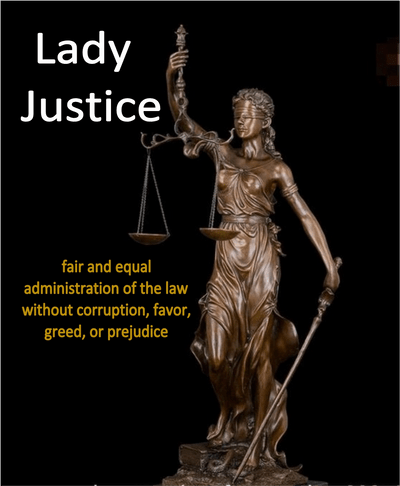
Lady Justice is blind to HOA justice

I think it’s well past due for someone of courage to remove the blindfold from the Lady so she can see the real HOA world as it is.

Knowledge is power to stand up to CAI

CONTINUING  HOMEOWNER ENLIGHTENMENT, EDUCATION  &  REORIENTATION  SERIES

CHEERS  PODCASTS

Advocates and homeowners have failed to stand up to CAI because they, too, have been indoctrinated and have failed to acquire the knowledge and strategies to overcome their lack of credibility causing their lack of power.

“Blaming the wolf will not help the sheep much.  The sheep must learn not to fall into the clutches of the wolf.”  Gandhi.

Boards of directors need to be educated and reoriented on the principles of democracy, and on HOA constitutionality relating to violations of due process and the equal protection of the laws,  because 1) the national lobbying entity, CAI, has indoctrinated boards of directors, the legislators, the courts, and the public with its CAI School of HOA Governance program that contains just lip service to constitutional questions, and 2) HOAs are a form of local government not subject to the Constitution. 

This indoctrination, by teachings of The CAI School, of boards of directors and all HOA members  prevents them from recognizing and accepting the true nature of HOA reality.  Indoctrination “is the process of teaching a person or group to accept a set of beliefs uncritically.”  Since the teachings are all that the indoctrinated ever see, they assume the School presents a true picture of HOA-Land. The actual reality!  NOT SO!

The idea of the Continuing Homeowner Education & Reorientation Series is to find a way for the indoctrinated BODs and members to come into the “light” and attain enlightenment from the School’s conditioning practices.  If they were to do this, they would be able to see HOA-Land for what it really is.

CHERS will provide this needed opposing voice.  Listen to CHERS podcasts — 24 podcasts in 4 program levels of learning.  See also CHERS series.