Realtors: Are they protecting buyers or the HOA?

Excerpt from L.A. Times column, Associations, May 21, 2006, with permission of the author Donie Vanitzian, relating to the sale of an HOA property. A writer asks:

Finally, I supplied an interested buyer with the association’s pro forma budget and some other papers the management company gave me. The buyer was unimpressed and refused to sign the offer to purchase without writing contingencies into the contract.

The buyer reserved the right to renege on the sale without penalties or forfeiture if the following contingencies were not met:

• The buyer’s acceptance of all of the association’s governing documents with copies of every amendment, rewrite and restatement.

• A forensic audit conducted by the buyer’s attorney or accountant of the association’s books, records and banking, at the buyer’s expense.

• An independent investigation of the association’s management company and personnel directly responsible for managing said association.

• A minimum of three years of final — not draft — board meeting minutes.

• Copies of all correspondence from seller to the board and from board to seller.

Here’s my problem: I’m moving because our association has a history of tyrannical boards and overspending without accountability. If the buyer learns of this, there goes the sale. Do I have to accept all these contingencies?

No remedy in the event of HOA violations

Why can’t homeowners withhold assessments until their dispute is resolved?

Looking at the larger picture that withholding assessments is attempting to solve, there is no “remedy in event of default by HOA” provision in any CC&Rs that I’ve seen. Some might have such a contractual CYA provision, but just for the HOA. It’s here where the unconscionable adhesion contract once again works against homeowners.

In my opinion, shouting for a “fix”, like “no proxy voting”, is not the way to go. Only when you place the fix into its proper place in attaining justice, will you succeed. You must argue unconscionable adhesion contract. You can argue due process concerns only if you argue that there is an imbalance of power as a result of the adhesion CC&Rs.

To offset the legalized extortion of HOA boards, there are no remedies in the CC&Rs that specify the right of the homeowner to escrow payments, or some other similar method, as is the norm with any creditor/debtor issue. Simply shouting “escrow the money” does not present a justification to the politicians, the legislators, to take up the cause.

Advocates must link this requirement to fair play and a balance of powers between the HOA and the homeowner.

Another look at the history of HOAs

“Community Associations”, a term still in use by CAI, originated in the first half of the 20th century and reflected a land use/planning policy of a managed community, a planned community, above and beyond simply laying out streets, utilities and homes. The term of choice was the concept of “community” since,

The innovators of CAs were entrepreneurs . . . . The dilemma [as far back as the 1930s] was how to ensure their widespread acceptance among government agencies, builders and developers, and prospective home buyers.¹

The initial trade organization behind HOAs was the National Assn of Real Estate Boards (now the National Assn of Realtors) that in 1936 split off its research function to the now known Urban Land Institute, to promote the better planning and development of urban areas. In 1944 it create a Community Builders Council to promote CAs. The Council published its first views on the need for homeowners associations in its 1945 Technical Bulletin #1 a mistake made by the Council’s chair with respect to his initial development of a community. That started the momentum for the institution of authoritarian private governments: a concern for profits that resulted in the necessity to create a corporate form of governance without concern for the protection of constitutional and civil liberties of the homeowners.

Just one year later ULI began urging developers to put HOAs in place with restrictive covenants attached to the subdivision. Next year came ULI’s comprehensive manual for HOAs, The Community Builders Handbook, which contained detailed and specific requirements and that the covenants run with the land. The authoritarian aspect of HOA governance was urged by including provisions for “The enforcement of covenants . . . or else covenants may become ineffective through nonobservance and violation. “² But no Homeowners Bill of Rights was required simply because ULI was a business trade group and not a governmental agency, and there were no homeowner voice to protect constitutional rights.

Parallel to ULI’s activities, the FHA set up its own land planning and usage division in 1938. NAREB (NAR) “had a large influence on the formation of FHA.” In 1963, Byron Hanke, an FHA employee later to be the primary founder and promoter for the creation of CAI in 1973 as a result of problems with accepting HOAs, participated in a Brookings Institute study funded by ULI. Part of this study was released at the National Association of Home Builders (NAHB) convention. This brochure, Planned Unit Development with a Homes Association, described “a cluster of subdivisions . . . combined with effective common land use.” Stable writes, “Using CC&Rs to organize an automatic [read mandatory] membership association, developers could meet competition from older forms of housing . . . .” ³ In order to get FHA insurance, the brochure specified the needs for automatic membership and a homes association, and the only acknowledgment of a voice, not necessarily a democratic voice, was a requirement to have a voting membership.

In 1966, this brochure was expanded to the infamous, Homes Association Handbook, Technical Bulletin #50, published by ULI, from which all else follows.

For more information, see History.

Other sources are: Privatopia: Homeowners Associations and the Rise of residential Private Government, Evan McKenzie (1994); Neighborhood Politics: Residential Communitiey Associations in American Governance, Robert Jay Dilger (1992),

Notes:
1. Community Associations: The Emergence and Acceptance of a Quiet Innovation in Housing, p. 68, Donald R. Stabile (Greenwood Press 2000). (A book partially funded by ULI and CAI).
2. Supra, p. 77
3. Supra, p. 90

HOAs require unrealistic human behavior

Dear Arizona Republic Editor,

I’m amazed at the rose colored look at the hopeful benefits claimed by planned community supporters that HOAs help shape better communities. In “Neighborhood groups fight apathy”, there’s the failure to understand that, in spite of the special interest group’s promotion, HOAs have not been about better communities, but about better property values. And to attain that goal, arbitrary and profit-motivated rules and restrictions are instituted and imposed on homeowners under the guise of fully informed consent.

This wishful thinking is reflected in statements, such as quoted, “a unique opportunity to become a close-knit community” and “to have pride in the cooperative relationship they have with their HOA.” These are want-it-to-be statements, and are based on unrealistic human behavior. Apathy results when a certain behavior pattern is demanded in order to make the HOA work, but the members do not agree with the demands and feel helpless to change them. They really bought a home and not an active participation in the government of a society that demands behavior inconsistent with human behavior patterns.

If the state should stop mandating homeowner associations and ramming these unworkable demands on people, then the problems with homeowner associations will improve.

Legislators must accept responsibility for HOA problems

After a heated discussion at my annual HOA meeting relating to the board’s failure to setup CC&R mandated reserves, a board member said to me,

“George, lighten up. This is a small social gathering of friendly neighbors seeking to maintain property values.”

I replied,

“So long as the HOA has a right to take my house, or to impose financial difficulties for me and my family, supported by state laws that do not allow me proper due process if I disagree with the HOA, there can be no social gathering of friendly neighbors. This is a contractual arrangement that is one-sided against me, and all other individual homeowners. If you want a friendly social gathering of neighbors, throw away the threat of financial distress, the state supported CC&Rs, and we can then act like good, friendly neighbors.”

Homeowner association problems continue year to year in each and every state as a result of the creation of laws, and the repeated refusal to correct their errors of judgment, by state legislatures that “sanction” and “bless” the unconscionable adhesion CC&Rs contracts.

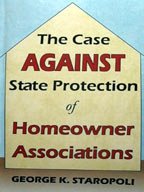
The arguments made in this 2003 publication, The Case Against State Protection of Homeowner Associations, sadly, remain valid in the Arizona legislature and in the legislatures of others states, including California, Texas, Florida, New Jersey and Nevada. The problem can be stated in simple terms as had just occurred in regard to my small HOA in Arizona.