Montelena and Sun City: the failure of government agencies to protect consumers of HOA controlled homes

Once again, the necessity of obtaining an attorney to read and explain the
legalese of those CC&Rs or declaration cannot be overstated! Why? Because
Arizona government agencies do not protect home buying consumers!

With respect to the transfer fee demand by the Montelena HOA on a buyer to
pay a whopping $2,500 fee to the association (see Homebuyer: HOA
‘Unscrupulous’ In Raising Fee), let’s examine what the buyer would be
getting into. First, and highly questionable and undemocratic, the 440
members of Montelena HOA have unwittingly agreed to have the board, by
majority vote, to set forth rules that become and are held to be amendments
to the CC&Rs, without a vote of the membership (see Article 5.3 of the
CC&Rs). Generally, it usually requires a supermajority vote of the members
to amend the CC&Rs.

Furthermore, buried within Article 6 of the CC&Rs, titled “Membership and
Voting”, are sections 6.8 and 6.9 that require a new owner to pay 2 fees,
both equal to 1/6 of the then current annual assessment, as contributions to
the annual assessment and to the Reserves assessment. And, surprisingly,
section 7.15 allows an additional third fee, a transfer fee, designated as
such, imposed by either the board or the management company. How many fees
is that on the third-party buyer (as such, he is not a legal party to the
CC&Rs agreement). Article 8 grants the HOA the right to lien and foreclose
for nonpayment of assessments. On the third-party buyer, too?? (The buyer
must agree under his purchase contract with the seller, not the HOA, to
assume these assessments in order for the assessment to be binding on him.)
Under section 7.2, Annual Assessments, the board cannot increase assessments
above 20% without a 2/3 vote of the members. Section 7.8 says the
assessments must be uniform across all members, raising the issue that a
transfer fee on sellers alone violates the CC&Rs. (Note that transfer fees,
by whatever name, have been outlawed by new law this year, HB2768).

The public should be protected and made aware that there are so many powers
granted to the HOA or denied to the homeowner hidden within these 50 – 120 page legal agreements. Agreements, by law, that do not even have to be seen, read or acknowledged in order to be binding on unsuspecting homeowners. The real estate agent who is required materially disclose all information and to treat all parties fairly under the simple R. E. Commissioner’s Rule, R4-28-1101, is allowed to ignore this rule. Furthermore since the Arizona Constitution allows real estate agents to to real estate transactions, an additional duty to protect the buyer has been placed upon the agent.

Now, it is not unreasonable to argue that a prudent person buying, for many, their largest asset purchase would consider the above representative covenants as material to his decision to purchase in a particular HOA, or in any HOA. And, it is not unreasonable to argue that the real estate agent is duty bound to provide such material information to the prospective buyer, and that the real estate department, in keeping with R4-28-1101, would have promulgated guidelines and procedures in order to make this material disclosure a meaningful and effective rule. The rule has been ignored by ADRE with respect material information about HOAs.

Last month, in regard to another failure to protect a homeowner from HOA abuse (see Who prosecutes for homeowner justice against HOAs?), I wrote to the Arizona R. E. Commissioner, asking:

Who will protect homeowner justice against HOAs?   I ask ADRE why is it not adhering to its mission, as stated in its pamphlet, ‘The Arizona Department of Real Estate (ADRE) protects the Public Interest through Licensure and Regulation of the Real Estate Industry in Arizona’ . . . . Who, then, will protect the public interest if not the licensed real estate agent under ADRE regulation?  I call your attention to Commissioner’s Rules, R4-28-1101, Duties to Client.

A reply by the Assistant Commissioner side-stepped this questions posed above with a “not my job” reply:

We have been given no authority to adjudicate disputes between HOAs and its member-homeowners. The separation of powers doctrine places this adjudication role in the hands of the courts, not in the hands of the
executive government.

I clearly did not ask that ADRE adjudicate disputes, but to enforce R4-28-1101 and to stand behind its mission to protect consumers, all consistent with the existing delegation of powers to ADRE and to the Commissioner.

Qui Pro Domina Justitia Sequitur

(“who prosecutes on behalf of Lady Justice?”, DOJ seal)

Editorial comment. I suspect, like this year’s new law, HB 2774, “Take That George!” bill (my description), that explicitly states that government officials cannot be compelled to defend statutes, another bill, “Take That George, redux,” will be proposed that would explicitly say that ADRE cannot be compelled to provide consumer protection to buyers of HOA controlled property.

In the words of Jim Wallis, preacher and author of Rediscovering Values, “What has been deliberately and carefully made ‘socially acceptable’ was, not too long ago, thought to be irresponsible – both financially and morally.”
Confederate Texas and HOA governments: de facto, unlawful governments

I have argued that HOAs are a second form of illegitimate and unlawful, de facto local political governments.  Randy Barnett, a constitutional scholar, wrote: “Only if it is legitimate can an existing constitutional system issue commands to the citizenry that bind individuals in conscience.”[i]   The HOA government legitimacy rests on just “laws” respecting the rights and privileges of the people without violating the rights of others; that their member’s acquiescence to obey these unjust laws and covenants cannot be misconstrued and interpreted as having consented in good conscience to have so agreed.                                                                                    

I have also argued that, under “government”, Black’s Law Dictionary offers the simple definition:  “The structure of principles and rules determining how a state or organization is regulated.” And, to clarify by what is meant by a “state”, Black’s speaks in the same terms of the differences in function that distinguishes an association from that of the state, and of the need to determine the “essential and characteristic” activities and purposes of a state. A state, according to Black, is a community of people established for “securing certain objectives  . . .  a system of order to carry out its objectives.” Nothing-new here, but Black’s then goes on to say: “Modern states are territorial; their governments exercise control over persons and things within their frontiers” (emphasis added).  And Black cautions not to confuse the “state” with other communities of people in other forms of organizations designed to accomplish other objectives.

What has come to light since these earlier Commentaries, is the US Supreme Court interpretations of “state” and “government” in a question of the legitimacy of the secessionist State of Texas, in regard to the sale of  bonds by Confederate Texas.)

The Court reasoned (emphasis added),

It [a state] describes sometimes a people or community of individuals united more or less closely in political relations, inhabiting temporarily or permanently the same country; often it denotes only the country or territorial region, inhabited by such a community . . . .

The people, in whatever territory dwelling, either temporarily or permanently, and whether organized under a regular government, or united by looser and less definite relations, constitute the state . . . . A state, in the ordinary sense of the Constitution, is a political community of free citizens, occupying a territory of defined boundaries, and organized under a government sanctioned and limited by a written constitution, and established by the consent of the governed.[ii]

This 142 year-old opinion supports Black’ definition and the essential characteristic that makes an entity a government:  a government is the person or group that controls and regulates the people within a territory.  While the functions and services provided by a government are shared with many other entities, such as businesses per se and nonprofit organizations, this definition “separates the chaff from the wheat.”[iii]  HOAs are the governing body of subdivisions that are subject to covenants;  subdivisions are territories, plain and simple.

The Supreme Court further held, with respect to lawful and legitimate actions by de facto governments, and  Confederate Texas was so considered,

It may be said, perhaps with sufficient accuracy, that acts necessary to peace and good order among citizens . . . which would be valid if emanating from a lawful government, must be regarded in general as valid when proceeding from an actual [de facto], though unlawful government; and that acts . . .  intended to defeat the just rights of citizens, and other acts of like nature, must, in general, be regarded as invalid and void.


In other words, the acts and actions by a de facto and unlawful HOA political government have validity to the HOA “citizens,” unless these acts and actions defeat the rights, freedoms, privileges and immunities of the people, the HOA members.  The people are still subject to the Constitution in spite of all those arguments that the Constitution is negated by private contracts.  This view is consistent with Barnett’s arguments for obedience in conscience.

Unfortunately for our “Modern Times,”  there is a great division within this country, not this time between the Blue and the Grey, but between the Blue and the Red — the major political parties.  This great division, this Second Civil War as author Brownstein titles his book[iv],  is a war of ideology and dogma — as in the case with HOA “true believers” —  coming before “for the good of the county” and the people.

Notes


[i] See The legitimacy of HOA boards and state legislatures, George K. Staropoli, citing Randy E. Barnett, Restoring the Lost Constitution: The Presumption of Liberty, Ch. 2 (Princeton University Press, 2004).

[ii] Texas v. White , 74 U.S. 700 (1868).

[iii] Government is defined by a “social contract”; HOAs by the new social contract, the CC&Rs, George K. Staropoli (included as Part III, “American Political Governments”, in The Foundations of HOAs and the New America.

[iv] Ronald Brownstein, The Second Civil War: How Extreme Partisanship Has Paralyzed Washington and Polarized America (Penguin Books 2007).

Calif. finds HOA suit against opposition signs to be SLAPP

Some sense is finally being displayed by Cal. courts in support of the Constitution against the second local,  de facto  governments — HOAs.   Homeowners require protection to speak out, since HOA issues can be public issues.  Many states have an anti-SLAPP statutes.  

A SLAPP suit (strategic lawsuit against public participation) is a lawsuit brought primarily to chill a party’s constitutional right of petition or free speech. The anti-SLAPP statute was enacted to prevent and deter lawsuits that chill the valid exercise of the constitutional rights of freedom of speech and petition for the redress of grievances and provides “an efficient procedural mechanism to obtain an early and inexpensive dismissal of nonmeritorious claims” arising from the exercise of those constitutional rights. (Martinez v. Metabolife Intern., Inc. (2003) 113 Cal.App.4th 181, 186.)

Section 425.16, subdivision (b)(1), states: “A cause of action against a person arising from any act of that person in furtherance of the person’s right of petition or free speech under the United States Constitution or the California Constitution in connection with a public issue shall be subject to a special motion to strike, unless the court determines that the plaintiff has established that there is a probability that the plaintiff will prevail on the claim.”

The Signs Are Speech Protected by the First Amendment

The Signs Are Not Defamatory

The Signs are in a Public Forum and Concern a Matter of Public Interest

No Probability of Success on the Merits Nuisance

Slander of Title.  The Beach Club asserts that it has stated a cause of action for slander of title because the signs disparage and impair the marketability of its property.

 
HOLDING:  Beach Club action was SLAPP.

SANTA BARBARA BEACH CLUB, LLC, v. FREEMAN, No. B212972 (Cal. App. 2 Div. May 3, 2010).  

http://www.leagle.com/unsecure/page.htm?shortname=incaco20100503008

Letter to NC House Select HOA Committee


Dear Committee members:

I am providing a copy of an email from a NC homeowner that exhibits her frustration and inability to deal in a fair and equitable manner with her HOA board.  If you believe that homeowners openly and freely agreed to be subjected to this type of treatment by de facto private governments, then I have a bridge in Brooklyn that I’d like to sell you.  Homeowners need to be protected like any other segment of the people from abuse by any group or organization. To say that a homeowner can go to court for a redress of grievances, would be like saying that there was nothing wrong with the 1950s Poll Tax abomination, used as an effective, legal at the time, devise to stop voter registrations.

 Please see my earlier post to concerned parties pertaining to recent NC Supreme Court decisions regarding HOAs.

Please restore constitutional protections for homeowners, along with the respect and dignity that they deserve, and provide penalties against abusive boards for violating NC laws.

 Respectfully,

George K. Staropoli

Pres.

Citizens for Constitutional Local Government

HOA lobbyist CAI facing financial problems?

Audited Consolidated Financial Statements
and Other Financial Information
COMMUNITY ASSOCIATIONS


INSTITUTE & SUBSIDIARY
June 30, 2009

L. ACCUMULATED DEFICIT

 
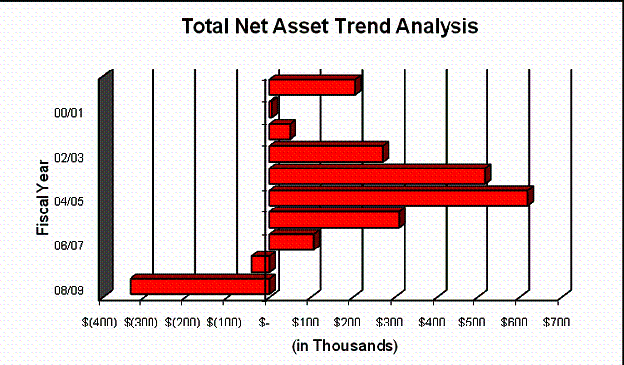
As indicated in the accompanying statement of financial position, CAI has reported recurring losses which have generated a deficit in undesignated net assets of $611,972 and $395,589 as of June 30, 2009 and 2008, respectively. Continued deficits threaten to undermine CAI’s  ability to continue its current level of operations in the future. The consolidated financial statements do not include any adjustments that might be necessary in the event that CAI is unable to continue its current operations.

Management’s plan to alleviate the deficit includes supporting and advancing manager licensing legislation in more states expanding and creating new international partnerships; developing a new virtual membership category and reducing personnel and overhead costs.

In accordance with the approved three year financial plan, the Board of Directors has approved a budget for the year ending June 30, 2010, which projects net income of approximately $42,000. However, there can be no assurance of the success of these efforts.