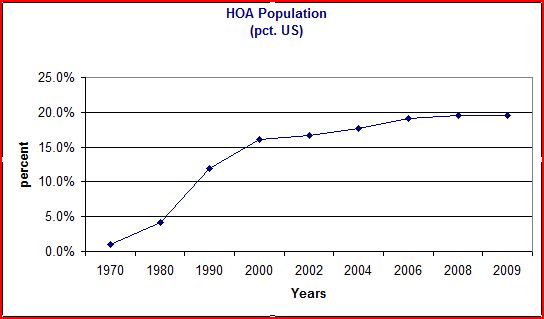
Have HOAs hit a growth plateau?

Wouldn’t that be great news? Homeowner associations have hit a wall! Maybe even begin to decrease.

The chart shows the population living in HOAs (overall term) is about 19.6% of the US population. The chart does introduce a distortion due to the 2-year periods, but the 10-year increases between 1990 – 2000 and 2000 – 2010 are about the same, roughly 4%. However, the increase from 1980 – 1990 was almost double, a whopping 7.8%.

Remember that as the US population continues to grow we can expect the number of people living in HOAs to increase likewise. And with local governments mandating only HOAs, an an increase is most likely. However, we can hope that the HOA percentage does, indeed, begin to drop. (Recall that Arizona has 23.4% of its residents living in HOAs).

Source data from US Census and industry data.

HOA demographics: About 25% Arizonans live under HOA regimes

Continuing my investigation into HOA demographics, I researched the percent of the Arizona population living under a homeowners association government.  Surprisingly, that game to 23.4%.

 As a very good indicator, although subject to a more refined analysis, data from the Arizona Corporation Commission records showed 7,297 nonprofit corporations with one of the following words in their names: HOA, homeowners association, condominium, condo, property owners association, and community association.  Based on industry data from CAI, the following averages were obtained over nine entries, spanning 1970 through 2009:

 average residents per HOA:            211

average Units per HOA:                    82

average residents per Unit:              2.6

 The analysis reveals an estimated 600,069 HOA units and 1,543,067 people living in HOAs, based on a 2009 Arizona population estimate of 6,595,778.  That’s 23.4% of the people subject to a second form of local government, the HOA, with their constructive notice constitutions not subject to or approved by the state of Arizona, that deny the constitutional protections of due process and the equal application of the Arizona laws.


HOA demographics: Arizona Hispanics


Earlier I presented demographics from a 2007 CAI study in HOA satisfaction that alluded to the homeowner association resident population being significantly different from the general  population[i].    From the survey, the demographics showed that HOA residents are non-minority, educated, well off seniors.   Either the CAI – Zogby sample was biased or it was representative of the general HOA population.

Being curious as to whether HOAs admit to a segmentation of the general US population, I conducted a non-scientific, “take a peek” analysis of my own. My methodology selected 25 HOAs at random in Maricopa County, AZ, and to look at the single issue of Hispanics living in HOAs.  Because of the lack of accessible data, I relied on subdivision lot ownership records with Spanish surnames as my criteria for Hispanic ownership.  I obtained data on the 8 city/towns represented by the sample HOAs, as well as state and county data[ii]. 

The table below compares the city/town Hispanic percentages, based on the 2000 Census,  with the results found from the HOA county records.

Town/city Census HOA
         
Chandler   21%   5.4%
Gilbert   12%   3.1%
Phoenix   34%   22.2%
Scottsdale 7%   0.7%
Queen Creek 30%   3.6%
Peoria   15%   10.5%
Surprise   23%   11.6%
Avondale   46%   26.8%
         
  AVG 24%   10%


The 2000 Census showed a population of 25% Hispanics in Arizona and the sample shows 24%, with the HOA sample average of only 10%. The 2008 update gave a 31% Hispanic population in Maricopa County.  The deviations from the Census population data indicate that the Hispanic population in HOAs did not conform to the overall county data, and that HOAs have a significantly smaller Hispanic population. 

Now, seeking an explanation for this result, I reasoned that this smaller population figure could be the fact that Hispanics in Arizona own a smaller proportion of the homes than non-Hispanics.  In fact a study by HUD based on 2000 Census data revealed about a 50% reduction in ownership of homes for Hispanics:  24.8% for non-Hispanics vs. 12.4% for Hispanics (see Ownership, appendix table 1A,, n. 2).  Even with this substantial reduction in the number of Hispanic owners expected to be found by this analysis of county ownership records, the sample still reflects a significant difference from the Census data.

This question of HOA demographics needs to be given serious study and appropriate research conducted, since there is the implication that HOAs are a vehicle for class structure within the US.  Local governments increasingly support, and even mandate, an  HOA for all new home construction.  And, additionally, that the HOA form of government repudiates the US Constitution, and denies homeowners the equal protection and due process of law in pursuit of an empty statement of maintaining property values.

Notes

[i] See 2010 US Census ignores HOA demographics.

[ii] Ownership in Maricopa County, http://www.huduser.org/Publications/PDF/hisp_homeown7.pdf; population data from http://quickfacts.census.gov/qfd/states/04/0412000.html.  The data was based on the 2000 US Census and 2008 interim data.

2010 US Census ignores HOA demographics

With an estimated 20% of the population (based on industry data) residing in homeowners associations,  a percentage higher than either that of Black of Hispanic categories, the demographics of HOAs remains a mystery.  Who lives in homeowners associations?


The only hint at HOA demographics comes from the 2007 industry survey on HOA satisfaction, sponsored by the Community Associations Institute (CAI) trade group[i].  This sample of some 709 phone calls revealed a significant difference between the sample and the 2000 US Census data[ii]


Category HOA Survey US Census
Age 50+ 61% 27%
Education: college + 68% 24%
Minority 11% 25%
Incomes over $50,000 79% 42%


This difference can be explained by one of two alternatives.  One is that the sample is biased in order to bring about the most highly favorable results for CAI.  The other is that the sample does reflect the norms of  homeowners associations, and reveals that the HOA population represents a distinct class or subset of American society: the senior, educated, white, well-off segment of America. 


The demographics of this survey should be of concern to the policy makers.  If the sample demographics are representative of HOAs, then the claims of HOAs as “affordable housing” should be replaced with the more accurate description, “discriminatory housing.”   Then the public policy that requires only HOA subdivisions for all new housing in an increasing number of towns and cities is discriminatory.  Unless, of course, the above demographics are not representative of homeowner associations.


It would seem that the time has come for “the acceptance of a quiet innovation in housing”[iii] to be exposed to the sunlight, and that a more thorough survey of homeowner association demographics is in order.  Who lives in HOAs?  Are HOAs, aided and abetted by local government mandatory HOAs for new housing,  establishing a class division within America?  


Notes


[i] As of this writing, all online links, either on the CAI or Zogby sites, to the details of this study are missing. The Jan. 19, 2008 analysis, see n. 2, references this web address: Survey.  A copy of the methodology was downloaded at that time and can be viewed here, http://pvtgov.org/pvtgov/downloads/survey-2007.pdf.

[ii] See Who lives in an HOA? Public officials take notice  (Jan. 2008).

[iii] Taken from the title of the CAI co-funded book, Community Associations: The Emergence and Acceptance of a Quiet Innovation in Housing. Donald R. Stabile (Greenwood Press 2000).

California ECHO and HOA bankruptcy alternative

California attorney Tyler Berding writes in the April 2010 Executive Council of Homeowners’ (see note 1) ECHO Journal, “Bankruptcy Won’t Work,” about “the practical and legal reasons why associations almost never go into bankruptcy.”  Essentially, Berding informs his readers that the HOA is communal, like a partnership, where all “partner-members” are responsible for the debts of the HOA “partnership”. Didn’t anybody tell you that before you bought your home? Or that your home is collateral for the survival of the HOA?

He correctly maintains that because the HOA has “deep pockets”, the pockets of its individual members, jointly and severally, the pursuit of a bankruptcy is not rationale. The judge will assess the remaining solvent homeowners to ante-up to pay all the debts of the HOA. One could say it’s one of those undisclosed pitfalls of HOA ownership. Pursuing individual homeowners who haven’t the means to bail the HOA out of its financial crises is just a fruitless undertaking by the members, who still do not want to accept the failure of the HOA legal structure to protect their individual assists. They have been blinded by the false propaganda of “the voice of the community” thinking that “community” means their own individual interests,  and do not see the communal nature of their HOA membership.

Berding does not mention that the failure to budget for bad debts, a standard accounting practice, reflects poor management by the HOA board, and its advisors (although he admits to understanding the meaning of “assessments for bad debts” below). Failure by incompetent boards and its advisors to act in a prudent manner, as required under law, is another inherent fault, another deficiency, within the structure of the HOA concept.

You can’t be successful in mass merchandising HOAs and getting all those people to buy if you bring up these serious financial negatives. Or to get the legislatures and planning boards and local governments to enthusiastically support and encourage HOAs if you bring up any negatives, can you?


Here are some of Berding’s messages from the ECHO Journal:


Ironically, it is not unusual to find that an association’s largest “creditor” is itself. The failure, year after year, to make reserve transfers creates unfunded liability and makes it impossible for the association to effect repairs when the time comes. . . . . The fact that some owners don’t pay their share of what their association owes to a creditor is not enough. That seeming shortfall becomes an internal debt to the association, which is in turn simply spread again across all owners in the form of assessment increases or emergency special assessments, until the creditor is paid in full. The ability of an association to pay its obligations is as deep as the combined equity of all property in the community and the assets of all of its members. This makes bankruptcy not a feasible option for associations.

For all of these reasons, a bankruptcy filing will not normally be considered a remedy available to a community association. There would have to be no equity available in property in the community, and each individual owner would have to file his or her own bankruptcy petition for that to be effective as against the association’s creditors. That’s simply not going to happen or ever be a permanent situation. As owners walk away from property and mortgage holders take it back, the banks become responsible for the next round of assessment shares to pay the creditor. Lender foreclosures wipe out mortgages and create new market equity in property. Owner bankruptcies, even if pre-petition assessment debt is discharged, won’t address post-petition rounds of assessments for bad debt as they’re spread across all owners. Shares may slowly contract and debts can be negotiated, but the principle that the obligation is shared by all remains.”


Notes (emphasis added)

1. The Executive Council of Homeowners (ECHO) is a nonprofit membership corporation dedicated to assisting California homeowners associations.

“The mission of ECHO is to advance the concept, interests and needs of homeowner associations through education and related services to board members, homeowner members, government officials and the professionals in the industry.”


Please pay attention to the contradiction in the mission statement of ECHO above. Do they speak for the homeowner members or for the HOA boards? Anyone with anyone knowledge of the legal structure of corporations understands the “class” distinctions between management and owners. With respect to HOAs, the attorneys are careful to state that the HOA attorney’s client is the HOA, as represented by the board through its president, and not the class of individuals who are owner-members. To state that the HOA board represents the interests of any individual homeowner, or even the entire class of owners is a false and misleading statement. The statutes and CC&Rs do not grant the HOA board the authority to represent the interests of the membership before public entities.

Its name is misleading and should read: The Executive Council of Homeowners Associations,  ECHOA!