HOA boards can be sued and not covered by insurance

Much of the abuse by boards, the management firms, and attorneys are tortious acts that are illegal and also constitute a fraud upon the members. You will not hear this at pro-HOA seminars sponsored by local governments and/or taught by CAI attorneys.

“D & O” means “directors and officers.”

“Most, if not all, D&O policies contain a provision that excludes intentional criminal and fraudulent acts committed by board members,” says Collins. “However, [our policy] will continue to defend the directors and/or officers until such time that a criminal action can be proven. The policy will then cease to provide any further protection once it is determined that a board member knowingly committed a criminal or fraudulent act.”

D&O coverage also doesn’t indemnify a board or board member against decisions made “in bad faith,” or with illegal intent. If a board is found to have acted in an illegal manner—deliberately discriminating against a prospective buyer, for example—and are hit with punitive damages, members are on their own when it comes to paying them.

The reason for pursuing these actions acts of bad faith is to force the homeowner into court, where the attorney gets his fees and the HOA gets a free ride, most of the time.  Directors and officers are legally bound to act in good faith toward their members.

The ABC’s of D&O

See also Will legislators stop CAI attorney acts of bad faith?

Will legislators stop CAI attorney acts of bad faith?

As a concrete example of a lack of good faith by HOA attorneys, that smells of aiding and abetting the board to get around the letter and intent of the law, is the newly effective Arizona statute permitting the videotaping of board meetings. Just 2 weeks after the signing of the bill into law, and still 3 months away from its effective date, the CAI member attorneys at Carpenter Hazlewood (CHDW) began their campaign against this open meeting law. They began by offering suggestions as how HOAs can adopt what CHDW considered reasonable rules. No board came forward and said, “How do I beat this law and protect the board?” as far as I know. (Such actions by a board would in itself be a violation of its duties of good faith to the owners as a whole).

Returning to the example at hand, Carpenter Hazelwood, through the management firm of AAM, the board informed the members of the Tatum Highlands CA board’s “reasonable” restrictions that, as usual, are one-way against the homeowner. Note that the HOA government is restricting free speech by not allowing dissemination or publication of the videotapes. Now, why would anyone videotape the meeting if not to distribute it for others who did not attend the meeting? What is the board afraid of? Some hanky-panky goings on?

It is quite clear that CAI does not act in good faith with respect to either the letter or intent of the laws. Rather than adopting the CAI Central propaganda that calls for creating harmonious, vibrant communities, which the homeowners can be proud of, its minions seek total advantage for the HOA.

State legislators must face up to reality of acts of bad faith by CAI attorneys and put a stop to this madness in no uncertain terms!

Read the complete Commentary here.


Gross injustice: HOA declarations not a contract, but held binding as a contract

In Epernay CA v. Shaar the Texas appellate court again avoided declaring that a declaration of CC&Rs is a contract, but use the carefully worded, CC&RS are subject to the general rules of contract construction,” followed by, “In construing contracts. . .” Other courts have declared CC&Rs to be a contract without providing evidence, making the declaration a dicta (ipse dixit made by a judge). Others have referred to cases that, themselves, are also dicta utterances.


The reason for this is that HOA governments under CC&Rs are held to be subject to the laws of equitable servitudes, which simply requires the filing of the CC&Rs with the county in order to be binding on the unsuspecting homeowner. He doesn’t even have to read the CC&Rs or even explicitly consent to agree in general, or to agree with the surrender or waiver of all his rights stated or implied in the CC&Rs. If indeed CC&RS were to be considered a bona fide contract under contract law 101, they would be thrown out the window.


See the responses to the Truth in HOAs poll where 92% said they would not agree to the conditions in HOAs as disclosed in the Disclosure Agreement.


Additionally, if the requirement for the genuine consent with full knowledge, and the absence of misrepresentation, were applied under contract law, the CC&Rs would be thrown out the window.


Why have the courts followed servitude laws over constitutional law with its requirements for the equal application of the law – contract law – and due process protections against special laws for special private organizations? Why have the courts or state legislatures failed to declare HOA governments to be an unconstitutional delegation of legislative powers to private organizations? Or to be state actors under the criteria set forth by the US Supreme Court (and not the ancient and misplaced holding of the “public functions” test)?


If people can get together a draw a contract, call it CC&RS, and operate as private governments not subject to the 14th Amendment, why do we need constitutional government? That’s secession, isn’t it?

Making substantive HOA reform legislation happen

A few years ago I produced the Rules of Engagement designed for advocates to combat the undue influence of CAI and other pro-HOA activists who had controlled the legislative playing field for years. Simply put, the Rules call for challenging, confronting, and exposing the issues with the facts based on fundamental principles. The Rules have proven successful, at least in Arizona and with CAI Central where they have been applied.


Once our opponents realize that they no longer control the playing field, as they must pause and defend their positions, they will become less outspoken in the media and be more circumspect in what they say and claim. This leveling of the playing field is a direct result of advocates having demonstrated the validity and strength of their positions. Its a basic necessity that the legislators, the media, and public be educated.


However, CAI and its paid minions still have a strong influence in the legislatures that must be overcome – I call it “walking the halls of the legislature and whispering in the ears of the legislators.” They are paid lobbyists and we are just citizen advocates. California and Florida have strong Evil Empire contingents, with other states having varying degrees of opposition. You know the strength of your opposition.


To overcome the opposition in the legislature, advocates must clearly understand and accept the fact that no legislature in any state is a friend of homeowner rights advocates. History has shown that to be the case, loud and clear. What has occurred is a relatively small number of legislators taking on the cause of the homeowner against the political party leadership opposition to reforms. I say again: the political party leadership is opposed to substantive HOA reform legislation.

In order to make a difference and obtain substantive legislative reforms, homeowners must find a legislative champion with courage, perseverance and political abilities to successfully fight our cause and make reform legislation happen. And these legislative White Knight champions, in order to be successful, must find outspoken support from the people and the media.


Advocates must find a media personality or reporter who can overcome the opposition from its editors and media owners to sally forth and expose the goings on and opposition from legislators. They must make news and force the opposition to defend its positions in public, using the statements and arguments of the advocates.


And, in order to accomplish the above, an advocate champion, preferable with many followers, must speak out with unassailable facts and arguments in the media, on the internet, and wherever he can have his voice heard. The best approach is to base these reform arguments in fundamental principles of democratic government, justice and in basic American values and beliefs. Remember that “maintaining property values,” or “no government interference,” or “HOAs are the voice of the people” are not fundamental values.


(As an important aside, one function of government is to maintain an orderly society by establishing justice where one faction does not dominate a weaker faction. See The Federalist Papers, #51. Who else can do this in the absence of legitimate public government? Vigilantes? Reliance on the goodwill of your HOA board that has no legal obligation to do so?).


Reform legislation can happen! Following the above guidelines will help make it happen, sooner rather than later, or never. Your state and your situation are not any different from all that that has gone before you across the country. As George Santayana wrote, “Those who cannot remember the past are condemned to repeat it.”

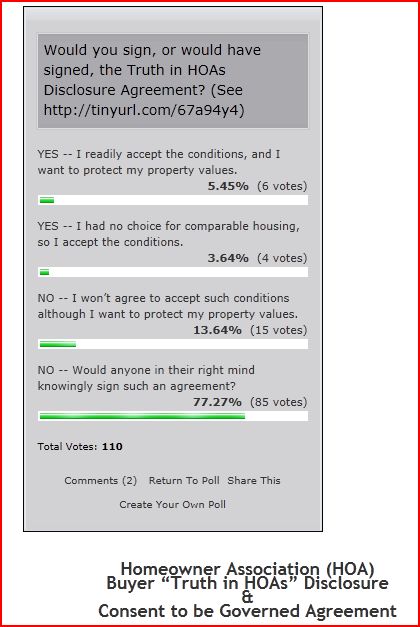
Truth In HOAs Poll update: 9% would surrender their rights to HOA

Aug. 15, 2011 results

The initial response after 1 day to my Truth In HOAs Poll of July 12th was a 98% vote of NO, they could not agree to the Disclosure Agreement. Only 1 YES vote was recorded. Understanding that this may reflect an anti-HOA audience, I allowed the Poll to remain open this past month (and will remain open) to record any change in attitude by the respondents, noting that pro-HOA polls sponsored by CAI and RIM have recorded a 70% “satisfied with their HOA” response.

The Truth In HOAs internet poll is freely available to all on the internet by simply visiting my Commentaries blog, and as notified by my numerous email list posts, my responses to homeowner inquiries, and links provided in my comments to many online media articles. It s not a telephone calling from a pre-selected list.

Within 2 weeks the YES votes for both categories dropped somewhat to 95% with a split between “YES, I would sign” regardless and “YES, I would sign, but I want property value protections.” Today, a month later with a small increment in respondents, the YES responses come to 9% and the NO response to 91%. The split in YES votes shows an small widening with the unconditional YES dominating.

It’s hard to believe that there are some people who have no concern for their rights. This 9% represents “hard-liners or “true believers.” The results are unmistakably clear as homeowner rights advocates have been shouting for years – the support for a valid consent to be governed by the courts and state legislatures is based on a false and misguided view of the authoritarian, private government HOA regimes that are unaccountable to the legitimate and legal constitutional public government.

The HOA supporters, including CAI, do not have clean hands! It’s well beyond time to stop this mockery of the Constitution and mockery that HOAs represent the true voice of the people. And, the state legislatures well know that there are existing statutes that permit “private communities” to exist yet be accountable to Constitutional public government as a state entity, and retain the perceived benefits of restricted amenities, “ordinances,” community “taxes,” etc. (See a Proposal for the Muni-zation of HOAs).

I invite any and all online media, and those public interest organizations who fight for individual rights, to duplicate this poll for their viewers. Let’s get to the whole truth by publishing this poll, or stop telling your viewers that you tell the truth!!!

It should be noted that another marked rebuttal to these “satisfied” polls was a recent Phoenix CBS affiliate, KPHO, poll on whether or not an HOA Syndrome – a PTSD resulting from living in an HOA, diagnosed by Dr. Gary Solomon – was real. The KPHO internet poll results showed a 69% response that the HOA Syndrome was alive in HOAs. (See HOA Syndrome survey: YES, it exists!).

Please freely distribute this commentary/email to interested parties and your local media.