CAI now seeks to lobby Congress on HOAs

Last month  in CAI Reacts[i] I warned about CAI’s long lobbying reach to sway the opinions of state legislators, but now CAI is seeking to sway Congressmen.  CAI is now in a campaign[ii] to influence Congress with its propaganda that HOAs provide an overwhelming public service, are highly supported by HOA members, and are preferred by the public. “Community associations are governed by neighbors and are often misunderstood.”[iii]  If there are no opposing voices, so will Congress be swayed and with join state legislatures in supporting pro-HOA legislation.

In CAI Reacts I wrote about the effects on state legislatures, which is applicable to Congress:

This tactic by CAI has ominous consequences for HOA reforms in every state! It becomes extremely important that advocates and homeowners in every state seeking redress of HOA problems form an advocacy group to inform the public, the media and their legislators of their views. As I have long argued, advocates must, even more so now, confront, challenge and expose CAI propaganda. They must also advance quality reform legislation.

The latest attempt to influence elected officials comes in the form of urging its members to write their Congressmen to support CAI’s FEMA position, which contains a wealth of pro-HOA propaganda from its biased surveys.[iv]  Here are some of the points provided to guide members in their meeting with a Congressman:

Associations ensure that the collective rights and interests of homeowners are respected and preserved. Association leaders seek an effective balance between the preferences of individual residents and the collective rights of all homeowners.  [Do you think that your Congressman would catch the distinction between “collective rights” as in socialism and “individual rights” as in a true democracy?]

 Association homeowners choose where to live and accept a contractual and ethical responsibility to abide by established policies and to meet their financial obligations to the association. [Nothing is said about “free choice” or an adhesion contract with implied and absent waivers of constitutional protections].

Association homeowners have the right to elect their community leaders and to use the democratic process to determine the policies that will protect their investments. [Nothing is said about the appearance and illusion of democratic election procedures and the absence of clean elections protections.]

 Without an organized and strident national voice in opposition, be prepared for a rewrite of “This is America: The New America of HOA-Land.”  Many of my Commentaries can be used to refute CAI’s propaganda. Use them!  For example, earlier this year I wrote here and as a comment on Privatopia Papers,[v]


It’s time to bring unity to this country and end subdivision governance by HOAs that create independent principalities. The planned community development can remain under a democratic form of government subject to the Constitution. And that must come from Washington. It can start with hearings to air those constitutional issues that have been avoided by every state and court for far too many years.[vi]


References


Establishing the Commonwealth of Belle Isle — do it with CC&Rs


A plan has been advanced, if you call it that, for the purchase of Belle Isle from Detroit, MI to be turned into another Hong Kong as the Commonwealth of Belle Isle. It would be a tax-free money machine without big government involvement so proclaims Roger Lockwood, the promoter of the Commonwealth of Belle Isle.

Puerto Rico, for example, is a US territory known as the Commonwealth of Puerto Rico. Legally, it is an organized, unincorporated territory of the US answerable to the Interior Department.  It was established not by the President, but by an enabling act of Congress known as the Territory of Puerto Rico Organic Act.  The organic act does not subject the Puerto Rico to the entire Constitution, but to certain aspects as determined by Congress.  It has no constitution as we know it.


The Virgin Islands of the United States is another US territory created by its own organic act. In 2010 Congress passed Public Law 111-194 authorizing the USVI constitutional committee to submit a constitution for review by Congress. It was rejected and the committee could not create a revised constitution.  So with this understanding, Belle Isle will not be entirely free from BIG government.

The only other case that has bearing on this proposal was the creation of West Virginia where the people had to secede from Virginia and then re-join the Union. It had to be decided by the US Supreme Court in Virginia v. West Virginia, 78 U.S. 39 (1870).  It was a messy affair that also included an organic act and the adoption of a new state constitution.

Belle Isle would be messy, too.  Purchase from Detroit, secede from Michigan, and be established as an independent principality/territory by an act of Congress. 

I would think it would be easier for Lockwood to adopt a Declaration of Covenants, Conditions and Restrictions after acquiring Belle Isle from Detroit and start shouting to the FEDs and Michigan, “no interference in contacts, no interference in contracts!”  With a Declaration there would be no need for government approval or compliance to laws or ordinances, etc.  And, so long as money flows back to the powers that be, anything can be included in the Declaration.  Robert Nelson proposed such a secessionist future in 2005. See HOA Secession from Local Government: The future of Planned Communities?


Go for it, Lockwood!

HOAs & state legislatures: rule by the Prince or by the Constitution?

“Where ethical restraint is lacking, there can be no hope of overcoming problems.”[1]

With the banishment of God from government, our “unalienable” rights, which were held by the Founding Fathers to be superior to any rights granted by any government, have been declared null and void by the US Supreme Court. With no substitute standard being announced by the Supremes to guide the people, they are left to flounder. And we have floundered.[2]

In his commentary on Machiavelli’s The Prince,[3] William B. Allen provides Machiavelli’s view of politicians,

Once the obligation to act according to natural or devine standards is removed, the question that remains . . . is how to participate in the management of political appearances to secure their [the politicians’] own interests.[4]

For Machiavelli “the role of morals in politics is mainly to cultivate illusions . . . politics is merely appearance and morality is merely pretense.”[5] 

Understandably, it is not surprising that the Supremes have held that all legislation is presumed to be constitutional, placing the burden on the people to prove the unconstitutionality of a law.  With this legal doctrine, the Supremes, the 9 Men In Black, have declared that “the sovereign can do no wrong.”  But, that is not the fundamental basis of our system of government with its separation of powers, checks and balances, and Bill of Rights.  The Supremes just abdicated their function under the Constitution.  In its place, it has assigned the role of the Protector of the Constitution to the people, the average person. 

Consistent with this doctrine, the Arizona Legislature also presumes all statutes to be constitutional, perhaps because the Legislature provides checks on the constitutionality of a bill before it can be sent to the Governor for signing. (The Arizona Constitution also provides a check on statute constitutionality before signing by the Governor).

However, in spite of statements to the contrary found in the Arizona State Legislature guides for the public, the legislature and individual legislators have failed to protect the people against the violations of the Arizona Constitution as in the case of the unconstitutional SB1454. They have ignored their duties, obligations and rules for the proper functioning of the Legislative Council and the Rules Committee. (See HOA reforms, SB 1454 and the inner workings of the legislature).

In contrast to Machiavelli’s principles of government, Hadley Arkes reminds us that

The founders understood that the principal mission of government was to secure people in their natural rights — to protect them against the lawless private thugs as well as of ill-intentioned legislators (emphasis added).[6]

He quotes US Justice Wilson’s (1798) warning that

The people in sovereign office might well perform unjustified and therefore lawless acts . . . such acts, though vested with ‘legal’ authority could not fully claim nor elicit from the people an obligation to obey.[7]


In regard to the HOA amendments surreptitiously placed into SB 1454, Arizona has dropped the ball.  Arizona has fallen off the pedestal.


References


[1] Ethics for the New Millennium, His Holiness The Dalai Lama, p. 26, Riverhead Books, 1999.

[2]God is dead, and so, too, are our unalienable rights, HOA Constitutional Government, February 5, 2008

[3] The Prince, Niccolo Machiavelli, Yale University, 1997.

[4] Id., Machiavelli and Modernity, W. B. Allen, p. 108.

[5] Id., p. 104.

[6] Supra n 3, Machiavelli and America, Hadley Arkes, p. 145.

[7] Id., p. 128.

HOA reforms, SB 1454 and the inner workings of the legislature

Arizona’s Rep. Michelle Ugenti amended a bill in an underhanded tactic to bypass the Arizona Constitution[i] in her determined and overzealous efforts to have special laws enacted for special organizations. Attorney for the plaintiffs, Tim Hogan, Executive Director, Arizona Center for Law in the Public Interest, explained the reasons for the complaint in his Arizona Horizon PBS interview.[ii]

In her interviews, Ugenti defended her amendment in terms of procedural legislative rules; my Staff said it was legal: “that the rules committee staff found her amendment to be germane to the original bill”[iii]  and “her additions to the bill are legal, if for no other reason than one of the changes does deal with elections.”[iv]    Her actions can be better understood in terms of the inner workings of state legislatures, so let’s examine the inner workings of the Legislature. 

The Bill to Law publication[v] of the Arizona Senate talks about the role of the Legislative (“Leg”) Council (my emphasis):

All proposed bills are drafted and prepared for introduction by the Legislative Council staff. Legislative Council may be requested to prepare a proposed bill draft by any legislator, by partisan staff at the direction of a legislator, or by direction from a committee of the Senate.

. . . .

Most importantly, legal staff in Leg Council may suggest changes intended to help the proposal pass Constitutional muster. For example, the Constitution (Article IV, Part 2, Section 13) [the very issue of the complaint] requires that, “Every act shall embrace but one subject and matters properly connected therewith…” If proposed legislation obviously covers two or more subjects, Leg Council will advise the sponsor that the bill must be trimmed, split into two or more bills, or face a potentially successful challenge on Constitutional grounds.

 The question remains: who told who?  And did Ugenti overrule the Legislative Council? Or, did the Legislative Council get it all wrong?  

And what about the Rules Committee, that functions as described in the Bill to Law publication[vi]:

Legislators on the Rules Committee, aided by advice from the nonpartisan Rules Attorneys, function as a sort of legal review panel for proposed legislation. Among other things, the Rules Committee reviews each bill for constitutionality . . . .  

It is in the Rules Committee that potential difficulties with constitutionality and form are worked out. In rare instances a bill is rejected entirely. Most often amendments are proposed to correct deficiencies noted by the Rules Attorney.

 In a surprisingly frank statement of the inner workings of the Legislature (my emphasis), 

It is not unheard of for proposed legislation to pass even though almost all parties know it will be ruled unconstitutional — sometimes there are political reasons for doing so. For the most part, though, a ruling by the Rules Attorney that proposed legislation is unconstitutional is enough to severely dim any chances of the proposed bill becoming law.[vii]

I guess the legislature “got caught with its pants down” with respect to SB 1454!  Or, is it a case of “The sovereign can do no wrong”?   I don’t think so under our constitutional system of government.

In regard to HOA legislation, the legislative inner workings are described in my latest Commentaries:

  1. CAI reacts to HOA Enlightenment Movement with targeted lobbying of legislators
  2. What is this “association law” thing all about?
  3. The questionable role of HOA attorneys
  4. SB 1454: crossing the line for HOAs

I raise the question once again: what was Ugenti’s motive for dogmatically and overzealously pursuing these HOA amendments?  Is she a diehard, true believer in HOA-Land?  Or, were there other factors that pressured or influenced her in her decision to sneak HOA reforms into SB 1454?


References


[iii] “Public interest group claims last-minute HOA bill is unconstitutional”, Arizona Capitol Times, July 16, 2013

[iv]Lawsuit filed against Arizona’s new HOA law”, East Valley Tribune, July 17, 2013.

[v]The Role of the Legislative Council,” From Idea ….. To Bill ….. To Law, State Senator Randall Grant (2000) , p. 29. (http://www.azleg.gov/alisPDFs/BillToLaw.pdf).

[vi] Id., “The Role of the Rules Committee”, p. 51.

[vii] Id., p. 51-52.

CAI reacts to HOA Enlightenment Movement with targeted lobbying of legislators

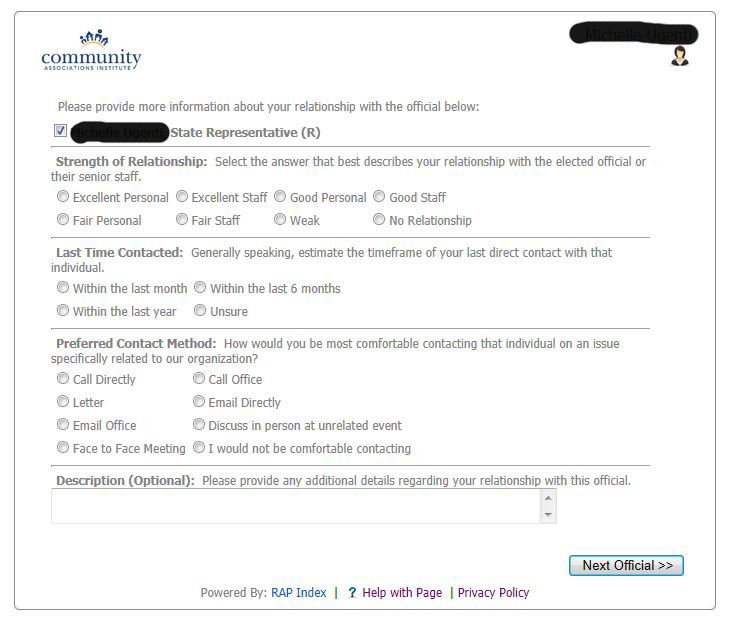
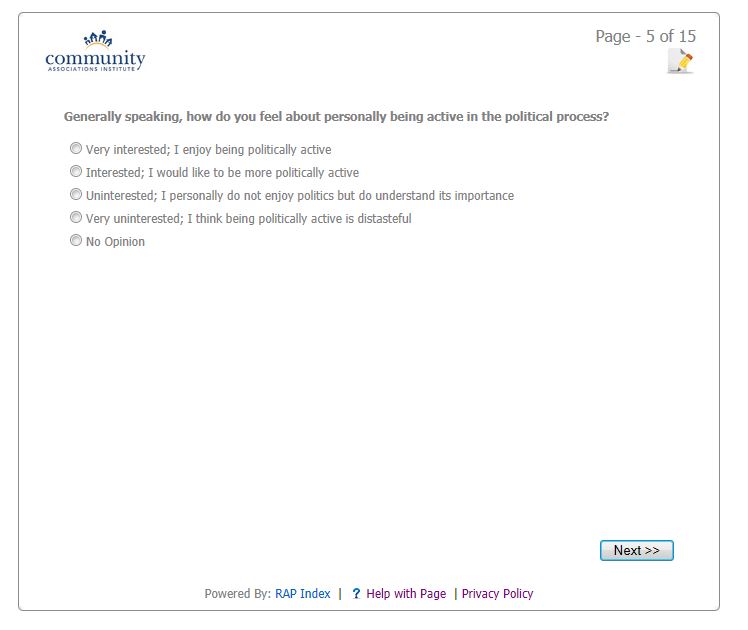
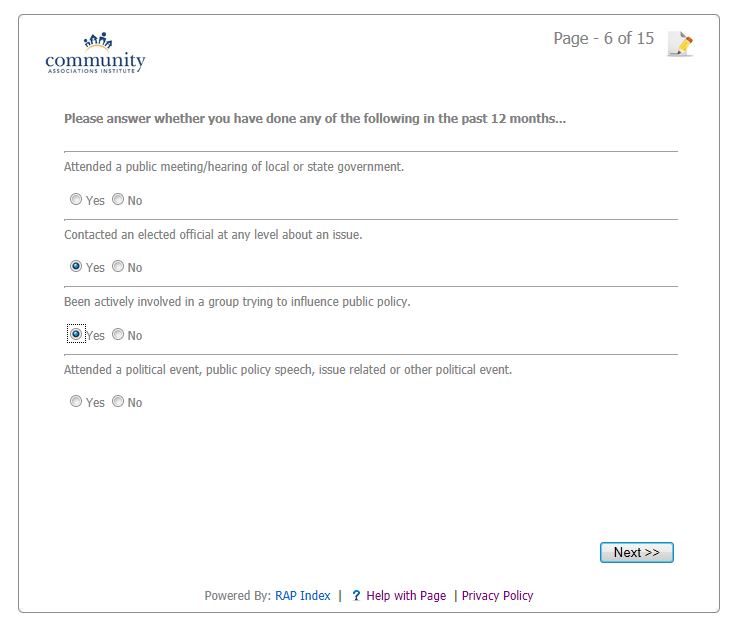
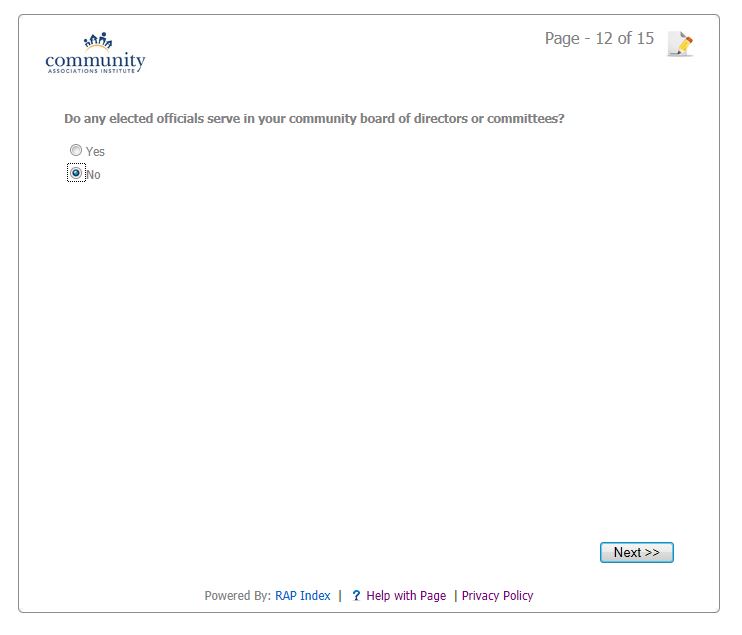
Apparently, CAI Central in Falls Church, VA is feeling the heat of the Enlightenment Movement — the awakening of the public, the media and state legislators as to what HOA-Land is really all about.  It has sent an email (“You can Enhance CAI’s Advocacy Program by Participating in this Brief Interview,” July 24, 2013) to its faithful members — presumably its “volunteer” members who are for the most part HOA directors — asking for their participation in a survey of their relationships with elected officials.  Obviously, for intense, micro-managed lobbying efforts in support of CAI’s objectives.

By understanding our network of relationships with elected officials, we can build advocacy programs that advance our positions on any number of issues that directly impact our members and the community association industry.

Recall that I wrote that CAI was formed in 1973 to deal with the problems of HOAs as defined and modeled by the 1964 Homes Association Handbook.  In 1992, CAI made a substantial change in its mission and elected to no longer be an educational organization (Tax exempt 501(c)3) and to become a business trade organization (501(c)6).   It did so under mounting pressures and criticisms in articles, research journals, and books, including McKenzie’s Privatopia.  CAI had to reach the legislatures that controlled state laws regarding the HOA industry.

This latest “brief interview” is another attempt to influence legislators in favor of HOA friendly legislation, knowing that advocates are still fragmented.  With the response from the party faithful, CAI will not only know who the friendly legislators are, but what members have good relationships with specific officials.  CAI Central, or through the local state chapter, can then produce targeted emails — as successfully used by Obama in the past election — to influence legislators. The advocates, unless they want to demand copies of all emails, will be in the dark.

This tactic by CAI has ominous consequences for HOA reforms in every state!  It becomes extremely important that advocates and homeowners in every state seeking redress of HOA problems form an advocacy group to inform the public, the media and their legislators of their views.  As I have long argued, advocates must, even more so now, confront, challenge and expose CAI propaganda.  They must also advance quality reform legislation.

This tactic by CAI of addressing legislators in all states makes it a national issue of unfairly influencing state legislators to advance authoritarian private governments not subject to the US Constitution.  Homeowner rights advocacy groups must be given equal access to their legislators!  Advocates must be given equal bargaining powers over HOA issues!  Legislative committees must not be allowed to hear that the “stakeholders” met without hearing from an advocacy group!

Links to representative CAI “interview” questions: CAI-network3, CAI- network 4, CAI- network 5, and CAI-network6.


See What is this “association law” thing all about? and The questionable role of HOA attorneys.