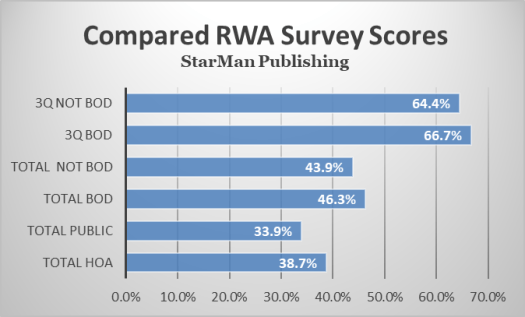
Preliminary HOA – public survey report

Allow me to offer some important background so you can better understand the objective, method and results being sought. You have noticed that this survey is quite unique for an HOA problem/satisfaction survey. It is a survey of RWA – Right Wing Authoritarianism. (It is not a political measure and does not reflect political parties or conservative- liberal orientation).

results graph 9-6-19


View the report.


Survey asks: Do HOA members differ from the general public?

The US Constitution, the Bill of Rights and our democratic system of government are bigger than any of us, bigger than businesses, organizations, groups, nonprofits and local private governments.  They are the fabric that holds this country, the states and the local governments together to maintain an orderly society — an orderly community. Otherwise there is chaos or dictatorship.

sp_logo_newStarMan Publishing* is conducting a survey to assess whether there are differences in personalities and character between persons living in HOA communities from those living in traditional residential communities.  Do the members of an HOA constitute communities or societies distinguishable from public communities?  It is estimated that some 23% of US population live in an HOA of some kind.

Twenty short questions are asked to form this assessment.  All questions must be answered —  there is a “not sure” response.  It is estimated to take only 5 minutes for this important survey. For those respondents who live in an HOA, an additional eight questions are asked with respect to the respondent’s attitude toward the HOA.   All responses and email addresses will be kept confidential. Results may be used in research studies.  Recipients are urged to participate.


Take this important survey HERE.

Results will be updated from time to time.

                  “With malice toward none; with charity for all


* StarMan Publishing, LLC is a nonprofit producer of books and videos relating to homeowners associations, their legal structure and model of private government. George K. Staropoli, is a homeowner rights advocate for over 18 years and the publisher and editor.


High RWA followers can be found in HOA members

This commentary is a copy of my Amazon review of Robert Altemeyer’s 2007 book, The Authoritarians.  “RWA”  is the author’s term for Right-Wing Authoritarian followers, where the term ‘right-wing”  is used to designate people who “traditionally submit to authority.” Altemeyer writes,

Followers submit too much to the leaders, trust them too much, and give them too much leeway to do whatever they want–which often is something undemocratic, tyrannical and brutal.

My concern focused on the blind, to me, acquiescence to whatever the BOD told the members what it wanted approved, especially when it involved amendments to the governing documents. When presented with hard, concrete evidence of violations of the law or governing documents, the majority of the members just gave the BOD a blank check. The conduct of the BOD and numerous members echoed the behavior described by Altemeyer in the opening chapters of his book: a defense of the board, attacking the “whistleblower,” refusal to discuss, or debate or hear any opposition, with the ultimate dogmatic final defenses coming into play.

Reading the opening chapters of The Authoritarians immediately brought to mind the conduct of HOA members. Chapter 6 on legislative RWAs also hit the button since state legislators fell into the same defense of HOA-Land (the fragmented collection of HOAs across the country) with a dogmatic reaction. Chapter 7 on “What to do” was not surprising as I’ve attempted his short-term suggestions and failed just as Altemeyer stated. If I had been aware of Altemeyer 10 years ago I would have saved a lot of time.

My own analysis of this blind obedience is presented in my book, HOA-Land Nation Within America, (Part 1, “The Cultural Dynamics of HOA-Land”) and fell short of making a solid case for this behavior. HOA right or wrong rested on the pro-HOA national lobbyist indoctrination into its authoritarian model of HOA governance. Altemeyer gives me solid ground to explain this behavior and his suggestions on how to combat it in the long term.

What is needed to confirm my analysis, however, is to run the RWA scale against HOA members and BODs, and to survey their views on a number of HOA aspects, as Altemeyer did with his students and state legislators.

If you truly want to understand how HOA-Land is undermining American democracy, The Authoritarians explains the contributions by the majority of the 23% Americans living in HOAs. He offers a path to returning to the fundamental values and principles of The Founding Fathers.


The validity of legal dicta in HOA court decisions

Too often I’ve come across the use of dicta by judges in highly controversial cases involving questions of HOAs a mini or quasi-government, as a state actor, and agreed to be bound and CC&Rs as a contract. Dicta are too often viewed by the average person to be a valid, legal precedent to be followed by the judge. Unfortunately, dicta are statements characterized by the lack of evidentiary support or authority and is essentially a side comment.

In short, “dictum” (singular of dicta) is “a comment by a judge in a decision or ruling which is not required to reach the decision . . . an opinion by a court on a question that is not essential to its decision it does not have the full force of a precedent.”[1] Unfortunately, it can be cited as to what a judge stated in his discussion, which can be the cause of a serious misunderstanding of its importance.

Take for instance the clarification of such a misunderstanding in Orchard Estate Homes[2] in which the homeowner plaintiffs mistook a statement by the trial court judge as law and used it as the basis for an appeal. The appellate court held, “we conclude Alliance [plaintiff] has incorrectly construed statements made in dicta in some authorities regarding the purpose of the statutory procedure.”  The misconstrued dicta read (emphasis added),

The purpose of [the statute] is to provide homeowners associations with the `ability to amend [their] governing documents when, because of voter apathy or other reasons, important amendments cannot be approved by the normal procedures authorized by the declaration.

However, the actual statute made no reference or a requirement to show voter apathy and consequently the plaintiff’s argument for a failure to show apathy was moot — not relevant.

* * *

With respect to the controversial issues mentioned above, I’ve found judges making dicta stating that HOAs are not state actors, CC&Rs are a contract or are interpreted as a contract, and “agreed to be bound,” all without any case history or statute in support of such a broad statement. There are implied assumptions in each of these cases that make these dicta subject to misleading legal statements: that the legal model of HOAs does not meet the US Supreme Court criteria for state actors/actions; satisfies legal scrutiny, that the CC&Rs are a valid contract according to contract law and not equitable servitudes doctrine; that the agreement to be bound is a bona fide and valid consent according to contract law. No law, statute, code or court opinion are cited to support these dicta.

With respect to HOAs not being mini-governments, however, it is obvious that the creation of the HOA is by means of nonprofit corporation law and not municipal corporation law, which would not make any court statement dicta – it is a fact and not an unsupported opinion. However, the fact that an entity was given explicit statutory identification as a nonprofit organization and not an agency of the state was overruled by SCOTUS[3] (US Supreme Court). It held that the actual operation and functioning of the entity determined its status as an agency and not as a nonprofit corporation. This reasoning has not been applied to HOAs as nonprofit or mini-governments.

(Mini or quasi-government status is meaningless as it implies a municipal government. It is more appropriate to classify the HOA as a state actor — an arm of the state.)

As Chief Justice Marshall wrote long ago, dicta are “less likely to be accurate statements of law,”[4] And that is the danger facing homeowners seeking justice in the courts. Plaintiff homeowners need to challenge such dicta that have been wrongfully treated as precedent.

* * * * *

Did you know: “HOAs currently engage in many activities that would be prohibited if they were viewed by the courts as the equivalent of local governments. . . . This often leads to people becoming angry at board meetings and claiming that their “rights” have been violated – rights that they wrongly believe they have in the [HOA]. (Prof. Evan McKenzie, Privatopia, 1994).

To learn more about your loss of these rights and freedoms see The HOA-Land Nation Within America.

References

[1] Dicta is Latin for “remark, “a comment by a judge in a decision or ruling which is not required to reach the decision, but may state a related legal principle as the judge understands it. While it may be cited in legal argument, it does not have the full force of a precedent (previous court decisions or interpretations) since the comment was not part of the legal basis for judgment. The standard counter argument is: “it is only dictum (or dicta).” (https://dictionary.law.com/Default.aspx?selected=514). Chief Justice Marshall provides an instrumental justification for the maxim that dicta need not be followed. Dicta are less carefully considered than holdings, and, therefore, less likely to be accurate statements of law.

[2] Orchard Estate Homes v. Orchard Homeowner Alliance, 32 Cal.App.5th 471 (2019).

[3] DOT v. Assn of American Railroads, 135 S.Ct. 1225 1233 (2015).

[4] Supra n. 2./span>

HOA red lining by local governments? YES!

In general, red lining back in the 1950s was the selective restriction of providing real estate services to selected areas that were actually outlined in red on maps.  Real estate agents would not show certain neighborhoods to certain buyers. It has been illegal for years.

Today we can ask: Are state governments and local planning boards creating conditions that induce and promote HOA developments that place traditional residential home ownership at a practical disadvantage?  For example, among others, tax breaks on common areas while double-taxing property owners; in all intents, holding HOA boards harmless for  violations of state laws and governing documents while permitting HOA to “steal” your home for nonpayment of assessments.

Most harmful of all to homeowners is the failure to apply constitutional protections to these de facto – functioning in all reality — private governments. It appears that local governments are steering homebuyers to HOA-Land.  It’s a win-win for developers and local governments to the detriment of homeowner property rights.

Allow me to add an important resolution to this red lining.  Many moons ago in Lewisboro Township (part of Westchester County, NY) a ruling came down (not familiar with it) that required the township to allow middle income families to find a home in this upscale part of Westchester County. (Think of MS. Hillary’s home in Chappaquiddick, also part of upscale NY suburbs). Here, today, what’s stopping planning boards supported by state law to require such diversion and allow for traditional residential homes?  Nothing!

The national lobbying firm, CAI, loves to tout the increase in HOAs as an indication of desirability rather than reflecting in good part, a lack of alternative housing and free choice.[1]  It could be argued as a restriction of free speech and a form of coercion with respect to equal but separate housing.

In her latest post on IAC,[2]  outspoken homeowner rights advocate Deborah Goonan speaks of “No free market in U.S. home construction,” “Does the house we want exist?”, and “Where are the small detached homes buyers want?”  A must read for those who want the truth about the HOA legal scheme and state government protection of unamerican private governments.

For more info, see HOA-Land Nation Within America.

Notes

[1]The report details top reasons for the growth of community associations. Privatizing public functions. With many local municipalities facing fiscal challenges, communities often are developed with the stipulation that the builder create an association that will assume many responsibilities that traditionally belonged to local and state government (e.g., road maintenance, snow and trash removal, and storm water management. ”MORE AMERICANS ARE CHOOSING TO LIVE IN HOMEOWNERS ASSOCIATIONS AND CONDOMINIUM COMMUNITIES , CAI (August 1, 2019).

[2] Deborah Goonan, “Why can’t home buyers find the kind of homes they really want?”, IAC, (August 1, 2019).