HOA attorneys support coercive HOA laws over member justice

Yesterday, June 24, I attended a ZOOM meeting with a number of attorneys from across the country who were debating 1) whether or not new HOA laws should be applied retroactively to all HOAs even those that were formed prior to the effective date of the new law, and 2) should draft versions of the HOA minutes, from member and board  meetings, be made available to the members and when. 

The general attitude was that new  laws should be made retroactive for the “comfort” of judges and BODs — too many old laws was a pain. But America has existed for over 234 years  with restrictions on ex post facto laws, and more generally, restrictions on civil retroactive laws. While the consensus would allow for individual pre-law HOAs  formed prior to the effective date to opt-out of retroactive application, failure to do so would automatically subject the HOA to the new version of the law a few years later, regardless. The rationale was that the HOA had an opportunity to remove itself from the law.  The general consensus was to adopt the retroactive law in spite of the fact that it was coercive in nature.  HOAs were promoted with this privacy aspect and objections to top-down government interference of one size fits all.

Allow me to explain, if an act, either by the HOA or by  member,  was valid at that time a subsequent version of that law would apply.  Applying the new law could make such a pre-law act invalid with potential financial consequences for the member.  For example, putting a then valid storage bin in the backyard is now invalid if over  a specified footage, and must be removed at the member’s expense.  Or forced to paint his home because the new law gave the HOA permission to require new painting for the good of the community. These ex post facto laws, like the ex post facto HOA amendments, make your alleged contract at closing a mere piece of paper and your rights surrendered to the whims and views of your neighbors.  These retroactive laws are coercive and do not serve member justice nor reflect a home rule doctrine where deference is given to the local community.

In regard to draft minute access, concerns centered around practicability and protecting the HOA, even though many states have laws allowing for verbatim videoing of these meetings — a growing trend toward transparency. I called to their attention that making draft versions available served as a check and balance on BOD conduct and that it would make the BOD’s actions more circumspect. I also raised my concern with regard to the timing of draft and approved minutes since delays of over a  month are an obstacle for effective member response – limiting any after the fact opposition.  In general, it was felt that the member should attend these meetings if concerned, which also raised practicality issues.  There was substantial support  for draft availability.

Overall, the attitude was toward protecting the HOA over BOD transparency.

Lady Justice is blind to HOA justice

I think it’s well past due for someone of courage to remove the blindfold from the Lady so she can see the real HOA world as it is.

Knowledge is power to stand up to CAI

CONTINUING  HOMEOWNER ENLIGHTENMENT, EDUCATION  &  REORIENTATION  SERIES

CHEERS  PODCASTS

Advocates and homeowners have failed to stand up to CAI because they, too, have been indoctrinated and have failed to acquire the knowledge and strategies to overcome their lack of credibility causing their lack of power.

“Blaming the wolf will not help the sheep much.  The sheep must learn not to fall into the clutches of the wolf.”  Gandhi.

Boards of directors need to be educated and reoriented on the principles of democracy, and on HOA constitutionality relating to violations of due process and the equal protection of the laws,  because 1) the national lobbying entity, CAI, has indoctrinated boards of directors, the legislators, the courts, and the public with its CAI School of HOA Governance program that contains just lip service to constitutional questions, and 2) HOAs are a form of local government not subject to the Constitution. 

This indoctrination, by teachings of The CAI School, of boards of directors and all HOA members  prevents them from recognizing and accepting the true nature of HOA reality.  Indoctrination “is the process of teaching a person or group to accept a set of beliefs uncritically.”  Since the teachings are all that the indoctrinated ever see, they assume the School presents a true picture of HOA-Land. The actual reality!  NOT SO!

The idea of the Continuing Homeowner Education & Reorientation Series is to find a way for the indoctrinated BODs and members to come into the “light” and attain enlightenment from the School’s conditioning practices.  If they were to do this, they would be able to see HOA-Land for what it really is.

CHERS will provide this needed opposing voice.  Listen to CHERS podcasts — 24 podcasts in 4 program levels of learning.  See also CHERS series.

Elitist large-scale HOAs

Understanding private elitist HOAs as social welfare HOAs

Data on HOA member demographics is scare but I’ve been able to uncover  documents, 11 years apart, that lead one to believe that H-O-As are elitist for the most part.  A CAI  survey showed 79% respondents with incomes over $50,000 and 86% with some college of more.  US Census showed 24.4% and 44.9% respectively. A confirming study on a large-scale H-O-A showed 88.1% with some college or more and 76.4% with income over $45,000.

According to CAI’s LSA (large-scale associations) category of 1,000 or more units, a Nevada CAI survey showed a mere 2.0% were LSAs. This emphasis by CAI on LSAs, a small minority of HOAs across the country, impacts all H-O-As of every size in the state as a result of its intense lobbying efforts, its one size fits all policy.

These surveys are not  consistent with the totality of social welfare HOAs as contained in the IRS databases of 36,532 organizations filing under (c)4. Just 10.8% (3,931) of these organizations met the criteria for “homeowner associations” under the IRS subcategories, a far contrast with the surveys. Analyzing the justification by the IRS for one large-scale H-O-A raised concerns about the (c)4 tax-exempt process.

The absence of any discussion by SCG, a large-scale H-O-A, of it’s social welfare status  and related activities is compelling.  Based on my many years exposure to HOA legalities, I would hazard a guess that the board had advisers and assistance in preparing and filing its application.  SCG has close ties to CAI by virtue of its directors being CAI members, its attorney and CAM being CAI members, and its accounting firm, Mansperger Patterson & McMullin, also being a CAI member.

Read the full research study at elitist H-O-As.

What is the range of HOAs by revenue?

In this post I will not be discussing CAI’s dominance and influence on HOA-Land, its legalities, environment or culture, but setting the CAI record straight.

All that I now about HOAs I learned from CAI,

from its polls, surveys,  and fact sheets going back as far as 2005.  All of which revealed some 70% plus  happy and contented homeowners in their land of milk and honey

I have been concerned about several issues not addressed by CAI’s findings, one of which was the distribution — number of HOAs in each category by size — according to population, by preference, or by revenues as used in this study.

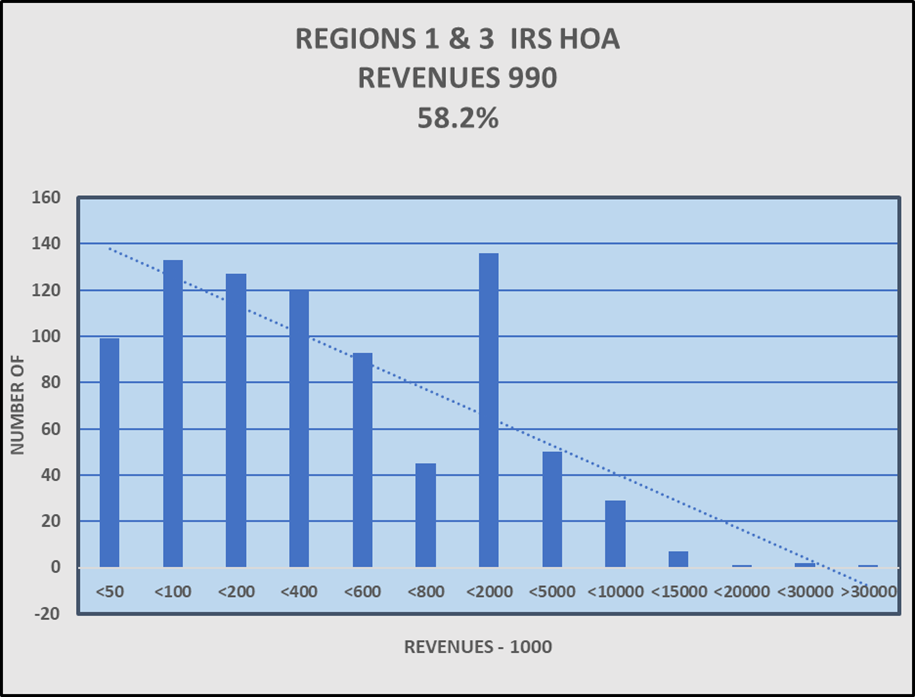
The data for the above charts was taken from the extensive IRS  EO BMF files[1] (over 1.8 million entries) and massaged using EXCEL. (The slanting line is the downward trendline showing fewer and fewer HOAs as their siz increases).  It is a list of all current tax exempt organizations from which coded ‘homeowners associations’ were selected.  Only 2 of the 3 Regions (representing 58.2%) were included in my research. Only a miniscule 843 organizations classified as a 501(c)4 social welfare organization (SWO) were found  meeting the 5 applicable sub-designations HOAs.

The  source of the IRS database came from mandated annual 990 tax filings, signed and certified like any other tax filing; unlike responses to polls and surveys. It is revealing that there are just 10.7% large-scale[2] HOAs (LSA) according to CAI’s definition, of all those SWOs on record and where CAI is most interested — it’s where the money is.   

What this tells me is that of the 351,000 HOAs in America, as claimed by CAI, these social welfare HOAs are “sub-atomic” dots in the playing field, either because they don’t care, they gain nothing so why file complex 200+ page forms, or it just doesn’t apply to them.  It seems only relevant to the larger moneyed HOAs that can gain a little tax benefit from telling the IRS that they really do social welfare work, when the common boilerplate CC&Rs do not indicate such activities for these private membership, contractual subdivisions. 

This emphasis on LSA becomes very meaningful when you take a broader perspective and step back away from the “trees” so you can see the “ugly forest” that CAI doesn’t want you to see.  In addition to the above findings on SWOs and LSA, and the extent of CAI’s presence and influence on HOA boards,[3]  the ugly HOA forest is exposed. 

Until CAI has been held accountable and made to answer for its conduct, advocates will continue to spin wheels and getting very little accomplished.

References


[1] Exempt Organizations Business Master File Extract (EO BMF). (May 10, 2021).

[2] Large Scale Associations CAI study, 2016.

[3] Who’s in charge of the larger HOA? The BOD or CAI?