Calif. finds HOA suit against opposition signs to be SLAPP

Some sense is finally being displayed by Cal. courts in support of the Constitution against the second local,  de facto  governments — HOAs.   Homeowners require protection to speak out, since HOA issues can be public issues.  Many states have an anti-SLAPP statutes.  

A SLAPP suit (strategic lawsuit against public participation) is a lawsuit brought primarily to chill a party’s constitutional right of petition or free speech. The anti-SLAPP statute was enacted to prevent and deter lawsuits that chill the valid exercise of the constitutional rights of freedom of speech and petition for the redress of grievances and provides “an efficient procedural mechanism to obtain an early and inexpensive dismissal of nonmeritorious claims” arising from the exercise of those constitutional rights. (Martinez v. Metabolife Intern., Inc. (2003) 113 Cal.App.4th 181, 186.)

Section 425.16, subdivision (b)(1), states: “A cause of action against a person arising from any act of that person in furtherance of the person’s right of petition or free speech under the United States Constitution or the California Constitution in connection with a public issue shall be subject to a special motion to strike, unless the court determines that the plaintiff has established that there is a probability that the plaintiff will prevail on the claim.”

The Signs Are Speech Protected by the First Amendment

The Signs Are Not Defamatory

The Signs are in a Public Forum and Concern a Matter of Public Interest

No Probability of Success on the Merits Nuisance

Slander of Title.  The Beach Club asserts that it has stated a cause of action for slander of title because the signs disparage and impair the marketability of its property.

 
HOLDING:  Beach Club action was SLAPP.

SANTA BARBARA BEACH CLUB, LLC, v. FREEMAN, No. B212972 (Cal. App. 2 Div. May 3, 2010).  

http://www.leagle.com/unsecure/page.htm?shortname=incaco20100503008

Letter to NC House Select HOA Committee


Dear Committee members:

I am providing a copy of an email from a NC homeowner that exhibits her frustration and inability to deal in a fair and equitable manner with her HOA board.  If you believe that homeowners openly and freely agreed to be subjected to this type of treatment by de facto private governments, then I have a bridge in Brooklyn that I’d like to sell you.  Homeowners need to be protected like any other segment of the people from abuse by any group or organization. To say that a homeowner can go to court for a redress of grievances, would be like saying that there was nothing wrong with the 1950s Poll Tax abomination, used as an effective, legal at the time, devise to stop voter registrations.

 Please see my earlier post to concerned parties pertaining to recent NC Supreme Court decisions regarding HOAs.

Please restore constitutional protections for homeowners, along with the respect and dignity that they deserve, and provide penalties against abusive boards for violating NC laws.

 Respectfully,

George K. Staropoli

Pres.

Citizens for Constitutional Local Government

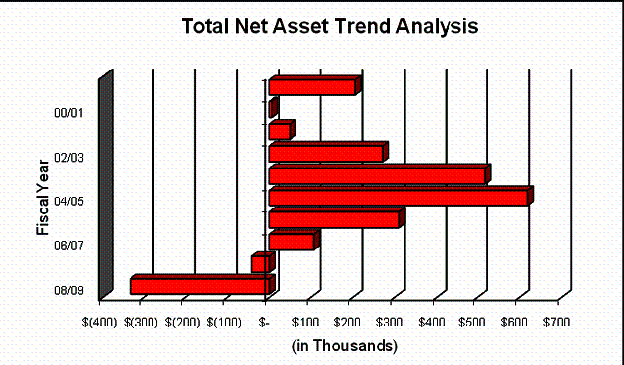
HOA lobbyist CAI facing financial problems?

Audited Consolidated Financial Statements
and Other Financial Information
COMMUNITY ASSOCIATIONS


INSTITUTE & SUBSIDIARY
June 30, 2009

L. ACCUMULATED DEFICIT

 
As indicated in the accompanying statement of financial position, CAI has reported recurring losses which have generated a deficit in undesignated net assets of $611,972 and $395,589 as of June 30, 2009 and 2008, respectively. Continued deficits threaten to undermine CAI’s  ability to continue its current level of operations in the future. The consolidated financial statements do not include any adjustments that might be necessary in the event that CAI is unable to continue its current operations.

Management’s plan to alleviate the deficit includes supporting and advancing manager licensing legislation in more states expanding and creating new international partnerships; developing a new virtual membership category and reducing personnel and overhead costs.

In accordance with the approved three year financial plan, the Board of Directors has approved a budget for the year ending June 30, 2010, which projects net income of approximately $42,000. However, there can be no assurance of the success of these efforts.

Arizona Attorney General will not prosecute for HOA justice

In response to a homeowners complaint, the AG’s office, Consumer Protection and Advocacy Section, replied,

Unfortunately, the problem you complained about is not within our jurisdiction.  Our office enforces the Consumer Fraud Act, however, the Act does not allow our office to pursue private disputes. Our office represents the state of Arizona and cannot act as a private attorney for individual citizens.


Understand that under the legalities here, the AG’s authority to deal with fraud is limited to “consumer fraud”.  Carefully reading the AG’s authority on its website[i], I found that fraud is defined solely in terms of the “selling or advertising“, which precludes its involvement in many of the HOA offenses and abuse.  Fraud, itself, is basically defined in terms of misrepresentation and false statements.[ii]  Consequently, homeowners must look elsewhere within the Attorney General’s Office for possible assistance. 

The Criminal Division[iii] has authority to  “protect the citizens of Arizona by successfully investigating and aggressively and fairly prosecuting criminal cases within the State of Arizona.”  Its Criminal Prosecutions Section contains the Fraud and Public Corruption unit, which “prosecutes white collar crime and fraud by individuals . . ..”  (Nothing further is mentioned of white-collar crime on the AG’s website). Note the distinction between “white collar crime” and “fraud”.  White-collar crime, as stated by the Gillespie Law firm, is a broad label, 

White-collar crimes typically refer to a type of financial, corporate, or economic crime often committed by employees or professionals using deception, as opposed to violent crimes that involve force. Most people who think of white-collar crime think of stock market and business fraud cases. However, white-collar crime involves a wide variety of criminal offenses.[iv]


Gillespie then lists the following as white-collar crimes:

1.      Bribery A.R.S. §§ 13-2601, et. seq. 

2.      Embezzlement, Theft, and Larceny A.R.S. § 13-1802 

3.      Extortion A.R.S. § 13-1804.  “Extortion” is a type of theft involving taking property or services through the use of a threat.  A person commits extortion when they knowingly 1) obtain or try to obtain something by threatening to: Cause damage to property, 2) Expose a secret that will subject anyone to hatred, contempt, or ridicule, or to impair their credit or business, or 3) Cause anyone to part with any property.

4.      Fraud Schemes A.R.S. § 13-2310[v].  A person commits a “fraudulent scheme” if, through the use of a scheme, they knowingly obtain any benefit by using false pretenses, representations, promises, or materials omissions.

In order to get the Attorney General to take your case, you need to file a complaint according to the above, with  evidence that can be taken to court.[vi]  Will he take your case?  In spite of the fact that he’s running for Governor, based on his prior unwillingness to defend homeowners against HOA abuse, and his failure to defend the OAH adjudication of HOA disputes, not very likely.  The AG has the discretion to declare, and will most likely do so, declare your complaint a private matter, a tort — a civil, not criminal wrong.[vii]  And asked if his office is to do justice, unlike the Dept. of Justice, he will probably say, no, it is to defend the state government. 

The AG will once again say  (paraphrasing), “Go ye unto the legislature, the sovereign of the state, and seek redress of your grievances.”   We must reply, “Will you come forward and support our cause against HOA abuse and injustice?”  And we must remind him that, “In every stage of these oppressions we have petitioned for redress in the most humble terms: our repeated petitions have been answered only by repeated injury.” [viii]

 Notes


[i] http://www.azag.gov/consumer

[ii] “A knowing misrepresentation of the truth or concealment of a material fact to induce another to act to his detriment“, Black’s Law Dictionary.

[iii] http://www.azag.gov/criminal

[iv] ARIZONA THEFT / WHITE COLLAR CRIME, The Gillespie Law firm; the law firm is a criminal defense firm  (http://www.craiggillespie.com /theft.html).

[v]Any person who, pursuant to a scheme or artifice to defraud, knowingly obtains any benefit by means of false or fraudulent pretenses, representations, promises or material omissions is guilty of a class 2 felony.”

[vi]Fraud must be proved by showing that the defendant’s actions involved five separate elements: (1) a false statement of a material fact,(2) knowledge on the part of the defendant that the statement is untrue, (3) intent on the part of the defendant to deceive the alleged victim, (4) justifiable reliance by the alleged victim on the statement, and (5) injury to the alleged victim as a result.” The Free Legal Dictionary,  (http://legal-dictionary.thefreedictionary.com/fraud). 

[vii] Viewing HOA injustice as a civil matter sets public policy against the homeowner in that the state is not interested in violations of the law with respect to HOAs. In general, a crime is an offense against society, whereas a tort is a civil wrong against a person. See Tort Law for Legal Assistants, Edwards & Edwards, eds. p. 6 (Thomson 2004).

[viii] Declaration of Independence.

How good are the CAI member HOA attorneys?

Ever wonder if the CAI member HOA attorneys are worth their fees? How good are they? What’s their Win – Loss stats? This data is very difficult to come by from the trial courts, and even from the appellate courts where records are kept. Of course, we wouldn’t want to get these stats from CAI unless their source data is provided for independent inspection, which is a problem based on the recent CAI “satisfaction surveys” lacking in such material disclosures.

Fortunately, detailed records are available from the Arizona Office of Administrative Hearings (OAH) where proceedings are recorded and decisions posted on the internet. For the short period of 28 months (from September 2006 to February 2009), this state agency was permitted to adjudicate HOA disputes, and decided 52 out of 66 petitions.  Although this is a limited sampling not related to civil court cases — where the Rules of Civil Procedure come into play against the Pro Per — these OAH hearings present a leveling of the litigation playing field. An analysis of these cases will provide a good clue to the litigation value of an HOA attorney, and to whether or not engaging a CAI member attorney resulted in improved success.

A colleague gathered the data, which showed the following prevailing party percentages:

HOA                    53.8%
Homeowner   40.4%
Split                      5.8%

This is quite surprising given that in almost all the cases the homeowner was a Pro Per and the HOA was represented by an attorney; and given the fact that the state laws are clearly pro-HOA, and the governing documents amount to an adhesion contract in favor of the HOA. What the percentages seem to be saying is that “black letter” provisions of the statutes or governing documents — it’s right there, in black and white — were violated by the HOA. That an unambiguous provision had been violated and yet the HOA and its attorney failed to “own up” and voluntarily correct these obvious violations. That it took a hearing by the victimized homeowner in order to obtain justice.

The question before us to be answered is: did using a CAI member attorney improve the stats? Roughly 38% of the petitions, 20 out of 52, involved one of four CAI member attorney firms, with

CAI prevailed                            55.0%
Homeowner prevailed           45.0%

Intuitively, and supported by statistical analysis, engaging CAI member attorneys had no impact on the outcome of the hearings. We then ask: What role, if any, do these attorneys play in HOA disputes? And the answer, partly addressed in the highlighted sentence in the earlier paragraph, and from the prolific advisories from one CAI member firm, Carpenter Hazlewood, is: to seek and promote loopholes and technicalities in the law and governing documents that would lead to adversarial litigation.