HOA homebuyers MUST have a competent lawyer before they buy


Not only must prospective buyers of homeowner association controlled homes retain a competent lawyer, if one can be found who will represent the buyer, but must also understand the fact that covenants are being constantly interpreted by the courts.  That means whatever you or your attorney think you’ve agreed to, assuming unlike today the buyer doesn’t even have to see the CC&Rs in order to be bound by them, the court may give any entirely different spin on the meaning of the covenant. 

That’s called making new law.  And that’s on top of existing legal precedent heavily in support of HOA governments, and against the privileges and immunities to which we all are supposed to be entitled.  To a very good extent, buyers of HOA homes are getting “a pig in the poke.”

When further considering the argument, like CAI and HOA promoters like to argue, that buying a home is buying an investment, this HOA investment is a very bad deal for an investor.  Recall that even the common law authority on servitudes (covenants)[i] recommends that in the event of a conflict between servitude law and constitutional law, servitude law should prevail.  There goes any vestige of any rights still retained by a homeowner.

In a recent example of “surprise” by the Wyoming Supreme Court[ii], owners who sued their HOA for imposing unreasonable requirements on modifications to their home, and won on that issue, were still denied their breach of contract claim.  Now follow carefully.  The trial court accepted the claim of unreasonableness and stopped there, not addressing the other claim of breach of contract and payment of attorney fees.  The supreme court took the position,

 While we have often explained that restrictive covenants are contractual in nature . . . that does not necessarily mean that a homeowner is entitled to recover contract damages against a homeowners association. Ms. Dwan has not identified any provision of her CCRs that would allow her to claim damages against the Association. She has not provided any legal authority, from Wyoming or any other jurisdiction, supporting her claim for damages.[iii]

The court distinguished between equitable relief  — this ain’t right — from a contract with its explicit wording and absence of wording, which doesn’t have to be equitable.  The board can act unreasonably, but they are not punished for doing so.  (Contrast this with the right to punish the homeowner with fines, which is granted to the HOA under both the CC&Rs and almost every state HOA statutory Act).  Once again, the developer’s  “take it or leave it” contract does not protect against board actions by providing a penalty as a detriment against any such further actions. Once again, where wrong-doing was found against the HOA, the CC&Rs adhesion contract favors the HOA with its silence on damages in the event the homeowner does win a lawsuit.  

   Notes


[i] Restatement Third, Property: Servitudes, § 3.1, comment h.

[ii] Dwan v. Indian Springs Ranch HOA, No. S-09-0064, (WY June 3, 2010).

[iii] Id.
AZ ATTY Gen defends SB 1070, but couldn’t defend OAH constitutionality

The Arizona Attorney General, Terry Goddard, who is running for Governor, announced today that he feels compelled to defend Arizona even though he’s against the bill. But he didn’t lift a hand to defend the constitutionality of the OAH bill back in 2008-9, even after having submitted a brief in defense of the statute in an exactly the same prior case. I guess he didn’t believe in an independent tribunal to hear HOA complaints. HB 2428 gave homeowners a more level playing field for adjudication of HOA disputes, without a lawyer, and without having to know the Rules of Civil Procedure, which favored teh experienced attorneys. Perhaps it was the 42% victorieswon by homeowners that was disturbing to the powers that be.

Furthermore, just this past session, the legislature passed HB 2774 which declared that the Attorney General or legislative leaders cannot be compelled to defend the constitutionality of statutes. So why is he now finding it his duty to defend a statute he doesn’t believe in? Oh, he stated today that “It’s his duty.”

I guess Arizona believes in “equal justice under the law” for those the AG chooses. Arizona demonstrates that it is under the rule of man, not law.

See The State of Arizona will not protect buyers of HOA homes! and

Arizona’s new “Take That George!” law: officials don’t have to defend HOA statutes

Utah court believes in justice against developers

A state Supreme Court believes in doing  justice rather than in perpetuating dated precedents. The Utah SC clarified the air in this case of developer-sellers versus HOAs over construction defects.  The association was seeking recovery of damages due to defects that became apparent after the developer turned the association over to the membership.  The court said,

 The law should be based on current concepts of what is right and just and the judiciary should be alert to the never-ending need for keeping its common law principles abreast of the times.

  (It is time for the ancient 1946 Marsh v. Alabama holding pertaining to the “public functions” test, based on company towns, be buried deep, deep beyond resurrection.  There are new tests for state actors that will do well against private HOA governments).

  Here are some of the gems from the 2009 Davencourt at Pilgrims Landing Ass’n v. Davencourt at Pilgrims Landing, LLC (221 P.3d 234),

[W]hereas for a buyer the purchase of a new home is a significant and unique transaction. . . . To apply the rule of caveat emptor to an inexperienced buyer, and in favor of a builder who is daily engaged in the business of building and selling houses, is manifestly a denial of justice.”). Given these modern realities and this disparity, “[a] home buyer should be able to place reliance on the builder or developer who sells him a new house.”

 Hence, in protecting the innocent home purchaser by holding the responsible party accountable, the law has come to recognize that no longer does the purchaser of a new residence stand on an equal bargaining position with the builder-vendor or developer-vendor.

 And that should go for any issue relating to CC&Rs, as it is similar to the holding against adhesion contracts where one party has power over the weaker party.

 In regard to the developer’s fiduciary duties to the homeowners,

 The Restatement (Third) of Property offers guidance. It recognizes that a developer owes certain limited duties to an association and its members. (Section 6.20 of the Restatement).

 While the developer thus should not be a fiduciary in the broadest sense, we are nonetheless convinced that the developer’s control in this nonprofit association requires certain interests of the members and the association be protected. See id. This is achieved by the limited fiduciary duty.

Please understand this is a state court decision, and will serve as precedent elsewhere if there is no precedent  for the state in question.

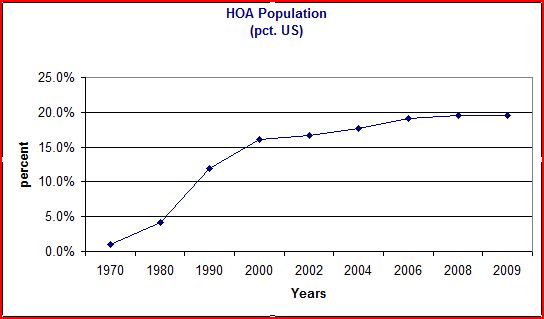
Have HOAs hit a growth plateau?

Wouldn’t that be great news? Homeowner associations have hit a wall! Maybe even begin to decrease.

The chart shows the population living in HOAs (overall term) is about 19.6% of the US population. The chart does introduce a distortion due to the 2-year periods, but the 10-year increases between 1990 – 2000 and 2000 – 2010 are about the same, roughly 4%. However, the increase from 1980 – 1990 was almost double, a whopping 7.8%.

Remember that as the US population continues to grow we can expect the number of people living in HOAs to increase likewise. And with local governments mandating only HOAs, an an increase is most likely. However, we can hope that the HOA percentage does, indeed, begin to drop. (Recall that Arizona has 23.4% of its residents living in HOAs).

Source data from US Census and industry data.

HOA demographics: About 25% Arizonans live under HOA regimes

Continuing my investigation into HOA demographics, I researched the percent of the Arizona population living under a homeowners association government.  Surprisingly, that game to 23.4%.

 As a very good indicator, although subject to a more refined analysis, data from the Arizona Corporation Commission records showed 7,297 nonprofit corporations with one of the following words in their names: HOA, homeowners association, condominium, condo, property owners association, and community association.  Based on industry data from CAI, the following averages were obtained over nine entries, spanning 1970 through 2009:

 average residents per HOA:            211

average Units per HOA:                    82

average residents per Unit:              2.6

 The analysis reveals an estimated 600,069 HOA units and 1,543,067 people living in HOAs, based on a 2009 Arizona population estimate of 6,595,778.  That’s 23.4% of the people subject to a second form of local government, the HOA, with their constructive notice constitutions not subject to or approved by the state of Arizona, that deny the constitutional protections of due process and the equal application of the Arizona laws.