Letters to Editor now available

For all these years I regarded this site as an Internet publisher, like any other media publisher, for HOA issues.  Now I think it’s time to allow for subscribers to post Letters to the Editor on relevant and substantive concerns and issues that are focused on constitutional issues.

Events and news may be appropriate provided your letter appeals  to constitutional issues or one of my six HOA defects as contained in my HOA Common Sense: rejecting private government. Letters about any local issues particular to your HOA or any revenge/grievance posts will be rejected.  

Your chance of being posted under your name depends on my review.  Submit your letters to info@pvtgov.org with Letters to the Editor as the subject.  Your name and email address must be included for consideration. You can have a voice here.

Non-conforming HOA voting procedure

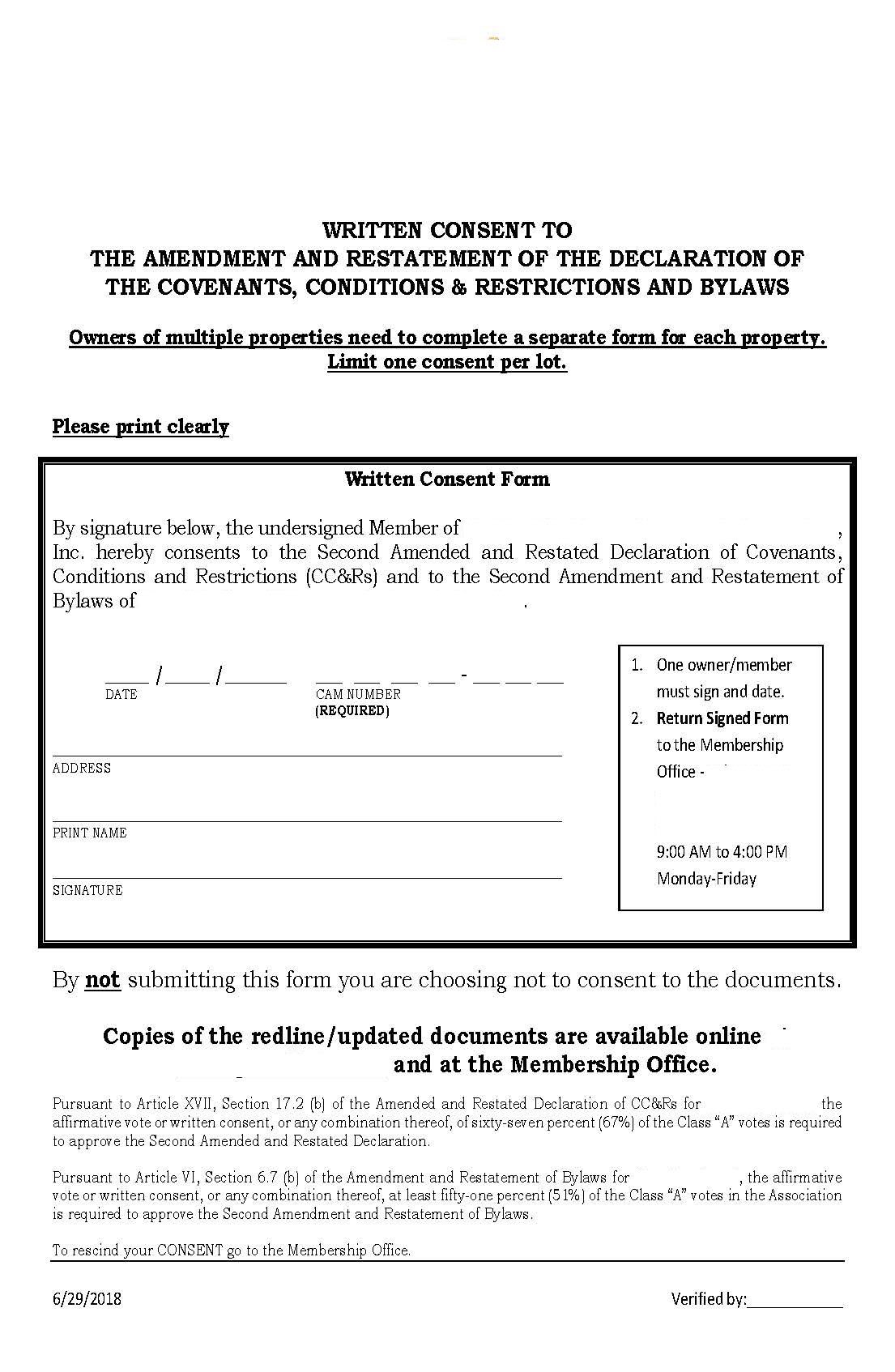
A large, upscale HOA in Arizona, with a CAI member attorney, is using a voting procedure to approve amendments that employs Consent Forms.

The distributed Consent Form is, in reality, a vote by ballot: a rose by any other name is a rose.  As such, it does not conform to the law, ARS section 33-1812. The relevant subsection is (A), paragraphs (1), (2) and (4), require that the ballot itself set forth each proposal, that the member be able to vote for each proposed amendment instead of a blanket “all or nothing,” and a date for submission of the ballot must be provided in order to  be counted, respectively.

Furthermore, contrary to established democratic election procedure, the Consent Form has no set “cutoff date” for tabulating the ballots; it’s an open-ended procedure that hopes to obtain a quorum of votes and an approval, no matter how long it takes —  maybe in 2 months, a year, or in 5 years.

In addition, there is no option for a NO vote on the Consent form, the members being told that not submitting the Consent is a NO vote.  Not so! In effect, it could be an actual NO vote, or an I don’t care vote.  It doesn’t make sense to promote non-voting by suggesting not to send in the form.  Unheard of!

With the open-ended procedure the HOA will continue to influence and pressure the members to do what’s good for the HOA, in the Board’s mind, and submit their Consent.  It’s electioneering without an opportunity for a voice by the opposition. That’s outrageous!

In mid-February, watch for mailing to those homeowners whose consents have not “yet been recorded by Membership. The mailing is being sent to make certain everyone knows of the Consent Process and serves as a reminder to those who might have misplaced the Consent Form or have delayed signing in their busyness of life in xxxx.”

Being allowed to submit a NO vote easily settles the matter for the member to exercise  his voting rights. It also allows the NO member to avoid undue influence. But the procedure doesn’t allow the member to submit his NO decision.

In short, the HOA election procedure disenfranchises the membership and makes a mockery of the governing document’s right to a meaningful vote.  Is it a valid voting procedure?


Pink is a good color but HOA doesn’t think so

Is there anything wrong with this expression of art and individuality?? I mean, HOAs can only think in terms of shades of tan, grey or white, setting new architectural standards for America. In Austin, TX and HOA looking to sue.

pink house.png


Georgia SB 302 helps HOA developer approvals

Let’s forget about the controversy surrounding SB 320 for the moment and look at the bill itself.  It applies to Title 8, Chapter 2, Article 1, Part 1 that deals with water concerns and has nothing to do with “building design elements” or zoning.

The bill reflects a power struggle between the developers of private government HOAs and constitutional government that’s occurring in many states besides Georgia.  There is the Georgia Constitution and Code (Title 36, Chapter 35, HOME RULE POWERS) that grants municipal powers with certain restrictions.  The Georgia Home Rule code grants restricted freedoms and powers to local government but holds them accountable under the state constitution and laws.  This is not so with HOAs that go by and large unregulated.  The bill makes them more so!

The  Georgia Constitution specifically provides for “home rule” for counties and municipalities in Georgia. While county home rule is constitutionally prescribed, cities may be granted the same right by the state legislature. In both cases the county or city is authorized to adopt “clearly reasonable ordinances, resolutions, or regulations . . . for which no provision has been made by general law and which is not inconsistent with” the Constitution of Georgia.” (“Home Rule and Ordinances,”  New Georgia  Encyclopedia).

SB 302 supports, in my view, easier HOA approvals by the municipality planning board.  Code section 8-2-5 adds (c)(2), the bill does not “Affect the validity or enforceability of private covenants or other contractual agreements among property owners relating to building design elements.”   The definition of zoning (Section 2 of the bill) is reworked in Code section 36-66-3. The prohibition of the municipality to regulate “building elements” (Section 1 of the bill) is necessary to allow developer a full play as presented by Section 2.

A reading of Section 2 of the bill  allows the perception that it is an attempt to grant HOA developers and their created subdivisions a host of building features and elements, which they can take before the municipality to get rubber stamped.  Planning board approvals are basically granted unless there is citizen opposition, or the subdivision plan violates some aspect of the law.

Guess what? SB 302 puts the law on the developer’s side!

HOA homeowner membership in CAI is a mere 36%

Since has been some time since I checked CAI’s membership breakdown, here’s some surprising news I just uncovered, right from CAI Central’s own mouth. HOA representation through “volunteers” (since HOAs per se are not allowed) consists of a mere 36%, and yet CAI has the gall to say they speak for homeowners to  federal agencies, to state legislators, to the media and to the public at large!

As I’ve said all too often, board members are targeted by CAI through discount fees based on the number who join from an HOA.  In my view, all HOA directors who are CAI members are conflicted as to whom they owe their allegiance.  To the vendor organization whose members feed off them, or to the  unit owner, members as required by the CC&Rs contract?

“Business partners” means, for the most part, attorneys; “managers” total 42%.

See CAI Marketing Opportunities, CAI Member Breakdown, page 3. I suspect the announced increase to 40,000 came from international growth.

cai membership 2017a