Combined Advocate Surveys vs. CAI surveys

Let the truth be known!

Two homeowner rights advocates, Sara Benson (Chicago) and Jill Schweitzer (Phoenix), were responsible for 2 online polls on homeowner satisfaction with HOAs.[i]  In stark contrast, not surprisingly, the Combined Advocate Surveys, as I refer to them, revealed opinions and views refuting the results of the CAI “happiness” surveys.[ii] It appears that the CAI studies were happiness studies of happy HOA members.

Under the trade name, George Analytics,[iii] a proprietary investigation and analysis of the 3 surveys was conducted and standard statistical T Tests for validity were applied.  Some observations: both the CAI and Combined surveys were internet polls (CAI included telephone calling) consisted of a reported 800 responses.  CAI’s questions were more generalized and less detailed than the enquiring questions in the Combined surveys, which, naturally, provided more insights into HOA issues and controversies.

Because of the variations in the questions asked and response alternatives provided, some ‘reworking’ was in order.  Consequently, a ‘favorable to HOA’ vs. ‘unfavorable to HOA’ category was adopted and the responses placed accordingly.  For example, a YES response could be pro-HOA or not depending on the wording of the question. Three sets of responses are used as examples:  yes/no, like/favor/prefer, and positive/negative with respect to favorable or unfavorable.  To avoid the yes/no example above, I had to rephrase some questions so that ‘yes,’ for example, was always a favorable, pro-HOA response.

In statistical terms, the George Analytics table below shows that the CAI and Combined responses (average percentages) come from 2 distinct samples, segments, of the HOA population at a 99.5% significance level.

favorable            unfavorable

combined advocate response                 8%                          79%

CAI response                                             59%                         15%


Now, in laymen’s terms, what does this mean and how can this wide gap in views be reconciled? First, the lauded CAI surveys do not represent the complete population of HOA members as claimed by CAI[iv], and these surveys cannot be promoted as representing reality within HOA-Land.  They are tainted!  So too, for that matter, are the Combined surveys. However, they are valid within themselves and also serve the important purpose of refuting the results of all those CAI surveys that CAI now claims to have been validated. As CAI proclaimed,

The findings objectively refute the unfounded and unsubstantiated myth that the community association model of governance is failing to serve the best interests of Americans who choose to live in common-interest communities.[v]

Not so!

The findings from the six surveys are strikingly consistent and rarely vary a standard margin error for national, demographically representative surveys.[v]

This is a meaningless statement. What does ‘rarely vary a standard margin of error’ ( the commonly seen “+/- n” footnotes to political polls) mean?  It refers to the internal consistency of the polled samples and has only meaning as being representative only if there are statistics relating to a survey sample representing all HOA members. The Combined Advocate Surveys demonstrate that the CAI surveys are not representative of all HOA members.

Call to Action!

To truly validate its surveys CAI must reject the findings of the Combined Advocate Surveys, not by hyperbole or by rhetoric, but by opening up to a bona fide study of HOA-Land by independent researchers.  And state governments must cry out for this independent study to end its lack of awareness of conditions and stress within HOA-Land.

The Truth Is Out There!


References

[i] Combined Advocate Surveys — Sara Benson: Chppi’s 2015 National HOA Survey; Jill Schweitzer’s HOA Industry Survey.

[ii] CAI 2016 National Homeowner Survey,

[iii] HOA Surveys Comparison.

[iv] Supra ii.

[v] Supra ii.

Pro-HOA attorney finally clarifies the meaning of ‘HOA’

Finally!  The cracks in the great CAI defensive wall denying the reality that HOAs are governments are beginning to show. I welcome this enlightenment by pro-HOA proponents who are beginning to admit and to accept the reality that HOAs are private governments.  The latest in enlightenment comes from none other than a Florida attorney, Ryan Poliakoff.  Ryan finally comes clean and explains the legal meaning of “HOA” (emphasis added).

A homeowners’ association normally governs communities made of single-family homes. Despite the common phrasing, it is inaccurate to say that a person lives in an “HOA.” Instead, you would say that you live in a community governed by an HOA[1].

Congratulations Ryan!  For years on my website viewers were presented with a more explicit definition of the distinction between a government and a community.

If we are to make progress, we must distinguish the concept of a planned community, which is a real estate “package” of homes, landscaping, amenities, and rules, from that of the HOA, which is the undemocratic governing body of the planned community[2].

This is a first!  An admission from a nationally recognized pro-HOA special interest lobbyist that the HOA is really a government that regulates and controls the people within its territory – the fundamental definition of a political government. Black’s Law Dictionary[3] defines a state as,

“A state or political society is an association of human beings established for the attainment of certain ends by certain means ….What then is the difference between this and other forms of government? The difference is clearly one of function. The state must be defined by reference to such of its activities and purposes as are essential and characteristic”.

“Modern states are territorial; their governments exercise control over persons and things within their frontiers.”

And the HOA is not a democratic form of government, as all businesses are not democratic governments, and could and must be rejected and made to conform to our democratic system of government.  HOA-Land must be made part of the Union, and not a separatist state.

For those of you concerned about losing the real estate package as defined above, there are existing alternative forms of governance that are subject to the Constitution as all other forms of government.  And the package can still retain its privacy status, except it is answerable and accountable to the state.

If this is unacceptable, then you are essentially un-American, rejecting the laws of the land and our democratic system of government, plain and simple. Sorry, the free ride must go!

Notes

  1.  First step in solving problems begins with defining community, Ryan Poliakoff, MyPalmBeachPost, June 12, 2016.
  2. Citizens For Constitutional Local Government. See also, Are Your Best Interests Served by an HOA? (October 18, 2006).
  3. Definition of ‘state’, Black’s Law Dictionary, 7th Ed.

Should HOAs support the greater municipal community?

If Surprise, AZ — and other municipalities — seek the support from HOAs that dominate its jurisdiction[i], then the municipality must restore equal citizenship to the people of the municipality who are members of an HOA. The public policies at the state and  municipality levels, and any county or city/town leagues or associations, all support the independence of HOAs from constitutional protections and state laws.  HOA residents do not have the equal protection of the law nor due process protections, since HOAs are not subject to the 14th Amendment as are all state entities.

If a municipality seeks assistance from HOA members as Surprise is seeking bond support, it must understand that the HOA, which is really the board, does not speak for the membership on political matters.  HOA members must be treated equally as all other citizens. There is no excuse or valid justification for this denial of equal treatment.

Be it as it may, why should Surprise be surprised that its policy of supporting islands of independent principalities —  the HOAs – produces behavior precisely consistent with its policy of separate and unequal communities within the municipality. The HOA  members probably feel that supporting tax increases for bonds issues for those other guys not in their HOA is unfair. They have their own private amenities.

This policy should be reevaluated by the Legislature, the Arizona Association of Counties, the Arizona League of Cities and Towns, and the municipalities. They should all support the following proposed statutory amendment:

HOA member Declaration of US and State citizenship 

Therefore, the members of the association, having not waived or surrendered their rights, freedoms, privileges and immunities as citizens of the United States under Section 1 of the Fourteenth Amendment, and as citizens of the state within which they reside, the CC&Rs or Declaration for any planned community, condominium association or homeowners association shall state, or be amended to comply, that,

‘The association hereby waives and surrenders any rights or claims it may have under law and herewith unconditionally and irrevocably agrees 1) to be bound by the US and State Constitutions, and laws of the State within which it is located, as if it were a subdivision of the state and a local public government entity, and 2) that constitutional law shall prevail as the supreme law of the land including over conflicting laws and legal doctrines of equitable servitudes.’

Maybe then a municipality may justify additional taxes on HOA members for the common good of the greater community.

References

[i] Tax hikes are tough sell in cities full of HOAs, Jeffrey Gibbs, Azcentral.com, June 7, 2016.

Un-validating CAI’s survey Validation

CotoBuzz analysis

In today’s CotoBuzz Journal, Buzz Aquirre takes on CAI’s claim to Validation[1] of all its happy, happy HOA members surveys in “And the HOA Weasel Award . . . [goes to] CAI aided by Zogby Analytics!”[2] And CAI surveys are deserving of the Weasel Award.  Buzz joins with me and other homeowner rights advocates in calling out the obvious flaws in the surveys to the attention of the public.  Others, like Sara Benson[3] and Jill Schweitzer[4], have conducted their own surveys with differing results.

Examples of Buzz’s common sense analysis:

It also states that “respondents that were not available but qualified to respond were allowed to set appointments to be recalled within the time frame of the field work” So, what qualifies a respondent?

How complex is the weighting technique? Does it mean that the information in the “CAI fact books” is more important than anything else?  How does race, party, education and religion enter into the picture?

“The sampling frames use demographic variables, and if needed behavioral variables as part of the sampling and segmentation for each survey.”  Which demographic variables are used?  Which are the behavioral values?

Buzz concludes with, In 2016 the CAI is deserving of the HOA Weasel Award for forging public opinion . . . .”

 The tide is turning against CAI

CAI is discovering that the internet doesn’t forget.  What was said in the past never goes away and lives forever.  CAI is now being forced to answer for past statements, and as it does, following its past approach, it will need to defend its current statements.  No longer can CAI go unopposed speaking as it pleases without concern for rebuttals.  CAI will need to be careful as to what is preaches to the policy makers.

What I see happening is that homeowner rights advocates have put a scare into CAI. It needed to defend itself with the Validation assertion. Yes, CAI validated its surveys since 2005 as more of the same answers to the same questions to questionable respondents. As Albert Einstein wrote, “Insanity is doing the same thing over and over again and expecting different results.”

The fundamental flaw in the CAI surveys, all of them, is the presumption that 1) their professed demographics may be a valid representation of the US population, but is not representative of all HOA members; and 2) that the respondents are fully informed as to the true nature of their legal and financial status resulting from living in an HOA.  In regard to (1) above, the distribution of “rank and file” members versus board members is not provided.  How many were board members or officers?  Not given!

Ignorance is bliss.  In regard to (2) above, national CAI Board of Trustees member Richardson wrote,

Many owners do not recognize that the benefits of shared ownership involve relinquishing some of the independence of sole ownership. That’s the root of so many of the HOA horror stories we’ve all heard.[5]

In fact, none of these CAI surveys address the constitutional and contract law issues and violations set forth in my Truth in HOA Disclosure Poll,[6] like

That to enforce my rights under or compliance with the governing documents I must file suit in civil court, and that such a civil suit involves no state agency official, attorney general, or county attorney;  

That under current law, there are no substantive penalties against violations of the governing documents or state laws by the officers or directors of the association sufficient to serve as a detriment to future violations;

That the governing documents in all legal practicality serve as the subdivision’s “constitution,” taking precedence over state laws and the state and US Constitutions

Now CAI may argue, as it does with the consent to be governed controversy, Well, they’re still living there aren’t they? That’s 100% consent to all and everything. Same here in regard to being fully informed. Well, they’re still living there aren’t they? The implication is that if they did indeed know, it would make no difference.  Well, why don’t we ask them?  CAI has refused to ask them!

Are they afraid of the answers? The polls and surveys performed by Benson and Schweitzer asked different and more meaningful questions relating to life in HOA-Land, and not the broad Are you happy or Does your HOA do a good job questions.  For example, Schweitzer’s extensive online poll[7] asks meaningful questions like management company licensing, should have constitutional rights (88%), member initiatives, foreclosure, problems with HOAs (73%) and lack of meeting attendance and board awareness (94%) that conflict with CAI’s results. And more, including comments addressed to state legislators.

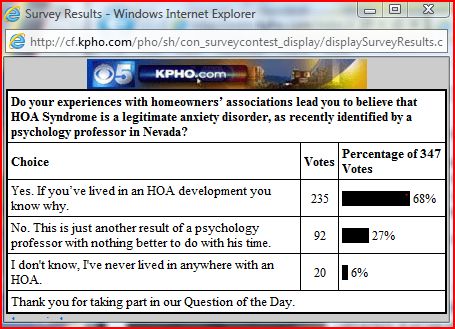
In 2011, CBS affiliate KPHO in Phoenix conducted an online poll asking if the Dr. Gary Solomon’s HOA Syndrome [8] — of emotional distress caused by living in an HOA — was real.  The poll results showed a 68% YES reply.


KPHO-survey
HOA SYndrome survey

Keep up the challenges!  Make CAI respond!  As Gandhi said, “We must continue to provoke until they respond and change the laws.”  That’s the key to homeowner rights success.  Show the public what CAI really stands for. Stop the legislative excuse that they are relying on CAI as the Word.  Hold them accountable, too, as they are part of the problem.


References

[1]  2016 National Homeowner Survey (June 4, 2016).

[2] https://cotobuzz.blogspot.com/2016/06/and-hoa-weasel-award-silver-anvil-award.html

[3] View Chppi’s 2015 National HOA Survey Results.

[4] Survey page: https://www.surveymonkey.com/r/S29YQHT.

[5] Realtor magazine publishes HOA socialism by CAI Trustee.

[6] Truth in HOAs disclosure poll — please vote your conscience.

[7] Supra n. 4. Schweitzer to post full results shortly.

[8] Psychologist defines the HOA Syndrome caused by oppressive HOAs.